
Key facts
- Classification
- Synthetic GHRH (1-29) analogue
- CJC-1295 with DAC, formula
- C165H269N47O46 (PubChem CID 91971820)
- CJC-1295 with DAC, molecular weight
- 3647.2 g/mol (PubChem)
- CJC-1295 with DAC, CAS
- 446262-90-4 (FDA GSRS, UNII 62RC32V9N7)
- CJC-1295 without DAC
- No separate PubChem or GSRS record found (October 2026)
- Vinnix availability
- Component of CJC-1295 + Ipamorelin (CP10); no standalone SKU
What Is CJC-1295?
It is a synthetic peptide built on the first 29 amino acids of human growth hormone-releasing hormone (GHRH), the hypothalamic hormone first isolated and sequenced in 1982 [1]. Those 29 residues, which FDA GSRS records as GRF (1-29) amide under the name sermorelin, are the starting point for several analogues, and the peptide on this page is one of them.
The 2005 paper that first identified the compound describes a tetrasubstituted form of hGRF(1-29) with an extra lysine at the C-terminus, and that lysine carries an N-epsilon-3-maleimidopropionamide group [2]. In animal models, the reactive group was designed to bind the free thiol on cysteine 34 of serum albumin after administration, extending the peptide's plasma half-life [2]. Its developers named the linker a drug affinity complex, or DAC.
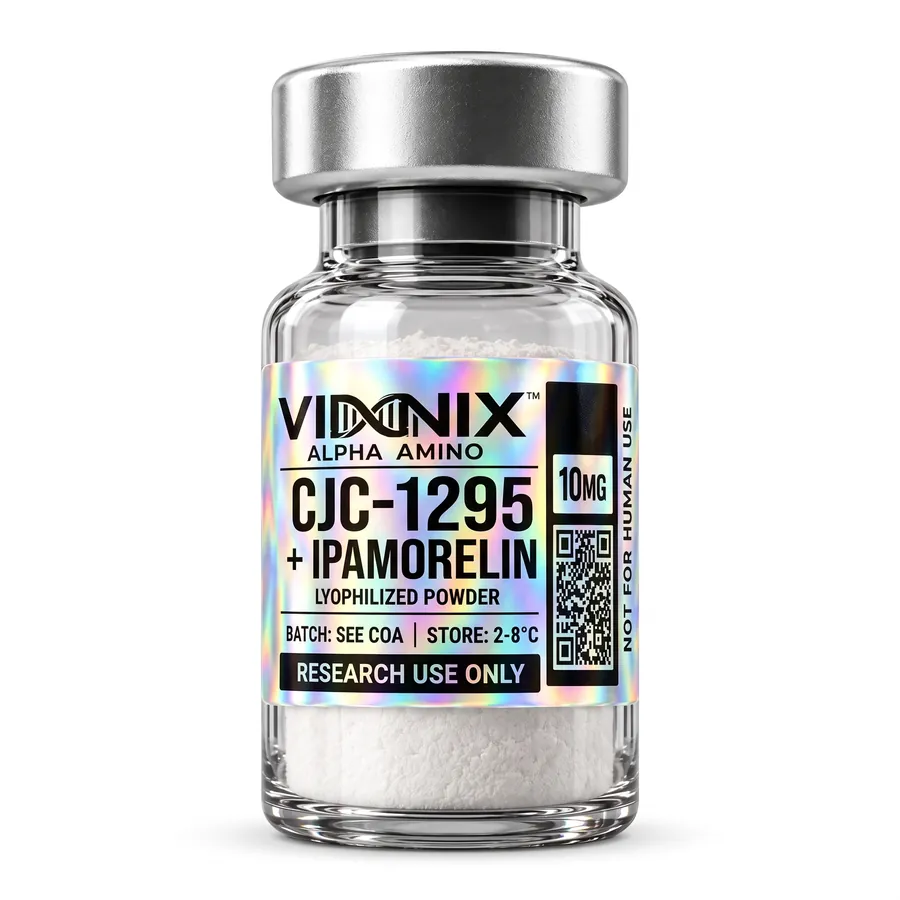
Vinnix doesn't sell this peptide on its own. It's one of the two peptides in the CP10 blend with ipamorelin, and this page is a reference-library entry.
CJC-1295 With DAC vs. Without DAC
These are two different molecules. The DAC version has an extra C-terminal lysine bearing the maleimidopropionyl group; the no-DAC version stops at residue 29.
| Property | CJC-1295 with DAC | CJC-1295 without DAC |
|---|---|---|
| Other names | CJC-1295, CJC-1295 DAC | Modified GRF (1-29), Mod GRF 1-29, tetrasubstituted GRF (1-29) |
| Length | 30 residues (29 + modified lysine) | 29 residues |
| C-terminus | Lys(maleimidopropionyl)-NH2 | Arg-NH2 |
| Albumin-reactive group | Yes (maleimide) | No |
| Molecular formula | C165H269N47O46 (PubChem CID 91971820) | No verified registry record found |
| Molecular weight | 3647.2 g/mol (PubChem) | Lower; no verified registry value |
| CAS / UNII | 446262-90-4 / 62RC32V9N7 (FDA GSRS) | None found in PubChem or GSRS |
| Primary literature | Jetté 2005; Teichman 2006; Ionescu 2006 [2][4][5] | Mainly catalog usage |
They share most of their sequence but differ by a whole modified residue, so mass spectrometry separates them easily. A product record should always say which one is present. For Vinnix CP10, the form present (with or without DAC) will be stated on the product record and on the batch COA when published.
CJC-1295 Product Specifications
With no standalone Vinnix SKU, the specifications below are given as compound data plus the one Vinnix product that contains the peptide.
| Field | Value |
|---|---|
| Compound | CJC-1295 |
| Classification | Synthetic peptide analogue of GHRH (1-29) |
| Sequence (with DAC) | Tyr-D-Ala-Asp-Ala-Ile-Phe-Thr-Gln-Ser-Tyr-Arg-Lys-Val-Leu-Ala-Gln-Leu-Ser-Ala-Arg-Lys-Leu-Leu-Gln-Asp-Ile-Leu-Ser-Arg-Lys(MPA)-NH2 |
| Molecular formula | C165H269N47O46 (with DAC, PubChem) |
| Molecular weight | 3647.2 g/mol (with DAC, PubChem) |
| CAS number | 446262-90-4 (with DAC, FDA GSRS) |
| Product quantity | Not sold separately; amount per CP10 vial listed on the batch COA when published |
| SKU | None standalone; component of CP10 (CJC-1295 + Ipamorelin, 10 mg total) |
| DAC status in CP10 | Stated on the CP10 batch COA when published |
| Batch / lot | Shown on the CP10 batch COA when published |
CJC-1295 Product Identity
Two things define the peptide's identity: its sequence and its C-terminal modification. FDA GSRS records it under UNII 62RC32V9N7 with CAS 446262-90-4.
What is the peptide sequence?
GSRS gives the backbone in one-letter code as YaDAIFTQSYRKVLAQLSARKLLQDILSRK, with the lower-case a marking D-alanine (see one-letter vs. three-letter amino acid codes). The 3-maleimidopropionyl group sits on the side-chain amine of the final lysine, and the C-terminus is amidated.
Set against native human GRF(1-29), as recorded for sermorelin (YADAIFTNSYRKVLGQLSARKLLQDIMSR), the analogue has four substitutions:
| Position | Native residue | CJC-1295 residue |
|---|---|---|
| 2 | L-Alanine | D-Alanine |
| 8 | Asparagine | Glutamine |
| 15 | Glycine | Alanine |
| 27 | Methionine | Leucine |
Those four changes are why the paper calls it a tetrasubstituted GRF(1-29) [2]. The same study reported that its albumin conjugates had enhanced in vitro stability against the enzyme dipeptidyl peptidase IV [2]. Notation conventions are explained in the peptide sequences guide.
CJC-1295 Terminology
You'll see several names for these materials, and they don't all point to one compound.
- CJC-1295 / CJC-1295 with DAC: the molecule described in the 2005 paper and registered in PubChem and GSRS.
- Without DAC / no DAC: catalog names for the 29-residue tetrasubstituted analogue without the lysine-maleimide extension.
- Mod GRF (1-29) / modified GRF 1-29: another catalog name for the no-DAC version.
- Sermorelin / GRF (1-29): the unsubstituted native 1-29 sequence, a different molecule.
- Tesamorelin: a modified full-length 1-44 GHRH analogue, also a different molecule.
If a label just says "CJC 1295", look at the batch mass spectrometry to see which molecule you have. Related reference pages: Sermorelin and Tesamorelin.
CJC-1295 Research Literature
There isn't much published on this peptide: one discovery study in rats, one animal study in knockout mice and two human pharmacology papers from 2006. All of them used the DAC version. In vitro vs. in vivo research explains how those study types differ.
How has the peptide been studied?
- Background (in vitro and biochemistry): GHRH, the parent hormone, was isolated and sequenced from a human pancreatic tumor [1].
- Discovery (in vitro and animal): researchers compared three maleimido derivatives of hGRF(1-29) for stability, activity in cultured rat pituitary cells, GH secretion in rats and persistence in plasma. They selected this derivative and showed it bound to albumin in rat plasma [2].
- Animal model: a study in GHRH knockout mice investigated growth and pituitary parameters with the peptide [3].
- Human pharmacology (clinical): two randomized, placebo-controlled, double-blind ascending-exposure studies in healthy adults. One investigated pharmacokinetics and plasma GH and IGF-I concentrations [4]; the other examined whether the pulsatile pattern of GH secretion persisted [5].
Preclinical findings do not establish safety or effectiveness in humans. The early human studies characterized pharmacology in small groups of volunteers; they did not establish clinical outcomes. The peptide is not an FDA-approved medicine. And because no published study covers the no-DAC version in comparable depth, results for one form shouldn't be applied to the other.
CJC-1295 Analytical Documentation
Analysis starts with identity. Mass spectrometry is the most direct way to tell the DAC version from the no-DAC version, and HPLC follows to assess purity.
- Mass spectrometry: the DAC version has a molecular weight of 3647.2 g/mol; the no-DAC version is lighter because it lacks the modified lysine. See mass spectrometry for peptides.
- HPLC: reports the main peak as a share of detected UV area. In CP10, the two peptides elute as separate peaks and should be reported on separate lines.
- Maleimide stability: the maleimide group can react with thiols, so related impurities may show up. LC-MS is the best way to identify them.
CP10 batch reports will be listed in the Vinnix COA Library as they're published. For the blend, a useful certificate of analysis gives each of the two peptides its own line, with an observed mass. Peptide testing and analysis covers methods in general, and the companion peptide has its own Ipamorelin page.
This peptide and the CP10 blend are supplied for laboratory and analytical research only, not for human or veterinary use, and not to diagnose, treat or prevent any condition.
FAQCJC-1295 FAQ
What is CJC-1295?
CJC-1295 is a synthetic analogue of the first 29 amino acids of growth hormone-releasing hormone, with four substitutions: D-alanine at 2, glutamine at 8, alanine at 15 and leucine at 27. The registered form also has a C-terminal lysine carrying a maleimidopropionyl group. That group is the drug affinity complex, designed to bind serum albumin.
Is CJC-1295 a peptide?
Yes. In its DAC form it is a synthetic peptide of 30 residues: 29 amino acids from the GHRH sequence plus a modified lysine. It contains one D-amino acid, D-alanine at position 2, and its C-terminus is amidated. The version sold without DAC is a 29-residue peptide carrying the same four substitutions.
What is the difference between CJC-1295 with and without DAC?
The DAC version has an extra C-terminal lysine bearing a maleimidopropionyl group that can bind albumin, which brings its molecular weight to 3647.2 g/mol. The version without DAC, also sold as Mod GRF (1-29), ends at residue 29 with no albumin-reactive group. So they are different molecules with different masses.
What is the CJC-1295 sequence?
FDA GSRS records the DAC form, in three-letter code, as Tyr-D-Ala-Asp-Ala-Ile-Phe-Thr-Gln-Ser-Tyr-Arg-Lys-Val-Leu-Ala-Gln-Leu-Ser-Ala-Arg-Lys-Leu-Leu-Gln-Asp-Ile-Leu-Ser-Arg-Lys(MPA)-NH2. The no-DAC version ends at arginine 29 as an amide, without the final modified lysine. Its mass is therefore lower, and mass spectrometry tells the two forms apart easily.
What molecular information identifies CJC-1295?
For the DAC form: formula C165H269N47O46 and molecular weight 3647.2 g/mol (PubChem CID 91971820), plus CAS 446262-90-4 and UNII 62RC32V9N7 (FDA GSRS). We couldn't find a separate PubChem or GSRS record for the no-DAC version, so the best way to confirm its identity is mass spectrometry against the stated sequence.
How is CJC-1295 studied?
The literature is short. A 2005 discovery study used cultured rat pituitary cells and rats, a 2006 study used GHRH knockout mice, and 2006 human pharmacology studies in healthy adults measured GH and IGF-I. Every one of them used the DAC form. Don't read preclinical results as human outcomes.
How can CJC-1295 be analytically characterized?
Mass spectrometry shows which form you have, because the DAC version at 3647.2 g/mol is heavier than the no-DAC version, and MS/MS can confirm the sequence. HPLC handles purity. In a blend like CP10, each peptide should be identified and reported as a separate component.
Where can I find the Vinnix CJC-1295 COA?
Look at the batch COAs for the Vinnix CP10 blend, which pairs this peptide with ipamorelin. They will be listed in the Vinnix COA Library under CP10 as each report is published. A COA covers only the batch it names, so check its lot number against the one on your vial label.
REFScientific references
-
Guillemin R, Brazeau P, Böhlen P, et al. Growth hormone-releasing factor from a human pancreatic tumor that caused acromegaly. Science. 1982;218(4572):585-587. PubMed 6812220
in vitro (isolation and sequencing) -
Jetté L, Léger R, Thibaudeau K, et al. Human growth hormone-releasing factor (hGRF)1-29-albumin bioconjugates activate the GRF receptor on the anterior pituitary in rats: identification of CJC-1295 as a long-lasting GRF analog. Endocrinology. 2005;146(7):3052-3058. PubMed 15817669
in vitro and animal -
Alba M, Fintini D, Sagazio A, et al. Once-daily administration of CJC-1295, a long-acting growth hormone-releasing hormone (GHRH) analog, normalizes growth in the GHRH knockout mouse. Am J Physiol Endocrinol Metab. 2006;291(6):E1290-E1294. PubMed 16822960
animal -
Teichman SL, Neale A, Lawrence B, et al. Prolonged stimulation of growth hormone (GH) and insulin-like growth factor I secretion by CJC-1295, a long-acting analog of GH-releasing hormone, in healthy adults. J Clin Endocrinol Metab. 2006;91(3):799-805. PubMed 16352683
human clinical pharmacology, randomized placebo-controlled -
Ionescu M, Frohman LA. Pulsatile secretion of growth hormone (GH) persists during continuous stimulation by CJC-1295, a long-acting GH-releasing hormone analog. J Clin Endocrinol Metab. 2006;91(12):4792-4797. PubMed 17018654
human clinical pharmacology
 Research Blend
 Peptides
 Research Library
 Testing & Analysis