
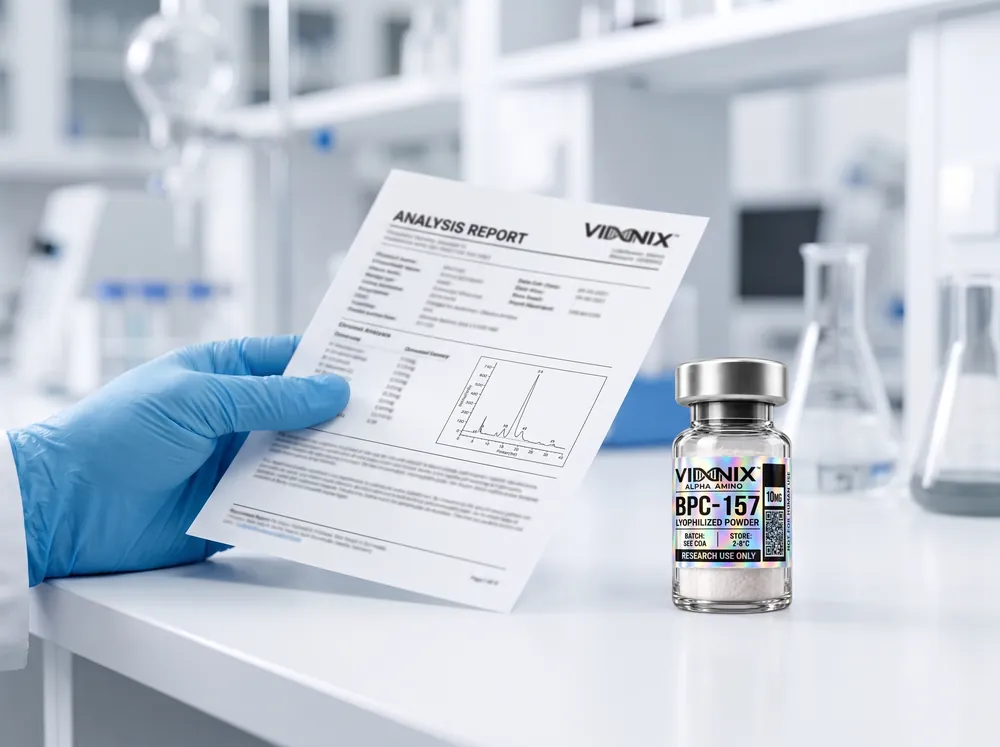
Definition: what is a certificate of analysis?
A certificate of analysis records specific tests run on a specific sample, along with the results. Specific is the word to hold onto. A COA describes the material that was sampled and analyzed, under the conditions and on the date printed on the report.
With synthetic peptides, the tests usually answer two questions. First, identity: is the intended molecule actually there? Mass spectrometry checks this by comparing an observed molecular mass with the mass calculated from the sequence [4]. Second, chromatographic purity: how much of the detected signal belongs to the main peak? Reversed-phase HPLC is the standard technique here [3]. Compendial peptide specifications rest on the same core attributes of identification, purity and assay [2].
So a COA is a narrow, factual document, and that narrowness is what makes it useful. Read for what it measured, it tells you a lot about one batch. Read as a general endorsement, it tells you nothing you can rely on.
What a COA should include: common COA fields
A complete peptide COA identifies the sample, ties it to a batch, says who tested it and how, and gives each result with the conditions you need to interpret it. Here are the fields to expect, and why each one matters.
| Field | What it records | Why it matters |
|---|---|---|
| Sample or product name | The compound and product the sample represents | Confirms the report is about the material you are looking at |
| Sample ID | The laboratory's internal reference for the sample | Lets the lab trace the result back to its own records |
| Batch or lot number | The production batch the sample was drawn from | Connects the report to physical vials from that batch |
| Testing date | When the analysis was performed | Places the result in time relative to manufacture and storage |
| Laboratory | The organization that performed and issued the analysis | Tells you who is accountable for the result |
| Analytical method | HPLC, mass spectrometry, LC-MS or other technique | Determines what the result can and cannot show |
| Method conditions | Column, mobile phase, detection wavelength, ionization mode | Allows the result to be interpreted and reproduced |
| Specification | The acceptance criterion, where one is set | Shows the target the result was compared against |
| Result | The measured value with units | The actual finding for this batch |
| Raw data | Chromatogram, mass spectrum | Lets you check that the summary matches the data |
| Approval | Analyst and reviewer sign-off | Shows the report was checked before release |
You won't see every field on every COA. A short report might leave out method conditions or raw data. That doesn't make it false, but it does limit how much you can check for yourself.
Batch context: why a COA belongs to one batch
The batch or lot number is what connects the paper to the vial, because a COA covers only the batch that was sampled. Peptides are made in discrete production runs, and impurity profiles shift from run to run. Solid-phase synthesis can leave deletion sequences, incompletely deprotected side chains, oxidized residues and other related impurities, in proportions that vary between runs [1].
A certificate for one batch therefore says nothing about another. If a report is offered as a generic certificate for all stock, with no batch number or one that never changes, it has lost the very connection that gave it meaning.
Batch and lot numbers
Most peptide documentation uses batch and lot interchangeably; both identify a group of units produced together. The number on the vial label should match the number on the certificate exactly, character for character. When the product page, label and report each show a different identifier, ask the supplier which one is authoritative before you rely on the report.
Limitations: what a COA does and does not establish
A COA establishes the results of the tests it lists, for the sample tested, at the time of testing. Nothing more. It doesn't establish every characteristic of the material, validate unrelated batches or establish suitability for human use.
| A COA can establish | A COA does not establish |
|---|---|
| The observed molecular mass of the main component | That every other batch has the same result |
| The chromatographic purity under stated HPLC conditions | The total amount of peptide in a vial (net peptide content) |
| Whether results met a stated specification | Anything about tests that were not performed |
| Which laboratory performed the work and when | Suitability, safety or any effect of the material |
Two mix-ups account for most misreadings. One is identity versus purity. A high HPLC percentage shows that one peak dominates; it doesn't show that the peak is the right molecule, which is the gap mass spectrometry fills. The other is purity versus content. Lyophilized peptide powder also holds counter-ions such as trifluoroacetate or acetate, plus some residual water, so the peptide mass in a vial is lower than the powder mass even when chromatographic purity is high [5].
Red flags on a COA
Problems with a certificate of analysis usually show up as broken links between the report, the batch and the data. Any of the following is a reason to ask questions before you rely on a report:
- No batch or lot number, or a number that does not match the product label.
- The same certificate shown for every batch or for several different products.
- No laboratory named, or a laboratory that cannot be identified.
- No method stated, so a purity figure has no defined meaning.
- A purity figure with no chromatogram and no method conditions behind it.
- An observed mass that does not match the theoretical mass for the stated sequence, with no explanation.
- Edited or inconsistent formatting, such as mismatched fonts, dates out of order or a compound name typed over another.
- Claims about effects or uses. An analytical report measures material. It doesn't describe outcomes.
A red flag means you should ask for clarification. It isn't proof of a problem. A supplier may be able to explain a renamed batch or a missing chromatogram; if they can't, treat the report as unverified. The guide to sourcing research peptides covers the other questions worth asking.
How to read a COA step by step
Reading a certificate of analysis boils down to seven checks, taken in order: sample, batch, date, laboratory, method, results and limitations. Each builds on the previous one, so if a report fails early you can stop there.
Our step-by-step guide to reading a COA runs through each check on an annotated sample report, including a worked example of HPLC and mass spectrometry results. For background on the methods, see peptide testing and analysis, HPLC testing and mass spectrometry.
Vinnix COA library: search by SKU or batch
In the Vinnix COA Library, every certificate of analysis is filed by product, SKU and batch number. Where available, each record shows the compound, product, batch, testing date, laboratory, HPLC report, mass spectrometry report and COA PDF.
A SKU code such as BC10, CU100 or MS10 identifies the product and strength; the batch number identifies the specific production run. You can search by either. Reports are added to the library as they become available. Until then, the record says the report is not yet published, and no substitute document is shown.
The quality and documentation page explains how we approach identification and documentation.
FAQFrequently asked questions
What is a certificate of analysis?
A certificate of analysis (COA) reports specified analytical results for one identified sample or batch. On a peptide COA you'll usually find the compound name, batch or lot number, testing date, laboratory, analytical methods such as HPLC and mass spectrometry, and the measured results. It covers only the tested material and only the tests it lists.
How do I read a peptide COA?
Go through seven checks in order. Confirm the sample name, match the batch number to your product and note the testing date. Then identify the laboratory and each method, read every result against its method, and note what wasn't tested. The Vinnix guide on how to read a COA works through each step on an annotated example report.
How do I find the COA for my batch?
Find the batch or lot number on the vial label and search for it in the Vinnix COA Library. Searching by SKU works too, for example BC10 or CU100, and then you pick the matching batch. If your batch has no report listed yet, it shows as not yet published, and you can contact Vinnix to ask about its status.
Is a peptide COA the same for every batch?
No. A peptide COA covers only the batch that was sampled and tested. Production runs can differ in impurity profile and content, so you can't carry a report from one batch over to another. Before relying on a report, make sure the batch number on it matches the number on your vial exactly.
Does a high purity percentage mean the peptide is correct?
Not by itself. An HPLC purity percentage tells you what share of the detected signal sits in the main peak under the stated conditions. It doesn't confirm that the main peak is the intended molecule. That's the job of mass spectrometry, which compares the observed molecular mass with the mass calculated from the sequence.
What is the difference between purity and peptide content?
Purity describes what the detected signal is made of, usually measured by HPLC. Content describes how much of the powder's mass is actually peptide. Lyophilized peptides also carry counter-ions, such as trifluoroacetate or acetate, and some residual water. A high-purity powder can therefore hold less peptide by weight than its total mass would suggest.
REFScientific references
-
D'Hondt M, Bracke N, Taevernier L, et al. Related impurities in peptide medicines. J Pharm Biomed Anal. 2014;101:2-30. PubMed 25044089
review -
Vergote V, Burvenich C, Van de Wiele C, De Spiegeleer B. Quality specifications for peptide drugs: a regulatory-pharmaceutical approach. J Pept Sci. 2009;15(11):697-710. PubMed 19750489
review -
Mant CT, Chen Y, Yan Z, et al. HPLC analysis and purification of peptides. Methods Mol Biol. 2007;386:3-55. PubMed 18604941
methods review -
Fenn JB, Mann M, Meng CK, Wong SF, Whitehouse CM. Electrospray ionization for mass spectrometry of large biomolecules. Science. 1989;246(4926):64-71. PubMed 2675315
analytical methods review -
Hettiarachchi K, Ridge S. Capillary electrophoretic determination of acetic acid and trifluoroacetic acid in synthetic peptide samples. J Chromatogr A. 1998;817(1-2):153-161. PubMed 9764489
analytical method validation study