
Key facts
- Core purpose
- Tie specific results to one specific batch
- Identification fields
- Product name, batch or lot number, sample ID
- Provenance fields
- Laboratory, test date, issue date, approval
- Results fields
- Test, method, specification, result, units
- Peptide-specific data
- HPLC chromatogram and mass spectrum for the same batch
- Biggest red flag
- No batch number, so the document cannot be matched to a container
What should a COA contain at minimum?
Strip a COA down to the minimum and it still has to answer three questions. Which material was tested? Who tested it, and when? What did they find, and by which method?
A certificate of analysis summarizes results for one batch. Its definition and role have their own certificate of analysis page, and the step-by-step reading order lives in how to read a COA. Think of this article as a COA checklist: the fields you should expect, why each one is there, and what a gap tells you.
Knowing what a COA is not helps too. A specification sheet lists the limits a product should meet and carries no results. A laboratory test report holds the raw data and method detail behind each measurement. The COA sits in between. It puts the specifications next to the batch's actual results, and it should point back to the underlying reports so someone can check them.
Which fields identify the material?
First on the COA checklist are the fields that name the material and tie the document to a single batch. Leave them out and nothing else on the COA can be linked to a specific container.
| Field | Why it matters | If it is missing |
|---|---|---|
| Product or compound name | States what the material is claimed to be | You cannot tell what was tested |
| Batch or lot number | Links the results to one production batch | The document cannot be matched to any container |
| Sample identifier | Links the report to the laboratory's own records | Harder to trace the result inside the lab |
| Sequence, formula or molecular weight | Gives the theoretical values that identity results are compared against | Mass results have nothing to be checked against |
| Container size (where stated) | Shows which product size the batch was filled into | Acceptable if one batch fills several sizes |
If your COA checklist has room for only one field, make it the batch number, because analytical results describe the batch that was sampled and no other. We go into why in batch number vs. lot number.
Which fields show who tested the sample and when?
Next on the COA checklist come the provenance fields, which record the laboratory, the dates and who approved the results. They are what let you trace the document and check it.
- Laboratory name and address. Tells you who generated the data, and whether the testing was in-house or done by a third party.
- Test date and issue date. When was the analysis run, and when was the certificate released? A test date after the issue date, or long before the batch was made, needs explaining.
- Report or certificate number. A unique reference that lets the laboratory find the original record.
- Signature or authorized approval. Shows that a responsible person reviewed and released the results.
- Page numbering. "Page 1 of 3" style numbering shows whether attachments such as chromatograms are missing.
Labs that work to ISO/IEC 17025, the international standard for laboratory competence, are expected to put items like these on their reports. A COA can be useful without accreditation behind it. That is why they sit on every COA checklist: without them, no report can be checked.
Which fields report the results?
The results section is the core of any COA checklist. It lists each test, the method used, the acceptance criterion and the value the lab actually got.
| Test | Method | Specification | Result |
|---|---|---|---|
| Appearance | Visual | White to off-white powder | Conforms / does not conform |
| Identity | ESI-MS | Observed mass matches theoretical within a stated tolerance | Observed and theoretical mass |
| Purity | RP-HPLC, UV 214 nm | Stated minimum, for example ≥ 98.0% | Measured percentage |
| Net peptide content (if tested) | Amino acid analysis or nitrogen determination | Report value | Measured percentage |
| Water content (if tested) | Karl Fischer titration | Stated maximum | Measured percentage |
| Counter-ion (if tested) | Ion chromatography or similar | Report value | Measured percentage |
A list of numbers becomes usable data when three things are in place. Each result names its method, since purity by HPLC and purity by some other technique are different measurements. The specification sits beside the result, so you can tell whether a reported 98.7% cleared a 98.0% limit or is just a number on the page. And results carry units, with mass values marked as monoisotopic or average. Pharmaceutical approaches to peptide quality structure specifications this way, with defined tests for identity, purity, related impurities and content [1][2].
What peptide-specific data should be attached?
For peptides, the COA checklist extends to attachments: a peptide COA should come with the raw analytical outputs behind it, meaning the HPLC chromatogram and the mass spectrum for the same batch.
HPLC attachment
- The chromatogram with a labeled time axis and the main peak marked.
- An integration table listing retention time and area percent for each peak.
- Column, mobile phase, gradient and detection wavelength.
Mass spectrometry attachment
- The spectrum with labeled m/z values.
- Observed mass, theoretical mass and the difference between them.
- Ionization method, and whether masses are monoisotopic or average.
With these attached, you can verify the summary instead of taking it on faith. Related impurities in peptides come in many forms, and whether you see them depends on the method [3], so the chromatogram often tells you more than the purity figure on page one. For what an HPLC purity number actually represents, read what HPLC purity means, and for reading the spectrum, see what is a mass spectrum.
What should a COA not claim?
A good COA checklist also covers what the document should leave out. A COA should report what was measured and stop there. It should not hint at properties that no listed test looked at.
Say a document reports HPLC purity and a mass match. Unless sterility, endotoxin, residual solvents or heavy metals are listed with results, it has told you nothing about them. A purity figure also does not tell you how much peptide is in the container. That takes a content measurement, because lyophilized peptides contain water and counter-ions that HPLC purity does not count [4]. Reading a COA well is mostly a matter of noticing which questions it answers and which it leaves open. We pull the two main ones apart in identity vs. purity.
COA checklist: red flags to look for
Run through this COA checklist to decide whether a COA is complete enough to rely on.
| Check | Look for | Red flag |
|---|---|---|
| Batch match | Batch number identical to your container label | No batch number, or a different one |
| Laboratory | A named laboratory with contact details | No laboratory named |
| Dates | Test and issue dates that make sense together | No dates, or dates that conflict |
| Methods | A named method for every result | "Purity: 99%" with no method |
| Specifications | Acceptance criteria beside results | Results with nothing to compare them against |
| Underlying data | Chromatogram and spectrum for the same batch | Summary numbers only |
| Identity and purity | Both reported, by different techniques | One result presented as covering both |
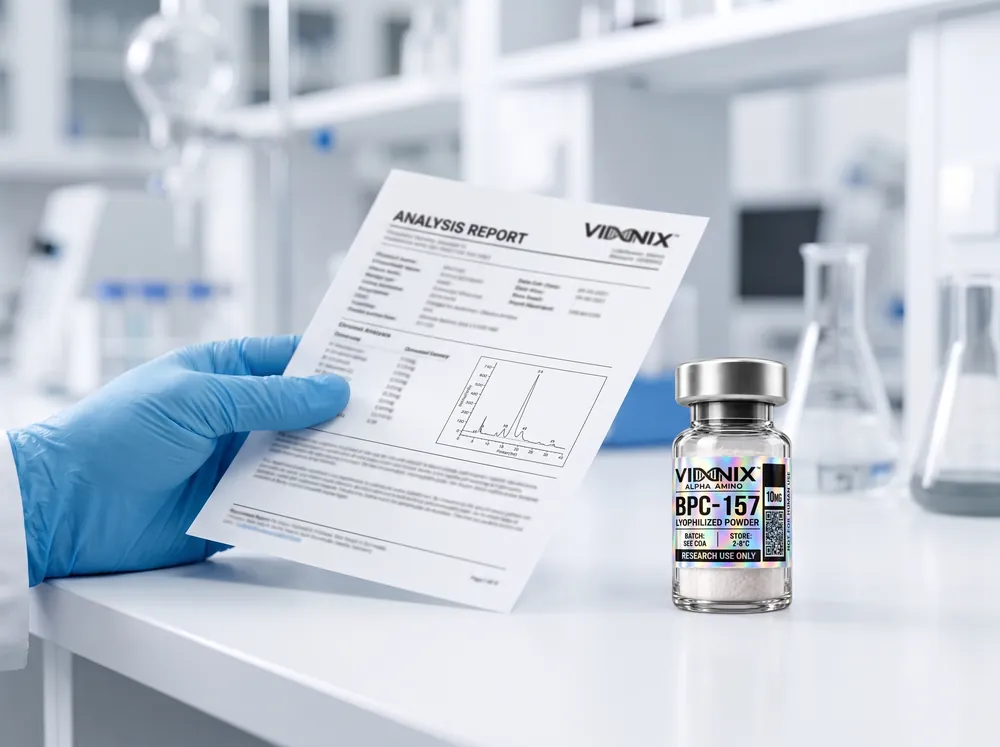
You can apply the same COA checklist to any Vinnix batch document. As each batch is released, Vinnix files its documents under that batch in the COA library, and anything not yet published is labeled that way. To see how the testing methods fit together, start with the peptide testing overview.
FAQFrequently asked questions
What information must a certificate of analysis include?
At a minimum: the product name, the batch or lot number, the testing laboratory, the test and issue dates, each test performed with its method, the specification or acceptance criterion, the actual result with units, and an authorized approval. For peptides you should also be able to see the HPLC chromatogram and mass spectrum for that same batch. Together, those items make up the core COA checklist.
Why is the batch number the most important field on a COA?
It is the link between the reported results and a physical container. Results describe the batch that was sampled, and the next batch can differ in purity or impurity profile. Without a batch number, or with a number that does not match your label, the COA cannot be applied to the material you actually have.
Should a COA include the HPLC chromatogram?
Ideally, yes, and it belongs on any COA checklist. The chromatogram shows the main peak, the impurity peaks and how they were integrated, none of which a purity figure can show. With it you can check that the result is plausible and that nobody left out a large peak. A COA that gives only a percentage, with no chromatogram or method details, asks the reader to take the number on trust.
Does a COA need to come from a third-party lab?
Not necessarily. An in-house COA and a third-party COA can both be valid, provided each clearly identifies the laboratory, the batch, the methods and the results. A third party brings independence. An in-house lab may know the product better. Either way, look for a document that is specific, traceable to a laboratory record and backed by underlying data such as chromatograms.
What is the difference between a specification and a result on a COA?
A specification is the acceptance criterion set before testing, such as a minimum HPLC purity of 98.0% or an observed mass within a stated tolerance. A result is the value actually measured for the batch. Put the two side by side and the reader can see whether the batch met its criteria. Print a result with no specification and there is nothing to judge it against.
Which tests are often missing from a peptide COA?
Plenty of research peptide COAs stop at identity by mass spectrometry and purity by HPLC. Net peptide content, water, counter-ions, residual solvents, endotoxin and sterility only show up if someone actually ran those tests. If a test is not listed with a result, the COA makes no statement about that property and should not be read as if it did.
REFScientific references
-
Vergote V, Burvenich C, Van de Wiele C, et al. Quality specifications for peptide drugs: a regulatory-pharmaceutical approach. J Pept Sci. 2009;15(11):697-710. PubMed 19750489
review (pharmacopeial specifications) -
McCarthy D, Han Y, Carrick K, et al. Reference Standards to Support Quality of Synthetic Peptide Therapeutics. Pharm Res. 2023;40(6):1317-1328. PubMed 36949371
review (pharmacopeial reference standards) -
D'Hondt M, Bracke N, Taevernier L, et al. Related impurities in peptide medicines. J Pharm Biomed Anal. 2014;101:2-30. PubMed 25044089
review -
Hoofnagle AN, Whiteaker JR, Carr SA, et al. Recommendations for the Generation, Quantification, Storage, and Handling of Peptides Used for Mass Spectrometry-Based Assays. Clin Chem. 2016;62(1):48-69. PubMed 26719571
consensus recommendations
 Documentation