
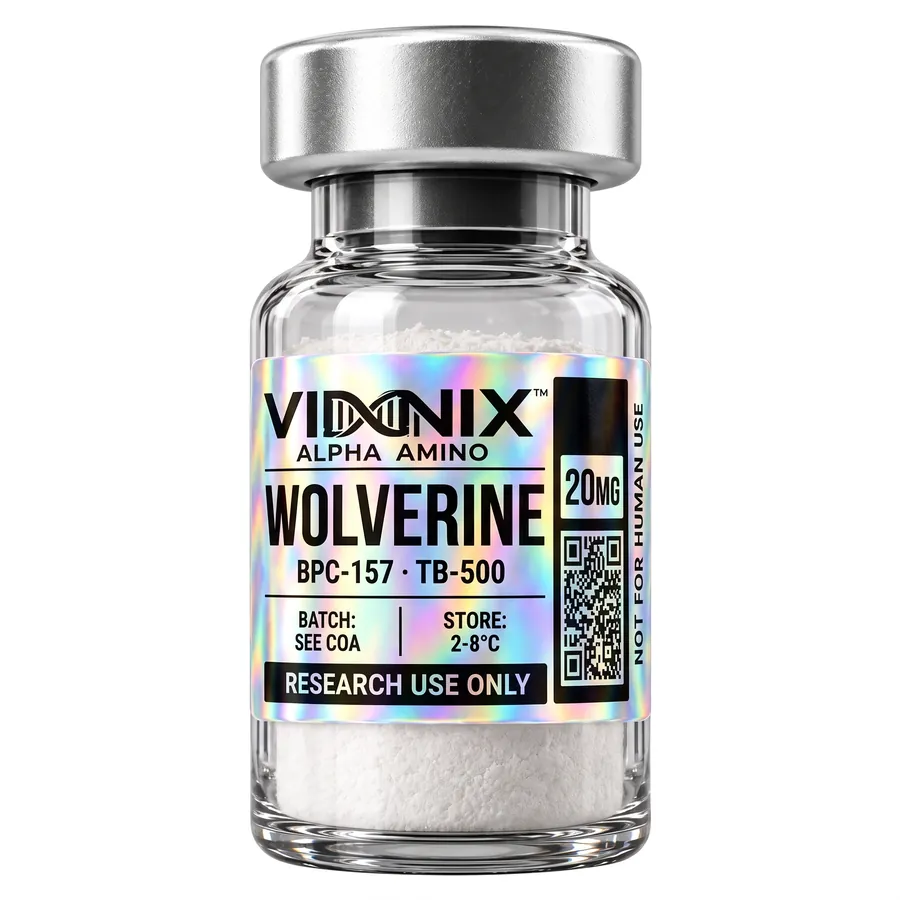
Key facts
- Product
- Wolverine Blend, SKU BB20
- Total quantity
- 20 mg
- Components
- BPC-157 and TB-500
- BPC-157 sequence
- GEPPPGKPADDAGLV (15 amino acids)
- BPC-157 molecular weight
- 1419.5 g/mol (PubChem CID 9941957)
- TB-500
- Synthetic peptide related to thymosin beta-4; exact sequence stated on product record
- Intended use
- Laboratory research use only
Batch reports are published in the COA Library as each batch is released. Match the batch number on your vial to its report.
Components: BPC-157, TB-500. Amounts per vial are listed on the batch COA.
What is the Wolverine stack?
Across the research-peptide market, Wolverine stack is the name for one product that holds both BPC-157 and TB-500. People also search for it as the wolverine peptide, the wolverine blend or the BPC 157 TB 500 blend. At Vinnix the word is a product name and nothing more. It tells you which two peptides are in the vial, not anything about how the material behaves.
Nothing links the two peptides chemically. They are separate molecules packed together, which means a vial of the Wolverine stack (BB20) holds two compounds with different lengths, sequences and molecular weights.
Vinnix products are sold for laboratory research only. They are not for human or veterinary use, and nothing on this page describes an effect of the product.
Blend composition and quantity of each compound
The Wolverine stack (BB20) holds 20 mg in total across its two components. For every Vinnix batch, the batch record and COA will list the amount of each one. Do not assume an equal split: a total figure says nothing about the ratio between the two peptides.
| Component | Type | Amount per vial | Identity reference |
|---|---|---|---|
| BPC-157 | Synthetic 15-residue peptide | Listed on the batch COA when published | PubChem CID 9941957; CAS 137525-51-0 |
| TB-500 | Synthetic peptide related to thymosin beta-4 | Listed on the batch COA when published | Sequence stated on the product record |
| Total | Two-component blend | 20 mg | SKU BB20 |
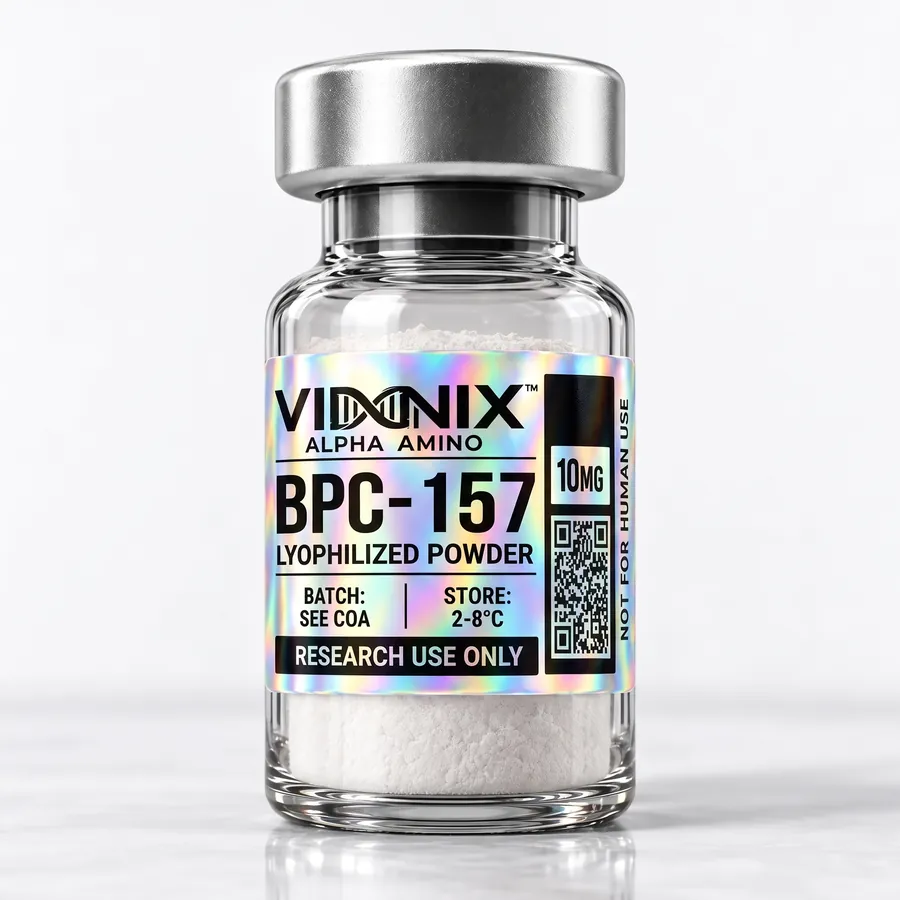
What is BPC-157?
BPC-157 is a synthetic 15-amino-acid peptide (a pentadecapeptide) with the sequence GEPPPGKPADDAGLV, read from the N-terminal glycine to the C-terminal valine. PubChem lists it under CID 9941957 with the molecular formula C62H98N16O22 and a molecular weight of 1419.5 g/mol, and its CAS number is 137525-51-0. Salt forms such as the acetate have a different formula and weight, which is why a product record should say which form is present. For full identity data, terminology and literature, go to the BPC-157 compound page.
Most of what has been published on BPC-157 comes from laboratory and animal research. A typical example: a cell-culture study that measured growth hormone receptor expression in rat tendon fibroblasts exposed to the peptide [1]. When a 2025 systematic review went through the orthopaedic literature, it found the evidence was predominantly preclinical, with very limited human data [2].
What is TB-500?
TB-500 is a trade name for a synthetic peptide related to thymosin beta-4, a 43-amino-acid protein whose complete sequence was first reported from bovine thymus in 1981 [3]. The full protein has the formula C212H350N56O78S and a weight of about 4963 g/mol (PubChem CID 45382195). Here is the complication. Sellers do not use the name consistently. Some materials sold as TB-500 match the full sequence, others are a short fragment, and research on short active-site sequences of thymosin beta-4 describes those fragments as distinct molecules [4]. So for any Vinnix batch, the product record states the exact TB-500 sequence. The TB-500 compound page has the detail.
Why do BPC-157 and TB-500 appear together in research?
Mostly, they show up together because each one has a long preclinical literature of its own, often in similar laboratory and animal tissue models. The pair has not been studied as one product. We know of no peer-reviewed controlled study that evaluated this exact combination as a single material.
| Component | Example literature | Study type |
|---|---|---|
| BPC-157 | Receptor expression in tendon fibroblasts [1] | In vitro |
| BPC-157 | Systematic review of orthopaedic literature [2] | Systematic review, mostly preclinical sources |
| Thymosin beta-4 | Complete amino-acid sequence [3] | Biochemical (protein sequencing) |
| Thymosin beta-4 | Activity mapped to short sequences [4] | Review of laboratory and animal work |
Two cautions follow. Research on full-length thymosin beta-4 does not automatically carry over to a short fragment sold as TB-500, and neither body of literature describes the Wolverine stack itself. And preclinical findings (see in vitro vs. in vivo research) do not establish safety or effectiveness in humans.
How is a BPC-157 and TB-500 blend analyzed?
Two peptides of very different sizes make the Wolverine stack one of the easier blends to analyze, but the rule is the same as for any blend: results come per component. BPC-157 and TB-500 each need an identity result and a quantity result (identity vs. purity explains the difference), and a single purity number for the vial would blur the two together. Peptide testing and analysis covers the general approach.
- Separate. On HPLC, the 15-residue BPC-157 and the larger TB-500 should elute as two well-spaced peaks.
- Identify. Mass spectrometry confirms which peptide sits under which peak by comparing measured and expected mass. In an LC-MS run this happens in the same pass.
- Quantify. Each peptide is measured against its own reference standard, which is how the COA arrives at separate BPC-157 and TB-500 amounts.
- Profile impurities. Related impurities are reported for each peptide. A good combined area figure can mask a problem confined to one of them.
Mass spectrometry earns its keep on the TB-500 component. A result near 4963 g/mol points to the full thymosin beta-4 sequence. A much lower mass points to a fragment. Either way, the report should match the sequence on the product record. BPC-157 is checked against its expected mass of 1419.5 g/mol for the free peptide.
Wolverine blend COA and batch documentation
Every batch of the Wolverine stack (BB20) will have its own certificate of analysis, tied to the batch number printed on the vial. With only two components the report is short, but it should still give each peptide its own line of results. Once published, reports will be listed in the Vinnix COA Library by product, SKU and batch. Look for:
- Product name, SKU and batch or lot number matching the vial
- Separate mass spectrometry identity results for BPC-157 and TB-500, with the TB-500 form stated
- The amount of each peptide in the 20 mg fill
- An HPLC chromatogram with both peaks labelled
- Testing laboratory, test date and methods
For help with any field, our guide to how to read a peptide COA goes step by step, and what a certificate of analysis is explains what any COA can and cannot show.
FAQWolverine Blend FAQ
What is the wolverine stack?
It is a market name for a research blend that puts BPC-157 and TB-500 in one vial. Vinnix supplies it as BB20, 20 mg in total, for laboratory research use only. The name refers to the pairing, not to any effect, and the two peptides remain separate molecules with their own identity data, to be confirmed on each batch COA.
What is in the BPC-157 and TB-500 blend?
Two peptides, and only two. BPC-157 is a 15-amino-acid synthetic peptide (GEPPPGKPADDAGLV, 1419.5 g/mol). TB-500 is a synthetic peptide related to thymosin beta-4, and its exact sequence is stated on the product record because TB-500 materials vary across the market. No other component is described as part of BB20.
How much of each compound is in BB20?
BB20 holds 20 mg in total. Each batch record and certificate of analysis will list the BPC-157 amount and the TB-500 amount separately. A total cannot tell you the ratio, so check the per-component figures on the COA whose batch number matches the one printed on your vial.
Is there a COA for the blend?
There will be. Each batch of the Wolverine stack will be documented with a certificate of analysis, published in the Vinnix COA Library and linked from this page. A complete blend COA should identify BPC-157 and TB-500 separately, report the quantity of each, and include the HPLC chromatogram and mass spectrometry results for the batch.
Is TB-500 the same as thymosin beta-4?
Not always. Thymosin beta-4 is a 43-amino-acid protein. Some materials sold as TB-500 match that full sequence, while others contain only a short fragment of it. Those are different molecules with different masses. That is why we lean on mass spectrometry and the product record to confirm which TB-500 form a Wolverine stack batch actually contains.
How is the Wolverine blend different from the GLOW blend?
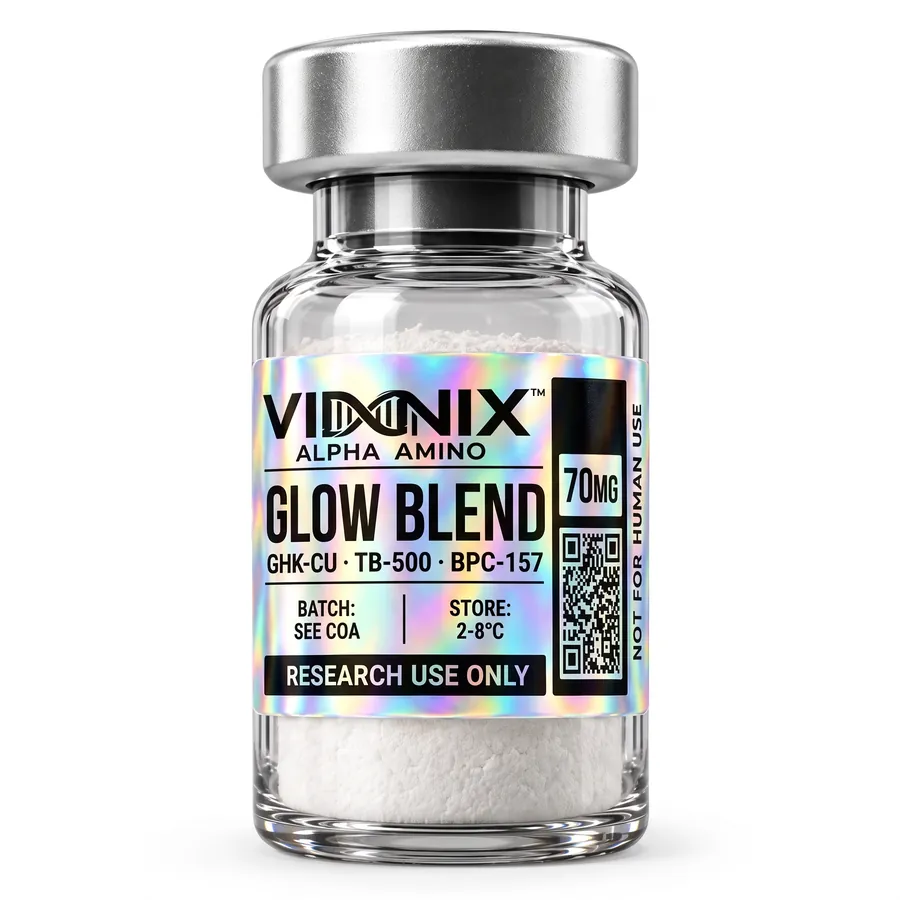
The Wolverine blend contains two peptides, BPC-157 and TB-500, in a 20 mg product (BB20). The GLOW blend contains those same two peptides plus GHK-Cu, a copper peptide complex, in a 70 mg product (BBG70). With three components, GLOW needs a COA that gives identity and quantity results for all three.
Can the Wolverine blend be used in people or animals?
No. The Wolverine blend is sold for laboratory research use only and is not intended for human or veterinary use. Vinnix does not provide usage, preparation or administration guidance, and the published research summarized here describes separate compounds studied mostly in cell and animal models, not this product.
REFScientific references
-
Chang CH, Tsai WC, Hsu YH, Pang JH. Pentadecapeptide BPC 157 enhances the growth hormone receptor expression in tendon fibroblasts. Molecules. 2014;19(11):19066-77. PubMed 25415472
in vitro study -
Vasireddi N, Hahamyan H, Salata MJ, et al. Emerging Use of BPC-157 in Orthopaedic Sports Medicine: A Systematic Review. HSS J. 2025;21(4):485-495. PubMed 40756949
systematic review -
Low TL, Hu SK, Goldstein AL. Complete amino acid sequence of bovine thymosin beta 4: a thymic hormone that induces terminal deoxynucleotidyl transferase activity in thymocyte populations. Proc Natl Acad Sci U S A. 1981;78(2):1162-6. PubMed 6940133
in vitro (protein sequencing) study -
Sosne G, Qiu P, Goldstein AL, Wheater M. Biological activities of thymosin beta4 defined by active sites in short peptide sequences. FASEB J. 2010;24(7):2144-51. PubMed 20179146
review
 Peptides
 Compound Library
 Research Blend
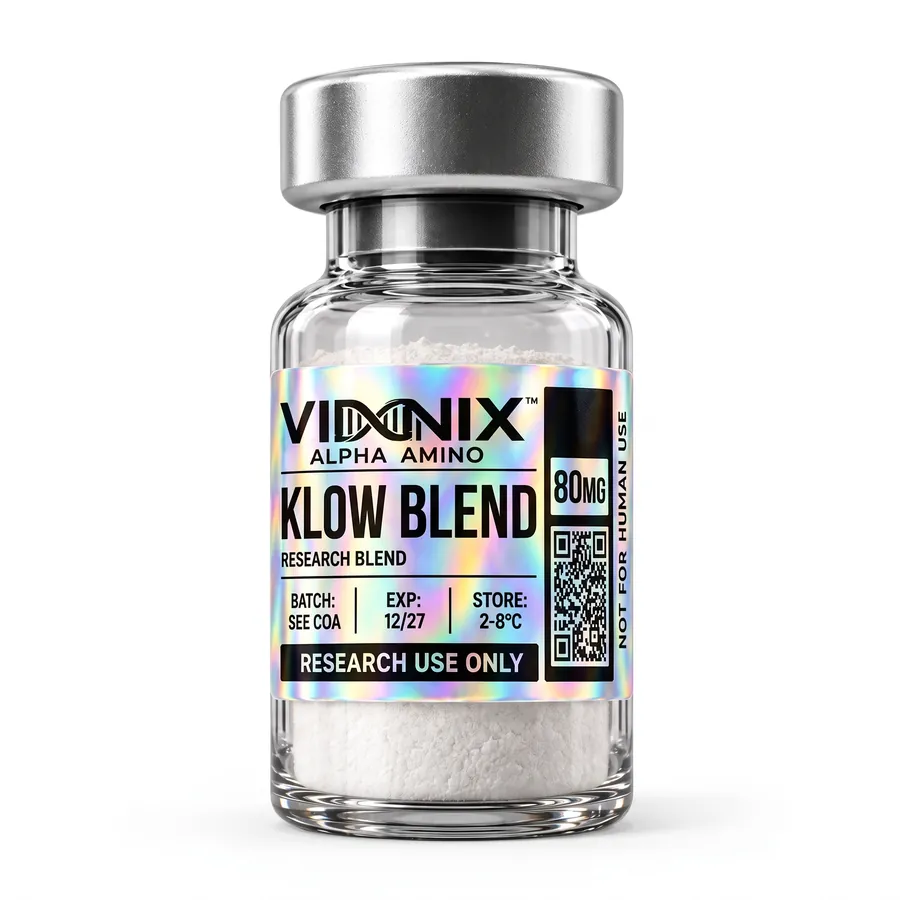 Research Blend
 Research Library
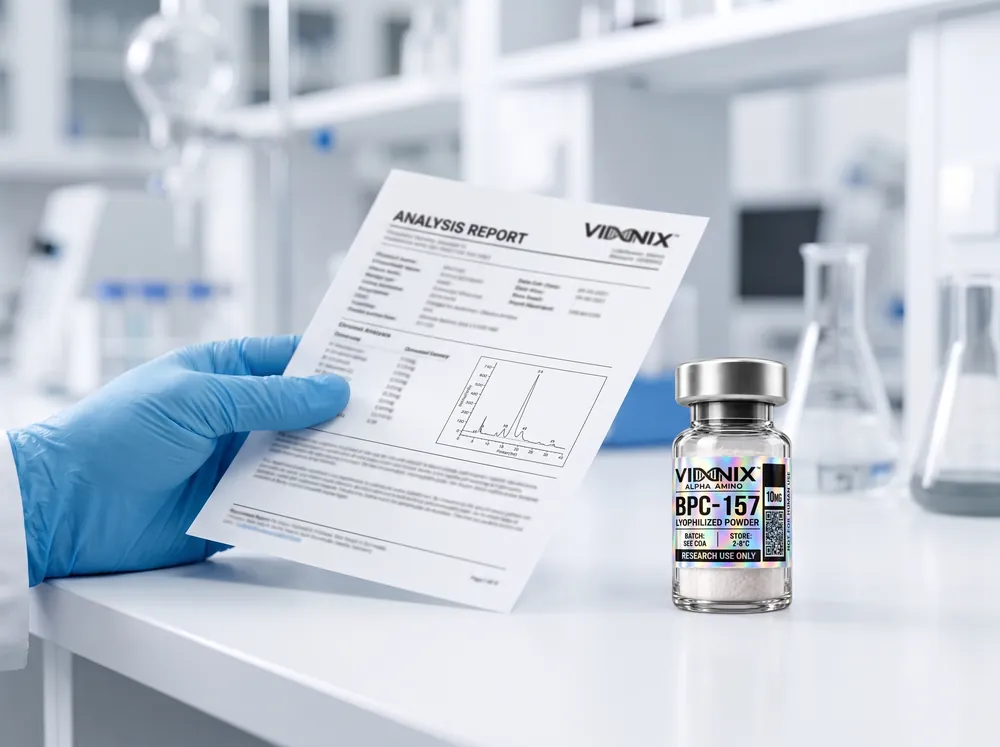 Documentation