
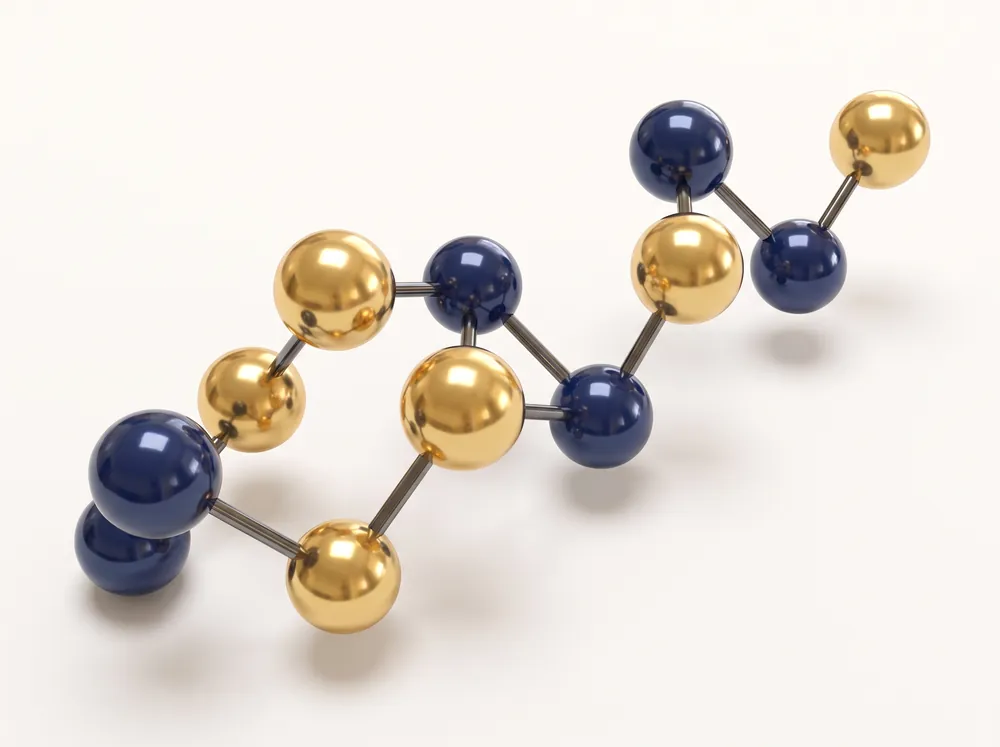
Key facts
- Compound
- KPV (Lys-Pro-Val)
- Classification
- Tripeptide
- Residues
- 3
- Sequence
- KPV (Lys-Pro-Val)
- Molecular formula
- C16H30N4O4
- Molecular weight
- 342.4 g/mol
- CAS number
- 67727-97-3
- Vinnix status
- Reference only, not sold standalone
What Is KPV Peptide?
KPV peptide is lysine-proline-valine, a three-residue peptide that mirrors the final three amino acids of alpha-MSH. Alpha-MSH itself is a 13-residue peptide cut from the precursor protein proopiomelanocortin, which is why papers also call KPV alpha-MSH(11-13) or MSH 11-13 [1][5].
Few peptides studied as defined compounds are smaller. KPV shows how much of a molecule's identity lives in its sequence: three amino acids, one fixed order. Swap that order to Val-Pro-Lys and you have a different molecule, even though the atoms are the same.
KPV is not a standalone Vinnix product. This entry belongs to the Compound Library and describes the molecule only, with no statement about the effects of any material.
KPV Peptide Product Specifications
Chemical identity for KPV is verified below. Product fields read not applicable, since Vinnix does not sell it as an individual item.
| Field | Value |
|---|---|
| Compound | KPV Peptide (Lys-Pro-Val) |
| Classification | Tripeptide |
| Sequence | KPV |
| Molecular formula | C16H30N4O4 (PubChem CID 125672) |
| Molecular weight | 342.4 g/mol (PubChem) |
| CAS number | 67727-97-3 |
| Product quantity | Not applicable |
| SKU | Not applicable |
| Batch/Lot | Not applicable |
KPV Identity
Two things pin down KPV: its three-residue sequence and the registry numbers, which all point to the free-acid tripeptide L-lysyl-L-prolyl-L-valine.
| Identifier | Value | Source |
|---|---|---|
| PubChem CID | 125672 (listed as Msh (11-13)) | PubChem |
| CAS Registry Number | 67727-97-3 | PubChem synonyms |
| FDA UNII | 7V6LGD8S5R | FDA GSRS (L-lysyl-L-prolyl-L-valine) |
| Common names | KPV; Lys-Pro-Val; alpha-MSH(11-13) | Literature usage |
One detail trips people up. Inside alpha-MSH the C-terminal valine is amidated, yet the PubChem and GSRS records above describe KPV as a free carboxylic acid. Research papers also use amidated (KPV-NH2) and acetylated variants, each with its own formula and mass, so a product record should say which form it contains.
Three-Amino-Acid Structure
Three amino acids, two peptide bonds. In KPV the chain starts with lysine at the N-terminus and ends with valine at the C-terminus.
| Position | Residue | Codes | Side-chain character |
|---|---|---|---|
| 1 (N-terminus) | Lysine | Lys, K | Basic, positively charged amine |
| 2 | Proline | Pro, P | Cyclic; its ring limits backbone flexibility |
| 3 (C-terminus) | Valine | Val, V | Nonpolar, branched aliphatic |
Proline is the odd one here. Its side chain loops back and bonds to the backbone nitrogen, which locks the chain's shape at that point. The peptide bonds article covers how residues link, and what are peptides explains size labels like dipeptide and tripeptide. For contrast, glutathione is another tripeptide in the Vinnix catalog, and its different three-residue sequence makes it a completely different compound.
Research Literature on KPV
The KPV literature is made up of animal studies and in vitro cell work (in vitro vs. in vivo research explains the difference). KPV is not an approved medicine, and this summary includes no human clinical findings.
Animal studies (preclinical)
Researchers in the 1980s and early 1990s tested the alpha-MSH 11-13 fragment in rabbit models [1] and compared analogues with altered stereochemistry, including D-amino-acid substitutions [2].
In vitro and combined studies
Later work followed KPV signalling in cultured human keratinocyte cells [3] and tracked its uptake through the intestinal peptide transporter PepT1 in cell and mouse models [4]. For background, a review covers the biochemistry of alpha-MSH and its C-terminal tripeptides [5].
All of these findings are preclinical. They describe what researchers looked at in cell cultures and animal models, and they should not be read as human outcomes.
KPV Peptide Analytical Documentation
Vinnix has no certificate of analysis for KPV on its own. Even so, a small peptide like this is characterized with the same core methods used across the catalog.
- HPLC separates KPV from synthesis by-products such as dipeptides or deletion sequences. More in HPLC testing.
- Mass spectrometry confirms identity. At about 342 g/mol, the singly protonated ion near m/z 343 is easy to find, and the amidated form shows up about 1 Da lower. More in mass spectrometry.
- Counter-ion and form need to be stated, since salt forms and C-terminal variants shift the reported mass.
FAQKPV Peptide FAQ
What is KPV Peptide?
KPV peptide is the tripeptide lysine-proline-valine, matching residues 11 to 13 at the C-terminal end of alpha-melanocyte-stimulating hormone. Its formula is C16H30N4O4 and its molecular weight is 342.4 g/mol. Vinnix doesn't sell KPV on its own; you're reading a Compound Library reference entry.
Is KPV Peptide a peptide?
Yes. KPV is a tripeptide, the next size class up from a dipeptide. Three amino acids are joined by two peptide bonds. In the free-acid form, lysine carries a free amino group at the N-terminus and valine carries a carboxyl group at the C-terminus.
What is the KPV Peptide sequence?
Written N-terminus to C-terminus, the sequence is Lys-Pro-Val in three-letter code, or KPV in one-letter code. The peptide's name is literally its one-letter sequence. You'll also see amidated or acetylated variants in the literature, marked with extra notation such as KPV-NH2.
What molecular information identifies KPV Peptide?
For the free-acid form, look for molecular formula C16H30N4O4, average molecular weight 342.4 g/mol, CAS number 67727-97-3, PubChem CID 125672 and FDA UNII 7V6LGD8S5R. Modified forms, such as the C-terminal amide, have different formulas and masses, so check the form against the product record.
How is KPV Peptide studied?
Mostly in cell cultures, including human keratinocyte and intestinal cell lines, and in animal models such as rabbits and mice. KPV is not an approved medicine. These are preclinical results: they tell you what was examined in laboratory systems, and they shouldn't be generalized to people.
How can KPV Peptide be analytically characterized?
Two methods do most of the work. HPLC separates KPV from related impurities and supports a purity value. Mass spectrometry confirms that the measured mass matches 342.4 g/mol for the free acid. Because the molecule is so small, the singly charged ion is usually the dominant signal.
Where can I find the Vinnix KPV Peptide COA?
There isn't one, because KPV is not sold as an individual product. Certificates for Vinnix products will be organized by product and batch in the Vinnix COA Library as each batch is released, and each report should be matched to the batch number printed on the product label.
REFScientific references
-
Richards DB, et al. Effect of alpha-MSH 11-13 (lysine-proline-valine) on fever in the rabbit. Peptides. 1984;5(4):815-7. PubMed 6333677
animal study -
Hiltz ME, et al. Anti-inflammatory activity of alpha-MSH(11-13) analogs: influences of alteration in stereochemistry. Peptides. 1991;12(4):767-71. PubMed 1788140
animal study -
Elliott RJ, et al. alpha-Melanocyte-stimulating hormone, MSH 11-13 KPV and adrenocorticotropic hormone signalling in human keratinocyte cells. J Invest Dermatol. 2004;122(4):1010-9. PubMed 15102092
in vitro study, human cell line -
Dalmasso G, et al. PepT1-mediated tripeptide KPV uptake reduces intestinal inflammation. Gastroenterology. 2008;134(1):166-78. PubMed 18061177
in vitro and animal study -
Brzoska T, et al. Terminal signal: anti-inflammatory effects of α-melanocyte-stimulating hormone related peptides beyond the pharmacophore. Adv Exp Med Biol. 2010;681:107-16. PubMed 21222263
review
 Peptides
 Research Library
 Documentation