
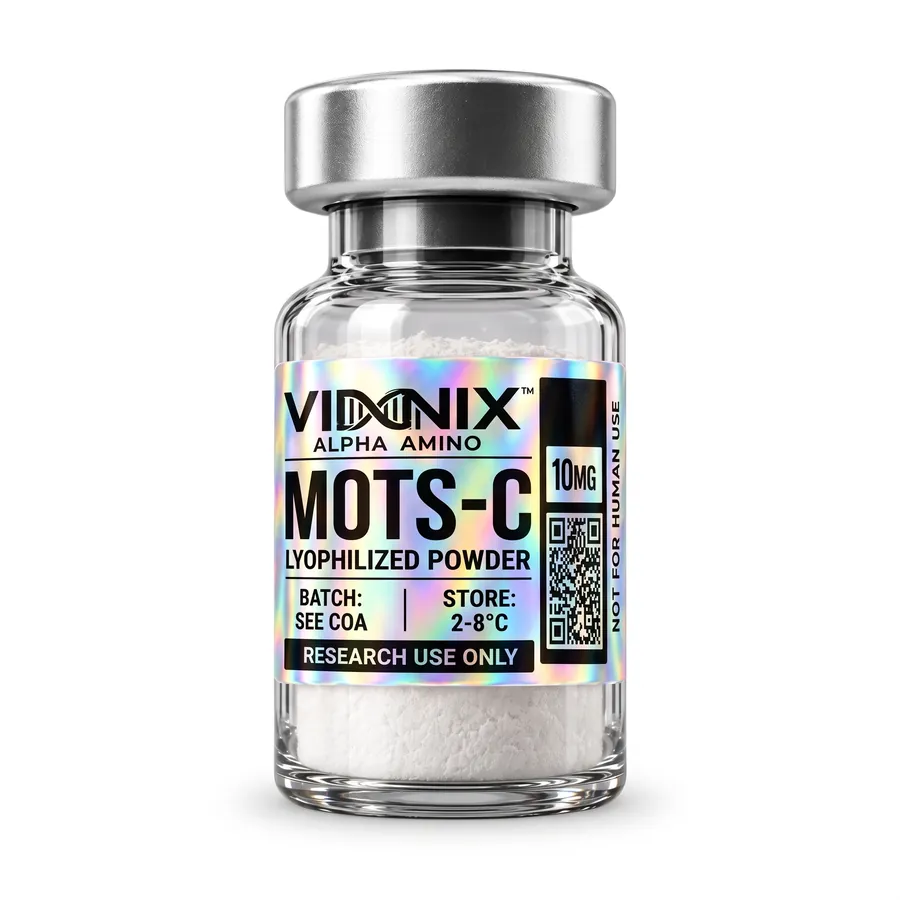
Key facts
- Sequence
- MRWQEMGYIFYPRKLR
- Amino acids
- 16
- Molecular formula
- C101H152N28O22S2
- Molecular weight
- 2174.6 g/mol (PubChem CID 146675088)
- CAS number
- 1627580-64-6
- Origin
- Encoded in the mitochondrial 12S rRNA region
- Vinnix SKU
- MS10 (10 mg)
Batch reports are published in the COA Library as each batch is released. Match the batch number on your vial to its report.
What Is MOTS-c?
The MOTS-c peptide is short, 16 amino acids long, and its coding sequence sits in the mitochondrial genome instead of the nuclear one. Changhan Lee, Pinchas Cohen and colleagues first described it in 2015 after combing mitochondrial DNA for short open reading frames [1].
The name is an acronym for mitochondrial open reading frame of the 12S rRNA type-c, which records where the sequence turned up: inside the stretch of mitochondrial DNA that encodes 12S ribosomal RNA. You'll see it written MOTS-c or MOTSc, and catalogs often call it the MOTS-c peptide.
Basic researchers care about this peptide mainly because of where it comes from. It belongs to a small class of molecules that complicate the older view that mitochondrial DNA encodes just 13 proteins plus its RNAs. What follows covers identity, molecular data, published research sorted by study type and how Vinnix documents each batch. Nothing here makes a claim about effects.
MOTS-c Product Specifications
The MOTS-c peptide comes in one strength at Vinnix: 10 mg per vial, SKU MS10. Lot number, physical form and storage statement will be published with each batch record. For general background on how lyophilized material is handled in the lab, see peptide storage.
| Field | Value |
|---|---|
| Compound | MOTS-c (mitochondrial open reading frame of the 12S rRNA type-c) |
| Classification | Mitochondrial-derived peptide |
| Sequence | Met-Arg-Trp-Gln-Glu-Met-Gly-Tyr-Ile-Phe-Tyr-Pro-Arg-Lys-Leu-Arg (MRWQEMGYIFYPRKLR) |
| Molecular formula | C101H152N28O22S2 |
| Molecular weight | 2174.6 g/mol (PubChem CID 146675088) |
| CAS number | 1627580-64-6 |
| Product quantity | 10 mg per vial |
| SKU | MS10 |
| Form | Shown on the batch COA when published |
| Batch / lot | Shown on the batch COA when published |
| Storage | Shown on the batch COA when published |
| COA | Linked per batch from the Vinnix COA Library as each report is released |
MOTS-c Identity: Sequence and Molecular Information
Read from the N-terminal methionine to the C-terminal arginine, the sequence is MRWQEMGYIFYPRKLR. In three-letter code: Met-Arg-Trp-Gln-Glu-Met-Gly-Tyr-Ile-Phe-Tyr-Pro-Arg-Lys-Leu-Arg.
How many amino acids are in the MOTS-c peptide?
Sixteen amino acids, joined by 15 peptide bonds. The mix of residues shapes how it behaves in the lab. Four are basic (three arginines and a lysine) and only one, a glutamate, is acidic, so the MOTS-c peptide carries a net positive charge at neutral pH. Two methionines and a tryptophan are prone to oxidation. The aromatic residues (tryptophan, two tyrosines, phenylalanine) absorb UV light at 280 nm.
| Identifier | Value | Source |
|---|---|---|
| Molecular formula | C101H152N28O22S2 | PubChem CID 146675088 |
| Average molecular weight | 2174.6 g/mol | PubChem |
| Monoisotopic mass | 2173.108 Da | PubChem |
| CAS number | 1627580-64-6 | PubChem synonyms |
| UNII | A5CV6JFB78 | FDA GSRS |
N-acetyl MOTS-c is a related substance with its own GSRS record (UNII 9ND3NG2FKG). An acetyl group changes both the mass and the identity, so a product record should say whether the N-terminus is free or modified.
What Is a Mitochondrial-Derived Peptide?
It's a short peptide whose coding sequence lies within mitochondrial DNA, usually as a small open reading frame that overlaps a ribosomal RNA gene. The MOTS-c peptide is among the best-known examples [1][4].
- Mitochondrial genome: the small circular DNA inside mitochondria, kept apart from the DNA in the cell nucleus.
- Open reading frame (ORF): a stretch of DNA, running from a start codon to a stop codon, that could be translated into a peptide.
- 12S and 16S rRNA: the mitochondrial genome's two ribosomal RNA genes. MOTS-c maps to the 12S region, while humanin and the small humanin-like peptides (SHLPs) map to the 16S region.
- Short ORF peptides: a wider term for small peptides encoded by short reading frames. Mitochondrial-derived peptides are one group within it.
New to how peptides are defined and built? Start with What Are Peptides? and Peptide Sequences.
MOTS-c Research Literature
The literature on the MOTS-c peptide is young. Most of it is cell culture and animal work (the difference is explained in in vitro vs. in vivo research), and the human side so far amounts to measurements in collected samples. Because the field only dates from 2015, it is far smaller than the literature on older peptides.
Preclinical findings do not establish safety or effectiveness in humans. Each entry below describes what was investigated, not an outcome for any product.
- Discovery (in vitro and animal): the 2015 study identified its open reading frame, detected the peptide in cells, tissues and plasma, and examined it in cultured cells and mouse models [1].
- Cellular localization (in vitro and animal): a 2018 study asked whether the peptide moves into the cell nucleus under metabolic stress and how it relates to nuclear gene expression [2].
- Age and exercise (animal, with human samples): a 2021 study looked at the peptide in mice of different ages and measured its levels in human tissue and plasma samples collected around exercise [3].
- Reviews: later reviews pull the growing literature together and lay out open questions about how it is produced and how it acts [4].
| Year | Study type | Focus | Ref. |
|---|---|---|---|
| 2015 | In vitro and animal | Identification of MOTS-c in mitochondrial DNA | [1] |
| 2018 | In vitro and animal | Nuclear translocation and gene expression | [2] |
| 2021 | Animal, plus human sample measurements | Age-related and exercise-related measurements | [3] |
| 2023 | Review | Summary of published MOTS-c research | [4] |
How Is MOTS-c Analyzed? HPLC and Mass Spectrometry
Reversed-phase HPLC handles purity and mass spectrometry handles identity. A few details of this sequence make the analysis more interesting than usual.
On HPLC, the aromatic residues allow detection at 280 nm on top of the usual 214 to 220 nm. Either methionine can oxidize to methionine sulfoxide, adding 16 Da per oxidized residue; that form usually elutes as a separate, earlier peak. A good report shows these related peaks instead of hiding them (see how to read an HPLC chromatogram), and it shows any deletion sequences left over from synthesis.
Under electrospray mass spectrometry, the four basic residues let the MOTS-c peptide pick up several protons easily. Working from the PubChem monoisotopic mass, you'd expect ions near m/z 1087.56 for [M+2H]2+, 725.38 for [M+3H]3+ and 544.28 for [M+4H]4+. Software combines these charge states into the molecular mass.
MOTS-c Analytical Documentation and COA
Each Vinnix 10 mg batch of the MOTS-c peptide will be documented with a certificate of analysis tied to its lot. That COA, with the HPLC chromatogram, mass spectrum and batch details, will be published in the COA Library. A batch report is expected to show:
- Lot number, quantity per vial and test date
- HPLC purity, with oxidized and other related peaks visible
- Observed versus calculated molecular mass
- Methods and laboratory
Certificate of Analysis and Peptide Testing explain how to read each field. If mitochondrial research is your interest, the Vinnix catalog also carries SS-31, a synthetic tetrapeptide, or you can browse all research peptides.
Vinnix products are supplied strictly for laboratory and analytical research. They are not drugs, supplements or personal-care products, are not for human or veterinary use, and nothing here describes or implies any use in people or animals.
FAQMOTS-c FAQ
What is MOTS-c?
MOTS-c is a 16-amino-acid peptide encoded within the 12S ribosomal RNA region of mitochondrial DNA. First described in 2015, it belongs to the group known as mitochondrial-derived peptides. Its sequence is MRWQEMGYIFYPRKLR, and PubChem lists its molecular weight as 2174.6 g/mol. Vinnix offers it as a 10 mg research vial.
What does MOTS-c stand for?
It stands for mitochondrial open reading frame of the 12S rRNA type-c. The name tells you where the coding sequence was found: a short open reading frame inside the mitochondrial gene for 12S ribosomal RNA, not in the nuclear genome. The lower-case c is part of the name the research group chose when they described it in 2015.
Is MOTS-c a peptide?
Yes. The MOTS-c peptide is 16 amino acids joined by 15 peptide bonds, short enough to count as an oligopeptide and far smaller than a protein. Research material is made by chemical synthesis. The sequence, MRWQEMGYIFYPRKLR, defines its identity, and measuring its molecular mass confirms that identity analytically.
What is the MOTS-c sequence?
MRWQEMGYIFYPRKLR, or Met-Arg-Trp-Gln-Glu-Met-Gly-Tyr-Ile-Phe-Tyr-Pro-Arg-Lys-Leu-Arg in three-letter code, read from the N-terminal methionine to the C-terminal arginine. It has three arginines and a lysine, two methionines, a tryptophan, two tyrosines and one glutamate. That mix explains the net positive charge and why analysts check for oxidized variants.
What molecular information identifies MOTS-c?
Look for the sequence, molecular formula C101H152N28O22S2, average molecular weight 2174.6 g/mol, monoisotopic mass 2173.108 Da, CAS number 1627580-64-6, PubChem CID 146675088 and FDA UNII A5CV6JFB78. N-acetyl MOTS-c is a separate substance with a different mass, so the supplied form should always be stated.
How is MOTS-c studied?
Since its discovery in 2015, the MOTS-c peptide has mostly been studied in cultured cells and mouse models. Human research so far is limited to measuring the peptide in collected tissue and plasma samples, and reviews summarize this young field. None of the preclinical findings establish safety or effectiveness in humans.
How can MOTS-c be analytically characterized?
Two methods. Reversed-phase HPLC reports purity and separates oxidized methionine forms and other related peaks. Electrospray mass spectrometry typically shows multiply charged ions near m/z 1087.6, 725.4 and 544.3. Between them, they confirm identity and measure purity, which is what a batch report needs to show.
Where can I find the Vinnix MOTS-c COA?
Batch documentation for the Vinnix 10 mg vial (SKU MS10) will be linked from this page and listed by batch number in the Vinnix COA Library once published. Make sure the lot number on your vial matches the lot on the report. If a batch has no published record yet, there is simply no COA link for it.
REFScientific references
-
Lee C, Zeng J, Drew BG, et al. The mitochondrial-derived peptide MOTS-c promotes metabolic homeostasis and reduces obesity and insulin resistance. Cell Metab. 2015;21(3):443-454. PubMed 25738459
in vitro and animal study -
Kim KH, Son JM, Benayoun BA, Lee C. The Mitochondrial-Encoded Peptide MOTS-c Translocates to the Nucleus to Regulate Nuclear Gene Expression in Response to Metabolic Stress. Cell Metab. 2018;28(3):516-524.e7. PubMed 29983246
in vitro and animal study -
Reynolds JC, Lai RW, Woodhead JST, et al. MOTS-c is an exercise-induced mitochondrial-encoded regulator of age-dependent physical decline and muscle homeostasis. Nat Commun. 2021;12(1):470. PubMed 33473109
animal study with human sample measurements -
Zheng Y, Wei Z, Wang T. MOTS-c: A promising mitochondrial-derived peptide for therapeutic exploitation. Front Endocrinol (Lausanne). 2023;14:1120533. PubMed 36761202
review
 Compound Library
 Peptides
 Research Library: Peptide Fundamentals
 Testing & Analysis
 Documentation