
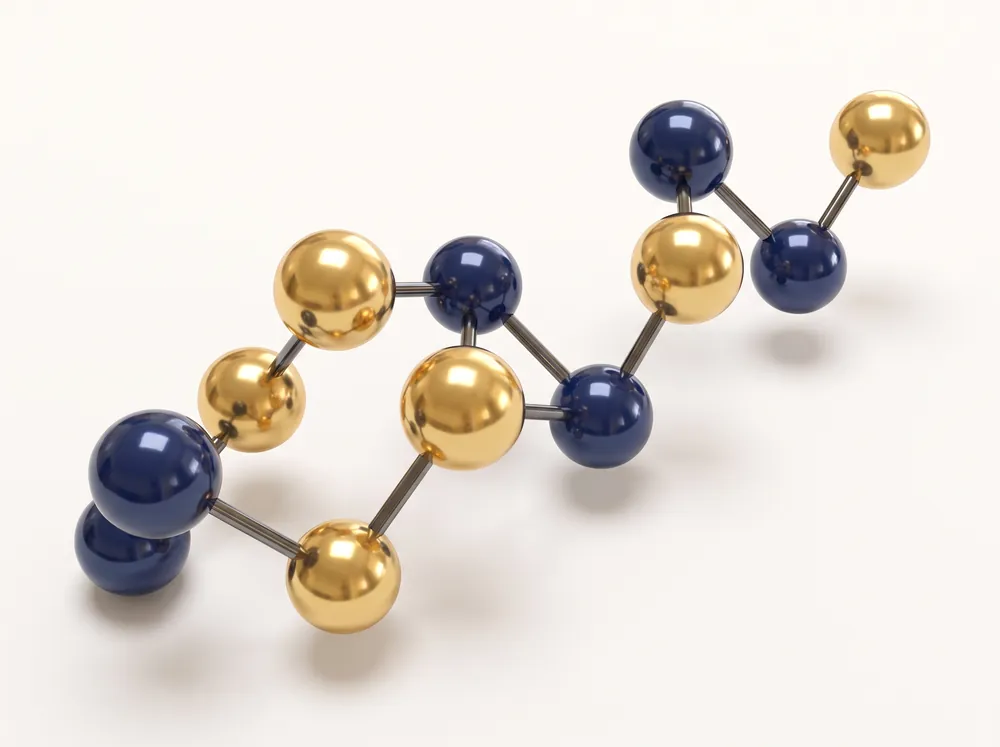
Key facts
- Sequence (one-letter)
- TKPRPGP
- Sequence (three-letter)
- Thr-Lys-Pro-Arg-Pro-Gly-Pro
- Molecular formula
- C33H57N11O9 (PubChem)
- Molecular weight
- 751.9 g/mol (PubChem)
- Monoisotopic mass
- 751.434 Da (PubChem)
- CAS number
- 129954-34-3 (FDA GSRS)
- PubChem CID
- 11765600
- UNII
- TS9JR8EP1G
- Parent peptide
- Tuftsin, Thr-Lys-Pro-Arg
- Vinnix availability
- Component of Selank + Semax (XS20); no standalone SKU
What Is Selank?
This is a short synthetic peptide of seven amino acids. It was developed in Russia as an analogue of tuftsin [2], a four-residue peptide that occurs naturally as a fragment of immunoglobulin G [1]. The name refers to one defined sequence, so unlike some catalog names it doesn't hide competing definitions.
FDA's Global Substance Registration System records the substance under that name, with the synonyms TP-7 and Selanc, and links it to the same PubChem record used on this page. You'll find it in the literature mainly in Russian laboratory and animal studies, often alongside its sister peptide Semax.
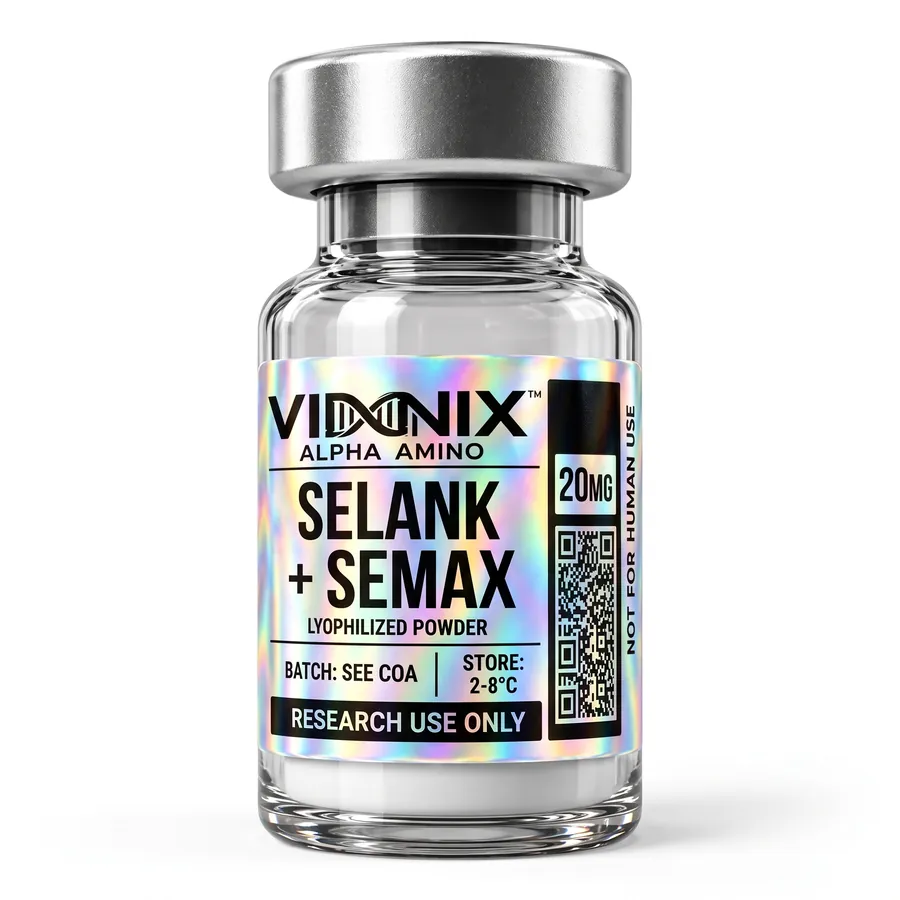
Vinnix doesn't sell it as a standalone vial. It is one of two components in the Selank + Semax research blend, and this page is the reference entry for the compound itself.
Selank Sequence and Origin
Tuftsin, Thr-Lys-Pro-Arg, was first described in 1970 as a natural peptide that stimulates phagocytic cells [1]. It is also broken down quickly in biological fluids [2]. The newer peptide keeps those four residues and extends the C-terminus with Pro-Gly-Pro, giving the heptapeptide below.
The added Pro-Gly-Pro belongs to a family of proline-rich fragments that Russian groups call glyprolines. Ashmarin and colleagues described hybrid, or "chimeric", peptides that join a regulatory sequence to a glyproline tail, and this peptide is one of their examples [3]. Peptides rich in proline tend to resist some peptidases, which is the usual rationale given for the design [4].
Two basic residues, lysine and arginine, give the molecule a net positive charge near neutral pH. That matters in the lab: it affects retention on reversed-phase HPLC and makes the peptide pick up protons readily in electrospray mass spectrometry.
Molecular and Registry Data
The identity values below come from PubChem and FDA GSRS. They describe the free peptide; a supplied material may also contain counter-ions such as acetate, which change the weight of the powder but not the peptide itself (see what molecular weight means).
| Field | Value | Source |
|---|---|---|
| Sequence | Thr-Lys-Pro-Arg-Pro-Gly-Pro (TKPRPGP) | PubChem, GSRS |
| Length | 7 residues | Sequence |
| Molecular formula | C33H57N11O9 | PubChem CID 11765600 |
| Molecular weight | 751.9 g/mol | PubChem |
| Monoisotopic mass | 751.434 Da | PubChem |
| CAS number | 129954-34-3 | FDA GSRS |
| UNII | TS9JR8EP1G | FDA GSRS |
| Synonyms | TP-7, Selanc | PubChem, GSRS |
Published Research
The published literature is small and mostly preclinical. Much of it appears in Russian-language journals, and very little has been repeated by independent groups elsewhere. The studies below show the kinds of questions laboratories have asked.
- Gene expression. An animal study measured the expression of inflammation-related genes in mouse spleen after exposure to the peptide [5].
- Enzyme studies. An in vitro study compared how Selank and Semax affected enkephalin-degrading enzymes in human serum samples [6].
- Animal models. A rat study examined Selank and Semax in a 6-OHDA lesion model [7].
- Stability. Reviews of proline-containing peptides discuss how glyproline-tailed sequences break down in biological media [4].
None of this establishes safety or any effect in humans, and it is not an approved medicine in the United States. Our guide to in vitro and in vivo research explains why the study type matters when reading these papers.
Laboratory Identification
Identity is confirmed by mass spectrometry: the measured mass should match 751.43 Da for the neutral molecule, which appears near m/z 752.44 as the singly protonated ion. HPLC then reports purity as the main peak's share of total peak area. In a blend, each of the two peptides should appear as separate, labeled peaks, each with its own result, as described in peptide testing and analysis.
Vinnix Products That Contain Selank
Vinnix offers this compound only inside the Selank + Semax blend (SKU XS20, 20 mg total per vial). The amount of each peptide is reported on the batch record. Batch reports are listed in the COA Library as each batch is released, and the vial's batch number is what links the two.
Material from Vinnix is supplied for laboratory research. Nothing on this page describes an effect in people or animals outside the cited studies.
FAQSelank FAQ
What is Selank?
Selank is a synthetic heptapeptide with the sequence Thr-Lys-Pro-Arg-Pro-Gly-Pro. PubChem lists it under CID 11765600 with the formula C33H57N11O9 and a molecular weight of 751.9 g/mol. It is an analogue of the natural peptide tuftsin, and Vinnix supplies it only as part of the Selank + Semax research blend.
Where does Selank come from?
It was designed in Russia from tuftsin, the tetrapeptide Thr-Lys-Pro-Arg found as a fragment of immunoglobulin G. Researchers kept those four residues and added the tripeptide Pro-Gly-Pro at the C-terminus. Proline-rich tails like this are associated with greater resistance to some peptidases, which is the usual explanation for the design.
Is Selank the same as tuftsin?
No. Tuftsin has four residues and the analogue has seven, so they have different formulas, masses and identifiers. It contains the full tuftsin sequence at its N-terminal end, then continues with Pro-Gly-Pro. A mass spectrometry result separates them easily, because the heptapeptide is heavier by the mass of the three added residues.
Does Vinnix sell Selank on its own?
No. Vinnix offers it only as a component of its Selank + Semax research product, SKU XS20, which holds 20 mg in total per vial. The batch record gives the amount of each peptide. This page is a compound reference entry and does not describe a separate product.
How is Selank told apart from Semax in a sample?
By mass and retention time. Selank weighs 751.9 g/mol and Semax 813.9 g/mol, a gap mass spectrometry resolves easily. Their different charges usually separate them on reversed-phase HPLC too. Both end in Pro-Gly-Pro, so fragment ions from that tail alone can't distinguish them; the full molecular mass of each peak settles it.
REFScientific references
-
Najjar VA, Nishioka K. "Tuftsin": a natural phagocytosis stimulating peptide. Nature. 1970;228(5272):672-673. PubMed 4097539
original research (peptide isolation) -
Siebert A, Gensicka-Kowalewska M, Cholewinski G, Dzierzbicka K. Tuftsin - Properties and Analogs. Curr Med Chem. 2017;24(34):3711-3727. PubMed 28745220
review -
Ashmarin IP, Samonina GE, Lyapina LA, Kamenskii AA, et al. Natural and hybrid ("chimeric") stable regulatory glyproline peptides. Pathophysiology. 2005;11(4):179-185. PubMed 15837162
review -
Shevchenko KV, Nagaev IY, Andreeva LA, Shevchenko VP, Myasoedov NF. [Stability of proline-containing peptides in biological media]. Biomed Khim. 2019;65(3):180-201. PubMed 31258142
review -
Kolomin T, Shadrina M, Andreeva L, et al. Expression of inflammation-related genes in mouse spleen under tuftsin analog Selank. Regul Pept. 2011;170(1-3):18-23. PubMed 21609736
animal study -
Kost NV, Sokolov OIu, Gabaeva MV, et al. [Semax and selank inhibit the enkephalin-degrading enzymes from human serum]. Bioorg Khim. 2001;27(3):180-183. PubMed 11443939
in vitro study -
Slominsky PA, Shadrina MI, Kolomin TA, et al. Peptides semax and selank affect the behavior of rats with 6-OHDA induced PD-like parkinsonism. Dokl Biol Sci. 2017;474(1):106-109. PubMed 28702721
animal study
 Research Blend
 Research Library: Peptide Fundamentals
 Research Library
 Testing & Analysis
 Documentation