
Key facts
- Full name
- High-performance liquid chromatography
- Usual mode for peptides
- Reversed-phase (C18 or C8 column)
- Mobile phase
- Water and acetonitrile gradient with acid modifier
- Detection
- UV absorbance, typically 214 to 220 nm
- Main output
- Chromatogram (signal vs retention time)
- Reported value
- Main peak area %
Definition: What Is HPLC Testing?
HPLC testing is an analytical method. A dissolved sample is pumped under high pressure through a tightly packed column, its components separate, and a detector records each one as it comes out. The "high-performance" part refers to the small, uniform column particles and high pressures, which give much sharper separations than older gravity-fed column chromatography.
Peptide labs use HPLC twice: once to purify a peptide after synthesis, and again to analyze it [1]. The analytical run is what ends up on a certificate of analysis, as a chromatogram and a purity value. Within peptide testing, HPLC covers purity, while identity usually falls to mass spectrometry.
How Chromatography Works
Separation happens because molecules split their time differently between a moving liquid (the mobile phase) and a fixed surface (the stationary phase). The more a molecule clings to the stationary phase, the slower it travels and the later it leaves the column.
Reversed-phase HPLC for peptides
Peptide HPLC is mostly reversed-phase. The stationary phase is silica bonded with hydrophobic chains such as C18, and the mobile phase starts out mostly aqueous [1]. As the run goes on, a gradient raises the share of organic solvent, usually acetonitrile. Hydrophilic components let go early and hydrophobic ones later, so retention tracks the peptide's net hydrophobicity, which in turn comes from its amino acid sequence.
Most methods add an acid modifier, commonly 0.1% trifluoroacetic acid (TFA). It works as an ion-pairing agent, masking charged groups so peptide peaks come out sharper [1]. There's a side effect worth remembering: peptides purified by HPLC often end up as trifluoroacetate salts, which becomes relevant when you look at net peptide content [2].
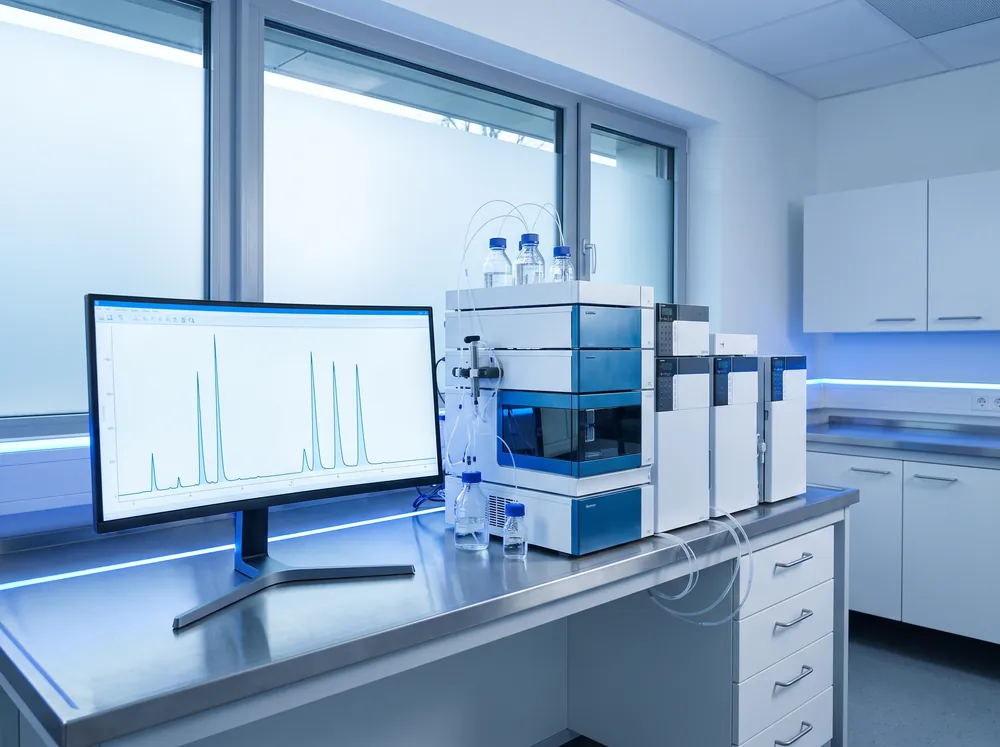
The main parts of an HPLC system
| Component | Role in peptide analysis |
|---|---|
| Pump | Delivers the mobile phase at constant flow and forms the gradient |
| Autosampler | Introduces a precise volume of dissolved sample into the flow |
| Column | Packed stationary phase (e.g. C18, 3 to 5 micrometer particles) where separation happens |
| Column oven | Holds temperature constant so retention times repeat |
| Detector | UV or photodiode array detector, usually read at 214 to 220 nm |
| Data system | Records the signal, integrates peaks and calculates area % |
Retention Time
Retention time is how long it takes from the sample entering the column to a component's peak reaching the detector. Keep the conditions fixed and the same compound gives the same retention time, which is how peaks get recognized from one run to the next.
Column, gradient, flow rate, temperature and mobile phase all affect retention time, so you can only compare it within one method. Matching a reference standard run on the same day and method is supporting evidence of identity. It isn't proof, because two different peptides can elute at almost the same moment. Pharmacopeial specifications therefore don't accept HPLC retention alone as identity; they pair it with other identification tests [3].
Chromatograms and Peaks
The chromatogram is the detector's output plotted against time. Each peak stands for one or more components that reached the detector together, and amounts are compared by peak area, not height.
- Main peak: the largest peak, expected to be the target peptide.
- Early-eluting peaks: often more hydrophilic species, for example shorter truncated sequences.
- Late-eluting peaks: often more hydrophobic species, for example sequences retaining a protecting group.
- Shoulders and split peaks: can signal a closely related impurity such as an oxidized or isomerized form [4].
- Baseline: should be flat; drift or noise affects how small peaks are integrated.
To walk through a real report layout step by step, see how to read a COA.
HPLC and Purity Terminology
HPLC purity is usually given as area percent: the main peak's area divided by the sum of all integrated peak areas, times 100. It's a relative measure of the components that absorb UV, and a peak-area percentage is not automatically the same as absolute mass purity.
| Peak | Retention time (min) | Area (mAU*s) | Area % |
|---|---|---|---|
| Impurity 1 | 11.2 | 1,200 | 0.6% |
| Main peak | 12.8 | 197,000 | 98.8% |
| Impurity 2 | 13.5 | 1,150 | 0.6% |
| Total | 199,350 | 100% |
You'll see a few related terms near this number:
- Related substances: peptide impurities structurally related to the target, such as deletion or truncated sequences [4].
- Single largest impurity: the area % of the biggest non-main peak; pharmacopeial specifications often limit it separately [3].
- Assay: a quantitative measurement against a reference standard, which is different from area % purity [5].
- Net peptide content: the peptide share of total powder weight, explained in peptide purity explained.
What Should an HPLC Testing Report State?
A good HPLC testing report lists the method conditions next to the result. The same sample can produce a different purity value under a different method, and without those details nobody can reproduce or compare the figure.
| Report field | Why it matters |
|---|---|
| Column (chemistry, length, particle size) | Determines how well closely related impurities are resolved |
| Mobile phases and acid modifier | TFA and formic acid give different peak shapes and selectivity |
| Gradient program | A shallow gradient separates more impurities than a steep one |
| Flow rate and column temperature | Both shift retention time and peak width |
| Detection wavelength | 214 to 220 nm reflects the peptide bond; higher wavelengths favor aromatic residues |
| Integration settings | Thresholds decide whether small peaks are counted at all |
| Chromatogram image with peak table | Lets a reader confirm the reported area % |
Before analyzing samples, regulated laboratories also run system suitability checks. They might confirm that a resolution mixture separates two closely eluting peptides, and that replicate runs give consistent retention times and areas. Pharmacopeial methods for approved peptides spell out such criteria and use characterized reference standards to anchor retention time and assay [3][5]. Research-grade reports may not include all of that. Still, the more of it you see, the more weight the purity value can bear.
With a report in hand, the companion guide on peptide purity shows how to keep the purity figure separate from identity and quantity. Terms such as resolution, tailing and related substances are defined in the peptide glossary.
HPLC Limitations
HPLC testing reports what the detector saw under one method. Its blind spots are whatever that method can't separate or can't detect. Results also depend on sample preparation, detection, separation, method validation and reporting, and undetected or unresolved components may not show up accurately in a simple peak-area calculation.
- Co-elution: an impurity eluting inside the main peak is counted as main peak.
- Response factors: area % assumes every component absorbs UV like the main peptide.
- Invisible components: water, most salts and counter-ions are not reported by UV area %.
- No identity proof: HPLC does not measure molecular mass, so it is usually paired with LC-MS or MS.
- Method dependence: changing gradient, column or wavelength can change the reported purity for the same sample.
A purity percentage is only meaningful with its method details and chromatogram. Compare it with the identity result, which comes from a different technique, explained in HPLC vs mass spectrometry.
FAQFrequently asked questions
What is HPLC testing?
HPLC testing means using high-performance liquid chromatography to separate a sample into its components and measure each one as a peak. With peptides it's usually reversed-phase HPLC with UV detection near 214 to 220 nm, and the headline result is a purity value: the main peak's share of total integrated peak area.
What does HPLC stand for?
High-performance liquid chromatography. People also used to call it high-pressure liquid chromatography, since the pumps drive the mobile phase through a densely packed column at high pressure. It's the small particle size in that column that gives the sharp, well-resolved separations peptide purity analysis depends on.
Why is reversed-phase HPLC used for peptides?
Reversed-phase HPLC sorts peptides by hydrophobicity, and hydrophobicity shifts even between sequences that differ by one amino acid. Run a C18 column with a water to acetonitrile gradient and an acid modifier, and most peptides give sharp peaks. That's what makes it so good at pulling the target sequence apart from deletion, truncated and modified impurities.
What is retention time in HPLC?
It's how long a component takes to get from the point where the sample enters the column to the detector. Under identical conditions, a compound comes back at the same retention time, which helps with recognizing peaks. Since it depends on the method, you can only compare retention times between runs using the same column, gradient and temperature.
Can HPLC confirm the identity of a peptide?
Not by itself. HPLC testing measures separation, not mass. A peak at the same retention time as a reference standard supports identity, but different molecules can elute close together. Identity is normally confirmed by mass spectrometry, which measures molecular mass. Plenty of laboratories run LC-MS to collect separation and mass data together in one analysis.
Why might two labs report different HPLC purity for the same peptide?
Because HPLC purity depends on the method. Column chemistry, gradient slope, detection wavelength and the way small peaks are integrated can all move the result. A shallow gradient might separate impurities that a fast gradient folds into the main peak. A comparison is only fair when the methods match, or when both are fully stated.
REFScientific references
-
Mant CT, Chen Y, Yan Z, et al. HPLC analysis and purification of peptides. Methods Mol Biol. 2007;386:3-55. PubMed 18604941
methods review -
Cornish J, Callon KE, Lin CQ, et al. Trifluoroacetate, a contaminant in purified proteins, inhibits proliferation of osteoblasts and chondrocytes. Am J Physiol. 1999;277(5):E779-E783. PubMed 10567002
in vitro study -
Vergote V, Burvenich C, Van de Wiele C, De Spiegeleer B. Quality specifications for peptide drugs: a regulatory-pharmaceutical approach. J Pept Sci. 2009;15(11):697-710. PubMed 19750489
review (pharmacopeial specifications) -
D'Hondt M, Bracke N, Taevernier L, et al. Related impurities in peptide medicines. J Pharm Biomed Anal. 2014;101:2-30. PubMed 25044089
review -
McCarthy D, Han Y, Carrick K, et al. Reference standards to support quality of synthetic peptide therapeutics. Pharm Res. 2023;40(6):1317-1328. PubMed 36949371
review (pharmacopeial reference standards)
 Testing & Analysis
 Research Library
 Documentation