
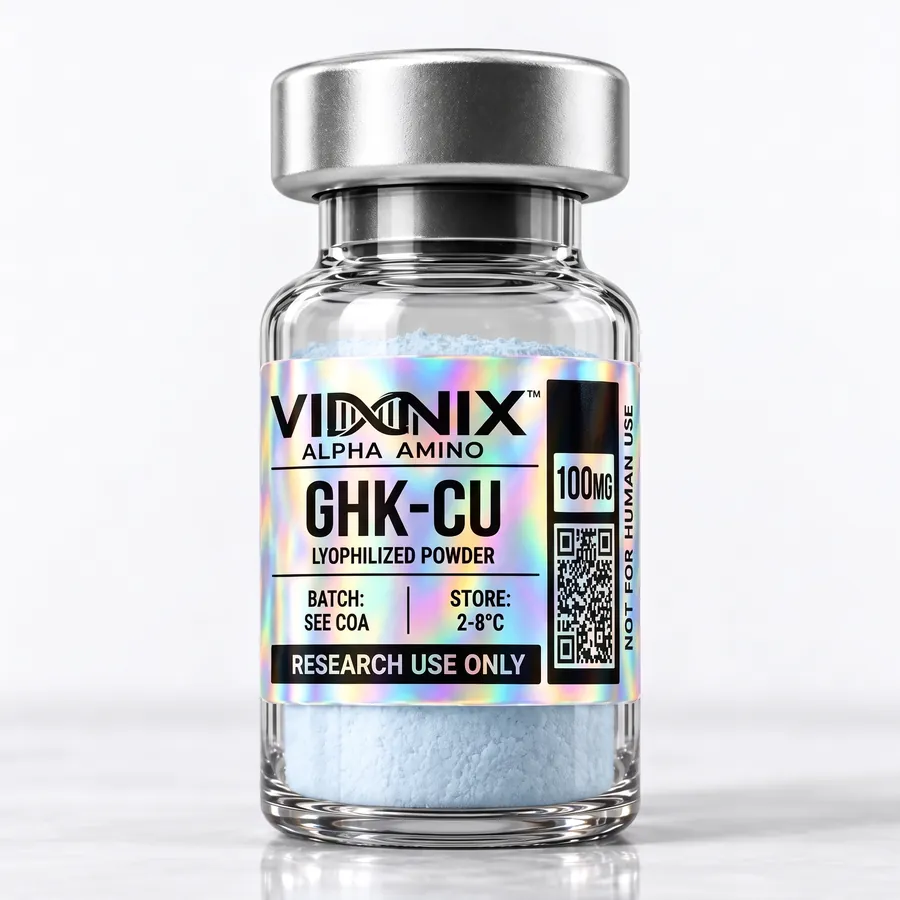
Key facts
- Sequence
- Gly-His-Lys (GHK) + Cu(II)
- Amino acids
- 3 (tripeptide)
- Molecular formula
- C14H23CuN6O4+
- Molecular weight
- 402.9 g/mol (PubChem CID 71587328)
- CAS number
- 89030-95-5
- Other names
- Copper tripeptide-1; prezatide copper
- Vinnix SKU
- CU100 (100 mg)
Batch reports are published in the COA Library as each batch is released. Match the batch number on your vial to its report.
What Is GHK-Cu?
It is a small copper peptide: the tripeptide glycyl-L-histidyl-L-lysine (GHK) holding a single copper(II) ion. You'll see the name written as GHK-Cu, GHK Cu or ghkcu. Ingredient databases and older papers also call it copper tripeptide-1 or prezatide copper. Every one of these names points to the same copper complex.
The peptide itself, GHK, was first reported in 1973 by Loren Pickart and Martin Thaler. They described a tripeptide fraction from human serum and tested it in cultured liver cells [1]. GHK grabs copper ions very readily, and that affinity eventually led researchers to treat the copper-bound form as a substance of its own, so the copper complex now has a literature distinct from that of the free peptide.
For a laboratory, the practical answer is simpler. The complex is a defined coordination compound with a known sequence, formula and mass, and it can be characterized like any other research peptide. Below you'll find its identity, the copper binding, how it differs from GHK, the history and kinds of published work, and how Vinnix documents each batch. Nothing here is a claim about what the Vinnix product does.
GHK-Cu Product Specifications
There is one strength: 100 mg per vial (SKU CU100), sold for laboratory research only. Lot number, physical form and storage statement belong to each batch record and will appear once that record is published. General handling background is in peptide storage.
| Field | Value |
|---|---|
| Compound | GHK-Cu (copper tripeptide-1; prezatide copper) |
| Classification | Copper(II) complex of a tripeptide |
| Sequence | Gly-His-Lys (GHK), bound to Cu(II) |
| Molecular formula | C14H23CuN6O4+ (PubChem CID 71587328) |
| Molecular weight | 402.9 g/mol |
| CAS number | 89030-95-5 |
| Product quantity | 100 mg per vial |
| SKU | CU100 |
| Form | Shown on the batch COA when published |
| Batch / lot | Shown on the batch COA when published |
| Storage | Shown on the batch COA when published |
| COA | Linked per batch from the Vinnix COA Library as each report is released |
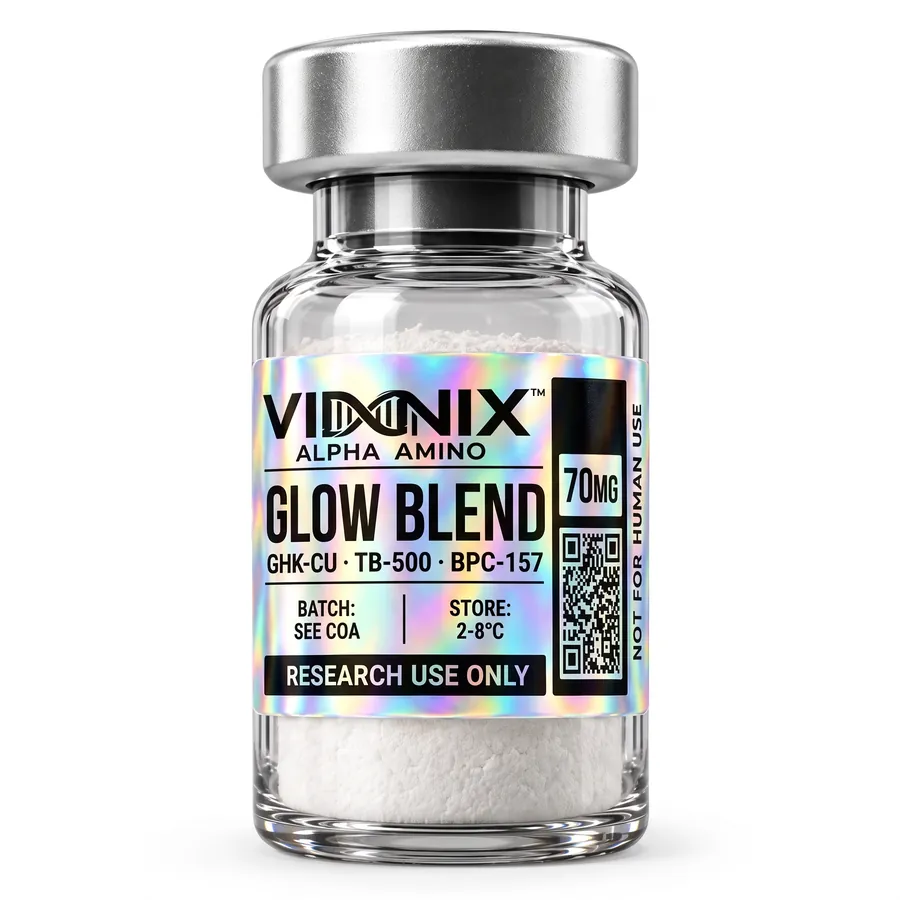
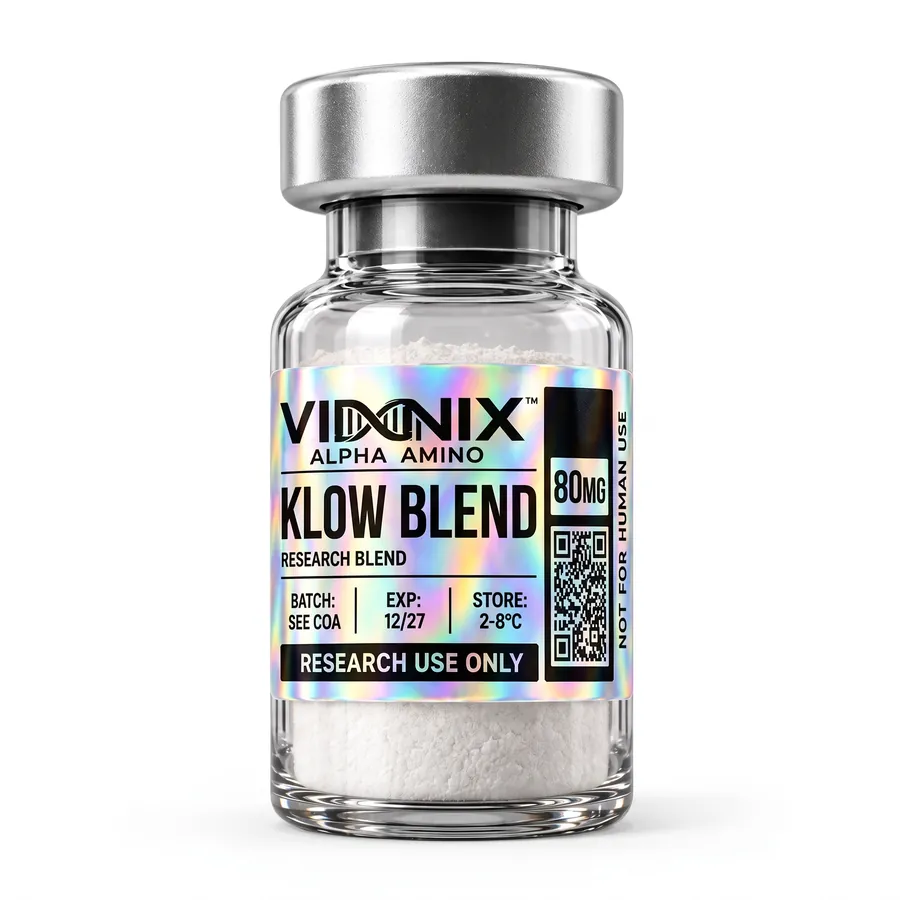
You'll also find it listed as a component of the Vinnix GLOW Blend. The KLOW Blend has its own page covering that product's composition and documentation.
GHK-Cu Structure and Sequence
The sequence is Gly-His-Lys, written GHK in one-letter code, with a copper(II) ion held by the peptide. As a tripeptide it has three amino acids joined by two peptide bonds, read from the N-terminal glycine to the C-terminal lysine (see Peptide Sequences).
Each residue brings something different. Glycine, the smallest amino acid, supplies a free N-terminal amine. Histidine carries an imidazole ring, which binds copper strongly. Lysine adds a long side chain that ends in a positively charged amine. The result is a compact copper-binding pocket at one end of the molecule, with the lysine side chain left free.
| Property | GHK (free peptide) | GHK-Cu (copper complex) |
|---|---|---|
| PubChem CID | 73587 | 71587328 |
| Molecular formula | C14H24N6O4 | C14H23CuN6O4+ |
| Molecular weight | 340.38 g/mol | 402.9 g/mol |
| Monoisotopic mass | 340.186 Da | 402.108 Da (63Cu) |
| CAS number | Not used on this page | 89030-95-5 |
Why Is GHK-Cu Called a Copper Peptide?
The term copper peptide is literal. The compound is a peptide coordinated to a copper(II) ion, not a peptide mixed with a separate copper salt, and specific atoms of the peptide hold the metal in place.
Which atoms? Crystallographic and solution studies point to three nitrogens of GHK: the free amine of glycine, the deprotonated backbone amide nitrogen between glycine and histidine, and a nitrogen of the histidine imidazole ring. In the solid-state structure, an oxygen from a neighboring complex fills the remaining coordination position [2]. Isothermal titration calorimetry has put numbers on how tightly GHK binds copper compared with other copper-binding peptides [3].
This chemistry shows up in the lab. Copper(II) peptide complexes are colored, so a solution of the complex looks blue while free GHK is colorless. Binding is also pH dependent. At strongly acidic pH the amide nitrogen picks up a proton and the complex can fall apart, which matters when you read analytical data, as the testing section explains.
GHK vs. GHK-Cu
Put simply, GHK is the tripeptide on its own and GHK-Cu is that tripeptide with a copper ion bound. They're related, but they are not interchangeable: the formulas, weights and identifiers all differ.
- Formula and mass: GHK is C14H24N6O4 (340.38 g/mol); GHK-Cu is C14H23CuN6O4+ (402.9 g/mol). One hydrogen is lost when the amide nitrogen binds copper.
- Appearance: GHK is colorless in solution; GHK-Cu is blue.
- Identifiers: they have separate PubChem records (CID 73587 and CID 71587328).
- Labeling: a product record should state clearly whether it contains the free GHK peptide or the copper complex, and in which salt form.
Someone searching for a GHK peptide could mean either form. The fastest way to tell which one a material really is: check the molecular formula and molecular weight on its certificate.
History of GHK-Cu Research
The story runs for more than five decades. It starts with the 1973 report of a tripeptide in human serum [1] and moves through coordination chemistry, cell culture and animal work to, more recently, gene expression analyses.
- 1970s: isolation of the tripeptide from human serum and early cell culture work with liver cells (in vitro) [1].
- 1980s to 2000s: recognition of its copper affinity and a growing body of cell culture and animal studies, summarized in a 2008 review by Pickart (review) [4].
- 2010s: detailed structural and thermodynamic chemistry of copper binding (in vitro) [2][3], and reviews that reinterpreted earlier work using public gene expression datasets (review) [5].
A good share of the later literature was written with consumer products in mind, which is why "copper peptide" gets searched so heavily. Vinnix makes no claim about appearance or personal-care use, and nothing on this page supports one.
Published Research on GHK-Cu
Broadly, the published work sorts into three groups: chemistry studies of copper binding, cultured-cell experiments, and animal studies. Reviews pull these together. How strong the evidence is depends a great deal on the topic.
Findings from preclinical research should not be interpreted as establishing safety or effectiveness in humans. The table below describes study types and research questions only.
| Study type | Research question examined | Ref. |
|---|---|---|
| In vitro (isolation, cell culture) | Identification of a tripeptide in human serum and its activity in cultured liver cells | [1] |
| In vitro (structural chemistry) | X-ray and solution structures of the Cu(II)-GHK complex and its redox properties | [2] |
| In vitro (thermodynamics) | Strength of Cu(II) binding to GHK measured by isothermal titration calorimetry | [3] |
| Review | Cell culture and animal work on GHK and tissue remodeling | [4] |
| Review | Reanalysis of earlier findings against public gene expression data | [5] |
One caution. Much of the review literature comes from a small group of authors, Pickart in particular. If you're weighing the field, go back to the primary studies each review cites and note whether the work was done in cells, animals or people (in vitro vs. in vivo research explains the categories).
How Is GHK-Cu Analyzed?
Three checks apply. HPLC measures purity, mass spectrometry confirms identity, and because the metal is part of what the molecule is, copper content can be confirmed on its own. Each answers a different question.
HPLC. Reversed-phase HPLC separates the peptide from related substances such as deletion products and other synthesis by-products. There's a catch with copper complexes, though. The acidic mobile phases commonly used for peptides can pull the copper off, so free GHK may appear in the chromatogram. Read the result alongside the method conditions printed on the report.
Mass spectrometry. In mass spectrometry, free GHK gives a protonated ion near m/z 341.19 and the intact copper complex appears near m/z 402.11 (both calculated from PubChem monoisotopic masses). Copper has two natural isotopes, 63Cu and 65Cu. Any copper-containing ion therefore shows a telltale pair of peaks (see what is a mass spectrum) two mass units apart, which makes a handy identity check.
Copper content. When the testing program includes it, an elemental method such as ICP analysis measures copper directly and confirms the metal-to-peptide ratio.
GHK-Cu Analytical Documentation and COA
Each Vinnix 100 mg batch will be documented with a certificate of analysis tying the vial to its own test results. Once published, the COA, HPLC chromatogram, mass spectrum and batch information will be listed by batch number in the COA Library.
- Batch or lot number and quantity per vial (100 mg)
- HPLC purity with the chromatogram and method conditions
- Observed versus expected mass from mass spectrometry
- Copper content, where tested
- Test date and laboratory
For a field-by-field walkthrough, see our guides to certificates of analysis and peptide testing. If you need the basics of peptide structure first, start with What Are Peptides?
Vinnix products are supplied strictly for laboratory and analytical research. They are not drugs, supplements or personal-care products, are not for human or veterinary use, and nothing on this page describes or implies any use in people or animals.
FAQGHK-Cu FAQ
What is GHK-Cu?
GHK-Cu, also written ghkcu or GHK Cu, is the copper(II) complex of the tripeptide glycine-histidine-lysine. It is known as copper tripeptide-1 and prezatide copper. PubChem lists the complex as C14H23CuN6O4+ with a molecular weight of 402.9 g/mol and CAS number 89030-95-5. Vinnix supplies it in 100 mg vials for laboratory research only.
Is GHK-Cu a peptide?
Yes. Its organic part is a tripeptide: glycine, histidine and lysine joined by two peptide bonds. The copper ion attaches to that peptide through nitrogen atoms, so the most accurate description is a copper-peptide complex. Take the copper away and you're left with the free tripeptide GHK, which has its own formula and identifiers.
What is the GHK-Cu sequence?
The sequence is Gly-His-Lys, written GHK in one-letter code, from the N-terminal glycine to the C-terminal lysine. In the copper complex, the copper(II) ion is bound by the glycine amine, the backbone amide nitrogen between glycine and histidine, and the histidine imidazole ring. The lysine side chain is not part of that binding site.
What molecular information identifies GHK-Cu?
The complex is identified by its formula C14H23CuN6O4+, molecular weight 402.9 g/mol, PubChem CID 71587328 and CAS number 89030-95-5. The free peptide GHK is a different entry: C14H24N6O4, 340.38 g/mol, PubChem CID 73587. A certificate should state which form is supplied and report the mass observed by mass spectrometry.
What is the difference between GHK and GHK-Cu?
GHK is the tripeptide by itself: colorless in solution, 340.38 g/mol. GHK-Cu is the same peptide with a copper(II) ion bound, blue in solution, at 402.9 g/mol. Each has its own PubChem record, and a label or certificate should never treat one as a stand-in for the other.
How is GHK-Cu studied?
Researchers have looked at the copper complex in coordination chemistry experiments on copper binding, in cultured cells and in animal models, and several reviews summarize that work. The history goes back to a 1973 report of the tripeptide in human serum. None of this preclinical research establishes safety or effectiveness in humans.
How can GHK-Cu be analytically characterized?
Purity comes from reversed-phase HPLC and identity from mass spectrometry, where the copper isotopes 63Cu and 65Cu give a distinctive pair of peaks. Acidic HPLC conditions can strip copper from the peptide, though, so labs often confirm copper content separately with an elemental method such as ICP.
Where can I find the Vinnix GHK-Cu COA?
Look in the Vinnix COA Library, where reports for the 100 mg product (SKU CU100) will be listed by batch number and linked from this page. Check that the lot number on your vial matches the one on the report. A batch gets its COA link on the day its record is published, not before.
REFScientific references
-
Pickart L, Thaler MM. Tripeptide in human serum which prolongs survival of normal liver cells and stimulates growth in neoplastic liver. Nat New Biol. 1973;243(124):85-87. PubMed 4349963
in vitro study -
Hureau C, Eury H, Guillot R, et al. X-ray and solution structures of Cu(II) GHK and Cu(II) DAHK complexes: influence on their redox properties. Chemistry. 2011;17(36):10151-10160. PubMed 21780203
in vitro (structural chemistry) -
Trapaidze A, Hureau C, Bal W, et al. Thermodynamic study of Cu2+ binding to the DAHK and GHK peptides by isothermal titration calorimetry (ITC) with the weaker competitor glycine. J Biol Inorg Chem. 2012;17(1):37-47. PubMed 21898044
in vitro (thermodynamics) -
Pickart L. The human tri-peptide GHK and tissue remodeling. J Biomater Sci Polym Ed. 2008;19(8):969-988. PubMed 18644225
review -
Pickart L, Margolina A. Regenerative and Protective Actions of the GHK-Cu Peptide in the Light of the New Gene Data. Int J Mol Sci. 2018;19(7):1987. PubMed 29986520
review
 Research Blend
 Research Blend
 Peptides
 Research Library: Peptide Fundamentals
 Research Library: Peptide Fundamentals
 Testing & Analysis