
Key facts
- Shared chemistry
- Amino acids joined by peptide bonds
- Common rule of thumb
- Under about 50 residues: peptide; longer: protein
- Borderline example
- Insulin, 51 residues in two chains
- Main structural difference
- Proteins usually have a stable folded 3D structure
- Typical lab production
- Peptides: chemical synthesis; proteins: recombinant expression
Overview: Peptides vs Proteins
Peptides and proteins are both built from amino acids linked by peptide bonds. The terms still aren't interchangeable. What separates them is scale and structure, not chemistry.
Chemically, any protein is one long polypeptide chain or a set of them, and any peptide uses the same backbone linkage described in our peptide bond guide. The split exists because short and long chains behave so differently in practice. They fold differently, differ in stability, get made in different ways and need different analysis [1].
Peptides
Peptides are short amino-acid chains, usually 2 to about 50 residues long. In solution they tend to be flexible, and they are often made by chemical synthesis.
A short chain rarely has enough internal contacts to hold one stable fold in water. Many peptides therefore exist as a population of shifting shapes, unless a ring, a disulfide bridge or a binding partner pins them down. Small size also makes them practical to build residue by residue: research peptides like BPC-157 (15 residues) and MOTS-c (16 residues) come from solid-phase peptide synthesis. And because they're built by hand, so to speak, it's easy to slip in non-standard residues, D-amino acids and terminal modifications, a point peptide chemistry reviews cover at length [3][4].
Proteins
Proteins are longer polypeptide chains, often hundreds of residues. They fold into defined three-dimensional structures, and many are assembled from more than one chain.
Protein structure is described at four levels: the sequence (primary), local helices and sheets (secondary), the full fold of one chain (tertiary), and the arrangement of several chains (quaternary) [1]. Folding brings distant residues together into binding sites and catalytic centers. That's why most enzymes are proteins and not short peptides. For research, proteins are usually made by recombinant expression in cells, since chemical synthesis gets impractical once chains run long.
Peptides vs Proteins Comparison Table
The table sums up the typical differences. Read each row as a general tendency; there are exceptions on both sides.
| Feature | Peptides | Proteins |
|---|---|---|
| Building blocks | Amino acids, including non-standard ones in synthetic peptides | Mainly the 20 standard amino acids, plus post-translational modifications |
| Linkage | Peptide bonds | Peptide bonds |
| Typical length | 2 to about 50 residues | About 50 to many thousands of residues |
| Molecular weight | Roughly 0.2 to 6 kDa | Roughly 5 kDa to over 1,000 kDa |
| 3D structure | Often flexible; rigid if cyclized or cross-linked | Usually a stable folded structure |
| Chains | Usually one | One or several subunits |
| Typical lab production | Chemical synthesis (SPPS) | Recombinant expression and purification |
| Common identity check | Intact mass by MS, purity by HPLC | Peptide mapping, intact mass, gel and other methods |
| Examples | Glutathione (3), BPC-157 (15), tesamorelin (44 plus modification) | Albumin, hemoglobin, collagen, enzymes |
Is Chain Length the Only Difference?
No. Chain length is the most common yardstick, but names also reflect structure, function, history and the field a researcher works in. Nobody applies one universal cut-off.
- Insulin has 51 residues in two chains held together by disulfide bonds. People call it a peptide hormone and a small protein, often in the same paper.
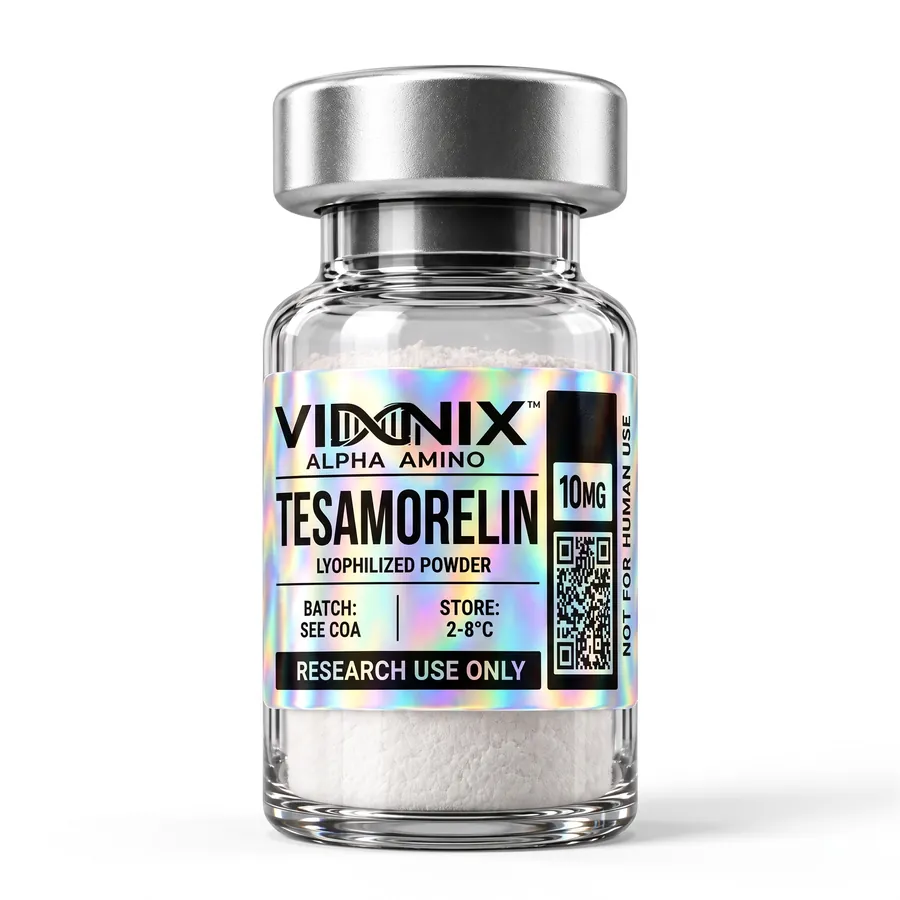
- Tesamorelin has 44 residues plus an N-terminal hexenoyl group and is described as a peptide, even though it is longer than many chains some textbooks would call polypeptides. See the tesamorelin profile.
- Fragments of proteins are called peptides even when the parent is a large protein. TB-500-type fragments and GHRH (1-29) analogues such as sermorelin are examples.
- Regulatory definitions sometimes set numeric thresholds for specific purposes. Those don't change general scientific usage.
In practice, "peptide or protein?" is rarely the useful question. "Which exact molecule?" is, and the sequence, modifications, formula and molecular weight answer it. Our guide to peptide sequences shows how those details are written.
Modifications in Peptides vs. Proteins
Both peptides and proteins can carry chemical modifications on top of the plain amino-acid chain. They usually acquire them by different routes.
Proteins made in cells pick up post-translational modifications from cellular enzymes after the chain is built: phosphorylation, glycosylation, disulfide bonds, cleavage of signal sequences [1]. Synthetic peptides get theirs by design, during or after chemical assembly. Examples include a C-terminal amide from the choice of resin, an N-terminal acetyl or acyl group, D-amino acids, Aib, or a lipid chain on a lysine side chain. One set of nomenclature rules covers residues, sequences and modifications for peptides and proteins alike [2], so the written structure of a modified peptide should list every change from the plain sequence.
Why the Distinction Matters for Analysis
In the lab the peptides vs. proteins distinction has teeth, because the two are characterized with partly different tools.
With a synthetic peptide, reversed-phase HPLC can separate the target from close relatives such as deletion sequences, and electrospray mass spectrometry can pin the intact mass to within a fraction of a dalton. Intact mass still helps with a protein. But analysts usually also digest it into peptides and map them, check folding and look for aggregation. The peptide testing overview and LC-MS explainer walk through the peptide workflow.
FAQFrequently asked questions
What is the difference between peptides and proteins?
Both are chains of amino acids joined by peptide bonds. Peptides are shorter, often under about 50 residues, and usually flexible in solution. Proteins are longer and fold into stable three-dimensional structures, sometimes with several subunits. Since naming also reflects history and context, there's no single official cut-off between the two.
How many amino acids make a protein instead of a peptide?
A common rule of thumb puts the boundary around 50 amino acids, but that's a convention, not a rule. Insulin, with 51 residues in two chains, gets called both a peptide and a protein. Tesamorelin, with 44 residues plus a modification, is consistently described as a peptide.
Is a protein a peptide?
Chemically, yes: a protein is a long polypeptide, built from the same peptide bonds as any peptide. In everyday scientific language, though, "peptide" usually means a short chain and "protein" a longer, folded molecule. You could defend calling a large folded enzyme a peptide, but almost nobody does.
Why are research peptides made synthetically but proteins usually are not?
Chemical synthesis adds one residue per cycle, and small losses at each step compound. That's fine for chains of a few dozen residues and impractical for proteins with hundreds. So proteins are usually expressed in engineered cells, while peptides come from solid-phase peptide synthesis, which has the bonus of allowing non-standard residues.
Do peptides and proteins have the same molecular structure levels?
Both have a primary structure, the sequence. Proteins usually add stable secondary, tertiary and sometimes quaternary structure on top. Short peptides may form helices or turns briefly, or when rings and disulfide bonds constrain them, but most don't hold one fixed three-dimensional fold in water the way a folded protein does.
REFScientific references
-
Alberts B, Johnson A, Lewis J, Raff M, Roberts K, Walter P. Molecular Biology of the Cell. 4th ed. New York: Garland Science; 2002. The Shape and Structure of Proteins. NCBI Bookshelf NBK26830. Source
textbook (NCBI Bookshelf) -
IUPAC-IUB Joint Commission on Biochemical Nomenclature (JCBN). Nomenclature and symbolism for amino acids and peptides. Recommendations 1983. Eur J Biochem. 1984;138(1):9-37. PubMed 6692818
nomenclature standard -
Muttenthaler M, King GF, Adams DJ, Alewood PF. Trends in peptide drug discovery. Nat Rev Drug Discov. 2021;20(4):309-325. PubMed 33536635
review -
Fosgerau K, Hoffmann T. Peptide therapeutics: current status and future directions. Drug Discov Today. 2015;20(1):122-128. PubMed 25450771
review
 Research Library: Peptide Fundamentals
 Research Library: Peptide Fundamentals
 Peptides