
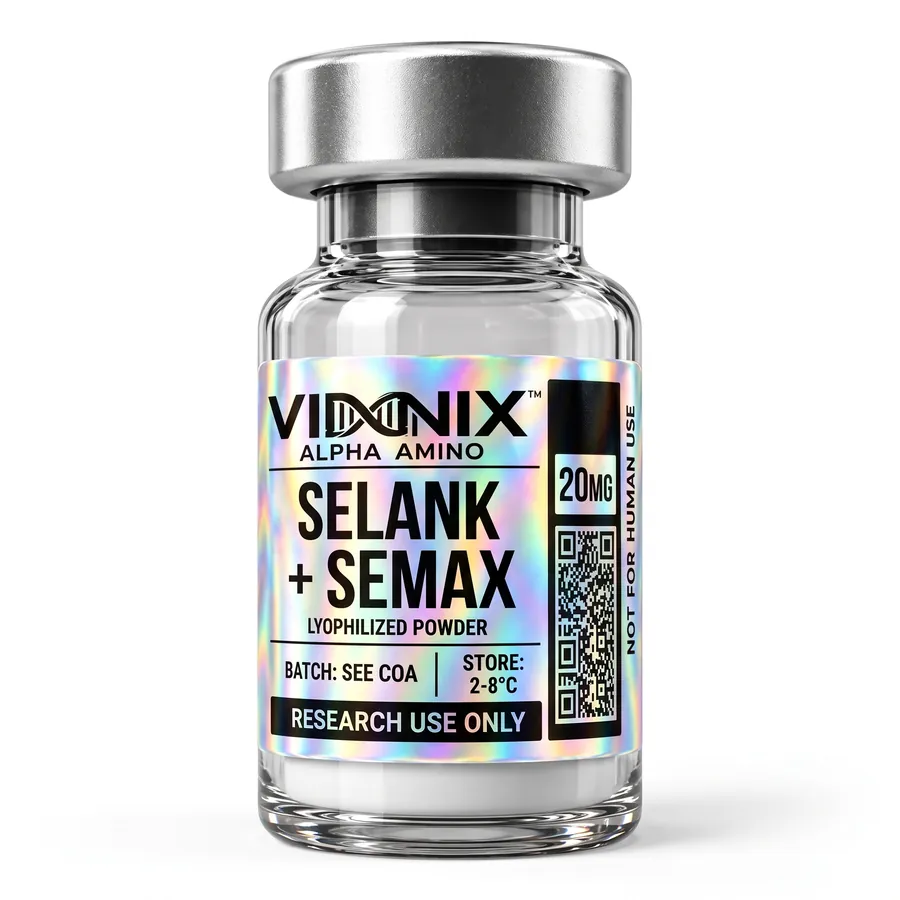
Key facts
- Product
- Selank + Semax, SKU XS20
- Total quantity
- 20 mg
- Selank
- TKPRPGP, C33H57N11O9, 751.9 g/mol (PubChem CID 11765600)
- Semax
- MEHFPGP, C37H51N9O10S, 813.9 g/mol (PubChem CID 9811102)
- Shared feature
- Both end in the tripeptide Pro-Gly-Pro
- Intended use
- Laboratory research use only
Batch reports are published in the COA Library as each batch is released. Match the batch number on your vial to its report.
Components: Selank, Semax. Amounts per vial are listed on the batch COA.
What is the Selank and Semax blend?
The Selank and Semax blend is a research product that puts two separate seven-residue peptides in one vial; Vinnix lists it as XS20. Most people arrive here after searching for one compound at a time, as selank, semax or semax peptide, not the combined name. So we cover each peptide fully before getting to the blend.
Both peptides came out of Russia, and both follow the same design idea: take a short, naturally occurring peptide fragment and extend its C-terminus with the tripeptide Pro-Gly-Pro. They are still different molecules, with different sequences, charges and masses. They're also mixed, not bonded, so the blend carries two sets of identity data.
Vinnix products are for laboratory research use only, not for human or veterinary use. Nothing on this page describes an effect of the product.
Blend composition and quantity of each compound
XS20 holds 20 mg in total across Selank and the Semax peptide. The amount of each will be on the batch record and the certificate of analysis. Don't assume an equal split; the total says nothing about the ratio, so check the per-component figures.
| Component | Sequence | Amount per vial | Identity reference |
|---|---|---|---|
| Selank | Thr-Lys-Pro-Arg-Pro-Gly-Pro | Listed on the batch COA when published | PubChem CID 11765600; CAS 129954-34-3 |
| Semax | Met-Glu-His-Phe-Pro-Gly-Pro | Listed on the batch COA when published | PubChem CID 9811102; CAS 80714-61-0 |
| Total | Two-component blend | 20 mg | SKU XS20 |
What is Selank?
Selank is a synthetic heptapeptide with the sequence Thr-Lys-Pro-Arg-Pro-Gly-Pro (TKPRPGP). It is tuftsin with Pro-Gly-Pro added to the C-terminus. Tuftsin itself is the natural tetrapeptide Thr-Lys-Pro-Arg, derived from the heavy chain of immunoglobulin G, and a review of tuftsin chemistry includes Selank among its synthetic analogues [1].
PubChem lists Selank under CID 11765600, with the formula C33H57N11O9 and a molecular weight of 751.9 g/mol. The CAS number is 129954-34-3 and the FDA GSRS UNII is TS9JR8EP1G; you may also see it called TP-7. Lysine and arginine give Selank a net positive charge at neutral pH. Published work includes animal studies of gene expression in mouse tissue [2]. The full compound profile is on the Selank page.
What is the Semax peptide?
The Semax peptide is a synthetic heptapeptide with the sequence Met-Glu-His-Phe-Pro-Gly-Pro (MEHFPGP). It links the ACTH(4-7) fragment of adrenocorticotropic hormone, Met-Glu-His-Phe, to the tripeptide Pro-Gly-Pro. The literature describes it as an analogue of ACTH(4-10) [3].
In PubChem, the Semax peptide is CID 9811102, formula C37H51N9O10S, molecular weight 813.9 g/mol. Its CAS number is 80714-61-0 and its FDA GSRS UNII is I5FAL2585H. That sulfur in the formula comes from the N-terminal methionine. Published work includes in vitro studies of how peptidases break Semax down [3] and animal studies of gene expression in rat brain tissue [4]. The full compound profile is on the Semax page.
Selank vs Semax
Selank and the Semax peptide have the same length and the same Pro-Gly-Pro ending. Beyond that, the parent peptide, composition and mass all differ, as the table shows.
| Selank | Semax | |
|---|---|---|
| Sequence | Thr-Lys-Pro-Arg-Pro-Gly-Pro | Met-Glu-His-Phe-Pro-Gly-Pro |
| One-letter code | TKPRPGP | MEHFPGP |
| Length | 7 residues | 7 residues |
| Parent peptide | Tuftsin (Thr-Lys-Pro-Arg) | ACTH(4-7) (Met-Glu-His-Phe) |
| Described as | Tuftsin analogue | ACTH(4-10) analogue |
| Molecular formula | C33H57N11O9 | C37H51N9O10S |
| Molecular weight | 751.9 g/mol | 813.9 g/mol |
| CAS number | 129954-34-3 | 80714-61-0 |
| PubChem CID | 11765600 | 9811102 |
| Charged residues | Lys, Arg (basic) | Glu (acidic), His |
With about 62 g/mol and a difference in charge between them, the two are easy to tell apart by mass spectrometry, and they generally separate on reversed-phase HPLC.
Why do Selank and Semax appear together in research?
They turn up together for a simple reason: both belong to the same family of Pro-Gly-Pro-extended regulatory peptides, and some laboratory studies have looked at them side by side. That is not the same as studying them as one combined product.
- An in vitro study compared how each peptide affected enkephalin-degrading enzymes in human serum samples [5].
- An animal study examined both peptides in a rat model of 6-OHDA-induced parkinsonism [6].
- Separate animal studies examined gene expression in rodent tissue for Selank [2] and for Semax [4].
We know of no peer-reviewed controlled study of a fixed Selank and Semax blend, and neither peptide is approved as a medicine in the United States. Findings from preclinical research should not be read as establishing safety or effectiveness in humans.
How is a Selank and Semax blend analyzed?
Two heptapeptides of similar size are a closer analytical pair than most blends, so the method has to work a little harder. The rule doesn't change, though: Selank and Semax each need an identity result and a quantity result of their own (identity vs. purity explains the difference). A single purity value for XS20 would describe neither. Peptide testing and analysis sets out the general approach.
- Chromatography. HPLC has to resolve the basic Selank from the more hydrophobic Semax, which carries phenylalanine and methionine, as two clean peaks.
- Mass check. Mass spectrometry assigns each peak by its molecular mass, 751.9 against 813.9 g/mol. An LC-MS run does the separation and the assignment together.
- Amounts. Each peptide is quantified against its own reference standard, which is how the COA can give a Selank figure and a Semax figure.
- Impurities. Related impurities are reported per peptide, since a tidy combined trace could still hide oxidized Semax or a Selank deletion product.
Two details are specific to this pair. First, the Semax peptide contains methionine, which can oxidize to methionine sulfoxide and add 16 mass units, so a careful report checks for that variant. Second, both peptides end in Pro-Gly-Pro. Fragment ions from that shared tail can't tell them apart on their own; the full molecular mass of each peak is what confirms identity.
Selank and Semax blend COA and batch documentation
Every batch of XS20, the Selank and Semax peptide blend, will come with its own certificate of analysis carrying the same batch number as the vial. Because the two peptides are close in mass and size, check that the report treats them as two separate entries. Reports will be listed in the Vinnix COA Library by product, SKU and batch once published. Each should include:
- Product name, SKU and a batch or lot number matching the vial
- A mass spectrometry identity result for Selank and another for Semax
- The amount of each peptide in the 20 mg fill
- An HPLC chromatogram with both peaks labeled
- Testing laboratory, test date and methods, including any check for oxidized Semax
The guide to how to read a peptide COA explains each field in turn, and what a certificate of analysis is covers what any COA can and can't establish.
FAQSelank + Semax FAQ
What is Selank?
Selank is a synthetic heptapeptide, Thr-Lys-Pro-Arg-Pro-Gly-Pro, made by extending the natural tetrapeptide tuftsin with Pro-Gly-Pro. PubChem lists it as C33H57N11O9 with a molecular weight of 751.9 g/mol (CID 11765600, CAS 129954-34-3). It's one of the two components in the Vinnix XS20 research blend.
What is Semax?
The Semax peptide is a synthetic heptapeptide, Met-Glu-His-Phe-Pro-Gly-Pro, that links the ACTH(4-7) fragment to the tripeptide Pro-Gly-Pro; it's usually described as an ACTH(4-10) analogue. PubChem lists it as C37H51N9O10S with a molecular weight of 813.9 g/mol (CID 9811102, CAS 80714-61-0). It's the other component of XS20.
What is the difference between Selank and Semax?
Both have seven residues and end in Pro-Gly-Pro, but their parent peptides differ. Selank extends tuftsin (Thr-Lys-Pro-Arg) and is basic. Semax extends ACTH(4-7) (Met-Glu-His-Phe) and carries an acidic glutamate and a sulfur-bearing methionine. Their molecular weights are 751.9 and 813.9 g/mol.
How much of each peptide is in XS20?
20 mg in total. The amounts of Selank and Semax will be listed separately on the batch record and certificate of analysis for each batch. Go by the per-component figures on the COA whose batch number matches your vial, and don't assume the total is split evenly.
Is there a COA for the blend?
There will be. Each batch of the Selank and Semax peptide blend (XS20) will be documented with a certificate of analysis, published in the Vinnix COA Library and linked from this page. A complete report should identify Selank and Semax separately by mass spectrometry, give the quantity of each, and include the HPLC chromatogram for that particular batch.
Why do Selank and Semax both end in Pro-Gly-Pro?
Both were designed the same way, by attaching the tripeptide Pro-Gly-Pro to the C-terminus of a short natural fragment: tuftsin for Selank, ACTH(4-7) for Semax. The shared tail is a structural signature of this peptide family. In vitro work has also looked at how peptidases degrade the Semax peptide.
Is the Selank and Semax blend for human use?
No. It's sold for laboratory research use only and isn't intended for human or veterinary use, and Vinnix gives no preparation or administration guidance. The studies cited here looked at each peptide separately in cell, tissue or animal models. None of them describes the blend itself.
REFScientific references
-
Siebert A, Gensicka-Kowalewska M, Cholewinski G, Dzierzbicka K. Tuftsin - Properties and Analogs. Curr Med Chem. 2017;24(34):3711-3727. PubMed 28745220
review -
Kolomin T, Shadrina M, Andreeva L, et al. Expression of inflammation-related genes in mouse spleen under tuftsin analog Selank. Regul Pept. 2011;170(1-3):18-23. PubMed 21609736
animal study -
Zolotarev YA, Dolotov OV, Inozemtseva LS, et al. Degradation of the ACTH(4-10) analog Semax in the presence of rat basal forebrain cell cultures and plasma membranes. Amino Acids. 2006;30(4):403-8. PubMed 16773243
in vitro study -
Medvedeva EV, Dmitrieva VG, Povarova OV, et al. The peptide semax affects the expression of genes related to the immune and vascular systems in rat brain focal ischemia: genome-wide transcriptional analysis. BMC Genomics. 2014;15:228. PubMed 24661604
animal study -
Kost NV, Sokolov OIu, Gabaeva MV, et al. [Semax and selank inhibit the enkephalin-degrading enzymes from human serum]. Bioorg Khim. 2001;27(3):180-3. PubMed 11443939
in vitro study -
Slominsky PA, Shadrina MI, Kolomin TA, et al. Peptides semax and selank affect the behavior of rats with 6-OHDA induced PD-like parkinsonism. Dokl Biol Sci. 2017;474(1):106-109. PubMed 28702721
animal study
 Compound Library
 Research Library
 Testing & Analysis
 Documentation