
Key facts
- Main lab method
- Solid-phase peptide synthesis (SPPS), Merrifield 1963
- Lab direction
- C-terminus to N-terminus
- Biological direction
- N-terminus to C-terminus (ribosome)
- Dominant chemistry
- Fmoc/tBu: base removes Fmoc, TFA cleaves
- Alternative chemistry
- Boc/Bzl: TFA removes Boc, HF cleaves
- After synthesis
- RP-HPLC purification, lyophilization, HPLC and MS testing
What Is Peptide Synthesis?
Peptide synthesis is any process that joins amino acids through peptide bonds in a planned order, so the finished chain has a defined sequence.
The hard part is control. Every amino acid has at least two reactive groups, an amino group and a carboxyl group, and some side chains bring more. Activate unprotected amino acids and mix them, and they couple in random order and polymerize. Each method that works, biological or chemical, gets around this the same way: it activates one carboxyl group at a time and leaves only one amino group free to react with it [4][5].
Biological Peptide Synthesis
Inside living cells, ribosomes make peptide and protein chains. They read messenger RNA and join the amino acids that transfer RNAs deliver, working in the N-to-C direction [6].
First, each amino acid is loaded onto its matching transfer RNA, which activates it. The ribosome then forms a peptide bond between the growing chain and the incoming amino acid, one codon at a time. Plenty of short biological peptides never exist at their final length straight off the ribosome; processing enzymes cut them out of larger precursor proteins. A few, glutathione among them, bypass the ribosome altogether and are built by dedicated enzymes. That is how glutathione ends up with its unusual gamma-glutamyl link (see glutathione for the structure).
Synthetic Peptide Production
Synthetic peptide production assembles a chosen sequence with controlled chemistry. At research scale, that nearly always means solid-phase synthesis.
The older solution-phase approach builds the chain in solution and purifies intermediates as it goes. It still earns its place for very short peptides and some large-scale manufacturing, but it is slow for longer sequences. Recombinant expression in bacteria or yeast suits long chains made only of standard residues. Solid-phase peptide synthesis fills the middle ground. It routinely handles chains from a few residues up to about 50, accepts non-standard building blocks such as D-amino acids and Aib, and can be automated [3]. For much longer targets, chemists join separately synthesized segments.
| Approach | Best suited to | Limitations |
|---|---|---|
| Solid-phase synthesis (SPPS) | Defined sequences up to about 50 residues; non-standard residues | Yield falls with length; aggregation-prone sequences |
| Solution-phase synthesis | Very short peptides; some large-scale processes | Intermediate purification at each step |
| Recombinant expression | Long chains of standard amino acids | Non-standard residues and terminal modifications are harder |
| Fragment ligation | Long or protein-sized chains | Requires specific junction chemistry |
Solid-Phase Peptide Synthesis
In solid-phase peptide synthesis, the chain's C-terminal residue is anchored to an insoluble resin. After each step, excess reagents and by-products just wash away.
R. Bruce Merrifield reported the method in 1963, making a tetrapeptide on a polystyrene resin [1]. Filtering instead of purifying after every reaction sounds like a small change. It made long syntheses practical, opened the door to automation, and earned Merrifield the 1984 Nobel Prize in Chemistry. One detail to keep in mind: the chain grows from the C-terminus toward the N-terminus, opposite to the ribosome.
The repeating cycle
- Anchor. The first (C-terminal) amino acid is attached to the resin through a linker. The linker chosen sets the C-terminus: Wang-type linkers give a free acid, Rink amide-type linkers give a C-terminal amide (-NH2).
- Deprotect. The temporary protecting group on the alpha-amino group is removed to expose one free amine.
- Wash. Reagents and by-products are washed off the resin.
- Couple. The next amino acid, with its own amino group protected, is activated and forms a peptide bond with the free amine.
- Wash and check. Excess reagent is washed away. Colorimetric tests for free amines can show whether coupling went to completion; incomplete couplings may be repeated or capped.
- Repeat until the full sequence is assembled, then cleave.
Fmoc vs Boc chemistry
Two protecting-group strategies dominate SPPS. They differ in what removes the temporary group and in what cleaves the finished peptide [4][5].
| Feature | Fmoc/tBu | Boc/Bzl |
|---|---|---|
| Temporary alpha-amino group | Fmoc (9-fluorenylmethoxycarbonyl) | Boc (tert-butyloxycarbonyl) |
| Removed by | Mild base, typically piperidine in DMF | Moderate acid, trifluoroacetic acid (TFA) |
| Side-chain protection | Acid-labile groups such as tBu, Trt, Boc, Pbf | Benzyl-type groups stable to TFA |
| Final cleavage | TFA with scavengers | Strong acid, usually anhydrous HF |
| Current use | Most common for research peptides | Still used for some difficult sequences |
Carpino and Han introduced the Fmoc group in 1972 [2]. What makes it attractive is orthogonality. Base takes off the Fmoc group at every cycle, the acid-labile side-chain groups stay put, and only the final acid step removes them. That sidesteps the hazardous HF step of classic Boc chemistry, a big part of why Fmoc became the default [5].
Protecting groups
Side chains with reactive groups need protection that lasts through every cycle and still comes off cleanly at the end. In Fmoc chemistry the usual choices are tBu ethers and esters for serine, threonine, tyrosine, aspartic and glutamic acids; Boc for lysine and tryptophan; trityl (Trt) for cysteine, histidine, asparagine and glutamine; and Pbf for arginine. Cysteine-rich peptides sometimes get special groups so the disulfide bonds can be formed in a chosen pattern after synthesis [4].
Coupling reagents
A coupling reagent activates the incoming amino acid's carboxyl group so it reacts quickly and cleanly with the free amine on the resin. Common classes are carbodiimides such as DIC, paired with additives like HOBt or OxymaPure, and onium salts such as HBTU and HATU [3]. Good conditions also hold down racemization, where an L-amino acid flips to its D form and leaves an impurity that is hard to separate.
Cleavage
Once assembly is done, a single strong-acid step frees the peptide from the resin and strips the side-chain protecting groups. In Fmoc chemistry that step uses a TFA mixture with scavengers, such as water and trialkylsilanes, to trap reactive carbocations before they latch onto tryptophan, methionine, cysteine or tyrosine. The crude peptide is then usually precipitated with cold ether and collected.
What Goes Wrong in SPPS?
Most impurities in synthetic peptides trace back to small inefficiencies repeated at every cycle.
The arithmetic is unforgiving. If each coupling reaches 99% completion, a 20-residue peptide still has an expected crude yield of only about 0.9919, roughly 83%, of full-length chains before any other losses. The remainder includes deletion sequences missing one residue, truncated chains, incompletely deprotected forms, oxidized methionine, aspartimide-derived by-products and racemized species. Some sequences also aggregate on the resin and couple poorly, a problem reviews of Fmoc SPPS cover in detail [5]. Purification and analytical testing exist largely to deal with these close relatives of the target.
Purification and Characterization
After cleavage, the crude peptide is purified, usually by preparative reversed-phase HPLC. It is then freeze-dried and characterized by analytical HPLC and mass spectrometry.
Purification
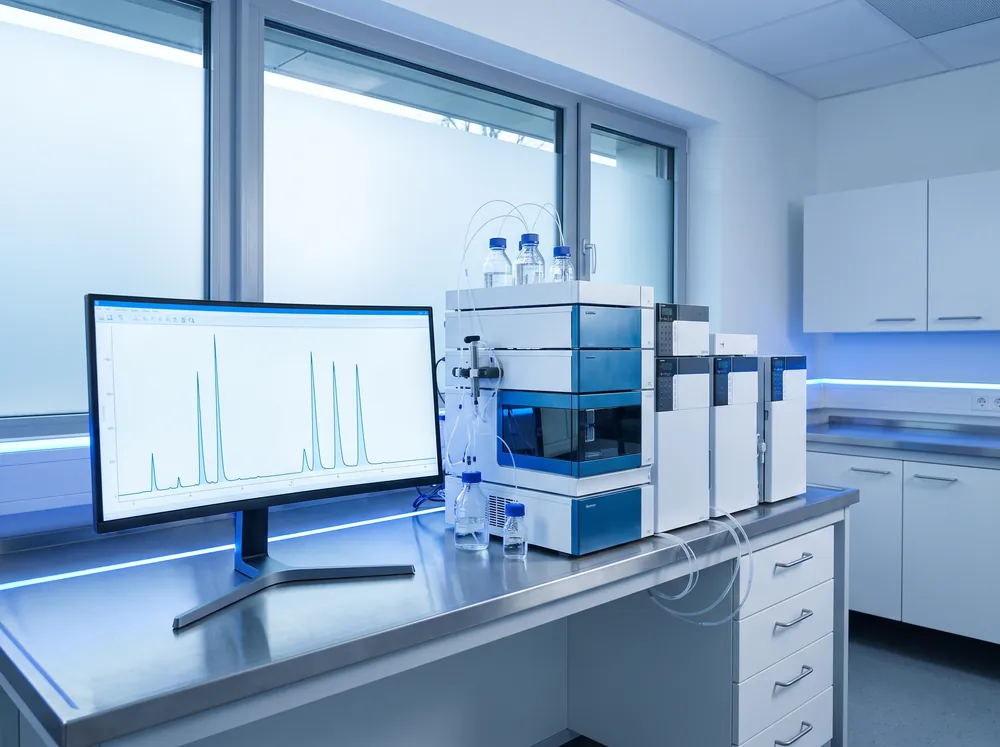
Preparative reversed-phase HPLC separates the target from related impurities by hydrophobicity, typically using a water and acetonitrile gradient that contains TFA [7]. Each fraction is checked, and the ones that meet the purity target are pooled.
Lyophilization
The pooled fractions are then freeze-dried (lyophilized). The solution is frozen and the water leaves under vacuum by sublimation, leaving a dry, fluffy powder. TFA is present through cleavage and purification, so synthetic peptides often come out as TFA salts unless someone runs a counter-ion exchange. Counter-ions and leftover water add to the powder's weight, which is why purity and net peptide content are different measurements.
Analytical characterization
- Analytical RP-HPLC reports purity as the main peak's percentage of total peak area at a stated wavelength [7]. See HPLC testing.
- Mass spectrometry, usually electrospray, confirms that the measured mass matches the sequence's expected mass [8]. See mass spectrometry.
- Supporting tests can include amino-acid analysis, water content and counter-ion content.
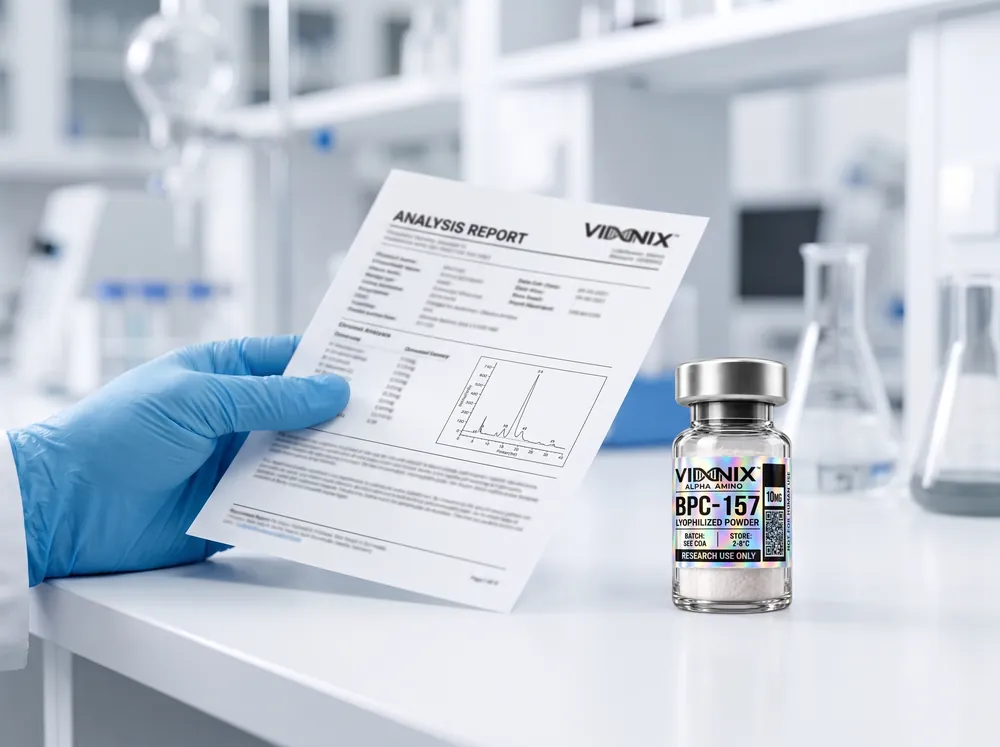
Each result is tied to a batch number and reported on a certificate of analysis, so the paperwork describes one specific lot rather than the compound in general. For how these results fit together, see the peptide testing overview.
FAQFrequently asked questions
How are peptides made?
Two ways: biologically or chemically. Cells build peptides on ribosomes from messenger RNA instructions, or with dedicated enzymes. Laboratories mostly use solid-phase peptide synthesis. Protected amino acids are added one at a time to a chain anchored on resin; the product is then cleaved, purified by HPLC, freeze-dried and tested by HPLC and mass spectrometry.
What is solid-phase peptide synthesis?
Solid-phase peptide synthesis (SPPS) is a method R. Bruce Merrifield introduced in 1963, in which the growing peptide chain is anchored to insoluble resin beads. Each cycle removes a temporary protecting group, couples the next protected amino acid and washes away the excess reagents. At the end, acid cleaves the finished chain from the resin.
What is the difference between Fmoc and Boc synthesis?
The difference is the temporary protecting group on the amino group. Fmoc comes off with a mild base such as piperidine, and the final cleavage uses TFA. Boc comes off with TFA at every cycle, so the final cleavage needs a stronger acid, usually HF. For research peptides, Fmoc chemistry is now the usual choice.
Why are synthetic peptides purified by HPLC?
Because no synthesis cycle is quite 100% efficient. Crude material ends up with deletion sequences, truncated chains and other close relatives of the target. Reversed-phase HPLC separates molecules by hydrophobicity finely enough to resolve many of them, and run in analytical mode, the same technique reports the purity of the final batch.
Why are peptides supplied as a lyophilized powder?
After purification, the peptide sits in a water and acetonitrile solution. Lyophilization, or freeze-drying, pulls off the solvent under vacuum and leaves a dry powder that's easier to handle, weigh and store than a liquid. That powder can still hold counter-ions such as TFA and some residual water, so net peptide content can differ from HPLC purity.
In which direction are peptides synthesized?
It depends on the method. Ribosomes build chains from the N-terminus to the C-terminus. Solid-phase peptide synthesis normally goes the other way, starting from the C-terminus attached to the resin and working toward the N-terminus. Either way, sequences are still written N to C.
REFScientific references
-
Merrifield RB. Solid phase peptide synthesis. I. The synthesis of a tetrapeptide. J Am Chem Soc. 1963;85(14):2149-2154. doi:10.1021/ja00897a025 (not indexed in PubMed; verified via Crossref).
original chemistry method paper -
Carpino LA, Han GY. 9-Fluorenylmethoxycarbonyl amino-protecting group. J Org Chem. 1972;37(22):3404-3409. doi:10.1021/jo00795a005 (not indexed in PubMed; verified via Crossref).
original chemistry method paper -
El-Faham A, Albericio F. Peptide coupling reagents, more than a letter soup. Chem Rev. 2011;111(11):6557-6602. PubMed 21866984
review -
Isidro-Llobet A, Alvarez M, Albericio F. Amino acid-protecting groups. Chem Rev. 2009;109(6):2455-2504. PubMed 19364121
review -
Behrendt R, White P, Offer J. Advances in Fmoc solid-phase peptide synthesis. J Pept Sci. 2016;22(1):4-27. PubMed 26785684
review -
Alberts B, Johnson A, Lewis J, Raff M, Roberts K, Walter P. Molecular Biology of the Cell. 4th ed. New York: Garland Science; 2002. From RNA to Protein. NCBI Bookshelf NBK26829. Source
textbook (NCBI Bookshelf) -
Mant CT, Chen Y, Yan Z, et al. HPLC analysis and purification of peptides. Methods Mol Biol. 2007;386:3-55. PubMed 18604941
methods review -
Fenn JB, Mann M, Meng CK, Wong SF, Whitehouse CM. Electrospray ionization for mass spectrometry of large biomolecules. Science. 1989;246(4926):64-71. PubMed 2675315
analytical methods paper
 Research Library: Peptide Fundamentals
 Research Library
 Documentation