
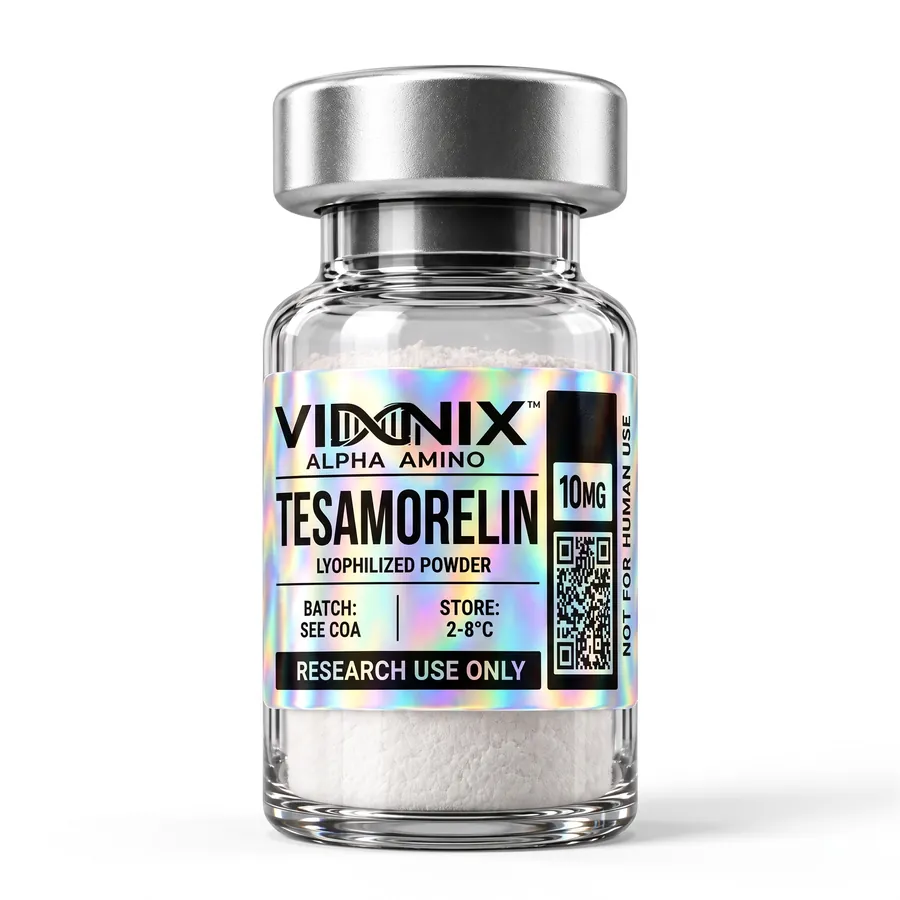
Key facts
- Sequence
- (3E)-hex-3-enoyl-YADAIFTNSYRKVLGQLSARKLLQDIMSRQQGESNQERGARARL-NH2
- Amino acids
- 44
- Molecular formula
- C221H366N72O67S
- Molecular weight
- 5136 g/mol (PubChem CID 16137828)
- CAS number
- 218949-48-5
- Development code
- TH9507
- Vinnix SKU
- TSM10 (10 mg)
Batch reports are published in the COA Library as each batch is released. Match the batch number on your vial to its report.
What Is Tesamorelin?
The tesamorelin peptide is a synthetic analogue of human growth hormone-releasing hormone (GHRH), which is a 44-amino-acid peptide hormone. It keeps the whole natural 1 to 44 sequence and makes one chemical change: a trans-3-hexenoyl group on the N-terminal tyrosine. Its development code was TH9507.
That one modification is the only thing separating this analogue from the native hormone. According to the literature, the N-terminal group makes the tesamorelin peptide harder for enzymes to cleave at that end of the chain [5]. In every other respect (length, residue order, C-terminal amide) the peptide matches human GHRH(1-44).
It is also the active ingredient of a prescription medicine approved in the United States in 2010 [5]. The approval covers that drug product and nothing else. Vinnix sells the compound as a laboratory material, and this page sticks to the compound's identity, literature and documentation, with no claims about use or effect.
Tesamorelin Product Specifications
Vinnix offers the tesamorelin peptide in a single strength, 10 mg per vial (SKU TSM10). Lot number, physical form, salt form and the storage statement will be published with each batch record. General handling background is in peptide storage.
| Field | Value |
|---|---|
| Compound | Tesamorelin (TH9507) |
| Classification | Synthetic peptide; N-terminally modified GHRH(1-44) amide |
| Sequence | (3E)-hex-3-enoyl-YADAIFTNSYRKVLGQLSARKLLQDIMSRQQGESNQERGARARL-NH2 |
| Molecular formula | C221H366N72O67S |
| Molecular weight | 5136 g/mol (PubChem CID 16137828) |
| CAS number | 218949-48-5 |
| Product quantity | 10 mg per vial |
| SKU | TSM10 |
| Form | Shown on the batch COA when published |
| Batch / lot | Shown on the batch COA when published |
| Storage | Shown on the batch COA when published |
| COA | Linked per batch from the Vinnix COA Library as each report is released |
Tesamorelin Identity
Three structural features identify this compound, and you need all of them: the full 44-residue GHRH sequence, the (3E)-hex-3-enoyl group on tyrosine 1, and the amidated C-terminal leucine. Lose any one and you have a different substance.
In the FDA Global Substance Registration System, the tesamorelin peptide (UNII MQG94M5EEO) is recorded as a protein-class substance with exactly those two modifications, and the acetate salt has its own entry (UNII LGW5H38VE3). The salt form changes the formula weight of what's in the vial, so a certificate ought to say which form was tested.
How the tesamorelin peptide relates to other GHRH peptides
| Peptide | GHRH residues | Key modification |
|---|---|---|
| Human GHRH | 1 to 44 | Natural hormone, C-terminal amide |
| Sermorelin | 1 to 29 | Shortened fragment, C-terminal amide |
| CJC-1295 | 1 to 29 | Amino acid substitutions; some versions carry a DAC linker |
| Tesamorelin | 1 to 44 | N-terminal trans-3-hexenoyl group, C-terminal amide |
A different pair of compounds from the same broad research area is covered on the Vinnix CJC-1295 + Ipamorelin page. Any comparison here is structural only.
Tesamorelin Sequence & Molecular Information
In one-letter code, the sequence reads YADAIFTNSYRKVLGQLSARKLLQDIMSRQQGESNQERGARARL, with a (3E)-hex-3-enoyl group on the N-terminal Y and an amide on the C-terminal L. GSRS records the sequence and both modifications.
Switch to three-letter code and the chain opens Tyr-Ala-Asp-Ala-Ile-Phe-Thr-Asn-Ser-Tyr and closes Gln-Glu-Arg-Gly-Ala-Arg-Ala-Arg-Leu-NH2. A few residues matter for analysis. The lone methionine at position 27 can oxidize, and the asparagine and glutamine residues can deamidate; each of these gives a closely related variant that HPLC can separate. Peptide Sequences explains how residue numbering works.
What is the molecular weight of tesamorelin?
PubChem (CID 16137828) gives an average molecular weight of 5136 g/mol for C221H366N72O67S and a monoisotopic mass of 5132.717 Da. With a molecule this big, the average mass is the more useful number, since the isotope pattern spreads across many peaks. Molecular weight vs. molecular mass explains the difference.
| Identifier | Value | Source |
|---|---|---|
| Molecular formula | C221H366N72O67S | PubChem CID 16137828 |
| Average molecular weight | 5136 g/mol | PubChem |
| Monoisotopic mass | 5132.717 Da | PubChem |
| CAS number | 218949-48-5 | PubChem synonyms |
| UNII | MQG94M5EEO (acetate: LGW5H38VE3) | FDA GSRS |
Tesamorelin Research Literature
Most research peptides have little or no human data. The tesamorelin peptide is different: it went through randomized controlled trials during drug development, so there is a sizeable clinical literature. Those trials studied a defined patient population under medical supervision, and they say nothing about research materials or other settings.
- Phase 3 randomized trial (human clinical): a 2007 multicenter, double-blind, placebo-controlled trial in adults with HIV and abdominal adiposity, with CT imaging of visceral adipose tissue as the primary endpoint [1].
- Pooled phase 3 analysis (human clinical): a 2010 report that combined two phase 3 trials to look at efficacy and safety endpoints in a larger group [2].
- Randomized trial in liver research (human clinical): a 2019 multicenter, double-blind trial in adults with HIV and non-alcoholic fatty liver disease that measured hepatic lipid content by imaging [3].
- Reviews: drug reviews covering the development program, pharmacology and regulatory history [4][5].
| Year | Study type | Population / focus | Ref. |
|---|---|---|---|
| 2007 | Phase 3 RCT | Adults with HIV; visceral adipose tissue by CT | [1] |
| 2010 | Pooled analysis of two phase 3 trials | Combined efficacy and safety data | [2] |
| 2012 | Review | Pharmacology and development | [4] |
| 2011 | Review | Clinical program and regulatory history | [5] |
| 2019 | Randomized controlled trial | Adults with HIV and NAFLD; hepatic lipid imaging | [3] |
Clinical trial results belong to the approved drug product, in the population studied, under trial conditions. They are not evidence about any research material. Preclinical findings, likewise, do not establish safety or effectiveness in humans.
How Is Tesamorelin Analyzed?
As with smaller peptides, the tesamorelin peptide is characterized by reversed-phase HPLC for purity and mass spectrometry for identity. Its size, though, changes what the data look like.
On HPLC, the main peak is judged against variants that elute close by: the methionine-oxidized form, deamidated forms and deletion sequences left over from synthesis. The hydrophobic hexenoyl group also shifts retention relative to unmodified GHRH, which makes the two easier to tell apart.
In electrospray mass spectrometry, a peptide of about 5.1 kDa doesn't give one peak. It gives a series of multiply charged ions, as what is a mass spectrum illustrates. Working from the PubChem average mass, [M+4H]4+ lands near m/z 1285, [M+5H]5+ near 1028 and [M+6H]6+ near 857. Deconvolution software folds these into one molecular mass, which is then compared with 5136 g/mol.
Tesamorelin Analytical Documentation and COA
Each Vinnix TSM10 batch of the tesamorelin peptide will be documented with its own certificate of analysis, and the HPLC chromatogram, mass spectrum and batch details will be published in the COA Library. Each report is expected to cover:
- Lot number, quantity per vial and test date
- HPLC purity and the related-peak profile
- Deconvoluted molecular mass against the expected value
- Salt form, where stated, and the methods used
For help reading each field, see Certificate of Analysis and Peptide Testing. How peptides of this size get classified is covered in What Are Peptides?.
Vinnix products are for laboratory and analytical research only. They are not drugs, supplements or personal-care products, they are not for human or veterinary use, and nothing on this page describes or implies any use in people or animals.
FAQTesamorelin FAQ
What is tesamorelin?
Tesamorelin is a synthetic peptide made of the full 44-amino-acid sequence of human growth hormone-releasing hormone, with a trans-3-hexenoyl group on the N-terminal tyrosine and a C-terminal amide. Developed as TH9507, it is the active ingredient of a medicine approved in the United States in 2010. Vinnix sells the tesamorelin peptide as a laboratory research material.
Is tesamorelin a peptide?
Yes. With 44 residues the tesamorelin peptide sits at the large end of the peptide range, and GSRS classifies it as a protein-type substance. The backbone is a single chain of amino acids joined by peptide bonds, with a modification at each end: a hexenoyl group at the N-terminus and an amide at the C-terminus.
What is the tesamorelin sequence?
In one-letter code it is YADAIFTNSYRKVLGQLSARKLLQDIMSRQQGESNQERGARARL, with a (3E)-hex-3-enoyl group on the first tyrosine and an amide on the last leucine. Apart from that N-terminal modification, it is identical to human GHRH(1-44), and the FDA Global Substance Registration System records it in exactly this form.
What molecular information identifies tesamorelin?
Look for molecular formula C221H366N72O67S, average molecular weight 5136 g/mol, monoisotopic mass 5132.717 Da, CAS number 218949-48-5, PubChem CID 16137828 and FDA UNII MQG94M5EEO. The acetate salt has its own UNII, LGW5H38VE3, which is why documentation should state the salt form.
How is tesamorelin studied?
Through laboratory and animal work and, which is unusual for a research peptide, randomized human clinical trials (phase 3 included) run to support its approved drug product. Those results apply only to that product and that population. And preclinical findings, on their own, do not establish safety or effectiveness in humans.
How can tesamorelin be analytically characterized?
Reversed-phase HPLC separates the intact tesamorelin peptide from oxidized, deamidated and truncated variants. Electrospray mass spectrometry shows it as several charge states, for example near m/z 1285, 1028 and 857. Deconvolute those ions and you get a single molecular mass to compare with 5136 g/mol.
What is the difference between tesamorelin and sermorelin?
Sermorelin is GHRH residues 1 to 29 with a C-terminal amide, a shortened fragment. Tesamorelin keeps all 44 residues of GHRH and adds a trans-3-hexenoyl group at the N-terminus. Length, formula and molecular weight all differ, and they are separate substances with separate identifiers.
Where can I find the Vinnix tesamorelin COA?
Batch documents for the Vinnix 10 mg vial (SKU TSM10) will be linked from this page and listed by batch number in the Vinnix COA Library once published. Check that the lot number on your vial matches the lot on the report. No COA link appears for a batch until its record has been published.
REFScientific references
-
Falutz J, Allas S, Blot K, et al. Metabolic effects of a growth hormone-releasing factor in patients with HIV. N Engl J Med. 2007;357(23):2359-2370. PubMed 18057338
human clinical, phase 3 RCT -
Falutz J, Mamputu JC, Potvin D, et al. Effects of tesamorelin (TH9507), a growth hormone-releasing factor analog, in human immunodeficiency virus-infected patients with excess abdominal fat: a pooled analysis of two multicenter, double-blind placebo-controlled phase 3 trials with safety extension data. J Clin Endocrinol Metab. 2010;95(9):4291-4304. PubMed 20554713
human clinical, pooled phase 3 analysis -
Stanley TL, Fourman LT, Feldpausch MN, et al. Effects of tesamorelin on non-alcoholic fatty liver disease in HIV: a randomised, double-blind, multicentre trial. Lancet HIV. 2019;6(12):e821-e830. PubMed 31611038
human clinical, randomized controlled trial -
Spooner LM, Olin JL. Tesamorelin: a growth hormone-releasing factor analogue for HIV-associated lipodystrophy. Ann Pharmacother. 2012;46(2):240-247. PubMed 22298602
review -
Dhillon S. Tesamorelin: a review of its use in the management of HIV-associated lipodystrophy. Drugs. 2011;71(8):1071-1091. PubMed 21668043
review
 Research Blend
 Compound Library
 Peptides
 Testing & Analysis