
Key facts
- Registry definition
- Ac-LKKTETQ, N-acetylated thymosin beta-4 fragment 17-23 (FDA GSRS)
- Molecular formula (fragment)
- C38H68N10O14 (PubChem CID 62707662)
- Molecular weight (fragment)
- 889.0 g/mol (PubChem)
- CAS number (fragment)
- 885340-08-9 (FDA GSRS, UNII QHK6Z47GTG)
- Parent protein
- Thymosin beta-4, 43 residues, C212H350N56O78S, 4963 g/mol (PubChem CID 45382195)
- Vinnix availability
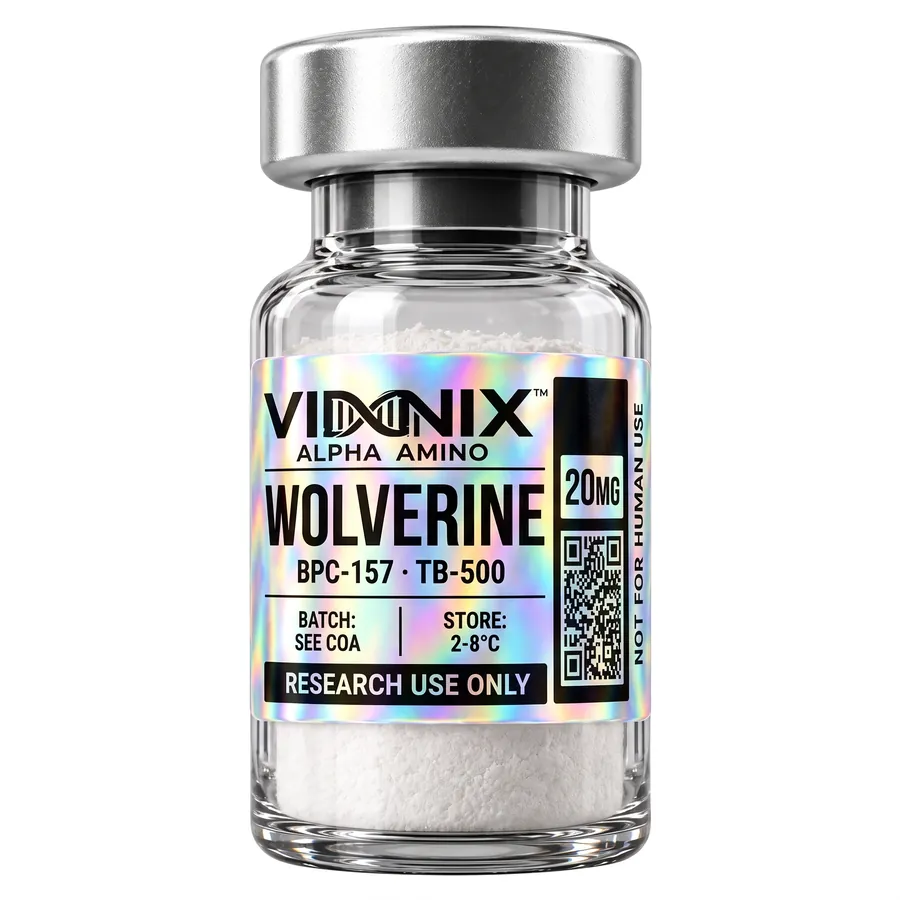
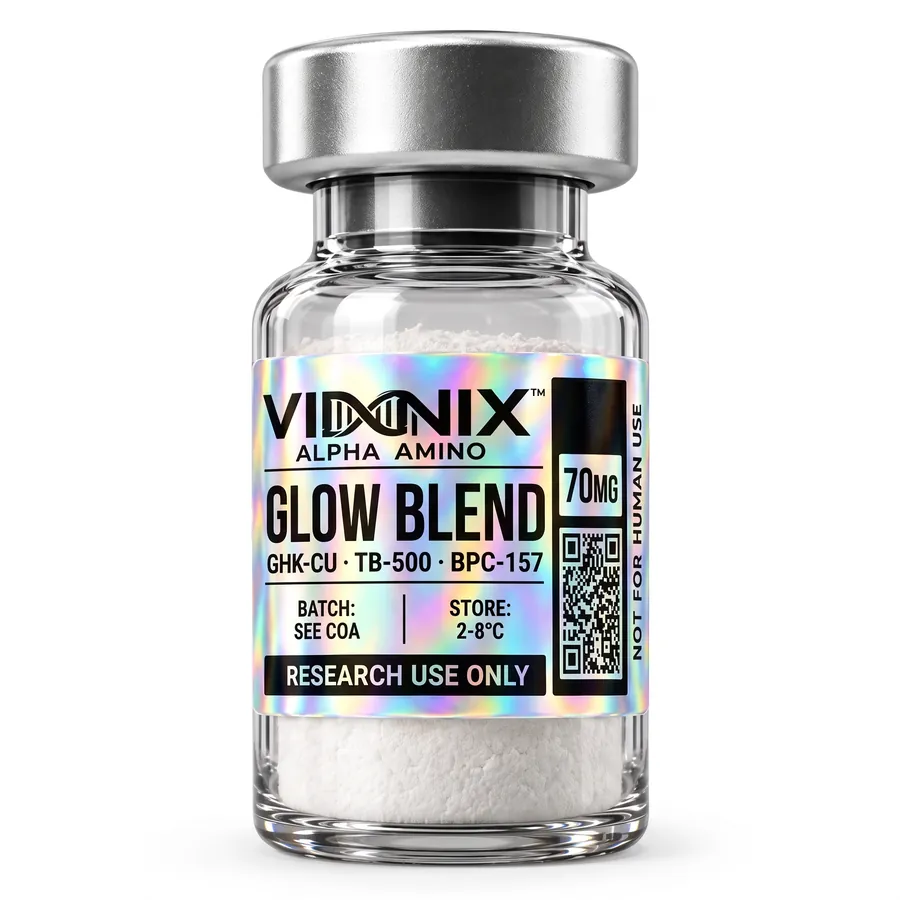
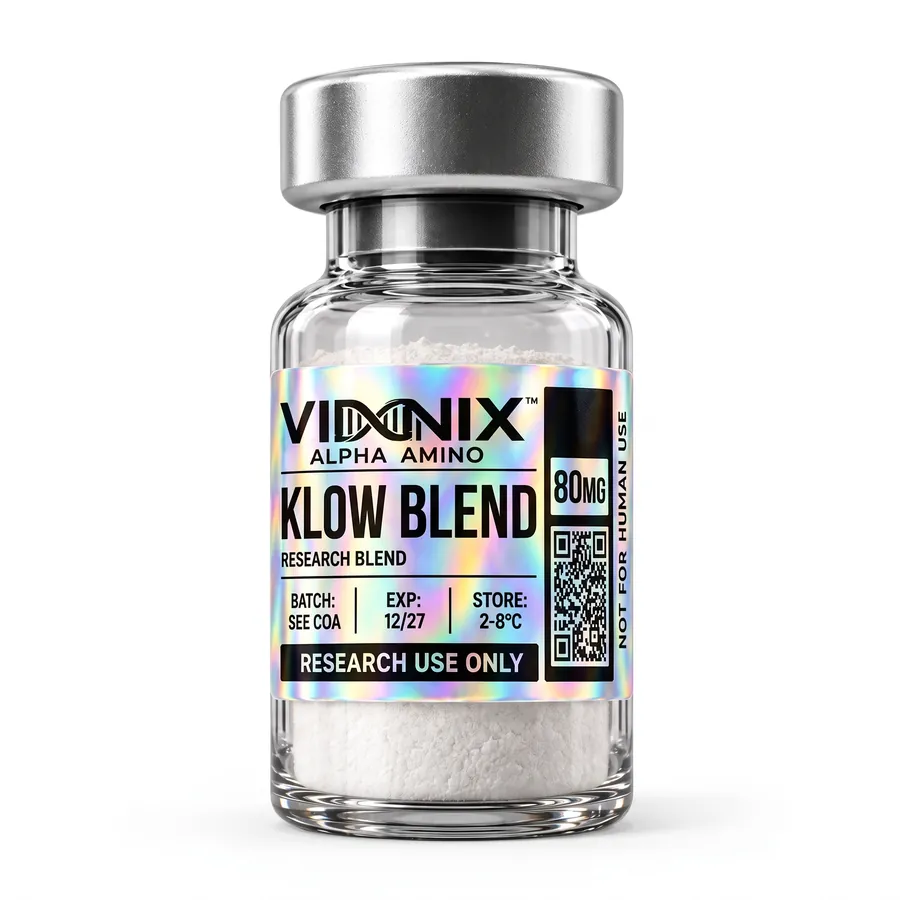
- Component of Wolverine and GLOW blends; commonly associated with KLOW (see KLOW80 batch COA when published); no standalone SKU
What Is TB-500?
This is a catalog and trade name, not a chemical one. It refers to a synthetic peptide related to thymosin beta-4 (often written Tβ4), a small, acidic protein found inside most animal cells. Researchers have studied Tβ4 for decades as a regulator of actin, the protein that forms the cell's internal scaffolding [2][3].
The trouble is that people don't use the name consistently. FDA's Global Substance Registration System (GSRS) records the substance under that name as a seven-residue fragment, N-acetyl-Leu-Lys-Lys-Thr-Glu-Thr-Gln, matching residues 17 to 23 of thymosin beta-4. When analytical chemists examined a commercial product carrying that label, the same acetylated fragment is what they found [6][7]. Other sellers put the same label on the full 43-residue protein. Those are very different molecules: roughly 0.9 kDa against 5 kDa.
Vinnix doesn't sell this peptide as a standalone vial. You'll find it as a component of the Wolverine Blend (with BPC-157) and the GLOW Blend. It is also commonly associated with the KLOW blend, whose exact composition will be listed on the KLOW80 batch COA when published. This page is a reference entry that explains the compound itself.
TB-500 and Thymosin Beta-4
The two names overlap without being interchangeable. Thymosin beta-4 is the 43-residue parent protein; the registry definition of the catalog name is a short acetylated piece of it.
Thymosin beta-4 was sequenced from bovine thymus tissue in 1981 [1]. Later work showed it to be the main peptide in many cells that binds and holds unpolymerized (G-) actin, a job usually called actin sequestering [2]. GSRS records human thymosin beta-4 as the 43-residue sequence below, with an acetylated N-terminal serine:
SDKPDMAEIEKFDKSKLKKTETQEKNPLPSKETIEQEKQAGES
Residues 17 to 23 of that chain read LKKTETQ. Laboratory studies pinned this stretch down as the protein's central actin-binding motif [4], and later reviews describe short sequences within thymosin beta-4 being studied apart from the whole molecule [5]. That's where the naming mess began. Someone synthesized the fragment, acetylated it and sold it as TB-500, while the same name stayed attached to full-length material too.
| Property | Thymosin beta-4 | TB-500 (Ac-LKKTETQ, GSRS) |
|---|---|---|
| Length | 43 residues | 7 residues |
| N-terminus | Acetylated serine | Acetylated leucine |
| Molecular formula | C212H350N56O78S | C38H68N10O14 |
| Molecular weight | 4963 g/mol | 889.0 g/mol |
| PubChem CID | 45382195 | 62707662 |
| GSRS UNII | 549LM7U24W (thymosin beta-4); 2D5MRE3SSY (INN timbetasin) | QHK6Z47GTG |
| CAS (GSRS) | 77591-33-4 (timbetasin record) | 885340-08-9 |
GSRS also lists timbetasin, which is the INN for synthetic thymosin beta-4. The fragment is a peptide in every sense. Its 43-residue parent sits near the size where some textbooks switch to calling things proteins (see peptides vs. proteins).
TB-500 Product Specifications
There is no standalone Vinnix SKU for this peptide. Its specifications appear here as compound data, alongside the blend products that contain it.
| Field | Value |
|---|---|
| Compound | TB-500 |
| Classification | Synthetic peptide related to thymosin beta-4 |
| Sequence (registry definition) | Ac-Leu-Lys-Lys-Thr-Glu-Thr-Gln (Ac-LKKTETQ) |
| Molecular formula | C38H68N10O14 (PubChem CID 62707662) |
| Molecular weight | 889.0 g/mol (PubChem) |
| CAS number | 885340-08-9 (FDA GSRS) |
| Product quantity | Not sold separately; amount per blend vial listed on each blend's batch COA when published |
| SKU | None standalone; component of BB20 (Wolverine) and BBG70 (GLOW); commonly associated with KLOW80 (composition on its batch COA) |
| Form used in Vinnix blends | Fragment or full-length thymosin beta-4, stated on the batch COA when published |
| Batch / lot | Shown on each blend's batch COA when published |
Since the name covers two different molecules, no specification is complete until it states the sequence. For its blends, Vinnix will publish the confirmed form once the product record and the batch mass spectrometry data are in.
TB-500 and Scientific Terminology
You will rarely find "TB-500" in a scientific paper. Authors write thymosin beta-4 or Tβ4, or name a specific fragment by its residue numbers.
- Thymosin beta-4 / Tβ4 / TMSB4X: the 43-residue protein and the name of its human gene.
- Timbetasin: the INN for synthetic thymosin beta-4 (GSRS).
- Tβ4 (17-23), LKKTETQ, Ac-LKKTETQ: the actin-binding fragment and its acetylated form, which is how the registry defines the catalog name.
- TB-500, TB 500, TB500: catalog names that can mean either the fragment or the full protein.
- Ac-SDKP: a different tetrapeptide, taken from the N-terminus of thymosin beta-4. People sometimes mix it up with the LKKTETQ fragment, but it is not the same.
Whenever you read a study, check what was actually used: the full protein, a fragment, or a modified analogue. A result from one tells you nothing certain about the others. The peptide sequences guide covers the notation.
TB-500 Research
Most of the research that bears on this peptide is about thymosin beta-4 and its fragments in laboratory and animal models, plus a handful of analytical studies of the catalog material itself. When we searched PubMed for this page, we found no published clinical trials of the Ac-LKKTETQ fragment.
How is TB-500 studied?
- Protein chemistry (in vitro): the sequencing of thymosin beta-4 [1] and biochemical work showing that it binds and sequesters G-actin [2].
- Fragment studies (in vitro and ex vivo): mapping of the seven-residue actin-binding motif, compared against the full protein in endothelial cell migration and aortic-ring vessel sprouting assays [4]. Reviews summarize the activities attributed to short sequences inside thymosin beta-4 [5].
- Analytical and anti-doping chemistry: synthesis and characterization of the acetylated 17-23 fragment found in a commercial product [6], and an LC-MS method that detects it and its metabolites in equine urine and plasma [7].
- Reviews: overviews of the beta-thymosin family and what it does in cells [3].
Preclinical findings (see in vitro vs. in vivo research) do not establish safety or effectiveness in humans. Nor should a result obtained with full-length thymosin beta-4 be assumed to hold for a seven-residue fragment, or the other way round.
TB-500 Analysis
Analysis has to start with identity, because the name won't tell you which molecule is in the vial. Mass spectrometry answers that question directly, as what is a mass spectrum shows.
- Mass spectrometry: the acetylated fragment weighs in near 889 g/mol, while full-length thymosin beta-4 comes in near 4963 g/mol, so one MS measurement tells them apart. MS/MS fragmentation can then confirm the LKKTETQ order [6][7]. See mass spectrometry for peptides.
- HPLC: separates the sample and reports the main peak as a share of the detected UV area. See HPLC testing.
- In a blend: every component should be identified and reported on its own line, so this peptide's result doesn't disappear into a combined purity figure.
TB-500 Analytical Documentation
For Vinnix, this documentation will live on the batch reports of the blends that contain it. Each of those reports covers only the batch it names.
The Wolverine (BB20) and GLOW (BBG70) reports will be published in the Vinnix COA Library. A good certificate of analysis for a blend gives the peptide its own line, with the observed mass and the method. The KLOW Research Blend is often described as containing it too, and the KLOW80 batch COA will settle that when published. For methods in general, see peptide testing and analysis.
This peptide and the blends that contain it are for laboratory and analytical research only. They are not for human or veterinary use and are not intended to diagnose, treat or prevent any condition.
FAQTB-500 FAQ
What is TB-500?
TB-500 is a catalog name for a synthetic peptide related to thymosin beta-4. FDA GSRS records it as the acetylated seven-residue fragment Ac-LKKTETQ, which is residues 17 to 23 of thymosin beta-4. Some products, though, use the name for the full 43-residue protein, so confirm the exact sequence of any such material from its batch data.
Is TB-500 a peptide?
Yes. The registry form, Ac-LKKTETQ, is a seven-residue peptide with an acetylated N-terminus and a molecular weight of about 889 g/mol. Full-length thymosin beta-4, which is also sold under the name, has 43 residues. Most sources still call that a peptide, though it is close to the size where some texts start saying protein.
Is TB-500 the same as thymosin beta-4?
Not necessarily. Thymosin beta-4 is the 43-residue parent protein. What FDA GSRS registers under the name, and what turned up in the commercial product examined in published doping-control work, is a short acetylated fragment of it. Some materials sold under the name really are full-length thymosin beta-4. A mass spectrum settles which one you have.
What is the TB-500 sequence?
Going by the registry definition, it is Ac-Leu-Lys-Lys-Thr-Glu-Thr-Gln, or Ac-LKKTETQ in one-letter code, matching residues 17 to 23 of thymosin beta-4. Material sold as full-length thymosin beta-4 instead carries the 43-residue sequence that begins Ac-SDKPDMAEIEKF. That is why the sequence needs checking product by product.
What molecular information identifies TB-500?
For the registry fragment: formula C38H68N10O14 and molecular weight 889.0 g/mol (PubChem CID 62707662), CAS 885340-08-9 and UNII QHK6Z47GTG (FDA GSRS). Full-length thymosin beta-4 is C212H350N56O78S at 4963 g/mol (PubChem CID 45382195). With a gap that large, telling the two apart is easy.
How is TB-500 studied?
The relevant work includes protein chemistry on thymosin beta-4, laboratory and animal studies of the LKKTETQ actin-binding fragment, review articles, and analytical chemistry that characterized the catalog peptide for anti-doping testing. We didn't find any published clinical trials of the fragment, and preclinical findings shouldn't be read as human outcomes.
How can TB-500 be analytically characterized?
Start with mass spectrometry, which identifies the molecule by mass: about 889 g/mol for the acetylated fragment and about 4963 g/mol for full-length thymosin beta-4. MS/MS can then confirm the residue order. HPLC looks at the composition of the sample. In a blend, it should be reported as its own component.
Which Vinnix products contain TB-500?
Two Vinnix blends contain this peptide: the Wolverine Blend (BB20, with BPC-157) and the GLOW Blend (BBG70, with GHK-Cu and BPC-157). The KLOW Research Blend is commonly associated with it too, and its exact composition will appear on the KLOW80 batch COA. For now, the peptide is not sold as a standalone Vinnix product.
Where can I find the Vinnix TB-500 COA?
Results for this peptide will show up on the batch COAs for the blends that contain it. Those will be listed in the Vinnix COA Library under BB20 and BBG70 as each report is published. A report covers only the batch it names, so check that its lot number matches the one on your vial label.
REFScientific references
-
Low TL, Hu SK, Goldstein AL. Complete amino acid sequence of bovine thymosin beta 4: a thymic hormone that induces terminal deoxynucleotidyl transferase activity in thymocyte populations. Proc Natl Acad Sci U S A. 1981;78(2):1162-1166. PubMed 6940133
in vitro (protein sequencing) -
Safer D, Elzinga M, Nachmias VT. Thymosin beta 4 and Fx, an actin-sequestering peptide, are indistinguishable. J Biol Chem. 1991;266(7):4029-4032. PubMed 1999398
in vitro (biochemistry) -
Huff T, Müller CS, Otto AM, et al. beta-Thymosins, small acidic peptides with multiple functions. Int J Biochem Cell Biol. 2001;33(3):205-220. PubMed 11311852
review -
Philp D, Huff T, Gho YS, et al. The actin binding site on thymosin beta4 promotes angiogenesis. FASEB J. 2003;17(14):2103-2105. PubMed 14500546
in vitro and ex vivo -
Sosne G, Qiu P, Goldstein AL, Wheater M. Biological activities of thymosin beta4 defined by active sites in short peptide sequences. FASEB J. 2010;24(7):2144-2151. PubMed 20179146
review -
Esposito S, Deventer K, Goeman J, et al. Synthesis and characterization of the N-terminal acetylated 17-23 fragment of thymosin beta 4 identified in TB-500, a product suspected to possess doping potential. Drug Test Anal. 2012;4(9):733-738. PubMed 22962027
analytical chemistry -
Ho EN, Kwok WH, Lau MY, et al. Doping control analysis of TB-500, a synthetic version of an active region of thymosin β4, in equine urine and plasma by liquid chromatography-mass spectrometry. J Chromatogr A. 2012;1265:57-69. PubMed 23084823
analytical chemistry (LC-MS method, equine samples)
 Research Blend
 Research Blend
 Research Blend
 Peptides
 Testing & Analysis
 Research Library