
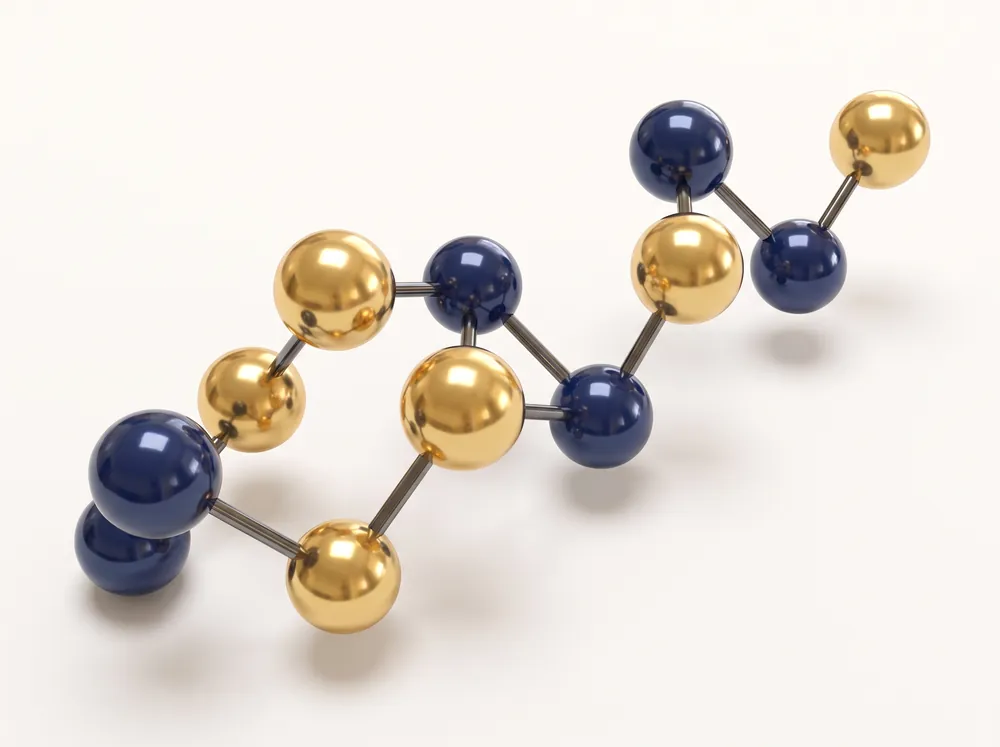
Key facts
- Sequence (one-letter)
- MEHFPGP
- Sequence (three-letter)
- Met-Glu-His-Phe-Pro-Gly-Pro
- Molecular formula
- C37H51N9O10S (PubChem)
- Molecular weight
- 813.9 g/mol (PubChem)
- Monoisotopic mass
- 813.348 Da (PubChem)
- CAS number
- 80714-61-0 (FDA GSRS)
- PubChem CID
- 9811102
- UNII
- I5FAL2585H
- Parent fragment
- ACTH(4-7), Met-Glu-His-Phe
- Vinnix availability
- Component of Selank + Semax (XS20); no standalone SKU
What Is Semax?
This synthetic heptapeptide was developed in Russia. Its first four residues are a fragment of adrenocorticotropic hormone (ACTH), and its last three are the tripeptide Pro-Gly-Pro. Papers usually describe it as an analogue of ACTH(4-10) [1].
FDA's Global Substance Registration System records it as SEMAX, with the synonym "ACTH (4-7), Pro-Gly-Pro-", which states the design in one line. Most of the literature comes from Russian laboratories, and it often appears next to Selank, which was built on the same principle from a different parent peptide.
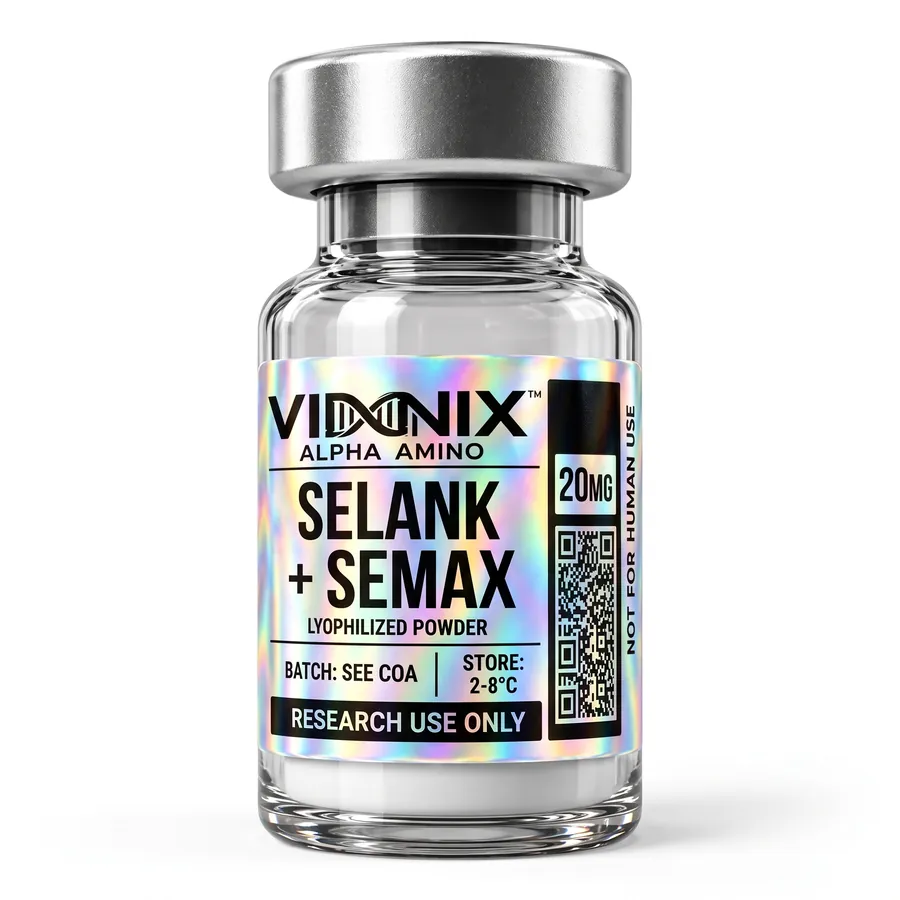
Vinnix doesn't sell it as a standalone vial. It is one of the two components in the Selank + Semax research blend. This page covers the compound itself.
Semax Sequence and ACTH Origin
ACTH is a 39-residue hormone. Counting from its N-terminus, residues 4 to 7 read Met-Glu-His-Phe, and that stretch forms the front half of the molecule. The rest of the native hormone is dropped and replaced with Pro-Gly-Pro.
Ashmarin and colleagues grouped it with other hybrid peptides that pair a regulatory fragment with a glyproline tail [2]. Short ACTH fragments are broken down quickly by peptidases, and proline-rich C-terminal extensions are the standard explanation for the longer half-life reported for such hybrids [3]. An in vitro study tracked how the peptide itself is degraded by rat brain cell cultures and membranes [1].
The sequence has one acidic residue (glutamate), one histidine and no lysine or arginine. That gives the molecule a different charge profile from Selank, and the methionine at position 1 supplies the single sulfur atom in its formula.
Molecular and Registry Data
Values below come from PubChem and FDA GSRS and describe the free peptide. Counter-ions in a supplied powder change its bulk weight but not the molecular formula (see what a molecular formula tells you).
| Field | Value | Source |
|---|---|---|
| Sequence | Met-Glu-His-Phe-Pro-Gly-Pro (MEHFPGP) | PubChem, GSRS |
| Length | 7 residues | Sequence |
| Molecular formula | C37H51N9O10S | PubChem CID 9811102 |
| Molecular weight | 813.9 g/mol | PubChem |
| Monoisotopic mass | 813.348 Da | PubChem |
| CAS number | 80714-61-0 | FDA GSRS |
| UNII | I5FAL2585H | FDA GSRS |
| Registry synonym | ACTH (4-7), Pro-Gly-Pro- | FDA GSRS |
Published Research
Most of this research is preclinical and was published by a small number of Russian groups. The examples below show the study types you'll meet.
- Degradation. An in vitro study followed how the peptide is broken down by rat basal forebrain cell cultures and plasma membranes [1].
- Gene expression. An animal study used genome-wide transcriptional analysis in a rat model of focal brain ischemia [4].
- Enzyme studies. An in vitro study compared Semax and Selank against enkephalin-degrading enzymes in human serum [5].
- Animal models. A rat study examined both peptides in a 6-OHDA lesion model [6].
These findings don't establish safety or any effect in people, and it is not an approved medicine in the United States. Our in vitro vs. in vivo guide explains how to weigh each study type.
Laboratory Identification
Mass spectrometry should show a neutral mass of 813.35 Da, seen near m/z 814.36 as the singly protonated ion. One detail is specific to this peptide: methionine oxidizes easily to methionine sulfoxide, which adds 16 Da. A careful report looks for that +16 signal and counts it as an impurity. HPLC purity and the per-component approach for blends are covered in peptide testing and analysis.
Vinnix Products That Contain Semax
Vinnix offers this compound only in the Selank + Semax blend (SKU XS20, 20 mg total per vial), with the amount of each peptide given on the batch record. Batch reports go into the COA Library as each batch is released; match the batch number on the vial to its report.
Material from Vinnix is supplied for laboratory research. This page describes the compound and the cited studies, not an effect in people.
FAQSemax FAQ
What is Semax?
Semax is a synthetic heptapeptide with the sequence Met-Glu-His-Phe-Pro-Gly-Pro. PubChem lists it under CID 9811102 with the formula C37H51N9O10S and a molecular weight of 813.9 g/mol. It combines a fragment of ACTH with a Pro-Gly-Pro tail, and Vinnix supplies it only inside the Selank + Semax research blend.
What is Semax derived from?
Its first four residues, Met-Glu-His-Phe, are positions 4 to 7 of adrenocorticotropic hormone (ACTH), a 39-residue pituitary hormone. The remaining three residues, Pro-Gly-Pro, are a synthetic addition. The literature often calls it an ACTH(4-10) analogue because it was designed as a more stable stand-in for that longer fragment.
Is Semax the same as ACTH?
No. ACTH has 39 residues; the analogue has seven and shares only four of them with the hormone. Its formula, mass and registry identifiers are its own: CAS 80714-61-0 and UNII I5FAL2585H. A mass spectrum separates them immediately, since ACTH is several times heavier.
Does Vinnix sell Semax on its own?
No. It is offered only as a component of the Selank + Semax research product, SKU XS20, with 20 mg in total per vial. The amount of each peptide appears on the batch record. This page is a reference entry for the compound, not a separate product listing.
Why does methionine matter when analyzing Semax?
Methionine is the residue most prone to oxidation, and this peptide starts with one. Oxidized material shows up in a mass spectrum 16 Da heavier than the expected peak and often elutes slightly earlier on reversed-phase HPLC. Checking for that variant is a simple way to judge how well a sample has been handled and stored.
REFScientific references
-
Zolotarev YA, Dolotov OV, Inozemtseva LS, et al. Degradation of the ACTH(4-10) analog Semax in the presence of rat basal forebrain cell cultures and plasma membranes. Amino Acids. 2006;30(4):403-408. PubMed 16773243
in vitro study -
Ashmarin IP, Samonina GE, Lyapina LA, Kamenskii AA, et al. Natural and hybrid ("chimeric") stable regulatory glyproline peptides. Pathophysiology. 2005;11(4):179-185. PubMed 15837162
review -
Shevchenko KV, Nagaev IY, Andreeva LA, Shevchenko VP, Myasoedov NF. [Stability of proline-containing peptides in biological media]. Biomed Khim. 2019;65(3):180-201. PubMed 31258142
review -
Medvedeva EV, Dmitrieva VG, Povarova OV, et al. The peptide semax affects the expression of genes related to the immune and vascular systems in rat brain focal ischemia: genome-wide transcriptional analysis. BMC Genomics. 2014;15:228. PubMed 24661604
animal study -
Kost NV, Sokolov OIu, Gabaeva MV, et al. [Semax and selank inhibit the enkephalin-degrading enzymes from human serum]. Bioorg Khim. 2001;27(3):180-183. PubMed 11443939
in vitro study -
Slominsky PA, Shadrina MI, Kolomin TA, et al. Peptides semax and selank affect the behavior of rats with 6-OHDA induced PD-like parkinsonism. Dokl Biol Sci. 2017;474(1):106-109. PubMed 28702721
animal study
 Research Blend
 Research Library: Peptide Fundamentals
 Research Library
 Testing & Analysis
 Documentation