
Key facts
- Steps
- 7 (sample, batch, date, lab, method, results, limitations)
- First check
- Batch number matches the vial label
- Identity method
- Mass spectrometry or LC-MS
- Purity method
- Reversed-phase HPLC
- Time needed
- A few minutes per report
- Related
- What a COA is, COA Library
Before you start: how to read a COA in order
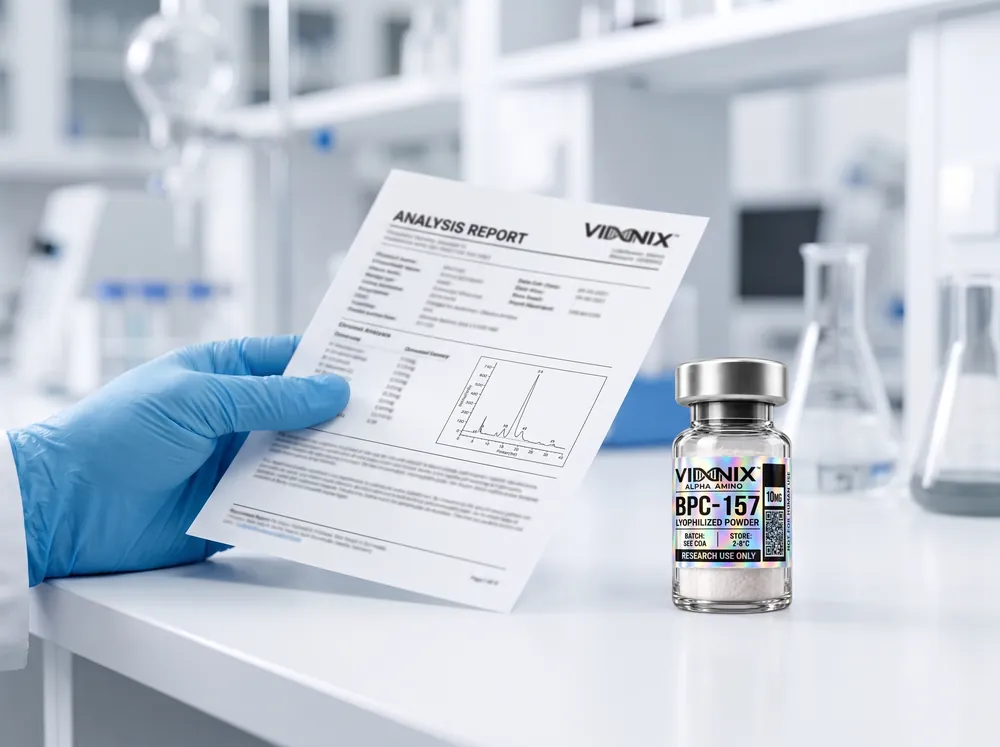
Read a COA in a fixed order. Each step depends on the one before it, and there's no point studying the chromatogram on a report for the wrong batch. We'll go through the annotated sample report below, then run all seven steps on an illustrative worked example.
Want the definition first? Start with what a certificate of analysis is. From here on, we assume you have a report in front of you and want to check it.
The checks follow the attributes formal peptide specifications are built on: identification, purity and assay [2]. You don't need a chemistry background to read a COA. You just need the report and the vial label.
1. Identify the Sample
The first move when you read a COA is making sure the compound and product named on the report are exactly the ones you're checking. Read the sample name, the product description and any stated strength. Near-matches are the trap here. CJC-1295 with DAC and CJC-1295 without DAC are different molecules, and a blend report has to name every component it covers.
Jot down the laboratory's sample ID while you're there. It won't mean much to you, but it's how the lab traces the result if you ever have a question about it.
2. Check the Batch
Now compare the batch or lot number on the report with the one on your vial, character by character. Of all seven steps you take to read a COA, this one matters most: it is the link between the document and the physical product.
If the numbers differ, stop there. The report is about some other production run and tells you nothing dependable about yours. Solid-phase synthesis gives different impurity profiles from run to run, so results don't carry over from one batch to the next [1].
3. Check the Testing Date
Find the date the analysis was done and see how it lines up with the batch. A test date earlier than the batch could have existed, or a report older than the product's launch, is an inconsistency worth raising.
Some reports give both a sample received date and an analysis date. That's fine, as long as you can tell which result was produced when.
4. Identify the Laboratory
To read a COA with any confidence, look for the organization that ran the analysis and issued the report. A named laboratory answers for its result. With no laboratory named, or just a logo with no identifiable organization behind it, there's nobody to follow up with.
If independence matters to you, check whether the laboratory is separate from the manufacturer; in practice, that's what "third-party testing" means. Any accreditation should be stated by the laboratory itself, with a scope you can look up.
5. Identify the Method
Next, confirm which technique produced each result. You can't read a COA properly without it, because the method defines what the number means. Peptide COAs typically report one or more of these:
| Method | Question it answers | Typical output |
|---|---|---|
| Reversed-phase HPLC | How much of the detected signal is in the main peak? | Purity percentage and chromatogram |
| Mass spectrometry (ESI-MS) | Does the main component have the expected molecular mass? | Observed mass or m/z values and spectrum |
| LC-MS | What is the mass of each separated peak? | Chromatogram with a mass for each peak |
| Counter-ion or water tests | How much of the powder is not peptide? | Percent by weight |
Check for method conditions too: column type, mobile phase and detection wavelength for HPLC, and ionization mode for mass spectrometry. Reversed-phase separation of peptides responds strongly to these choices, so a purity figure that comes without them is hard to interpret [3]. Our HPLC vs mass spectrometry article shows how the two methods complement each other, and the LC-MS article covers the combined technique.
6. Review the Results
Read every result against its method, its conditions and any stated specification. Don't mix them up. An HPLC percentage and an observed mass answer different questions, so when you read a COA, take each on its own terms.
Reading the HPLC result
The purity percentage is the main peak's area divided by the total area of all integrated peaks, at the stated detection wavelength. Look at the chromatogram: you should see one dominant peak, and the reported figure should match the picture. Small peaks just before or after the main one are related impurities, such as deletion or oxidized sequences [1]. Retention time and peak integration are explained further in the HPLC testing article.
Reading the mass spectrometry result
When you read a COA's mass result, set the observed mass beside the theoretical mass calculated from the sequence. Don't be thrown by multiple peaks. Electrospray ionization often gives one peptide several peaks, each with a different number of protons, so a single molecule turns up at more than one m/z value [4]. The report may list these charge states or a deconvoluted mass instead. Mass spectrometry explained shows how m/z values are read.
7. Understand the Limitations
Last, list what the report didn't test. To read a COA well you have to read its gaps too, without drawing conclusions about any of them. A COA with HPLC and MS results tells you nothing about peptide content, water, counter-ions or endotoxin unless those tests are actually on it. Lyophilized peptides commonly hold counter-ions such as trifluoroacetate or acetate left from synthesis and purification, and that's why purity and content differ [5].
Nor is a COA a statement about uses, effects or safety. It is a measurement record for one batch. For what a figure like "99% purity" does and doesn't mean, see the peptide purity article.
Worked example: reading an illustrative COA
The values below are invented for teaching. They describe a fictional "Peptide X" and are not results for any Vinnix product or batch.
| Field | Illustrative entry | What to check |
|---|---|---|
| Sample name | Peptide X, 10 mg vial | Matches the product you hold |
| Batch / lot | EX-0001 | Matches the vial label exactly |
| Analysis date | Listed on report | After the batch could exist |
| Laboratory | Named testing laboratory | Identifiable organization |
| HPLC method | Reversed-phase C18, UV 214 nm | Conditions stated |
| HPLC result | 98.6% main peak area | Chromatogram shows one dominant peak |
| Theoretical mass | 1,500.0 Da | Calculated from the sequence |
| Observed ESI-MS ions | m/z 1501.0, 751.0, 501.0 | Charge states consistent with 1,500.0 Da |
| Not tested | Net peptide content, water, counter-ions | Do not infer these |
Run the seven steps you'd use to read a COA from any lab. Sample name and batch match the vial, the date makes sense, and a laboratory is named, so this report belongs to this batch. The HPLC method is stated, and 98.6% means the main peak makes up 98.6% of the integrated signal at 214 nm.
On to the mass result. Each observed ion equals the molecular mass plus some number of protons, divided by that number. For a 1,500.0 Da peptide, one proton gives about 1501.0, two give about 751.0, and three give about 501.0. All three observed ions lead back to the same mass, which supports identity.
And the gaps: the report didn't measure content, water or counter-ions, so it can't tell you how many milligrams of peptide are in the vial. That's the complete, honest reading of this illustrative COA. To try the same steps on a real report, look up your batch in the Vinnix COA Library once its report is published. For a wider view of analytical methods, see peptide testing and analysis.
FAQFrequently asked questions
What is the most important thing to check on a COA?
The batch or lot number. Whenever you read a COA, it's the one field linking the report to the physical vial. If the number on the certificate doesn't match the label exactly, the report covers a different production run, and you can't rely on it for your batch no matter how good its results look.
How do I read the HPLC purity on a COA?
It's the main peak's area as a percentage of all integrated peaks at the stated detection wavelength. Check that the method conditions are listed, that the chromatogram has one dominant peak, and that the reported percentage matches the image. Keep in mind it describes chromatographic purity only, not identity and not peptide content.
Why does the mass spectrum show more than one peak for one peptide?
Electrospray ionization attaches different numbers of protons to the same molecule, so you get ions at several mass-to-charge values. A 1,500 Da peptide might show up near m/z 1501, 751 and 501. If every one of them works back to the same mass, they're one compound, not impurities.
Does a COA prove a product is safe?
No. A COA reports specific analytical results, such as chromatographic purity and observed mass, for a specific sample. It doesn't assess safety, suitability or any effect, and it's silent on tests that weren't run. Treat it strictly as a measurement record for the batch it names.
What should I do if a COA looks wrong?
Note what doesn't match, whether that's a different batch number, a missing laboratory or a mass that doesn't fit the sequence, and ask the supplier to explain. Plenty of issues turn out to have simple answers. If the supplier can't tie the report to your batch, though, treat the documentation as unverified.
Where can I find Vinnix COAs?
In the Vinnix COA Library, where you can search by product, SKU or batch number. Each product page links to its documentation as well. We publish batch reports as they become available. A batch without a published report is labeled Report not yet published, and we never put a substitute document in its place.
REFScientific references
-
D'Hondt M, Bracke N, Taevernier L, et al. Related impurities in peptide medicines. J Pharm Biomed Anal. 2014;101:2-30. PubMed 25044089
review -
Vergote V, Burvenich C, Van de Wiele C, De Spiegeleer B. Quality specifications for peptide drugs: a regulatory-pharmaceutical approach. J Pept Sci. 2009;15(11):697-710. PubMed 19750489
review -
Mant CT, Chen Y, Yan Z, et al. HPLC analysis and purification of peptides. Methods Mol Biol. 2007;386:3-55. PubMed 18604941
methods review -
Fenn JB, Mann M, Meng CK, Wong SF, Whitehouse CM. Electrospray ionization for mass spectrometry of large biomolecules. Science. 1989;246(4926):64-71. PubMed 2675315
analytical methods review -
Hettiarachchi K, Ridge S. Capillary electrophoretic determination of acetic acid and trifluoroacetic acid in synthetic peptide samples. J Chromatogr A. 1998;817(1-2):153-161. PubMed 9764489
analytical method validation study
 Research Library
 Research Library
 Testing & Analysis