
Key facts
- Batch
- Quantity produced in one cycle under a single manufacturing order
- Lot
- A batch, or an identified portion of a batch, of uniform quality
- Shared purpose
- Traceability to manufacturing, testing and distribution records
- Reference definitions
- US drug GMP regulations, 21 CFR 210.3
- Where to find it
- Container label, packing documents and the matching COA
- Common practice
- Many suppliers treat the two terms as synonyms
What is the difference between a batch number and a lot number?
Scope is the whole difference. A batch is everything made in one production run; a lot can be that entire batch or a defined portion of it.
US drug manufacturing regulations give the clearest widely used definitions. A batch is a specific quantity of material intended to have uniform character and quality, within specified limits, produced according to a single manufacturing order during the same cycle of manufacture. A lot is a batch, or a specific identified portion of a batch, with uniform character and quality within specified limits. In a continuous process, a lot can be a defined amount produced in a unit of time or quantity [1]. The same regulation treats lot number, control number and batch number as interchangeable names for any code that lets you determine the complete history of a batch or lot [1].
Research chemical suppliers don't necessarily operate under that regulation, since it was written for drug manufacturing. Even so, it offers the most precise shared vocabulary for the idea, and that makes it a handy reference point.
| Batch | Lot | |
|---|---|---|
| Defined by | One production run under one manufacturing order | Uniform quality; equal to a batch or part of one |
| Typical extent | The full output of the run | The full batch, or a subdivision such as one fill run |
| Continuous processes | Less natural fit | A defined amount per time period or quantity |
| Purpose of the number | Trace the complete production history | Trace the complete production history |
| Used interchangeably? | Often | Often |
Why do suppliers use batch and lot interchangeably?
For many products, one production run is packaged and released as a single unit. The batch and the lot are then literally the same material, so suppliers use the words interchangeably.
Things get more interesting when a batch is split. One peptide synthesis and purification run might be lyophilized and filled on different days, or into different container sizes. The producer could give the synthesis one batch number and each fill its own lot number. What matters to a researcher isn't the word on the label. It's whether the code maps cleanly to the records describing the material in hand. For how peptides are made and where those production steps fall, see peptide synthesis.
How does a batch number connect a container to its records?
Think of a batch or lot number as a key. It links one specific container to the manufacturing, testing and distribution records for the material inside.
- Production record. Which synthesis run, purification and lyophilization produced the material, and when.
- Analytical record. Which tests were run on that batch. For peptides, that's typically HPLC purity and mass spectrometry identity.
- Certificate of analysis. A summary document that reports those results for that batch and states the batch number.
- Distribution record. Which orders received containers from that batch.
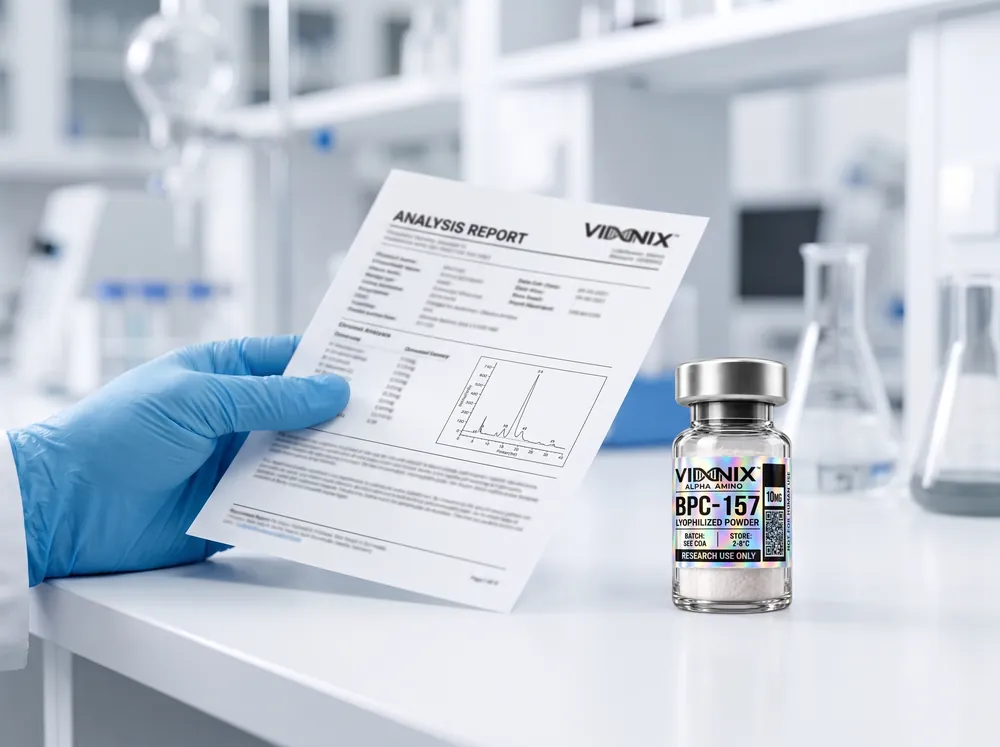
None of these links hold unless the number is printed consistently everywhere: container label, packing documents and COA. A COA with no batch number can't be tied to any particular container. That's the core point of the certificate of analysis page, too: a COA describes one batch, not a product in general.
Why does lot-to-lot variation matter?
Two lots of the same product can differ measurably. Results from one can't simply be assumed for the next.
Clinical laboratories have documented this in detail for reagents and calibrators. Shifts between lots can change measured results, so labs need procedures for evaluating each new lot before relying on it [2]. Synthetic peptides follow the same logic. Purity, impurity profile, counter-ion content and water content can all vary between batches, even when every batch meets its specification [3][4]. That's why consensus recommendations for peptides used in mass spectrometry-based assays call for documenting how each preparation was characterized, quantified and stored [5].
Analytical results belong to the batch that was tested. A purity value from an earlier lot tells you about that earlier lot, not about the material in your container.
What does a batch or lot number look like?
No universal format exists. A batch or lot number can be any mix of letters, numbers or symbols, as long as the producer can trace it back to its records [1].
Codes often embed a date, a product code, a site or a running counter. None of that is required, though, and one supplier's structure tells you nothing about another's. Treat the code as an opaque identifier whose only job is to match exactly, character for character, across the label, the order paperwork and the analytical documents.
- Watch for codes that are close but different, like a transposed digit or a missing suffix.
- If the product page shows a different batch from the one on your container, ask for your batch's documentation.
- Write the batch number into your lab notes so results trace back to the exact material used.
How Vinnix uses batch numbers
At Vinnix, analytical documentation is organized by batch. Each available report sits with the batch it describes instead of appearing as a generic certificate for all inventory.
You can search the Vinnix COA library by product, compound or batch/lot number. If a batch's documentation hasn't been published yet, the product page says so plainly rather than borrowing another batch's report. The quality and documentation page describes the broader approach. To confirm a COA matches your container, work through how to read a COA, which begins with the batch field. What a COA should contain lists every field.
FAQFrequently asked questions
Is a lot number the same as a batch number?
In practice, often yes. Many suppliers treat the terms as synonyms because one production run gets released as one unit. Strictly speaking, a batch is the material from one production run under one manufacturing order, and a lot is that batch or a defined portion of it with uniform quality. Either way, the number should lead to the complete records.
Can one batch have several lot numbers?
Yes. The drug-manufacturing definitions allow a lot to be a specific identified portion of a batch. So a producer might split one batch into separate fill runs or container sizes, each with its own lot number. Every lot should still link back to the parent batch and its testing records, so you can trace results in both directions.
Does one COA apply to every batch of a product?
No. A certificate of analysis reports results for the specific batch that was tested, and another batch of the same product may differ in purity, impurity profile or water content. A COA only means something for your material if its batch or lot number matches the one on your container exactly, character for character.
Where do I find the batch number on a product?
Look at the container label first; the batch or lot number is usually printed there and repeated on the packing documents. It might read Batch, Lot, LOT or a similar abbreviation. Check it against the batch number on the certificate of analysis. If neither the label nor the COA shows one, the document can't be tied to that container.
What is lot-to-lot variation?
It's the measurable difference between separate production lots of the same product. Clinical laboratories have documented it for reagents and calibrators, where shifts between lots can change test results. With synthetic peptides, purity, impurity profile and counter-ion or water content can vary from batch to batch, which is why results are always tied to a specific batch.
Why should I record the batch number in my lab notes?
So you can trace any result to the exact material behind it. If an experiment behaves unexpectedly, the batch number connects it to that batch's analytical data and shows whether other work used the same batch or a different one. It also lets you request the right documentation later, even after the product page has moved on to a newer batch.
REFScientific references
-
US Code of Federal Regulations. 21 CFR 210.3, Definitions. Part 210: Current Good Manufacturing Practice in Manufacturing, Processing, Packing, or Holding of Drugs; General. Electronic Code of Federal Regulations (eCFR), accessed 2026-10-06. Source
regulation (US federal) -
Thompson S, Chesher D. Lot-to-Lot Variation. Clin Biochem Rev. 2018;39(2):51-60. PubMed 30473592
review -
D'Hondt M, Bracke N, Taevernier L, et al. Related impurities in peptide medicines. J Pharm Biomed Anal. 2014;101:2-30. PubMed 25044089
review -
Vergote V, Burvenich C, Van de Wiele C, et al. Quality specifications for peptide drugs: a regulatory-pharmaceutical approach. J Pept Sci. 2009;15(11):697-710. PubMed 19750489
review (pharmacopeial specifications) -
Hoofnagle AN, Whiteaker JR, Carr SA, et al. Recommendations for the Generation, Quantification, Storage, and Handling of Peptides Used for Mass Spectrometry-Based Assays. Clin Chem. 2016;62(1):48-69. PubMed 26719571
consensus recommendations
 Documentation
 Documentation