
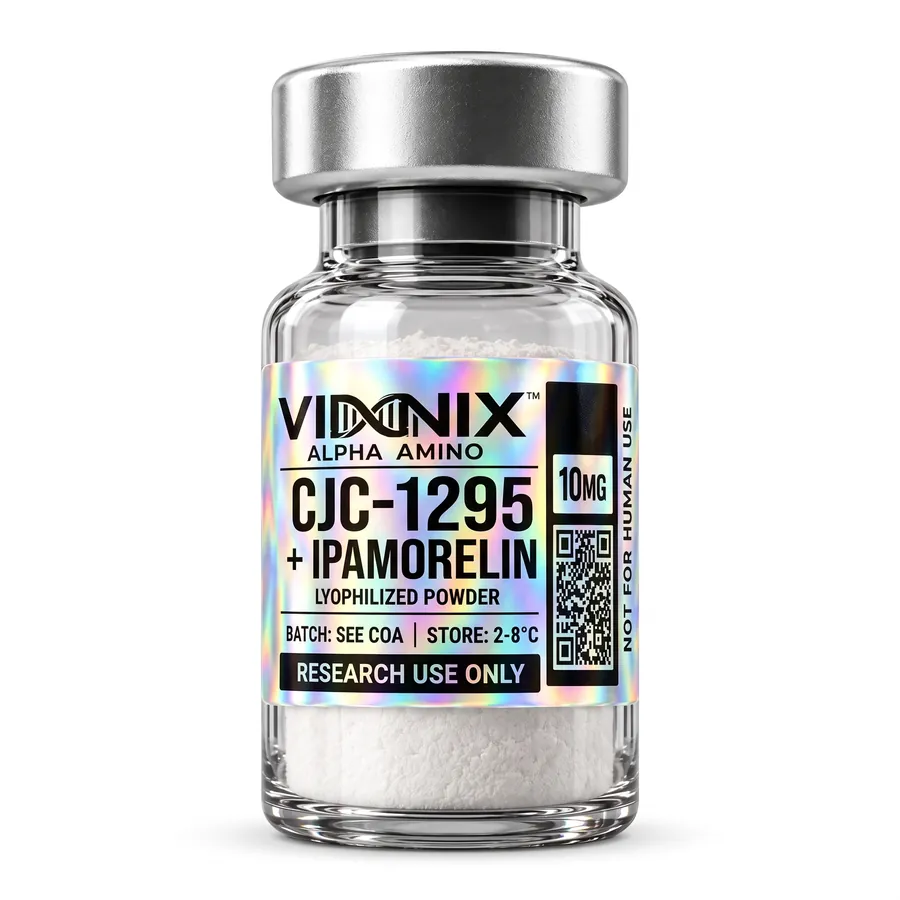
Key facts
- Product
- CJC-1295 + Ipamorelin, SKU CP10
- Total quantity
- 10 mg
- Components
- CJC-1295 and ipamorelin (two separate peptides)
- Ipamorelin sequence
- Aib-His-D-2-Nal-D-Phe-Lys-NH2
- Ipamorelin molecular weight
- 711.9 g/mol (C38H49N9O5, PubChem CID 9831659)
- CJC-1295 form
- With or without DAC, as stated on the product record
- Intended use
- Laboratory research use only
Batch reports are published in the COA Library as each batch is released. Match the batch number on your vial to its report.
Components: CJC-1295, Ipamorelin. Amounts per vial are listed on the batch COA.
What Is CJC-1295 + Ipamorelin?
CJC-1295 + Ipamorelin is a combination product holding two distinct peptides. It is not a new single molecule. People search for it as cjc 1295 ipamorelin, CJC-1295 and ipamorelin, or the cjc 1295 ipamorelin blend, and every version means the same thing: two compounds, each with its own sequence, formula and molecular weight, sharing one vial.
The peptides are mixed, not bonded, so the blend has no single sequence, formula or CAS number. A correct product record identifies each component and how much of it is present. On this page you'll find identity data for each peptide, a structural comparison, the published literature by study type, and how a CP10 batch is tested and documented.
Vinnix products are supplied for laboratory research use only and are not for human or veterinary use. Nothing on this page describes an effect of the product.
CJC-1295 + Ipamorelin Product Specifications
A blend of two peptides carries two sets of identity data, so the table lists each component separately.
| Field | CJC-1295 | Ipamorelin |
|---|---|---|
| Compound | CJC-1295 | Ipamorelin (NNC 26-0161) |
| Classification | Synthetic peptide analogue of GHRH (1-29) | Synthetic pentapeptide |
| Sequence | Substituted GHRH (1-29) sequence; exact form stated on the product record | Aib-His-D-2-Nal-D-Phe-Lys-NH2 |
| Molecular formula | C165H269N47O46 (with DAC, PubChem CID 91971820) | C38H49N9O5 (PubChem CID 9831659) |
| Molecular weight | 3647.2 g/mol (with DAC) | 711.9 g/mol |
| CAS number | 446262-90-4 (PubChem listing) | 170851-70-4 |
| DAC status | Stated on the product record | Not applicable |
| Amount per vial | Listed on the batch record | Listed on the batch record |
| Field | Value |
|---|---|
| Product | CJC-1295 + Ipamorelin |
| SKU | CP10 |
| Product quantity | 10 mg total |
| Batch / lot | Printed on the vial and matched on the batch COA |
Blend composition
CP10 holds 10 mg in total, split between CJC-1295 and ipamorelin. The batch record and certificate of analysis will give the amount of each. The total alone doesn't tell you the ratio, so don't assume an equal split.
Which form of CJC-1295 is present is part of the composition too. CJC-1295 with DAC and CJC-1295 without DAC are different molecules. The Vinnix product record will state which one CP10 contains, and the batch mass spectrometry result should agree with it.
What Is CJC-1295?
CJC-1295 is a synthetic peptide based on the first 29 amino acids of growth hormone-releasing hormone (GHRH), with several amino-acid substitutions. In the original literature it carries a drug affinity complex (DAC): a maleimidopropionic acid linker on a lysine residue, designed to bind albumin [1].
PubChem lists the DAC form under CID 91971820, with the formula C165H269N47O46 and a molecular weight of 3647.2 g/mol. The version without DAC, often called modified GRF (1-29), is just the substituted 29-residue peptide, and its mass is substantially lower. The two names aren't interchangeable. The CJC-1295 compound page has the full detail.
What Is Ipamorelin?
Ipamorelin, first described in 1998, is a synthetic pentapeptide: Aib-His-D-2-Nal-D-Phe-Lys-NH2 [4]. Aib stands for 2-aminoisobutyric acid and D-2-Nal for D-2-naphthylalanine, and the C-terminus is amidated. In other words, the sequence uses building blocks from outside the 20 standard amino acids.
PubChem lists ipamorelin under CID 9831659, with the formula C38H49N9O5 and a molecular weight of 711.9 g/mol. Its CAS number is 170851-70-4. It's classified as a ghrelin receptor (growth hormone secretagogue receptor) agonist. For more, see the ipamorelin compound page, and the guide to peptide sequences for how non-standard residues are written.
CJC-1295 vs Ipamorelin
The two peptides differ in size, structure and receptor classification. The comparison below stays at that structural level.
| CJC-1295 | Ipamorelin | |
|---|---|---|
| Type | GHRH (1-29) analogue | Pentapeptide |
| Length | 29 residues, plus DAC linker if present | 5 residues |
| Receptor class in literature | GHRH receptor | Ghrelin receptor (GHS-R) |
| Non-standard features | Amino-acid substitutions; optional DAC | Aib, D-amino acids, C-terminal amide |
| Molecular weight | 3647.2 g/mol (with DAC) | 711.9 g/mol |
| First described | 2005 (animal study) [1] | 1998 (in vitro and animal) [4] |
A roughly fivefold size gap comes in handy during analysis. The two peptides behave very differently on HPLC and give clearly separate signals in mass spectrometry. Related GHRH analogues have their own pages: tesamorelin and sermorelin.
Why do they appear together in research?
They're classified at two different receptors in the same endocrine axis, and each has its own literature. That's the link. The pair itself hasn't been established as a studied single product, and we're not aware of any peer-reviewed controlled study of the combination as one material.
| Compound | What was studied | Study type |
|---|---|---|
| CJC-1295 | Identification of CJC-1295 as an albumin-binding GRF analogue in rats [1] | Animal |
| CJC-1295 | GH and IGF-I secretion measures in healthy adults [2] | Human clinical, early-phase randomized placebo-controlled |
| CJC-1295 | Pattern of GH secretion during continuous stimulation [3] | Human clinical, early-phase |
| Ipamorelin | Receptor selectivity in pituitary cells and animal models [4] | In vitro and animal |
| Ipamorelin | Pharmacokinetic and pharmacodynamic modelling in volunteers [5] | Human clinical, phase 1 |
The human studies in this table were small, early-phase pharmacology studies of single compounds. Neither compound is an approved medicine, and none of these studies looked at the CP10 product. In vitro vs. in vivo research explains the study categories. Preclinical findings do not establish safety or effectiveness in humans.
How is a cjc 1295 ipamorelin blend analyzed?
The size gap between the two peptides shapes the analysis, though the principle is the one used for every blend: each component gets its own identity result and its own quantity result (identity vs. purity explains why these differ). A combined purity value would say little about either peptide. Peptide testing and analysis walks through the methods in general terms.
- HPLC separation. HPLC resolves the 29-residue CJC-1295 from the much smaller ipamorelin, which comes off the column at a clearly different retention time.
- Mass confirmation. Mass spectrometry checks the mass behind each peak against the expected value for that peptide. LC-MS combines the separation and the mass check in one run.
- Per-peptide quantity. Each peak is measured against a reference standard for that peptide, so the report gives two amounts, not one total.
- Per-peptide purity. Related impurities are reported for each component, because a high combined figure could still hide a problem with one of them.
Mass spectrometry also answers the DAC question. A CJC-1295 peak consistent with 3647.2 g/mol points to the DAC form; a substantially lower mass points to the form without DAC. Either way, the result should match the product record. Ipamorelin is checked against 711.9 g/mol, and at that small size its molecular ion is easy to confirm.
Combination Product Documentation
Documentation for a combination product has to be tied to the exact batch it describes. For CP10, one batch number will connect the vial, the certificate of analysis, the HPLC report and the mass spectrometry data, with separate results for CJC-1295 and ipamorelin.
This batch link matters even more for a blend than for a single compound. The CJC-1295 to ipamorelin proportion is set as each batch is prepared, so one batch's report can't tell you the ratio in another. To confirm both per-component amounts and the CJC-1295 form, read the COA for the exact batch on your vial.
CJC-1295 + Ipamorelin Analytical Documentation
CP10 batch documentation will be linked from this page and listed in the Vinnix COA Library by product name, SKU and batch number once published. For each published batch, these documents will be available:
- View COA: the certificate of analysis for the batch, with identity and quantity of each component
- View HPLC: the chromatogram showing a separate, labelled peak for CJC-1295 and for ipamorelin
- View mass spectrometry: measured masses for both peptides, including the CJC-1295 form
- View batch information: batch number, test date and testing laboratory
Need help with a field? See how to read a peptide COA and what a certificate of analysis is.
FAQCJC-1295 + Ipamorelin FAQ
What is CJC-1295 + Ipamorelin?
CJC-1295 + Ipamorelin is a research product that puts two separate peptides in one vial: CJC-1295, a synthetic analogue of GHRH (1-29), and ipamorelin, a synthetic pentapeptide. Vinnix lists it as CP10, 10 mg in total, for laboratory research use only. The two aren't chemically joined, and each is documented as its own component.
Is CJC-1295 + Ipamorelin a peptide?
Strictly, it contains two peptides rather than being one. CJC-1295 is a 29-residue peptide analogue, with or without a DAC linker, and ipamorelin has five residues. Since they're mixed and not bonded, the blend has no single peptide sequence, and the batch documentation will identify each component on its own.
What is the CJC-1295 + Ipamorelin sequence?
The blend doesn't have one. Ipamorelin is Aib-His-D-2-Nal-D-Phe-Lys-NH2. CJC-1295 is a substituted version of the first 29 residues of GHRH, and the Vinnix product record will state its exact form, with or without DAC. Each sequence belongs to its own component.
What molecular information identifies CJC-1295 + Ipamorelin?
Each component has separate data. Ipamorelin is C38H49N9O5, 711.9 g/mol, CAS 170851-70-4 (PubChem CID 9831659). PubChem lists CJC-1295 with DAC as C165H269N47O46, 3647.2 g/mol (CID 91971820). Without DAC the mass is lower, which is why the product record will state which form CP10 contains.
What is the difference between CJC-1295 and Ipamorelin?
CJC-1295 is a 29-residue analogue of GHRH, classified at the GHRH receptor and weighing about 3647 g/mol in its DAC form. Ipamorelin is a five-residue peptide built from non-standard building blocks, classified as a ghrelin receptor agonist, at 711.9 g/mol. Structurally they're unrelated molecules that often get supplied together.
Does the blend use CJC-1295 with or without DAC?
The Vinnix product record will state which CJC-1295 form CP10 contains, and the batch mass spectrometry result should confirm it. The DAC version carries an albumin-binding linker and is listed at 3647.2 g/mol. The version without DAC is substantially lighter, so telling them apart analytically is straightforward.
How is CJC-1295 + Ipamorelin studied?
Only as separate compounds. CJC-1295 was described in animal work, followed by early-phase human pharmacology studies; ipamorelin appears in laboratory, animal and phase 1 studies. We don't know of any controlled study of the combination as one product, and preclinical findings shouldn't be read as human outcomes.
How can CJC-1295 + Ipamorelin be analytically characterized?
HPLC splits the two peptides into distinct peaks. Mass spectrometry then confirms each one's identity by molecular mass, including whether CJC-1295 is the DAC form. Finally, each peak is quantified against its own reference standard, which gives a separate amount and purity result for CJC-1295 and for ipamorelin.
Where can I find the Vinnix CJC-1295 + Ipamorelin COA?
CP10 batch documentation, including the COA, HPLC report, mass spectrometry data and batch information, will be linked from this page and listed in the Vinnix COA Library. Before relying on any result, check that the batch number printed on your vial matches the one on the report.
REFScientific references
-
Jetté L, Léger R, Thibaudeau K, et al. Human growth hormone-releasing factor (hGRF)1-29-albumin bioconjugates activate the GRF receptor on the anterior pituitary in rats: identification of CJC-1295 as a long-lasting GRF analog. Endocrinology. 2005;146(7):3052-8. PubMed 15817669
animal study -
Teichman SL, Neale A, Lawrence B, et al. Prolonged stimulation of growth hormone (GH) and insulin-like growth factor I secretion by CJC-1295, a long-acting analog of GH-releasing hormone, in healthy adults. J Clin Endocrinol Metab. 2006;91(3):799-805. PubMed 16352683
human clinical, early-phase randomized placebo-controlled study -
Ionescu M, Frohman LA. Pulsatile secretion of growth hormone (GH) persists during continuous stimulation by CJC-1295, a long-acting GH-releasing hormone analog. J Clin Endocrinol Metab. 2006;91(12):4792-7. PubMed 17018654
human clinical, early-phase study -
Raun K, Hansen BS, Johansen NL, et al. Ipamorelin, the first selective growth hormone secretagogue. Eur J Endocrinol. 1998;139(5):552-61. PubMed 9849822
in vitro and animal study -
Gobburu JV, Agersø H, Jusko WJ, Ynddal L. Pharmacokinetic-pharmacodynamic modeling of ipamorelin, a growth hormone releasing peptide, in human volunteers. Pharm Res. 1999;16(9):1412-6. PubMed 10496658
human clinical, phase 1 pharmacokinetic study
 Compound Library
 Peptides
 Documentation
 Research Library