
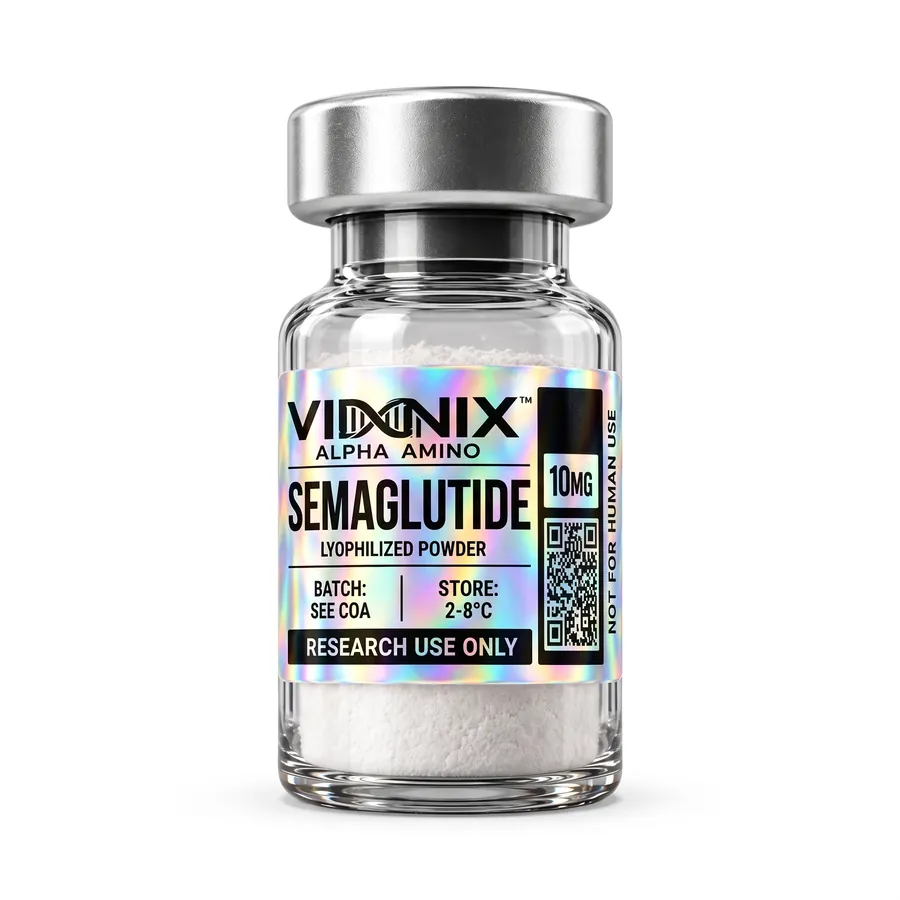
Key facts
- Development codes
- NN9535; NNC 0113-0217
- Molecular formula
- C187H291N45O59 (PubChem CID 56843331)
- Molecular weight
- 4114 g/mol (PubChem)
- CAS number
- 910463-68-2 (FDA GSRS, UNII 53AXN4NNHX)
- Backbone length
- 31 amino acids (GLP-1 positions 7 to 37)
- Receptor studied
- GLP-1 receptor
- Vinnix SKUs
- SM10, SM20, SM30
Batch reports are published in the COA Library as each batch is released. Match the batch number on your vial to its report.
What Is Semaglutide?
Semaglutide is one of the most heavily documented peptides in the scientific and regulatory literature. The semaglutide peptide Vinnix lists is a research material for laboratory and analytical work. Chemically, it is an analogue of human glucagon-like peptide-1 (GLP-1), altered to resist enzymatic breakdown and to bind serum albumin, and those two changes give it a far longer plasma half-life than the native hormone [1].
Compared with human GLP-1, the molecule carries two amino-acid substitutions (Aib at position 8 and Arg at position 34) plus a fatty-acid derivative on lysine 26, as set out in the original medicinal chemistry paper [1]. You may also see the shorthand "sema peptide" or the phrase semaglutide research peptide in catalogs. Both point to the same INN.
What follows covers identity, molecular data, terminology, references and the Vinnix documentation we have, with sources named and no promotional claims. If you need the basics first, start with what peptides are.
Semaglutide Product Information
Vinnix lists the semaglutide peptide in three quantities: SM10 (10 mg), SM20 (20 mg) and SM30 (30 mg). Fields that depend on the batch are filled in from the Vinnix product record as each batch is released (batch number vs. lot number explains those identifiers).
| Field | Value |
|---|---|
| Compound | Semaglutide |
| Product format | Stated on the batch COA when published |
| Quantity | 10 mg, 20 mg and 30 mg |
| SKU | SM10, SM20, SM30 |
| Batch / lot | Shown on the batch COA when published |
| CAS number | 910463-68-2 (FDA GSRS) |
| Molecular formula | C187H291N45O59 (PubChem) |
| Molecular mass | 4114 g/mol (PubChem) |
| Sequence / structure | 31-residue GLP-1 analogue with Aib at position 2, Arg at position 28 and an acylated lysine at position 20 (backbone numbering) |
| Available analytical documentation | Linked per batch in the COA Library once each report is published |
Seeing semaglutide for sale as a research material tells you nothing about identity, purity or content. Only the batch report can do that. Other research compounds are in the full Vinnix peptides catalog.
Compound Identity & Terminology
Semaglutide is the International Nonproprietary Name (INN) for the molecule that the FDA Global Substance Registration System (GSRS) records under UNII 53AXN4NNHX and CAS 910463-68-2.
- Semaglutide: the INN, used in the literature and in regulatory records.
- NN9535 and NNC 0113-0217: development codes that appear in GSRS and in early papers.
- Sema / sema peptide: informal shorthand with no formal standing.
- Related records: GSRS also lists the modified lysine residue and several synthesis intermediates, which are sometimes called semaglutide impurities. They are separate substances, not the peptide itself.
- Formulations: an oral tablet pairs semaglutide with the absorption enhancer SNAC [3]. That is a finished product, not a different form of the peptide.
Don't treat similar names, salts or formulations as interchangeable unless they really are equivalent. Tirzepatide and retatrutide, for example, are different molecules with their own sequences and records.
Molecular Information
The table below gives the verified molecular data for the semaglutide peptide, drawn from PubChem and FDA GSRS.
| Property | Value | Source |
|---|---|---|
| Molecular formula | C187H291N45O59 | PubChem CID 56843331 |
| Molecular weight | 4114 g/mol | PubChem CID 56843331 |
| CAS registry number | 910463-68-2 | FDA GSRS |
| UNII | 53AXN4NNHX | FDA GSRS |
| Development codes | NN9535; NNC 0113-0217 | FDA GSRS |
| Backbone length | 31 residues | FDA GSRS |
| C-terminus | Glycine, free acid | FDA GSRS |
At about 4.1 kDa, the semaglutide peptide shows up in electrospray mass spectrometry as a run of multiply charged ions (what is a mass spectrum shows the pattern). Deconvolution turns those into a single neutral mass, and a COA compares that number with the expected value for the complete acylated molecule.
Semaglutide Peptide Sequence and Structure
FDA GSRS records the semaglutide peptide backbone as the 31-letter sequence below. It spans positions 7 to 37 of human GLP-1, and three of those positions differ from, or are modified relative to, the native hormone.
HAEGTFTSDVSSYLEGQAAKEFIAWLVRGRG
| Backbone position | GLP-1 numbering | Residue | Note |
|---|---|---|---|
| 2 | 8 | 2-aminoisobutyric acid (Aib) | Replaces alanine; shown as A in the backbone [1] |
| 20 | 26 | Lysine with an acyl side chain | Linked through two AEEA spacers and gamma-glutamate to a C18 fatty diacid (FDA GSRS) |
| 28 | 34 | Arginine | Replaces lysine in native GLP-1 [1] |
| 31 | 37 | Glycine | Free acid C-terminus |
According to the design paper, the fatty acid and its linker were what gave the molecule its albumin affinity, and the team set out to make it fully stable against metabolic degradation [1]. Two numbering systems are in circulation, so check whether a source counts from the first residue of the 31-residue chain or uses GLP-1 numbering. The peptide sequences guide explains the notation.
Research Landscape
The published literature spans medicinal chemistry, laboratory and animal pharmacology, formulation science, large randomized clinical trials and reviews. Each type of evidence answers a different question, so it helps to know which kind of study you are reading. In vitro vs. in vivo research covers the basic distinction.
Laboratory and animal (preclinical) research
In the discovery paper, the authors report receptor affinity, albumin binding and animal pharmacokinetics (mini-pigs among them) for semaglutide and related analogues [1]. A later formulation study paired preclinical work in dogs with clinical work to find out where and how the peptide is absorbed when coformulated with SNAC for oral use [3]. Preclinical findings like these do not establish safety or effectiveness in humans.
Human clinical research
Three large trials are cited most often. SUSTAIN-6 was a randomized, placebo-controlled trial in adults with type 2 diabetes at high cardiovascular risk; its primary outcome was major adverse cardiovascular events [4]. STEP 1, a phase 3 randomized trial, enrolled adults with overweight or obesity but without diabetes and measured percentage change in body weight [5]. SELECT was event-driven and randomized, in adults with established cardiovascular disease and overweight or obesity but no diabetes, and it too used major adverse cardiovascular events as the primary outcome [6]. All three recorded adverse events and discontinuations.
Review literature
For the design history, a review written by the discovery team traces the route from liraglutide to semaglutide and the structural choices made along the way [2]. Reviews are secondary sources, so read them next to the primary studies.
The clinical studies used drug product made by the sponsor to controlled specifications. None of that work describes any Vinnix batch, and a result from one kind of study shouldn't be carried over to another.
Regulatory Context
Semaglutide is the active ingredient of prescription medicines approved by the US Food and Drug Administration (FDA), the first of them in 2017.
An approval like that covers only the specific drug products the approval holder makes under its own manufacturing and quality controls. It doesn't extend to material from another manufacturer, to compounded preparations, or to any Vinnix product. The Vinnix semaglutide peptide is a laboratory reagent, not a drug product, and it is not a substitute for one.
How Vinnix handles literature, evidence levels and batch documentation is set out in the Product & Research Information Disclosure.
Analytical Documentation
Analytical documentation for the Vinnix semaglutide peptide belongs only to the sample or batch named on each report. Each method on that report answers its own question.
How is semaglutide analyzed?
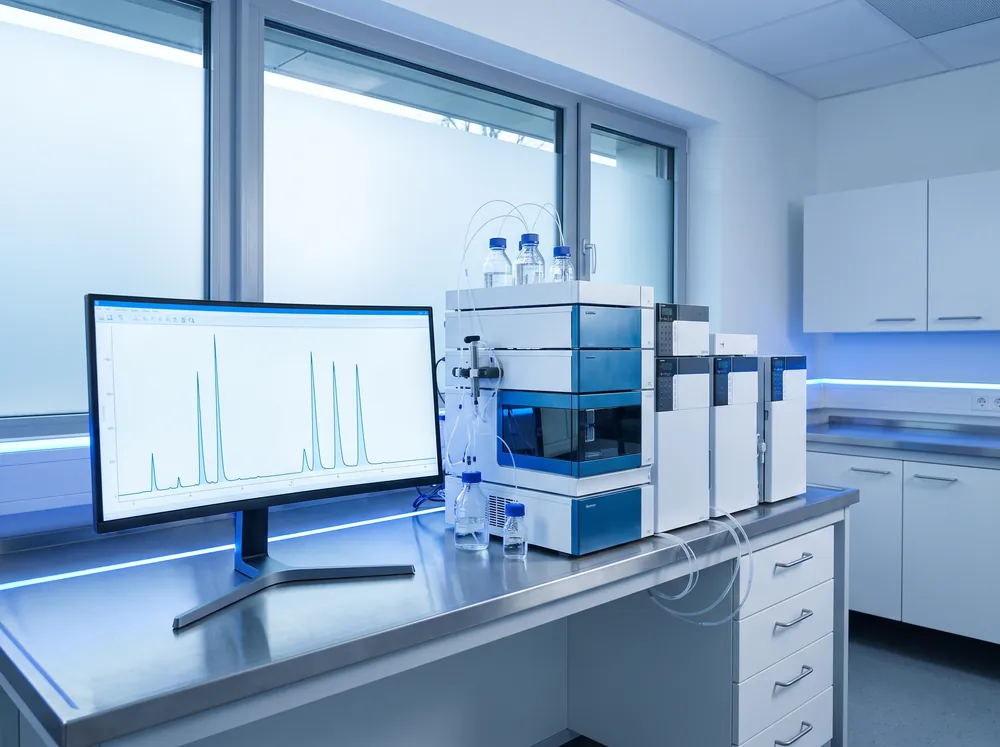
- HPLC: separates the sample and reports the main peak as a share of the detected UV peak area, which is a purity measure. See HPLC testing explained.
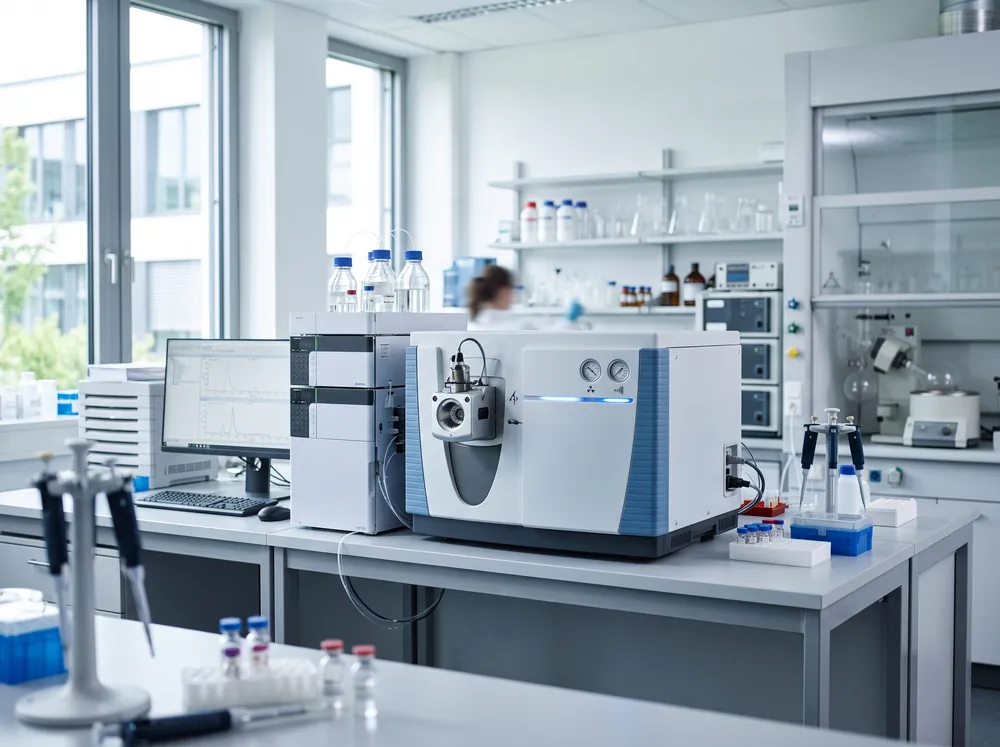
- Mass spectrometry: measures molecular mass and checks it against the expected value for the acylated peptide, which supports identity. See mass spectrometry for peptides.
- LC-MS: joins separation to mass measurement, so the main peak and related impurities can be identified in one run (see what LC-MS is).
Semaglutide COA and batch documentation
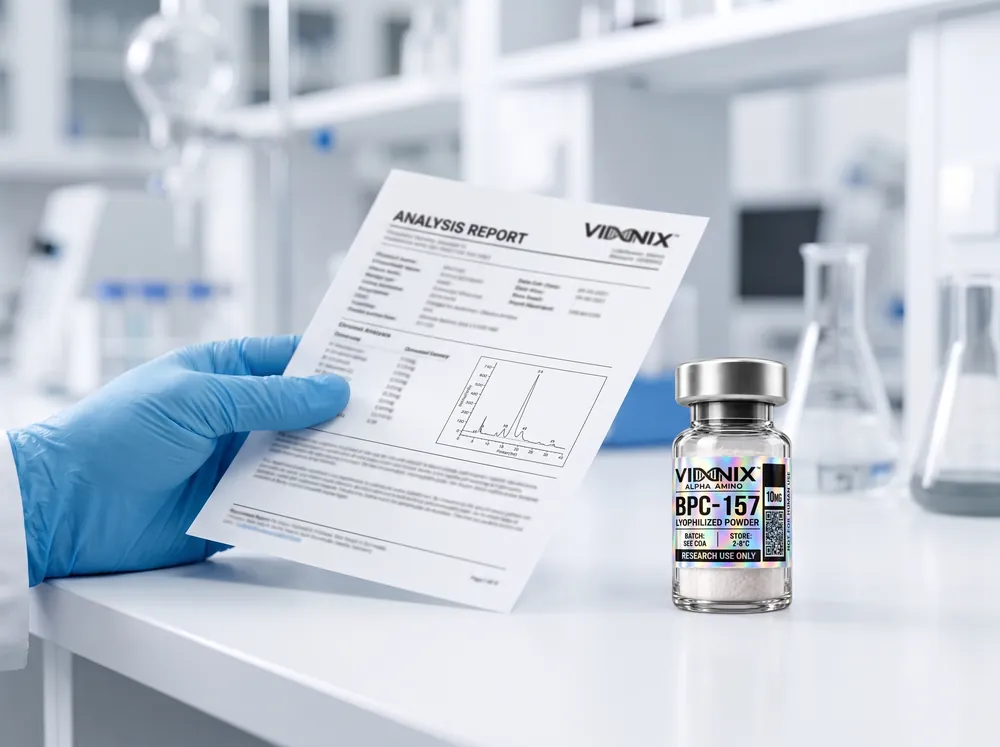
A certificate of analysis records the batch number, methods, results and test date for a single batch. Vinnix semaglutide peptide reports will go into the Vinnix COA Library as they are released, and each one covers only the batch it names. For the methods and their limits, see peptide testing and analysis.
Vinnix semaglutide is for laboratory and analytical research only, not for human or veterinary use, and it is not intended to diagnose, treat or prevent any condition. Check the batch COA before you use it in an experiment.
FAQSemaglutide FAQ
What is Semaglutide?
Semaglutide is a 31-residue analogue of human GLP-1. Using GLP-1 numbering, it has Aib at position 8, arginine at position 34 and a C18 fatty diacid side chain on lysine 26. It is the active ingredient of approved prescription medicines, but the Vinnix semaglutide peptide is a separate laboratory research material that will be documented batch by batch.
What molecular information is available for Semaglutide?
You'll find the molecular formula C187H291N45O59 and a molecular weight of 4114 g/mol (PubChem CID 56843331), CAS number 910463-68-2 and UNII 53AXN4NNHX (FDA GSRS), the 31-residue backbone sequence, and the positions of the substituted and modified residues. Every value on the page names where it came from.
What is the molecular weight of semaglutide?
PubChem gives 4114 g/mol for the formula C187H291N45O59, and that figure includes the whole fatty-acid side chain and linker. So when you read a mass spectrometry result on a COA, compare it with the complete structure. The bare GLP-1 backbone is much lighter and would give a misleading match.
How is Semaglutide researched?
Mostly by study type: medicinal chemistry and animal pharmacology, formulation studies, large randomized clinical trials, and review articles. A finding from one of those settings shouldn't be stretched to cover another. And none of the published work tells you anything about a particular Vinnix batch; only that batch's report can.
How is Vinnix Semaglutide analyzed?
Each batch report will list its own methods, usually HPLC for purity and mass spectrometry or LC-MS for identity. HPLC tells you how much of the detected material is the main component. Mass spectrometry tells you whether that main component has the mass you'd expect for the semaglutide peptide.
Where can I find the Vinnix Semaglutide COA?
Batch documents will be linked from this page and listed in the Vinnix COA Library under SM10, SM20 or SM30 as each report comes out. Before you rely on a result, check that the batch or lot number on the report matches the one on your product label.
Does a COA apply to every batch?
No. A certificate of analysis covers only the sample or batch it names. Synthesis, acylation and purification all vary from one production run to the next, so purity and peptide content can shift. One batch's result tells you nothing reliable about another batch.
REFScientific references
-
Lau J, Bloch P, Schäffer L, et al. Discovery of the Once-Weekly Glucagon-Like Peptide-1 (GLP-1) Analogue Semaglutide. J Med Chem. 2015;58(18):7370-7380. PubMed 26308095
medicinal chemistry, in vitro and animal -
Knudsen LB, Lau J. The Discovery and Development of Liraglutide and Semaglutide. Front Endocrinol (Lausanne). 2019;10:155. PubMed 31031702
review -
Buckley ST, Bækdal TA, Vegge A, et al. Transcellular stomach absorption of a derivatized glucagon-like peptide-1 receptor agonist. Sci Transl Med. 2018;10(467):eaar7047. PubMed 30429357
animal and human clinical pharmacology (formulation) -
Marso SP, Bain SC, Consoli A, et al. Semaglutide and Cardiovascular Outcomes in Patients with Type 2 Diabetes. N Engl J Med. 2016;375(19):1834-1844. PubMed 27633186
human clinical, randomized controlled trial (SUSTAIN-6) -
Wilding JPH, Batterham RL, Calanna S, et al. Once-Weekly Semaglutide in Adults with Overweight or Obesity. N Engl J Med. 2021;384(11):989-1002. PubMed 33567185
human clinical, phase 3 randomized trial (STEP 1) -
Lincoff AM, Brown-Frandsen K, Colhoun HM, et al. Semaglutide and Cardiovascular Outcomes in Obesity without Diabetes. N Engl J Med. 2023;389(24):2221-2232. PubMed 37952131
human clinical, randomized controlled trial (SELECT)
 Compound Library
 Compound Library
 Testing & Analysis
 Research Library
 Research Library
 Documentation