Key facts
- Compound
- Nicotinamide adenine dinucleotide (NAD+)
- Classification
- Dinucleotide coenzyme (not a peptide)
- Molecular formula
- C21H27N7O14P2
- Molecular weight
- 663.4 g/mol
- CAS number
- 53-84-9
- Reduced form
- NADH
- Vinnix product
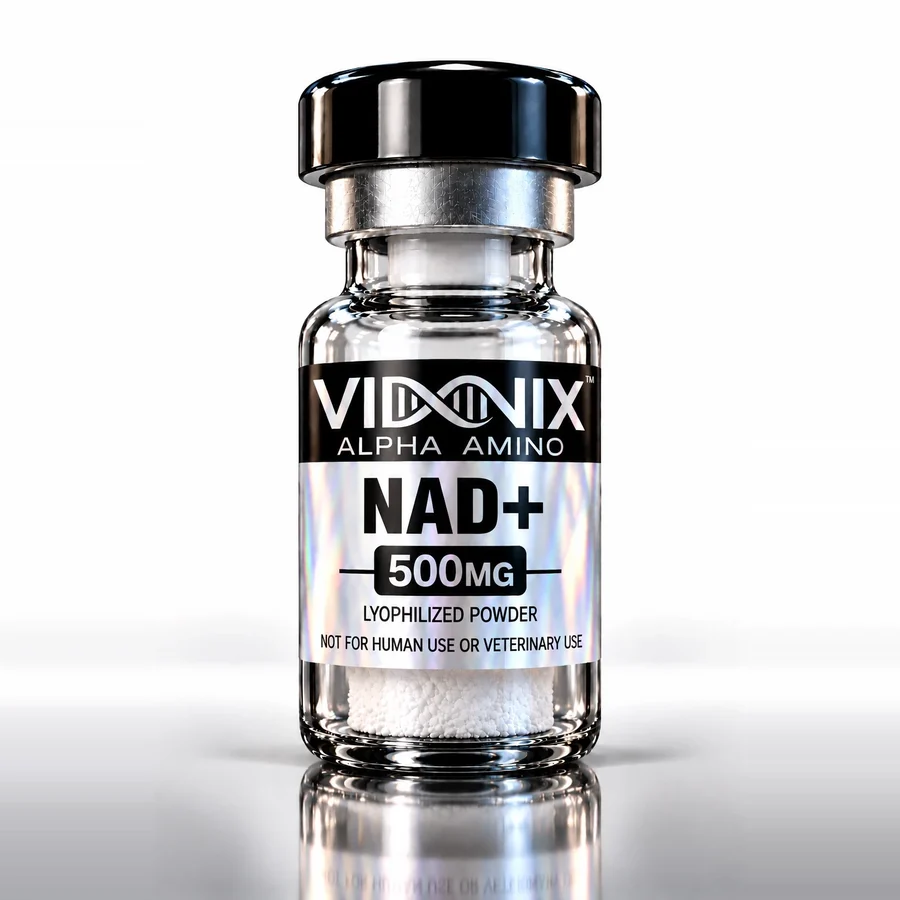
- 500 mg research vial
What Is NAD+?
NAD+ is the oxidized form of nicotinamide adenine dinucleotide. The molecule has two nucleotides, one carrying adenine and one carrying nicotinamide, linked through their phosphate groups. The plus sign refers to the positive charge on the nicotinamide ring in the oxidized state.
Unlike most products in the Vinnix catalog, NAD+ is not a peptide. It is a coenzyme, a small organic molecule that enzymes use while they work. It is listed alongside the peptides because researchers often study it in the same cell and metabolism experiments.
Vinnix supplies NAD+ as a 500 mg vial for laboratory research only. This page describes the molecule and published research, and makes no statement about effects in people or animals.
NAD+ Product Specifications
The Vinnix product is a 500 mg vial of NAD+ supplied as a lyophilized powder. Batch-specific details come from the product record as each batch is released.
| Field | Value |
|---|---|
| Compound | NAD+ (oxidized form) |
| Molecular formula | C21H27N7O14P2 |
| Molecular weight | 663.4 g/mol |
| CAS number | 53-84-9 |
| Product quantity | 500 mg per vial |
| Form | Lyophilized powder |
| Batch / lot | Shown on the vial label and batch record |
| Intended use | Laboratory research only |
NAD+ and NADH: The Redox Pair
NAD+ and NADH are two states of the same molecule. NAD+ accepts a hydride (a proton with two electrons) and becomes NADH; NADH gives it up and returns to NAD+. That swap lets the pair carry electrons between reactions in central metabolism, which is why it shows up in textbook pathways such as glycolysis and the citric acid cycle [1].
NAD+ is also consumed, not just recycled, by several enzyme families studied in the lab, including sirtuins, PARPs and CD38. Research on how cells make and use NAD+ is an active field, and published reviews describe most of that work in cell and animal models [1][2].
How NAD+ Identity Is Checked
For a small molecule like NAD+, identity and purity are usually checked with HPLC and mass spectrometry. HPLC separates NAD+ from related compounds such as NADH or nicotinamide, and mass spectrometry confirms the expected molecular mass. Our HPLC vs mass spectrometry guide explains what each method can and cannot show.
Batch reports for the Vinnix product will be listed in the COA Library as each batch is released. Match the report to the batch number printed on your vial.
FAQNAD+ (Nicotinamide Adenine Dinucleotide) FAQ
What is NAD+?
NAD+ is the oxidized form of nicotinamide adenine dinucleotide, a coenzyme made of two nucleotides joined by a pyrophosphate bridge. Its formula is C21H27N7O14P2 and its molecular weight is 663.4 g/mol.
Is NAD+ a peptide?
No. NAD+ is a dinucleotide coenzyme, not a chain of amino acids. Vinnix lists it with its research products because it is often studied alongside peptides in cell and metabolism research.
What is the difference between NAD+ and NADH?
They are the oxidized and reduced forms of the same molecule. NAD+ accepts a hydride to become NADH, and NADH donates it to become NAD+ again.
How much NAD+ is in a Vinnix vial?
500 mg per vial, supplied as a lyophilized powder for laboratory research use only.
Where can I find the Vinnix NAD+ COA?
NAD+ batch reports will be listed in the Vinnix COA Library by product and batch number as each batch is released. Match the report to the batch number on your vial.
REFScientific references
-
Verdin E. NAD+ in aging, metabolism, and neurodegeneration. Science. 2015;350(6265):1208-1213. PubMed 26785480
review -
Covarrubias AJ, Perrone R, Grozio A, Verdin E. NAD+ metabolism and its roles in cellular processes during ageing. Nat Rev Mol Cell Biol. 2021;22(2):119-141. PubMed 33353981
review
 Peptides
 Research Library
 Testing & Analysis
 Research Peptide Catalog