
Key facts
- HPLC answers
- How much of the detected material is the main component?
- MS answers
- Does the main component have the expected mass?
- HPLC output
- Chromatogram and area %
- MS output
- Mass spectrum and observed mass
- Combined technique
- LC-MS
- Common error
- Reading one result as proof of the other
Overview: HPLC vs Mass Spectrometry
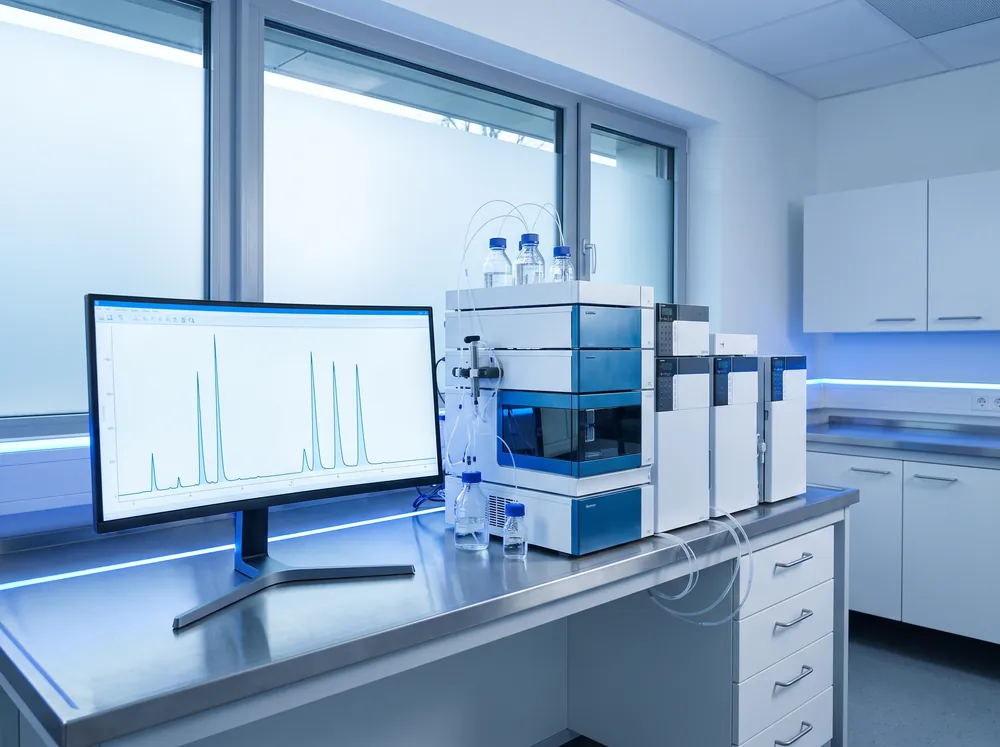
HPLC and mass spectrometry are both core methods in peptide testing, yet they measure completely different physical properties. HPLC watches how components interact with a column over time. Mass spectrometry measures the mass-to-charge ratio of ions.
| HPLC (with UV detection) | Mass spectrometry | |
|---|---|---|
| Principle | Chromatographic separation by hydrophobicity (reversed-phase) | Separation of ions by mass-to-charge ratio |
| Primary question | Purity: relative amount of main component | Identity: molecular mass of main component |
| Signal | UV absorbance vs retention time | Ion abundance vs m/z |
| Report value | Main peak area % | Observed mass vs theoretical mass |
| Quantitative? | Yes, for UV-absorbing species under one method | Not directly; ionization efficiency varies |
| Sees water and counter-ions? | No | No (not meaningfully) |
| Key blind spot | Co-eluting impurities | Same-mass (isobaric) species, poor ionizers |
HPLC: Separation and Purity
At heart, HPLC is a separation technique. It splits a sample into components by how strongly the column holds each one, and a detector turns each component into a peak whose area can be compared with the others.
The standard setup for peptides is reversed-phase HPLC with a water to acetonitrile gradient and UV detection around 214 to 220 nm [1]. Where it shines is reproducible relative quantitation. Where it falls short: a peak is just a peak, and the detector has no idea which molecule made it. A retention time that matches a reference standard counts as supporting evidence only, and that's why pharmacopeial specifications pair chromatographic purity with a separate identification test [2]. For more, read what is HPLC testing.
Mass Spectrometry: Mass and Identity
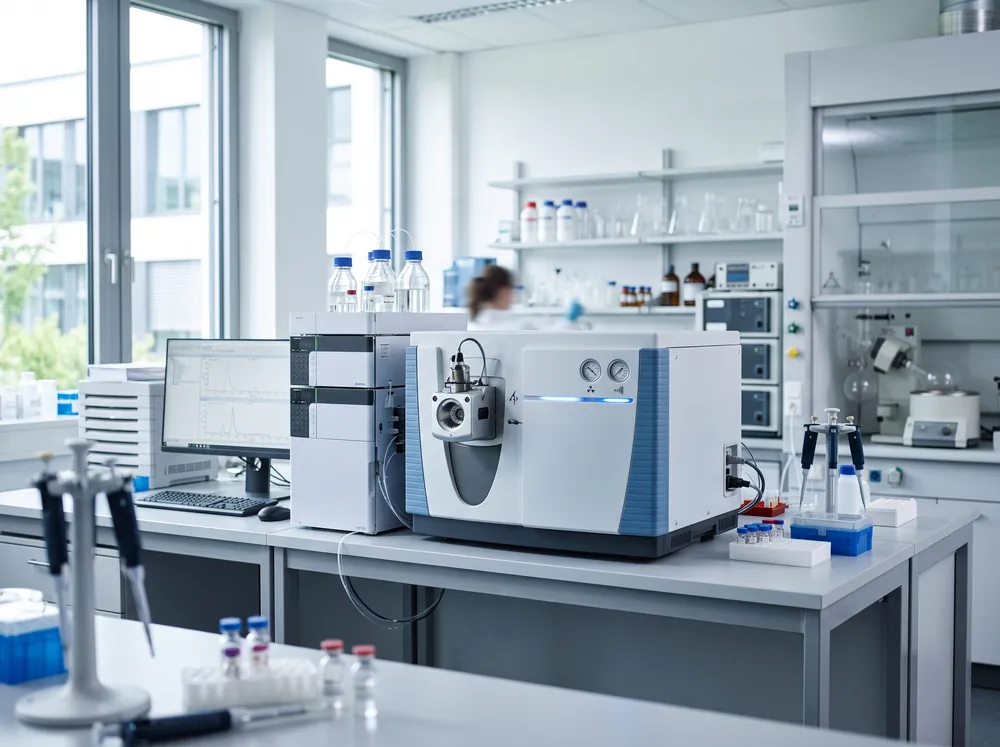
Mass spectrometry sorts ions by mass-to-charge ratio. That lets it pin down a peptide's molecular mass and, using MS/MS, its sequence as well.
Electrospray ionization is what made measuring intact peptides and proteins in solution practical [3]. When observed and theoretical mass agree, that's strong evidence the main component is right, and MS/MS fragment ladders can confirm the order of residues [4]. For purity, though, it has a real weakness. Molecules ionize with different efficiencies, so peak height isn't a dependable measure of amount, and some impurities ionize poorly or get suppressed by the main peptide [5]. For more, read what is mass spectrometry.
Why Methods Are Combined
Labs combine HPLC and mass spectrometry because each method covers the other's blind spot. HPLC can't name a peak. Mass spectrometry can't reliably tell you how much of each species is there.
What can go wrong with one method alone
- HPLC only: a well-purified wrong sequence can show 99% purity. Without a mass result, nothing in the report reveals it.
- MS only: a sample with the correct main mass can still contain a significant share of deletion sequences or other impurities that HPLC would have resolved.
- Neither: water, counter-ions and net peptide content need other methods, covered in peptide purity explained.
How HPLC and mass spectrometry are combined in practice
Labs usually pair HPLC and mass spectrometry in one of two setups. In the first, the laboratory runs a UV HPLC purity test and, separately, an MS identity test, often by direct infusion or MALDI. In the second, it runs LC-MS: the column output flows straight into the mass spectrometer, so the main peak and every impurity peak get a mass. LC-MS impurity profiling of synthetic peptides can assign specific related impurities, such as deletion or modified sequences, from their mass alone [6]. Even then, purity is normally quoted from the UV trace, since UV response is more consistent across related peptides than ionization is.
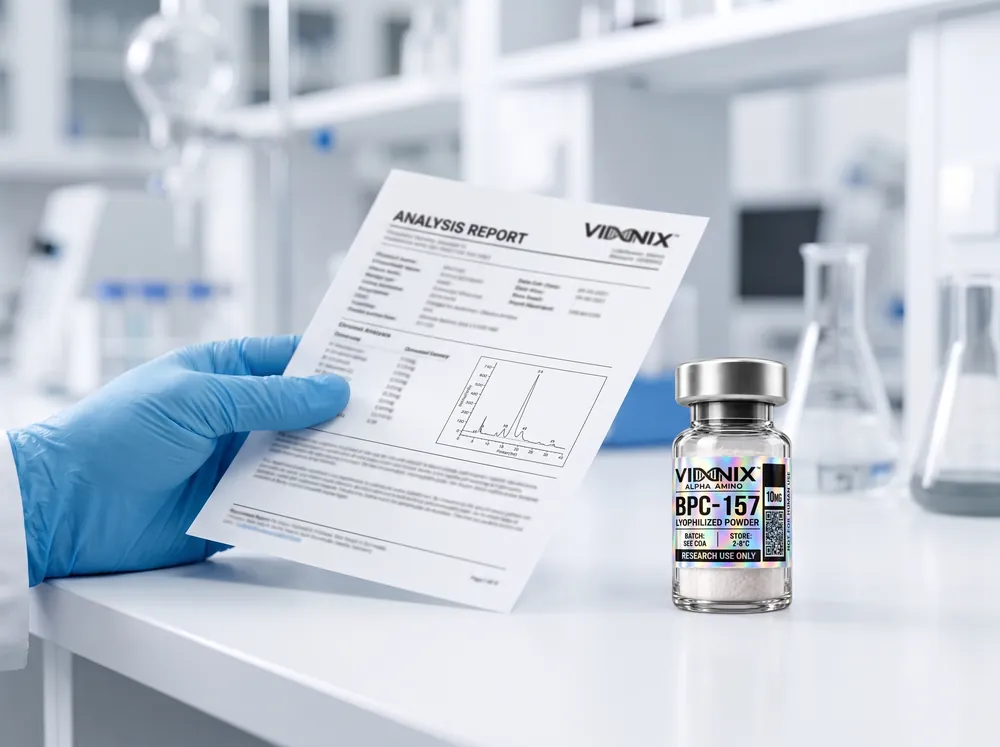
A complete identity and purity section draws on HPLC and mass spectrometry: it shows an HPLC chromatogram with area %, a mass spectrum or LC-MS trace with the observed mass, and the theoretical mass for comparison. The how to read a COA guide walks through each field.
A Worked Example: Reading Both Results Together
When you read HPLC and mass spectrometry results together, check that the purity result and the identity result describe the same batch and the same main component. The example below uses theoretical values for BPC-157 with made-up purity figures; it is not Vinnix batch data.
- The HPLC section reports a main peak at a stated retention time with 98.8% area under a stated gradient and 214 nm detection. This tells you the main component dominates the UV-detected material.
- The MS section reports a deconvoluted observed mass. For BPC-157 the theoretical monoisotopic mass is 1418.70 Da (PubChem CID 9941957), so an observed value close to that supports identity.
- If the spectrum shows the expected charge states, for example near m/z 710.36 for the doubly charged ion, the deconvolution is consistent.
- Both sections carry the same batch number and test date, so they describe the same material.
- Anything not reported, such as net peptide content or water, remains unknown rather than assumed.
Which Method Answers Which Question?
A report that includes HPLC and mass spectrometry is fastest to read if you pair each question with the method that can actually answer it.
| Question | Best suited method | Not suited |
|---|---|---|
| Is it the right peptide? | MS, LC-MS, MS/MS | HPLC alone |
| What share of detected material is the main peptide? | HPLC (UV area %) | MS alone |
| Which impurities are present? | LC-MS | HPLC alone (unassigned peaks) |
| How much peptide is in the vial? | Amino acid analysis, quantitative HPLC vs standard | HPLC area %, MS |
| Are blend components all present? | LC-MS per component | Single overall area % |
With blends such as the Wolverine blend or CJC-1295 + Ipamorelin, running both HPLC and mass spectrometry matters even more, since every component needs its own identity result. The certificate of analysis guide shows how these results sit together on the documentation.
FAQFrequently asked questions
What is the main difference between HPLC and mass spectrometry?
HPLC separates a sample's components and measures their relative amounts, so it's used for purity. Mass spectrometry measures the mass-to-charge ratio of ions, so it's used for identity. Put simply, HPLC tells you how much of the detected material is the main component, and mass spectrometry tells you what that component actually is.
Is HPLC or mass spectrometry better for peptide testing?
Neither one. They answer different questions. HPLC with UV detection is the standard way to report purity, and mass spectrometry is the standard way to confirm identity. A complete peptide report uses HPLC and mass spectrometry side by side, either as two separate tests or together as LC-MS, so that purity and identity are each backed by the right method.
Can HPLC alone confirm a peptide's identity?
No. HPLC shows peaks at particular retention times, but it doesn't measure which molecule produced them. Matching a reference standard's retention time is only supporting evidence, because different peptides can elute at similar times. Mass spectrometry is what confirms identity, by comparing the observed molecular mass with the theoretical mass.
Why is purity reported from HPLC and not from mass spectrometry?
Of HPLC and mass spectrometry, only the first gives a dependable relative measure. UV detection responds fairly evenly to the peptide bonds a peptide shares with its related impurities, so peak areas make a workable relative measure. Mass spectrometry is different. Ionization efficiency changes from molecule to molecule and other components can suppress it, so signal intensity doesn't reliably show how much of each species is present.
What is LC-MS and how does it relate to HPLC and MS?
LC-MS joins HPLC and mass spectrometry in one setup: liquid chromatography wired directly to a mass spectrometer. The chromatography separates the sample just as in HPLC, then each separated component flows into the mass spectrometer and gets measured by mass. You get retention time and mass together, which helps identify both the main peptide and the individual impurity peaks.
REFScientific references
-
Mant CT, Chen Y, Yan Z, et al. HPLC analysis and purification of peptides. Methods Mol Biol. 2007;386:3-55. PubMed 18604941
methods review -
Vergote V, Burvenich C, Van de Wiele C, De Spiegeleer B. Quality specifications for peptide drugs: a regulatory-pharmaceutical approach. J Pept Sci. 2009;15(11):697-710. PubMed 19750489
review (pharmacopeial specifications) -
Fenn JB, Mann M, Meng CK, Wong SF, Whitehouse CM. Electrospray ionization for mass spectrometry of large biomolecules. Science. 1989;246(4926):64-71. PubMed 2675315
methods review -
Steen H, Mann M. The ABC's (and XYZ's) of peptide sequencing. Nat Rev Mol Cell Biol. 2004;5(9):699-711. PubMed 15340378
review -
Pitt JJ. Principles and applications of liquid chromatography-mass spectrometry in clinical biochemistry. Clin Biochem Rev. 2009;30(1):19-34. PubMed 19224008
review -
Li M, Josephs RD, Daireaux A, et al. Structurally related peptide impurity identification and accurate quantification for synthetic oxytocin by liquid chromatography-high-resolution mass spectrometry. Anal Bioanal Chem. 2021;413(7):1861-1870. PubMed 33479819
analytical method study
 Testing & Analysis
 Research Library
 Testing & Analysis