
Key facts
- Minimum
- 2 amino acids (a dipeptide)
- Common working range
- 2 to about 50 residues
- Official upper limit
- None; the peptide and protein boundary is a convention
- Bonds vs residues
- n residues, n - 1 peptide bonds (linear chain)
- Mass rule
- Sum of residue masses + 18.02 g/mol (one water)
- Example
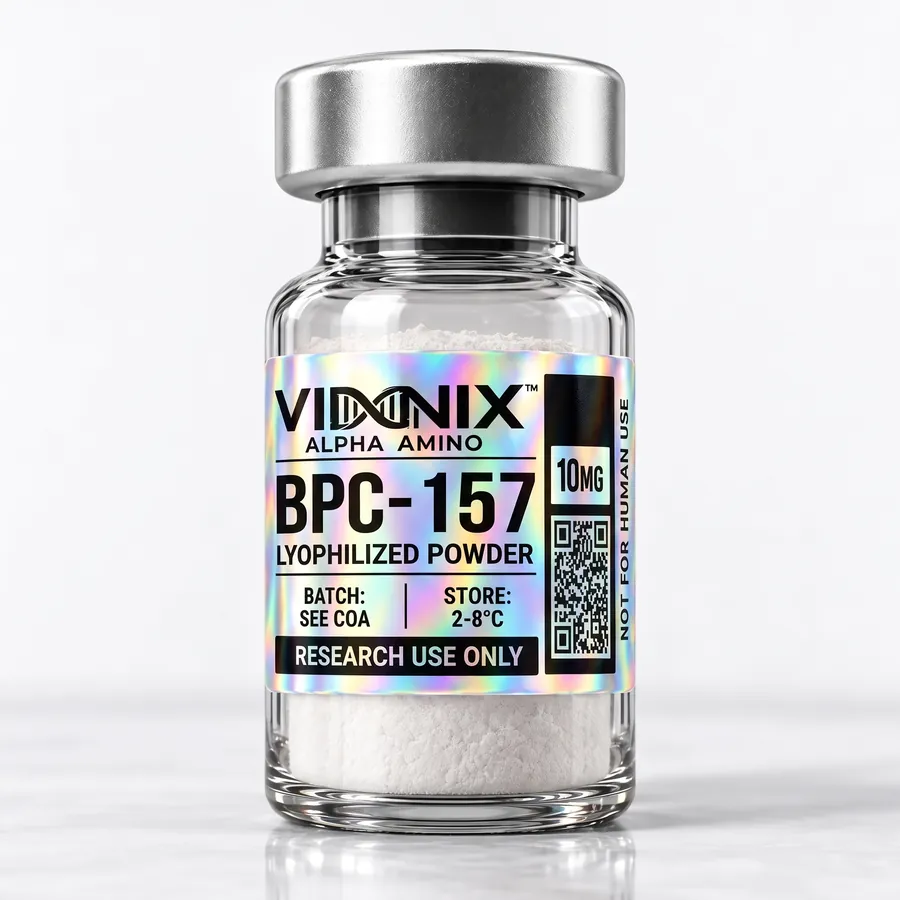
- BPC-157: 15 residues, 14 peptide bonds
The Short Answer: 2 to About 50
The count of amino acids in a peptide starts at two. By common convention it runs up to about 50.
That lower limit is firm. A peptide needs at least one peptide bond, a bond needs two amino acids, and so the smallest possible peptide is a dipeptide [1]. The upper limit is much softer. Nomenclature bodies define peptides by chemistry rather than by residue count, which means the point where a chain stops being a peptide and becomes a protein shifts from one textbook, journal or regulatory document to the next [1][2].
If you want the plain definition of the term, read What Is a Peptide?. Here we stick to the counting question.
Why Is There No Fixed Upper Limit?
Why no fixed ceiling on the amino acids in a peptide? The peptide and protein distinction rests on length and structure together, and neither one changes at a single sharp point.
A chain of a few residues is floppy and usually has no stable fold. Longer chains can fold into defined three-dimensional shapes, and folding is what most people picture when they think of a protein [2]. But it isn't tidy. Some 30 to 40 residue chains fold well, and some longer ones don't. So depending on the field, you'll see working cut-offs of 40, 50 or 100 residues. Thymosin beta-4, at 43 residues, usually gets called a protein; sermorelin, at 29, gets called a peptide.
Treat the number of amino acids in a peptide as a description, not a classification test. When a document says a compound is a peptide, check the stated sequence and residue count rather than relying on the label.
How Do You Count the Amino Acids in a Peptide?
Counting the amino acids in a peptide is straightforward: go through the written sequence and count the residues, one letter or one three-letter symbol for each.
- In one-letter code, count the letters: GEPPPGKPADDAGLV (BPC-157) has 15.
- In three-letter code, count the symbols between hyphens: Lys-Pro-Val (KPV) has 3.
- Do not count terminal groups. In Aib-His-D-2-Nal-D-Phe-Lys-NH2 (ipamorelin), the -NH2 is a C-terminal amide, not a residue, so the count is 5.
- Do count non-standard residues. Aib and D-2-Nal are residues even though they are not among the 20 standard amino acids.
- Watch for prefixes such as Ac- (acetyl) or pGlu (pyroglutamic acid). Ac- is a capping group and is not counted; pGlu is a modified residue and is counted.
If the codes themselves are unfamiliar, One-Letter vs. Three-Letter Amino Acid Codes explains them.
Residues vs Peptide Bonds
A linear peptide of n amino acids has n - 1 peptide bonds. The residue count and the bond count are always one apart.
| Residues | Peptide bonds | Size name | Example |
|---|---|---|---|
| 2 | 1 | Dipeptide | Gly-Gly |
| 3 | 2 | Tripeptide | KPV, GHK |
| 4 | 3 | Tetrapeptide | SS-31 |
| 5 | 4 | Pentapeptide | Ipamorelin |
| 15 | 14 | Pentadecapeptide | BPC-157 |
| 16 | 15 | Hexadecapeptide | MOTS-c [3] |
| 29 | 28 | (usually just 'peptide') | Sermorelin |
Cyclic peptides break the rule. Close the chain into a ring through its backbone and the bond count matches the residue count. Cyclize through side chains instead, as in PT-141, and the backbone still follows the linear rule, but extra amide or other links get added. In short, read the structure, not just the length. What Is a Peptide Bond? covers the chemistry of the bond itself.
How Does Residue Count Relate to Molecular Weight?
Molecular weight climbs roughly in step with the number of amino acids in a peptide, about 110 g/mol per residue on average. The exact figure depends on which amino acids are in the chain.
The math is easy. Add up the residue masses, then add 18.02 g/mol for the water left behind as the free terminal H and OH. Residue masses vary a lot, though: glycine comes in around 57 g/mol and tryptophan around 186 g/mol, so two peptides of equal length can have very different masses. Compare BPC-157 and MOTS-c. BPC-157 has 15 residues and a PubChem molecular weight of 1419.5 g/mol, roughly 95 per residue, since it's heavy on glycine, proline and alanine. MOTS-c has 16 residues and weighs 2174.6 g/mol, about 136 per residue, thanks to its tryptophan, tyrosine and phenylalanine.
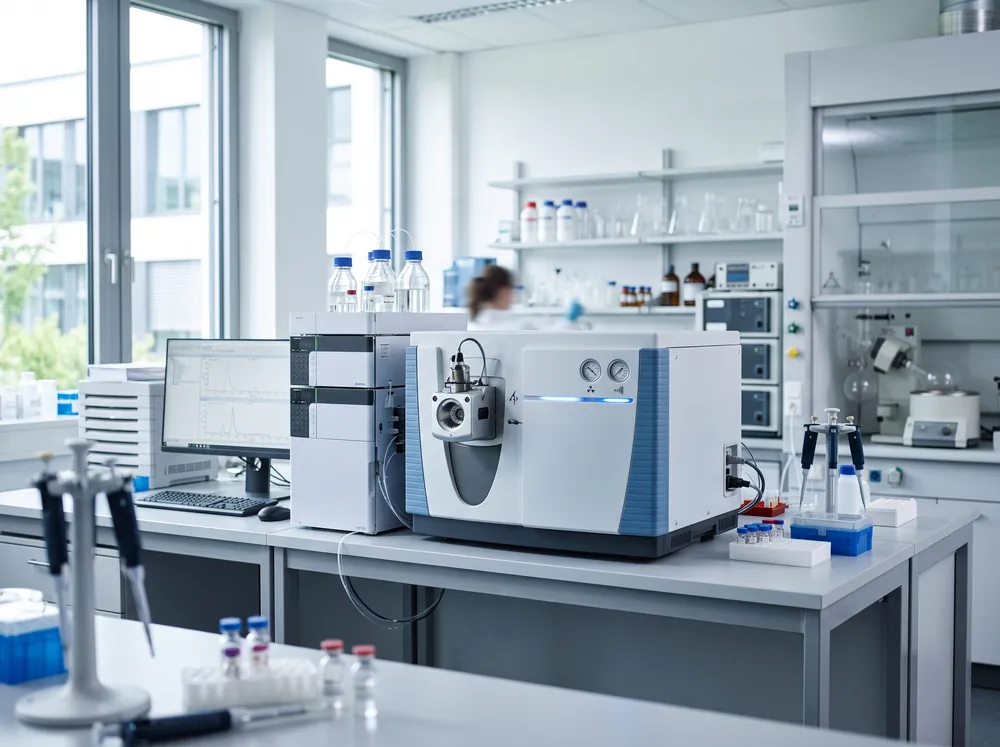
So identity testing compares the measured mass with the mass calculated from the full sequence, not from length. That comparison is what mass spectrometry does.
How Long Are Proteins, for Comparison?
Proteins tend to be far longer, usually hundreds of residues. The biggest known single chains reach tens of thousands.
Average protein length varies by organism. Proteome-wide studies find eukaryotic proteins longer on average than bacterial and archaeal ones in almost every functional category [4]. Then there's titin, the muscle protein at the far end of the scale: a single polypeptide whose human cardiac sequence predicts a mass of about 3 megadaltons [5]. Next to that, even the upper count of amino acids in a peptide, around 50, is tiny. Peptides vs. Proteins goes through the comparison in more detail.
Why the Number Matters in Analysis
In the lab, the number of amino acids in a peptide shapes how it is made, which impurities to expect and how it gets measured.
- Synthesis. Each residue added in solid-phase synthesis is another coupling step, so longer chains have more chances for deletion or truncation impurities.
- Purity. Those related impurities differ from the target by one or a few residues and are separated by HPLC. See Peptide Purity.
- Mass spectrometry. Longer peptides tend to carry more charges in electrospray ionization, producing several peaks for one molecule.
- Documentation. A Certificate of Analysis should state the sequence, so the count of amino acids in a peptide can be checked directly. See How to Read a COA.
FAQFrequently asked questions
What is the minimum number of amino acids in a peptide?
Two. The minimum number of amino acids in a peptide follows from the bond itself: every peptide needs at least one peptide bond, and a peptide bond links two amino acids; the result is a dipeptide. A single amino acid isn't a peptide, no matter how it has been modified, because there's no peptide bond tying it to another residue.
How many amino acids make a protein instead of a peptide?
There isn't an official number. Plenty of sources treat about 40 to 50 residues as the working boundary, and some use 100. Whether the chain folds into a stable structure also plays a part, so molecules near the line, like the 43-residue thymosin beta-4, get called a peptide in some places and a protein in others.
How many peptide bonds are in a peptide with 10 amino acids?
Nine. A linear peptide of n amino acids always has n - 1 peptide bonds, since each bond sits between two neighboring residues. The only change comes with backbone-cyclized peptides: closing the ring adds one more peptide bond, so the bond count then equals the residue count.
Does the -NH2 at the end of a sequence count as an amino acid?
No. A terminal -NH2 means the C-terminal carboxyl group has been turned into an amide. That nudges the formula and mass but adds no residue. So ipamorelin, written Aib-His-D-2-Nal-D-Phe-Lys-NH2, has five residues, not six. Other terminal groups, such as an N-terminal acetyl (Ac-), work the same way.
Can you estimate a peptide's molecular weight from its length?
Roughly, yes. The average residue weighs about 110 g/mol, so a 20-residue peptide usually lands somewhere near 2,000 to 2,500 g/mol. To get an exact value, add the specific residue masses plus 18.02 g/mol for water, then allow for any terminal modifications or salt forms.
How many amino acids are in BPC-157?
BPC-157 has 15 amino acids (sequence GEPPPGKPADDAGLV), which makes it a pentadecapeptide. Its 15 residues are linked by 14 peptide bonds. PubChem gives its molecular formula as C62H98N16O22 and its molecular weight as 1419.5 g/mol. Read left to right, glycine sits at the N-terminus and valine at the C-terminus.
REFScientific references
-
IUPAC-IUB Joint Commission on Biochemical Nomenclature (JCBN). Nomenclature and symbolism for amino acids and peptides. Recommendations 1983. Eur J Biochem. 1984;138(1):9-37. PubMed 6692818
nomenclature standard -
Alberts B, Johnson A, Lewis J, Raff M, Roberts K, Walter P. Molecular Biology of the Cell. 4th ed. New York: Garland Science; 2002. The Shape and Structure of Proteins. NCBI Bookshelf NBK26830. Source
textbook (NCBI Bookshelf) -
Lee C, Zeng J, Drew BG, et al. The mitochondrial-derived peptide MOTS-c promotes metabolic homeostasis and reduces obesity and insulin resistance. Cell Metab. 2015;21(3):443-454. PubMed 25738459
in vitro and animal study (cited here for sequence origin only) -
Brocchieri L, Karlin S. Protein length in eukaryotic and prokaryotic proteomes. Nucleic Acids Res. 2005;33(10):3390-3400. PubMed 15951512
database (proteome) analysis -
Labeit S, Kolmerer B. Titins: giant proteins in charge of muscle ultrastructure and elasticity. Science. 1995;270(5234):293-296. PubMed 7569978
sequencing study (cDNA)
 Research Library: Peptide Fundamentals
 Peptides
 Research Library