
Key facts
- Dipeptide
- 2 residues, 1 peptide bond
- Tripeptide
- 3 residues, 2 peptide bonds
- Oligopeptide
- A few residues; no fixed upper bound
- Polypeptide
- Long, unbranched chain; no fixed minimum
- Naming basis
- Greek number prefix + peptide
- Example tripeptides
- KPV, GHK, glutathione
Dipeptide vs Tripeptide vs Polypeptide at a Glance
It comes down to how many amino acids are in the chain: two, three, or many.
| Term | Residues | Peptide bonds | Example |
|---|---|---|---|
| Dipeptide | 2 | 1 | Gly-Gly; carnosine (beta-alanyl-histidine) |
| Tripeptide | 3 | 2 | KPV, GHK, glutathione |
| Tetrapeptide | 4 | 3 | SS-31 |
| Pentapeptide | 5 | 4 | Ipamorelin |
| Oligopeptide | A few (often up to about 10 to 20) | n - 1 | Any of the above |
| Polypeptide | Many | n - 1 | Insulin A and B chains; long peptides such as sermorelin (29) |
One rule governs the counts. A linear chain of n residues has n - 1 peptide bonds [1]. If you want the general definition of a peptide first, start with What Is a Peptide?.
What Is a Dipeptide?
A dipeptide is the smallest peptide there is: two amino acids joined by one peptide bond, with a free amino group at one end and a free carboxyl group at the other.
With 20 standard amino acids and order mattering, 400 standard dipeptides are possible. Gly-Ala and Ala-Gly share a formula but are different compounds, so even at two residues, sequence rather than composition defines the peptide. Carnosine is a naturally occurring dipeptide built from beta-alanine and histidine. Since beta-alanine is not an alpha-amino acid, carnosine also shows that the term stretches to non-standard building blocks.
What Is a Tripeptide?
Three amino acids joined by two peptide bonds make a tripeptide. Several well-studied research compounds are this size.
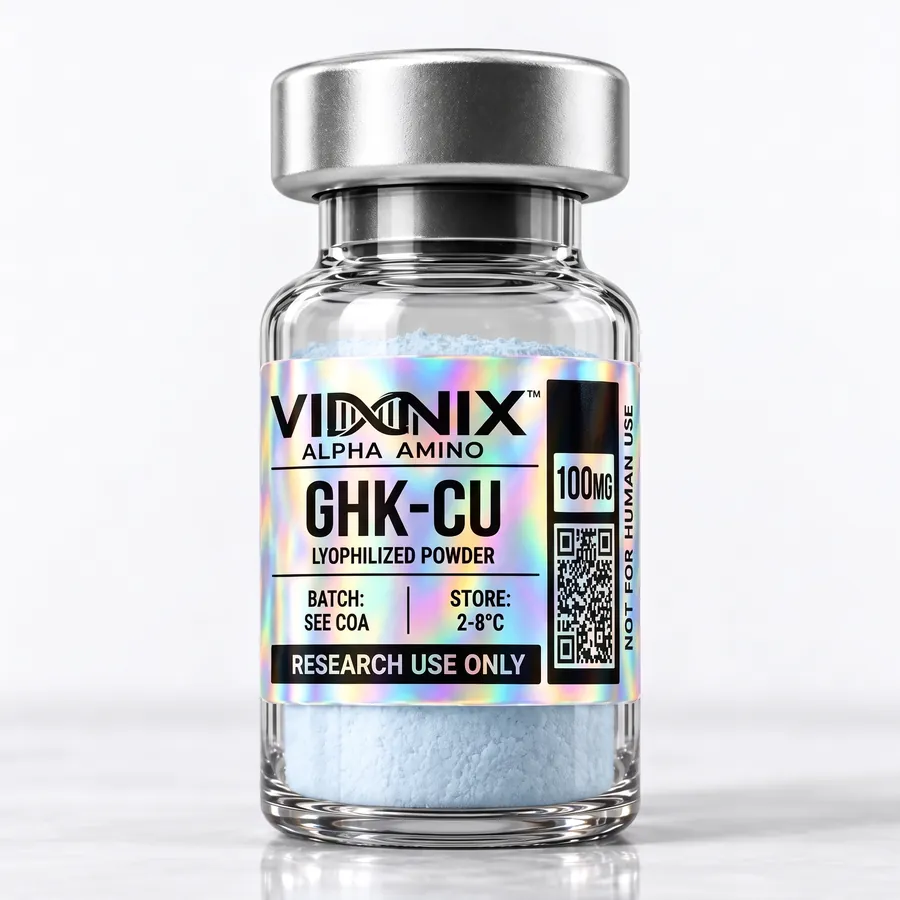
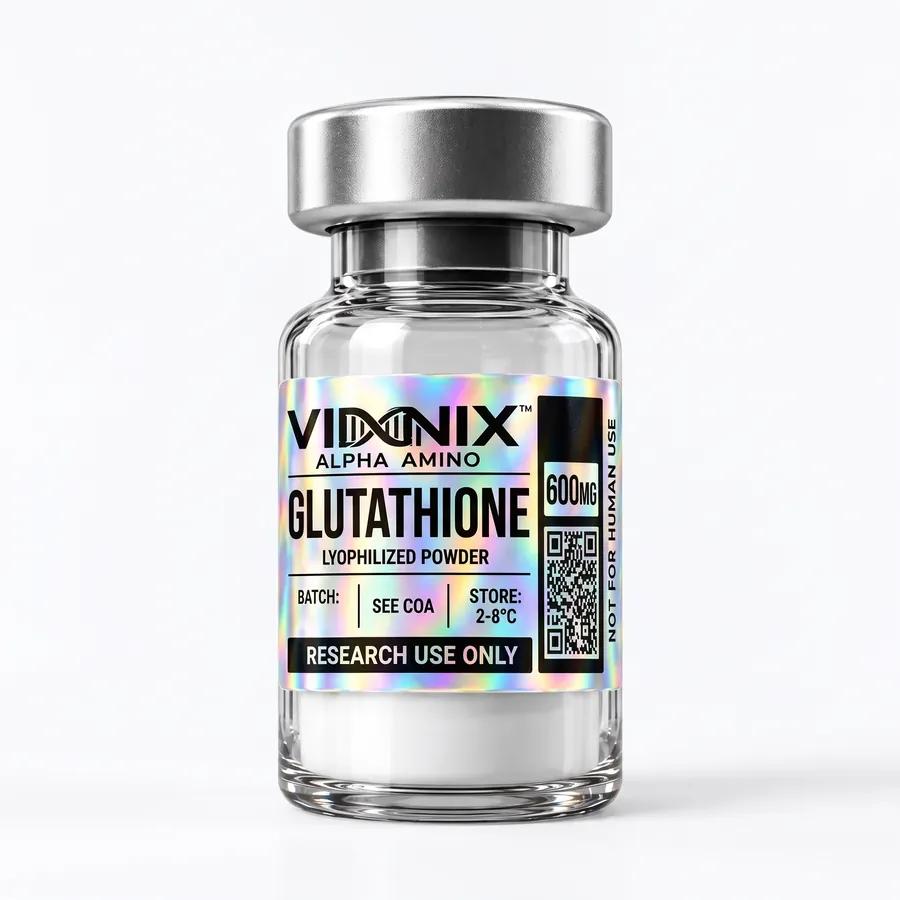
KPV (Lys-Pro-Val) matches the last three residues of alpha-melanocyte-stimulating hormone. GHK (Gly-His-Lys) forms GHK-Cu when bound to copper. Glutathione has an unusual link: its glutamate connects through the side-chain (gamma) carboxyl group instead of the usual alpha carboxyl, and that is why it is written gamma-Glu-Cys-Gly [2]. You can find all three in the Vinnix Compound Library.
KPV, GHK and glutathione are all tripeptides, but their formulas and molecular weights differ (342.4, 340.4 and 307.3 g/mol for KPV, free GHK and glutathione; PubChem CIDs 125672, 73587 and 124886). A size name tells you length and nothing more.
Tetrapeptides, Pentapeptides and Oligopeptides
Past three residues and short of a polypeptide, peptides take Greek number prefixes. Collectively they are called oligopeptides.
- Tetrapeptide (4): SS-31, written D-Arg-Dmt-Lys-Phe-NH2.
- Pentapeptide (5): ipamorelin, Aib-His-D-2-Nal-D-Phe-Lys-NH2.
- Heptapeptide (7): PT-141 is described as a cyclic heptapeptide.
- Decapeptide (10), pentadecapeptide (15): BPC-157 has 15 residues and is called a pentadecapeptide.
Oligo means few. Nobody has agreed on where an oligopeptide ends and a polypeptide begins. Sources use 10, 20 or more residues, and the IUPAC-IUB recommendations set no number [1]. Beyond about twelve the prefixes get unwieldy, so longer chains are usually described by residue count instead, as in a 29-residue peptide.
When Is a Chain Called a Polypeptide?
Usually when it is long, or when it is being discussed as one chain within a larger protein.
Unlike dipeptide and tripeptide, polypeptide does not mark a size threshold. It simply describes a long, unbranched chain. In practice it gets applied to chains of a few dozen residues and up, and to each separate chain of a multi-chain protein such as insulin, whose A and B chains have 21 and 30 residues [3]. Our polypeptide guide goes deeper on the term, and Peptides vs. Proteins explains where proteins begin.
How Do Size Names Relate to Molecular Weight?
Each added residue contributes its own mass, so molecular weight rises with size. The exact value depends on which amino acids are added.
Here is a handy rule: the molecular weight of any linear peptide is the sum of its residue masses plus 18.02 g/mol for the terminal H and OH. Two glycines joined as a dipeptide come to about 132 g/mol. Tripeptides in the Vinnix library run from 307.3 g/mol (glutathione) to 342.4 g/mol (KPV). At 15 residues, BPC-157 weighs 1419.5 g/mol, roughly ten times a tripeptide. Composition always sets the exact figure, so you cannot predict mass from a size name. Mass Spectrometry explains how mass is measured.
Common Mistakes With Size Terms
Two habits cause most of the errors: counting bonds instead of residues, and counting modifications as if they were residues.
- Counting bonds. A tripeptide has three residues and two bonds, not three bonds.
- Counting caps. Ac- and -NH2 are terminal groups, not residues. SS-31 is still a tetrapeptide.
- Ignoring non-standard residues. Aib, Dmt and D-amino acids are residues, and they count.
- Ignoring cyclization. Closing the backbone into a ring adds a bond, so a backbone-cyclic peptide has as many bonds as residues.
- Confusing copper complexes. GHK-Cu is a tripeptide bound to copper. The copper is not a residue.
For the written conventions behind these counts, see Understanding Peptide Sequences and How Many Amino Acids Are in a Peptide?.
Why Size Terms Matter in Analysis
In the lab, short and long peptides behave differently during synthesis, separation and mass measurement.
Dipeptides, tripeptides and other very small peptides are polar and can elute early in reversed-phase HPLC, so methods are adjusted to retain them. Longer peptides open the door to more deletion and truncation impurities, each a residue or two off from the target. In mass spectrometry, small peptides usually show up as singly charged ions, while longer chains spread across several charge states. When a Certificate of Analysis states the full sequence, you can check the size term against the actual structure.
FAQFrequently asked questions
What is the difference between a dipeptide and a tripeptide?
A dipeptide has two amino acids joined by one peptide bond. A tripeptide has three, joined by two. Both are oligopeptides. That extra residue brings a second bond and a new side chain, so the tripeptide differs from the dipeptide in formula, mass and chemical behavior.
Is a tripeptide a polypeptide?
Not in normal usage. A tripeptide is a very short oligopeptide, and polypeptide is kept for long chains or for individual chains within a protein. Chemically, they're all peptides held together by the same amide bonds. Still, calling a three-residue molecule a polypeptide would mislead readers.
How many peptide bonds are in a tripeptide?
Two. A linear tripeptide has three residues, so it has two peptide bonds: one between the first and second residues and one between the second and third. In general, a linear chain of n residues has n - 1 bonds.
What comes after tripeptide?
Tetrapeptide (4 residues), then pentapeptide (5), hexapeptide (6), heptapeptide (7), octapeptide (8), nonapeptide (9) and decapeptide (10). Longer names keep the same Greek pattern, like pentadecapeptide for 15. Past about a dozen residues, though, most writers just state the residue count.
What is an oligopeptide?
An oligopeptide is a peptide made of a few amino acids. There's no single agreed upper limit; some sources put it near 10 residues, others at 20. Dipeptides, tripeptides and tetrapeptides all qualify. The term is handy when you want to describe a short chain without giving an exact count.
Is glutathione a normal tripeptide?
Glutathione is a tripeptide of glutamate, cysteine and glycine, but its first link is unusual. The glutamate connects through its side-chain gamma carboxyl group instead of its alpha carboxyl, which is why it's written gamma-Glu-Cys-Gly. It still counts as three residues joined by two amide bonds.
REFScientific references
-
IUPAC-IUB Joint Commission on Biochemical Nomenclature (JCBN). Nomenclature and symbolism for amino acids and peptides. Recommendations 1983. Eur J Biochem. 1984;138(1):9-37. PubMed 6692818
nomenclature standard -
Ryle AP, Sanger F, Smith LF, Kitai R. The disulphide bonds of insulin. Biochem J. 1955;60(4):541-556. PubMed 13249947
in vitro chemical study
 Peptides
 Peptides