
Key facts
- Typical peptide column
- C18 bonded silica, 3 to 5 µm particles
- Operating pressure
- Conventional HPLC up to about 400 bar; UHPLC around 1,000 bar or more
- Elution
- Gradient of acetonitrile in water with 0.1% TFA
- Detection
- UV at 214 to 220 nm (peptide bond); 280 nm for Trp and Tyr
- Pore size
- About 100 to 130 Å for small peptides; 300 Å for larger ones
- Output
- Chromatogram of detector signal vs. retention time
How does HPLC work, step by step?
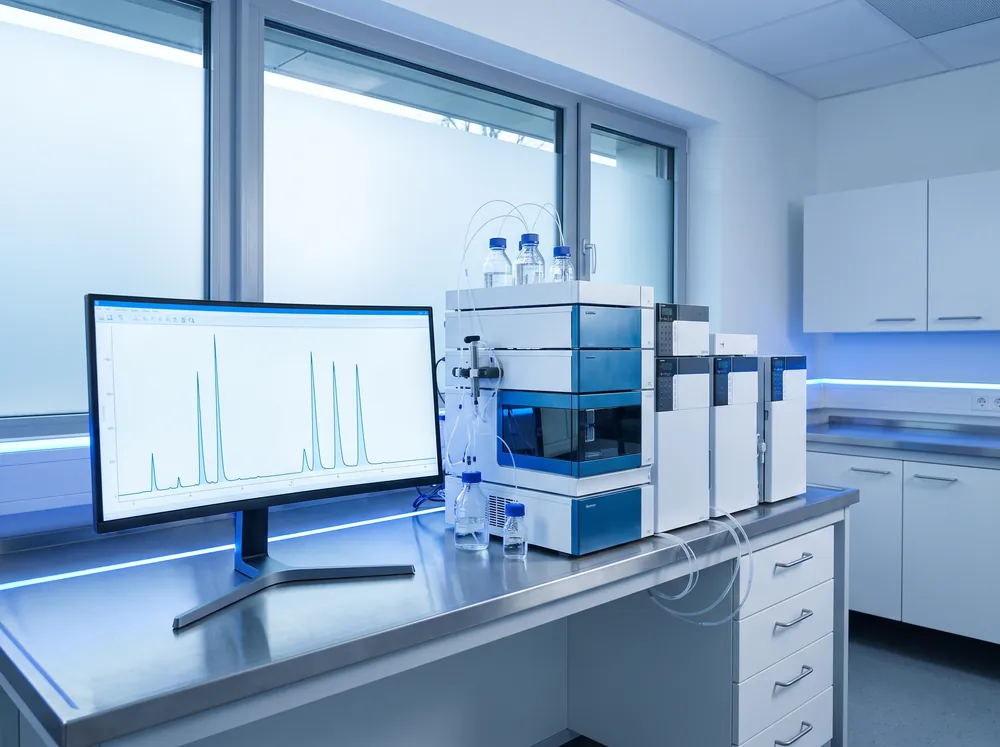
So how does HPLC work in practice? A run takes the sample through six stages, and a different part of the instrument handles each one. The core principle is borrowed from chromatography. What HPLC adds is pressure, very fine particles and tight control.
- Mobile phase preparation. Two solvents are prepared, usually water and acetonitrile, each with an acid additive such as 0.1% trifluoroacetic acid (TFA), and degassed so bubbles do not disturb the flow.
- Pumping. High-pressure pumps deliver a constant flow, often around 1 mL per minute on a standard analytical column, and mix the two solvents in a programmed ratio.
- Sample introduction. An autosampler loads a few microliters of dissolved sample into the flowing stream.
- Separation. The stream passes through the column, where components are retained for different lengths of time.
- Detection. Each component leaving the column passes a detector, most often a UV absorbance detector, which converts the amount present into a signal.
- Data processing. Software plots signal against time, finds the peaks and integrates their areas.
You'll find the system components summarized in a table on the HPLC testing page. Here the question is narrower: how does HPLC work inside the run itself?
Why does HPLC need high pressure?
Why the pressure? The tiny particles that give sharp separations also resist flow. Smaller, more uniform particles cut the distance a molecule has to diffuse to reach the stationary surface and come back. Bands stay narrow, and components that sit close together can be resolved.
So how does HPLC work so much faster than the old gravity columns? Early liquid chromatography relied on large particles and gravity, and a separation could take hours [2]. Pack a column with particles a few micrometers across and you need pumps that deliver several hundred bar. Ultra-high-performance systems (UHPLC) push further still, with particles below 2 µm and pressures around 1,000 bar or more, trading pressure for speed and resolution [2].
How do peptides separate in reversed-phase HPLC?
Reversed-phase HPLC separates peptides by hydrophobicity. They stick to a nonpolar stationary phase and let go as the mobile phase becomes more organic [3]. That stationary phase is silica bonded with hydrocarbon chains, usually 18 carbons long (C18).
How does HPLC work for peptides specifically? They behave in a distinctive way on these columns. They don't drift along steadily. Each one stays bound until the acetonitrile hits a fairly specific concentration, then elutes, which is why peptide methods run gradients instead of a fixed solvent mix [1][3]. Retention depends on the whole sequence. Swap one residue, oxidize a methionine or lose a single amino acid during synthesis, and the retention time can move far enough to pull the variant away from the main peptide.
Then there's the acid additive. TFA pairs with positively charged groups on the peptide, which sharpens peaks and improves retention [1]. Pore size gets matched to molecule size as well: roughly 100 to 130 Å pores suit small peptides, while 300 Å pores let larger peptides and proteins get at the bonded surface [1].
Gradient vs. isocratic elution
In isocratic elution the mobile phase composition stays fixed. In gradient elution it changes as the run goes on. Peptide purity methods use gradients almost without exception.
| Feature | Isocratic | Gradient |
|---|---|---|
| Mobile phase | Fixed composition | Organic share increases over time |
| Best for | Few components with similar retention | Mixtures with a wide range of hydrophobicity |
| Peak shape for late eluters | Broad | Kept sharp |
| Typical peptide use | Rare | Standard, e.g. a slow rise in acetonitrile over 20 to 40 minutes |
| Baseline | Flat | Can drift as solvent absorbance changes |
Make the gradient shallow and the peaks spread out, which helps resolve closely related impurities, though runs take longer. When a gradient finishes, the column goes back to starting conditions and re-equilibrates before the next sample.
How does the detector see peptides?
How does HPLC work at the detector? Most peptide methods detect the peptide bond itself. It absorbs ultraviolet light strongly between about 200 and 220 nm, so reading at 214 to 220 nm picks up every peptide and peptide-related impurity, aromatic residues or not [1].
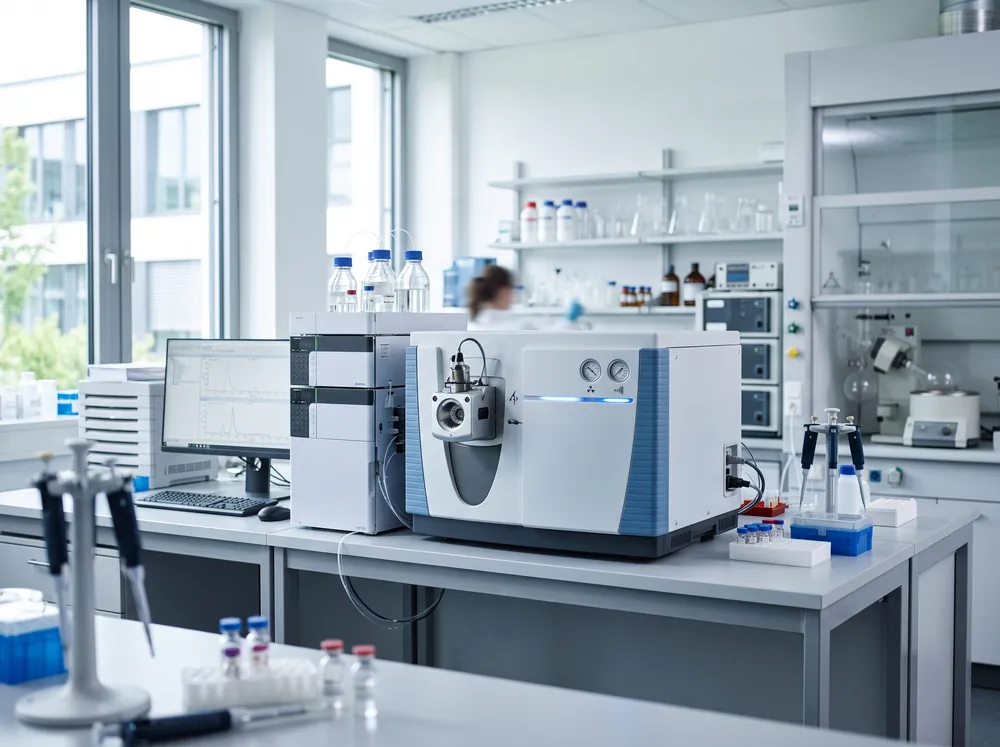
A second wavelength, 280 nm, responds to tryptophan and tyrosine side chains. It's more selective, but it misses any peptide without those residues. Photodiode array detectors capture the full spectrum at once, which helps when you want to check whether a peak is spectrally uniform. Put a mass spectrometer in the detector's place and you have LC-MS. In that setup, formic acid often replaces TFA, since TFA suppresses ionization.
Which method settings change the result?
How does HPLC work when someone adjusts the method? Change almost any setting and retention times move. Several settings shift the purity figure too. A result only means something when you know the method behind it.
| Parameter | Effect if changed |
|---|---|
| Column chemistry (C18, C8, phenyl) | Changes selectivity; impurities may move or merge with the main peak |
| Gradient slope | Shallower spreads peaks apart; steeper shortens run and can merge peaks |
| Column temperature | Shifts retention and can sharpen peaks |
| Acid additive (TFA vs. formic acid) | Alters peak shape and retention |
| Detection wavelength | Changes relative peak sizes |
| Sample amount | Overloading broadens and distorts the main peak |
In regulated laboratories, these settings are controlled, and system suitability checks confirm performance before each sequence. The reason goes back to separation theory: Martin and Synge's partition model already linked separation quality to how evenly and quickly components trade places between the phases [4]. To see how this plays out in reported purity, read peptide purity and the peptide testing overview.
FAQFrequently asked questions
How does HPLC separate compounds?
How does HPLC work at the most basic level? It pushes compounds in a liquid stream through a column packed with fine particles. Each compound interacts with the particle surface to a different extent, so some get held back longer than others. That means they leave the column at different times, called retention times, and a detector records each one as its own peak.
Why is it called high-performance liquid chromatography?
The name comes from performance: columns packed with very small, uniform particles give far sharper and faster separations than the old gravity-fed liquid chromatography. Pushing liquid through those columns takes high pressure, so the method was once also called high-pressure liquid chromatography. Both names mean the same technique.
What is the mobile phase in peptide HPLC?
Usually water and acetonitrile, each with about 0.1% trifluoroacetic acid. The run begins mostly aqueous, and the acetonitrile fraction climbs during a gradient. Each peptide stays bound to the column until the acetonitrile reaches a level that releases it, so peptides come off in order of hydrophobicity.
What is a C18 column?
It's an HPLC column packed with silica particles whose surface carries bonded hydrocarbon chains 18 carbon atoms long. Those chains make the surface hydrophobic, and that's the basis of reversed-phase separation. For peptides, C18 is the most common stationary phase; C8 and phenyl phases are alternatives that shift selectivity.
Why is 214 nm used in peptide HPLC?
The peptide bond absorbs ultraviolet light strongly between 200 and 220 nm. Detecting near 214 nm therefore picks up every peptide and peptide-related impurity, even ones without aromatic amino acids. Detection at 280 nm depends on tryptophan and tyrosine side chains and would miss peptides that lack them, so low-UV detection is the standard for purity work.
What is gradient elution?
It means the mobile phase composition changes during the HPLC run, usually by raising the share of an organic solvent like acetonitrile. That way, weakly and strongly retained components both elute in a single run, and late peaks stay sharp. Peptides elute over a narrow range of solvent strength, so purity methods nearly always use gradients. How does HPLC work for peptides, then? Largely through the gradient.
REFScientific references
-
Mant CT, Chen Y, Yan Z, et al. HPLC analysis and purification of peptides. Methods Mol Biol. 2007;386:3-55. PubMed 18604941
methods review -
Engelhardt H. One century of liquid chromatography. From Tswett's columns to modern high speed and high performance separations. J Chromatogr B Analyt Technol Biomed Life Sci. 2004;800(1-2):3-6. PubMed 14753203
historical review -
Aguilar MI. Reversed-phase high-performance liquid chromatography. Methods Mol Biol. 2004;251:9-22. PubMed 14704435
methods chapter -
Martin AJ, Synge RL. A new form of chromatogram employing two liquid phases: a theory of chromatography. 2. Application to the micro-determination of the higher monoamino-acids in proteins. Biochem J. 1941;35(12):1358-1368. PubMed 16747422
original research (method development)
 Research Library
 Research Library
 Testing & Analysis