
Key facts
- Also called
- Amino terminus, N-terminal end
- Chemical group
- Free alpha-amino group of the first residue
- Position in sequence
- Written first (leftmost)
- Written as
- H- (free amine) or a prefix such as Ac-
- Common modifications
- Acetylation (+42.01 Da), pyroglutamate formation
- Analytical relevance
- Edman sequencing; b-ion series in MS/MS
N-Terminus Definition
The N-terminus is the start of a peptide chain: the first amino acid residue, whose alpha-amino group is not part of a peptide bond [1].
Every amino acid has an amino group and a carboxyl group. Link them up and each peptide bond consumes the carboxyl group of one residue plus the amino group of the next. In a linear chain, that leaves one spare amino group at one end and one spare carboxyl group at the other. The amino end is the N-terminus, and the carboxyl end is the C-terminus.
Every separate chain gets its own amino end, so a two-chain protein such as insulin has two. That is exactly what Sanger picked up in 1945. He tagged the free amino groups, found glycine and phenylalanine at chain ends, and concluded that insulin contains two chains [2].
Why Are Sequences Written From the N-Terminus?
Partly it is convention: IUPAC-IUB says so. It also matches the direction in which cells make proteins [1][3].
A ribosome adds each new amino acid to the free carboxyl end of the growing chain. The N-terminal residue is made first, and the chain grows toward the C-terminus [3]. Writing sequences the same way keeps the page in step with the biology. In BPC-157 (GEPPPGKPADDAGLV) the N-terminal residue is glycine; in MOTS-c (MRWQEMGYIFYPRKLR) it is methionine.
In the lab it runs the other way. With solid-phase peptide synthesis the C-terminal residue is anchored to the resin and each new residue goes on toward the amino end, which makes the N-terminal residue the last one attached.
Charge and Chemistry at the N-Terminus
A free amino end is basic. Near neutral pH it usually carries a positive charge.
The terminal alpha-amino group in a peptide typically has a pKa of roughly 8 to 9, so at pH 7 most molecules carry it as -NH3+. That charge feeds into the peptide's net charge and solubility, and into how long it is retained in reversed-phase HPLC. Cap that amine, say with an acetyl group, and the charge disappears. Retention time and ionization behavior can shift noticeably as a result.
Common N-Terminal Modifications
Few positions get modified as often as this one, in natural proteins and synthetic peptides alike.
| Modification | How it is written | Mass change | Notes |
|---|---|---|---|
| Free amine | H- or no prefix | None | Default unmodified state |
| Acetylation | Ac- | +42.01 Da | Very common in eukaryotic proteins [4] |
| Pyroglutamate | pGlu | -17.03 Da from Gln; -18.01 Da from Glu | Cyclized N-terminal Gln or Glu |
| Methionine removal | (Met absent) | -131.04 Da | Initiator Met cleaved after synthesis |
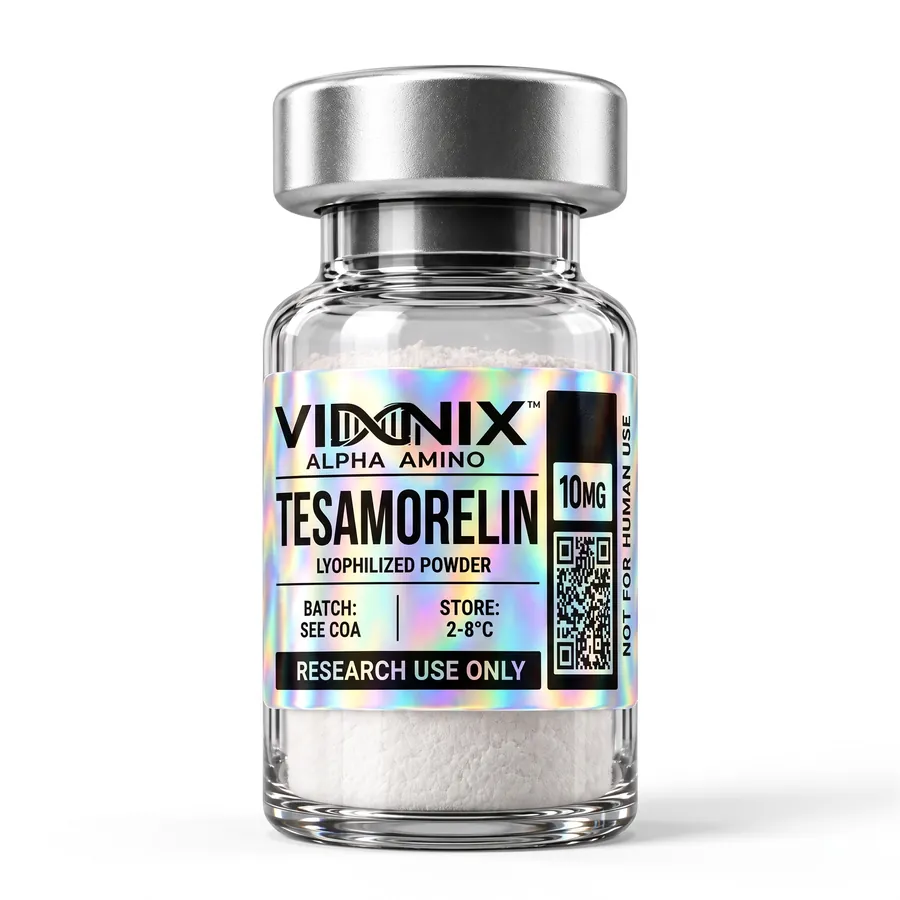
| Acyl groups | Prefix name | Varies | Tesamorelin carries trans-3-hexenoyl |
Acetylation in particular is everywhere in human cells. A proteomics study found it on 84% of the human protein N-termini analyzed, against 57% in yeast [4]. Among synthetic examples on Vinnix pages are PT-141, whose structure begins Ac-Nle, and Tesamorelin, whose first residue carries a trans-3-hexenoyl group that distinguishes it from natural GHRH.
An N-terminal group belongs to the compound's identity. It changes the molecular formula and the mass, so it has to appear in the written sequence and be accounted for when anyone checks mass spectrometry results.
How the N-Terminus Is Used in Analysis
Classic sequencing chemistry starts at the free amino end, and that end is one of the two anchors for reading fragment spectra.
- Edman degradation. Phenyl isothiocyanate reacts with the free N-terminal amine and clips off one residue per cycle, reading the sequence from that end inward. Automated in the 1960s as the protein sequenator [5], it cannot start on a blocked (acetylated or pyroglutamate) N-terminus.
- Tandem mass spectrometry. When a peptide fragments along its backbone, the pieces that keep the amino end are named a, b and c ions under the standard nomenclature [6]. With a complete b-ion ladder you can read the sequence from the N-terminal side. See Mass Spectrometry.
- Intact mass. An unexpected +42 Da shift often points to an acetylated N-terminus; -17 Da on an N-terminal Gln suggests pyroglutamate.
A Certificate of Analysis summarizes these checks, and our guide to reading a COA explains where to find them.
Finding the N-Terminus in a Written Sequence
Look at the first symbol on the left, along with any prefix attached to it. In a correctly written sequence, that is the N-terminal residue.
| Compound | Written sequence (start) | N-terminal residue | N-terminal group |
|---|---|---|---|
| KPV | Lys-Pro-Val | Lysine | Free amine |
| BPC-157 | GEPPPG... | Glycine | Free amine |
| MOTS-c | MRWQEM... | Methionine | Free amine |
| Ipamorelin | Aib-His-... | Aib (2-aminoisobutyric acid) | Free amine |
| SS-31 | D-Arg-Dmt-... | D-arginine | Free amine |
| PT-141 | Ac-Nle-cyclo[...] | Norleucine | Acetyl cap |
Watch two prefixes when you read this column. D- belongs to the residue and tells you its configuration, nothing about the terminus. Ac- belongs to the terminus and tells you the amino group is capped. For the codes themselves, see One-Letter vs. Three-Letter Amino Acid Codes.
N-Terminus vs Amino Group vs Side-Chain Amine
The N-terminus means one particular amino group: the one on the first residue's alpha carbon. Other amines in the chain are something else.
Lysine side chains carry amino groups too, and the reagents used to modify the terminal amine will happily react with them. Careful nomenclature handles this by writing N-alpha for the terminal amine and N-epsilon for the lysine side chain [1]. In CJC-1295 with DAC, for instance, the linker is attached to a lysine side chain rather than the N-terminus; see CJC-1295. The wider conventions are in Understanding Peptide Sequences.
FAQFrequently asked questions
What is the N-terminus of a peptide?
It is the start of the chain, where the first amino acid keeps a free amino group, and it is written first in any sequence. Every other residue spends its amino group on a peptide bond, so the N-terminal residue is the only one whose alpha-amino group remains unlinked, unless it has been modified.
Is the N-terminus positive or negative?
Near neutral pH, a free N-terminus is usually positive. Its terminal amino group typically has a pKa of roughly 8 to 9, so most molecules carry it as -NH3+ at pH 7. Capping it with an acetyl group removes that charge.
Why do sequences start at the N-terminus?
IUPAC-IUB conventions say sequences run from the N-terminus to the C-terminus, and biology agrees, since ribosomes build chains starting at the amino end. Writing in that direction means the first residue on the page is also the first residue the cell makes.
What does Ac- mean at the start of a peptide sequence?
Ac- means the N-terminal amino group carries an acetyl group. Acetylation adds about 42.01 Da, removes the terminal positive charge and blocks Edman sequencing. Since it is part of the molecule's identity, it belongs in the written structure and in the calculated mass every time.
What is a blocked N-terminus?
A blocked N-terminus is one whose amino group has been modified, most often by acetylation or by cyclization of glutamine or glutamic acid into pyroglutamate. Blocked termini cannot react in Edman degradation, so their sequence is usually confirmed by mass spectrometry instead.
How many N-termini does a protein have?
One per polypeptide chain. A single-chain protein has one N-terminus, and a protein built from several chains has one for each. Insulin has two N-termini because it consists of an A chain and a B chain joined by disulfide bonds, which is how early end-group labeling showed that insulin contains two chains.
REFScientific references
-
IUPAC-IUB Joint Commission on Biochemical Nomenclature (JCBN). Nomenclature and symbolism for amino acids and peptides. Recommendations 1983. Eur J Biochem. 1984;138(1):9-37. PubMed 6692818
nomenclature standard -
Sanger F. The free amino groups of insulin. Biochem J. 1945;39(5):507-515. PubMed 16747948
in vitro chemical study -
Alberts B, Johnson A, Lewis J, Raff M, Roberts K, Walter P. Molecular Biology of the Cell. 4th ed. New York: Garland Science; 2002. From RNA to Protein. NCBI Bookshelf NBK26829. Source
textbook (NCBI Bookshelf) -
Arnesen T, Van Damme P, Polevoda B, et al. Proteomics analyses reveal the evolutionary conservation and divergence of N-terminal acetyltransferases from yeast and humans. Proc Natl Acad Sci U S A. 2009;106(20):8157-8162. PubMed 19420222
proteomics study (human and yeast cells, in vitro) -
Edman P, Begg G. A protein sequenator. Eur J Biochem. 1967;1(1):80-91. PubMed 6059350
analytical methods paper -
Roepstorff P, Fohlman J. Proposal for a common nomenclature for sequence ions in mass spectra of peptides. Biomed Mass Spectrom. 1984;11(11):601. PubMed 6525415
nomenclature proposal (mass spectrometry)
 Research Library: Peptide Fundamentals
 Research Library
 Peptides