
Key facts
- Also called
- Freeze-drying
- Principle
- Sublimation of ice under reduced pressure
- Stages
- Freezing, primary drying, secondary drying
- Triple point of water
- 0.01 °C and about 611 Pa
- Typical appearance
- White powder or porous cake
- Key formulation limit
- Collapse temperature
What is lyophilization?
Lyophilization dries material while it is frozen. The water becomes ice first, and then the ice leaves as vapor under vacuum. Since the material never goes through a warm liquid stage on the way, the solid that remains keeps an open, porous structure.
It is the most common route to solid protein and peptide materials. Many of these molecules are less stable in solution, where water joins in reactions such as hydrolysis and deamidation, while a dry solid generally changes more slowly [2]. The catch is that freezing and drying put their own stresses on the molecule, so a cycle has to be designed for the material, not just switched on [2].
For peptides there is a second, more practical reason: it is the routine last step after purification. Fractions collected from preparative HPLC are aqueous acetonitrile solutions, and freeze-drying them yields the solid peptide [5]. So lyophilization sits right next to peptide synthesis and purification.
How does freeze-drying work?
At low enough pressure, ice can turn straight into vapor. That is the whole basis of the method. Below the triple point of water, about 0.01 °C and 611 pascals, liquid water cannot exist in equilibrium, so when you add heat to frozen material under vacuum, it sublimes instead of melting.
A freeze-dryer gives the operator two dials: the temperature of the shelves the containers sit on, and the pressure in the drying chamber. A very cold condenser catches the water vapor as ice. The hard part, and the central design problem, is picking a shelf temperature and chamber pressure that keep the product cold enough without dragging the run out for days [1][4].
What are the three stages of lyophilization?
There are three stages: freezing, primary drying and secondary drying. Each one deals with the water in its own way.
| Stage | What happens | What is controlled |
|---|---|---|
| 1. Freezing | Water forms ice crystals; dissolved material is concentrated into the spaces between them | Cooling rate, ice nucleation, optional annealing |
| 2. Primary drying | Ice sublimes under vacuum; this is usually the longest stage | Chamber pressure and shelf temperature, keeping product below its collapse temperature |
| 3. Secondary drying | Water that never froze is removed by desorption at higher temperature | Temperature and time, to reach the target residual moisture |
Freezing matters more than it looks. How the ice forms sets the pore structure for the rest of the cycle, and bigger ice crystals leave bigger pores that let vapor escape faster during primary drying [1]. When Tchessalov and colleagues revisited these recommendations in 2023, they found most still hold, and they pointed to newer tools such as controlled ice nucleation and computer modeling of each stage [4].
Key lyophilization terms
You will meet a handful of terms in almost any freeze-drying discussion, and on technical documents too.
- Tg' (glass transition of the freeze-concentrate). The temperature at which the concentrated, unfrozen portion of an amorphous formulation changes from a rigid glass to a viscous liquid [1].
- Collapse temperature. The product temperature above which the dried structure loses its pore network during primary drying. It usually sits a little above Tg' and marks the safe upper limit [1].
- Eutectic temperature. For crystallizing components, the temperature at which they melt together with ice.
- Residual moisture. Water left in the solid after secondary drying, reported as a weight percentage.
- Cake. The dried solid that keeps the shape of the frozen fill.
What is a lyophilized peptide?
A lyophilized peptide is one supplied as a freeze-dried solid instead of a solution. When a product record says "lyophilized powder", it is describing physical form. It says nothing about purity or peptide content.
There is usually more in that solid than the peptide chain. Synthetic peptides purified with trifluoroacetic acid typically come out as salts with counter-ions, and some water stays behind after drying [5]. Formulated protein products often also contain excipients: sugars such as sucrose or trehalose that protect the molecule during drying, and bulking agents such as mannitol that support the cake structure [3]. If a product contains any excipient, its record should say so.
That is why the weight of powder in a vial and the weight of peptide are two different numbers. Net peptide content and water content testing measure the gap, as explained under peptide purity and peptide testing.
What does the appearance of a lyophilized cake tell you?
Looking at the cake tells you about the drying process. It is not a chemical test. A well-formed cake is uniform and porous. You may also see shrinkage, cracks, a cake pulled away from the vial wall, or a partly collapsed or glassy look, and none of these on its own shows that the molecule has changed.
Manufacturers do track collapse, because it can raise residual moisture and change how the solid behaves [1][3]. Whether the peptide itself is intact is a question for analysis: HPLC for related impurities and mass spectrometry for identity, reported on the certificate of analysis for the batch.
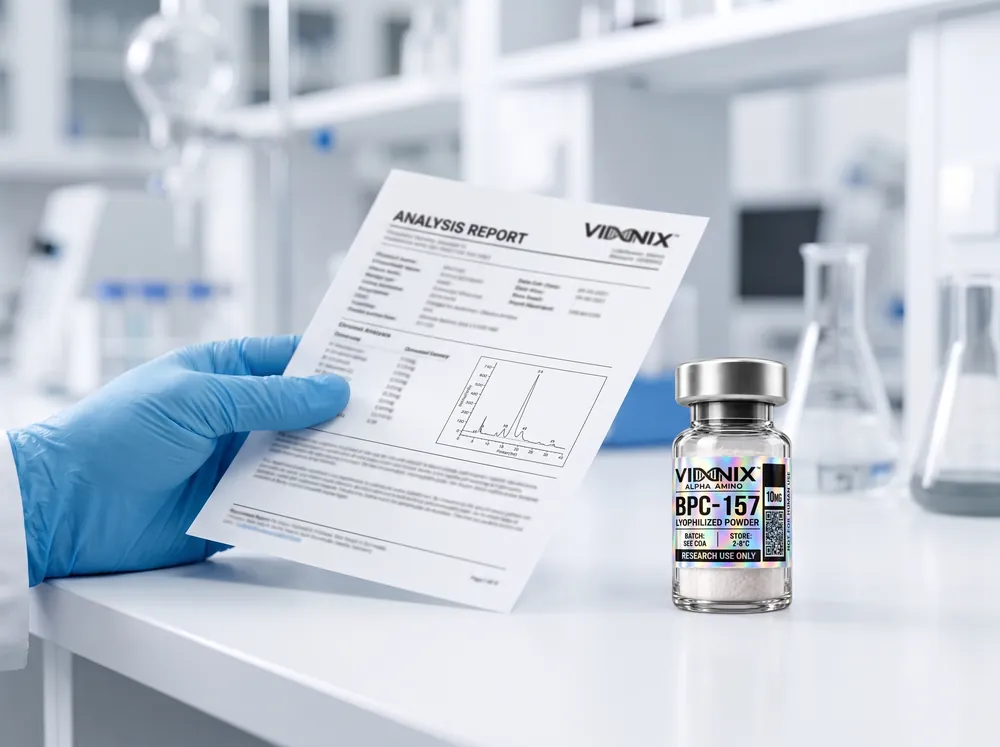
This article covers freeze-drying in general. For a specific Vinnix product, physical form and any storage information are on that product's own record and batch documentation.
How is water content measured after lyophilization?
Most labs use Karl Fischer titration, a chemical method that reacts specifically with water and reports it as a percentage of sample weight. Some use loss on drying or thermogravimetric analysis instead. Why bother? Water adds weight without adding peptide, so the number feeds straight into net peptide content calculations. To see where it shows up on a report, read how to read a COA.
FAQFrequently asked questions
What does lyophilized mean?
It means freeze-dried. The material was frozen, then dried under vacuum so the ice turned directly into vapor. A lyophilized peptide arrives as a dry solid, typically a white powder or porous cake, rather than as a liquid solution. The term describes the physical form only, not the purity or content of the material.
Is lyophilization the same as freeze-drying?
Yes, they are two names for one process. Lyophilization is the more technical term you see in pharmaceutical and analytical literature. Freeze-drying is the everyday word, and it turns up in food processing too. Both describe freezing a material and removing the ice by sublimation under reduced pressure, followed by a final drying step that removes bound water.
Why are peptides lyophilized?
Two reasons. Many peptides are less chemically stable in solution, where water takes part in reactions such as hydrolysis and deamidation, and a dry solid generally changes more slowly. Freeze-drying is also the standard way to pull a purified peptide out of the aqueous acetonitrile fractions from preparative HPLC, so it is a routine step in manufacturing anyway.
What does a lyophilized peptide look like?
Usually a white or off-white powder, or a compact, porous cake sitting at the bottom of the vial. The exact appearance depends on the fill volume, the formulation and the drying conditions. A cake that has shrunk or loosened from the vial wall is a physical variation and is not, on its own, a measure of chemical quality.
Does a lyophilized powder contain only peptide?
Usually not. Alongside the peptide you normally find counter-ions, such as acetate or trifluoroacetate left from purification, and some residual water. Formulated products may contain excipients as well. That is why net peptide content, which accounts for these components, differs from both the weight of powder in the vial and the HPLC purity value.
What is residual moisture in freeze-drying?
It is the water still left in the solid after the final, secondary drying stage. Most of it is water that never froze and stayed bound to the dried material. It is reported as a weight percentage, commonly measured by Karl Fischer titration, and appears on technical documents because it affects both the stability of the solid and calculations of peptide content.
REFScientific references
-
Tang X, Pikal MJ. Design of freeze-drying processes for pharmaceuticals: practical advice. Pharm Res. 2004;21(2):191-200. PubMed 15032301
review (process design) -
Wang W. Lyophilization and development of solid protein pharmaceuticals. Int J Pharm. 2000;203(1-2):1-60. PubMed 10967427
review -
Carpenter JF, Pikal MJ, Chang BS, Randolph TW. Rational design of stable lyophilized protein formulations: some practical advice. Pharm Res. 1997;14(8):969-975. PubMed 9279875
review (formulation) -
Tchessalov S, Maglio V, Kazarin P, et al. Practical advice on scientific design of freeze-drying process: 2023 update. Pharm Res. 2023;40(10):2433-2455. PubMed 37783925
review with process modeling -
Mant CT, Chen Y, Yan Z, et al. HPLC analysis and purification of peptides. Methods Mol Biol. 2007;386:3-55. PubMed 18604941
methods review
 Research Library: Peptide Fundamentals
 Research Library
 Documentation