
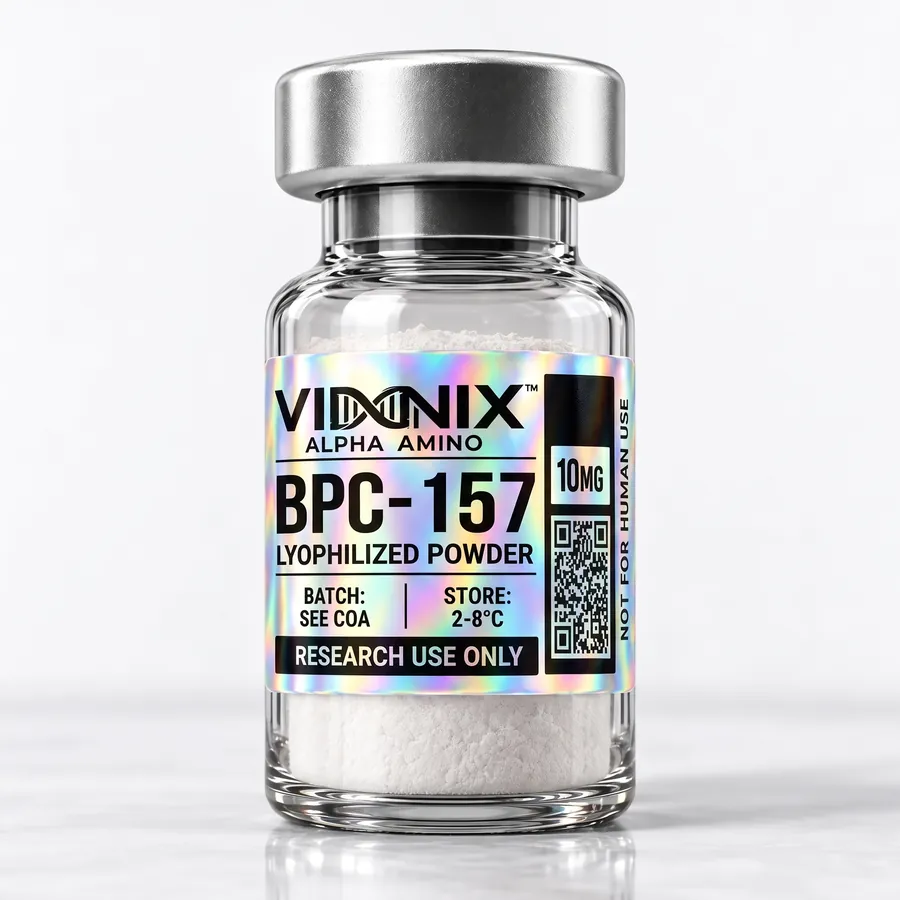
Key facts
- Sequence
- GEPPPGKPADDAGLV
- Amino acids
- 15 (pentadecapeptide)
- Molecular formula
- C62H98N16O22
- Molecular weight
- 1419.5 g/mol (PubChem)
- CAS number
- 137525-51-0
- PubChem CID
- 9941957
- Vinnix SKUs
- BC10 (10 mg), BC20 (20 mg)
Batch reports are published in the COA Library as each batch is released. Match the batch number on your vial to its report.
What Is BPC-157?
BPC-157 is a synthetic peptide consisting of 15 amino-acid residues, which makes it a pentadecapeptide. According to the literature, its sequence is a partial sequence of a larger protein reported in human gastric juice; that origin gives it the name Body Protection Compound, and 157 identifies this particular fragment [1][3]. It appears in scientific literature involving experimental biological models and investigations of peptide-related processes.
The name turns up in several spellings: BPC-157, BPC 157, BPC157 and, in some older papers, the stable gastric pentadecapeptide. All of them mean the same 15-residue sequence. At this length the peptide isn't a protein and has no defined folded structure. It's a short, flexible chain, and its identity comes from the order of its amino acids. New to these terms? What Are Peptides? explains how chains like this are put together.
Much of the commonly discussed BPC-157 literature involves preclinical research. Findings from laboratory and animal experiments should not be represented as established clinical outcomes in humans.
Below you'll find the identifying data for the peptide, the Vinnix product specifications, a summary of the published studies grouped by study type, and how each batch will be characterized and documented. We don't describe any use of the compound here, and we make no claim about the effects of any Vinnix product.
BPC-157 Product Specifications
Vinnix lists the peptide in two strengths: 10 mg (SKU BC10) and 20 mg (SKU BC20). Some details are set per batch, including lot number, physical form and storage statement. Those values are added once the batch record is verified, and the table below says where they will appear. General handling background is in peptide storage.
| Field | Value |
|---|---|
| Compound | BPC-157 (BPC 157; Body Protection Compound 157) |
| Classification | Synthetic peptide (pentadecapeptide) |
| Sequence | Gly-Glu-Pro-Pro-Pro-Gly-Lys-Pro-Ala-Asp-Asp-Ala-Gly-Leu-Val (GEPPPGKPADDAGLV) |
| Molecular formula | C62H98N16O22 (free peptide) |
| Molecular weight | 1419.5 g/mol (PubChem CID 9941957) |
| CAS number | 137525-51-0 |
| Product quantity | 10 mg or 20 mg per vial |
| SKU | BC10 (10 mg), BC20 (20 mg) |
| Form | Shown on the batch COA when published |
| Batch / lot | Shown on the batch COA when published |
| Storage | Stated on the batch record when published |
| COA | Linked per batch from the Vinnix COA Library as each report is released |
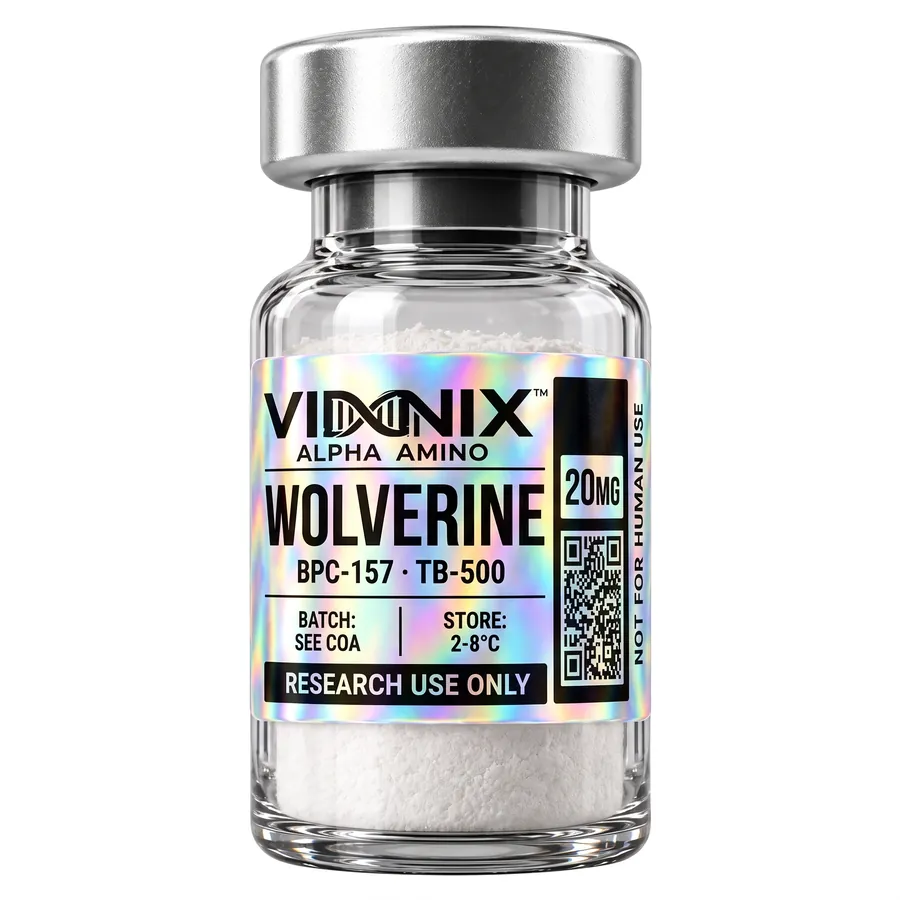
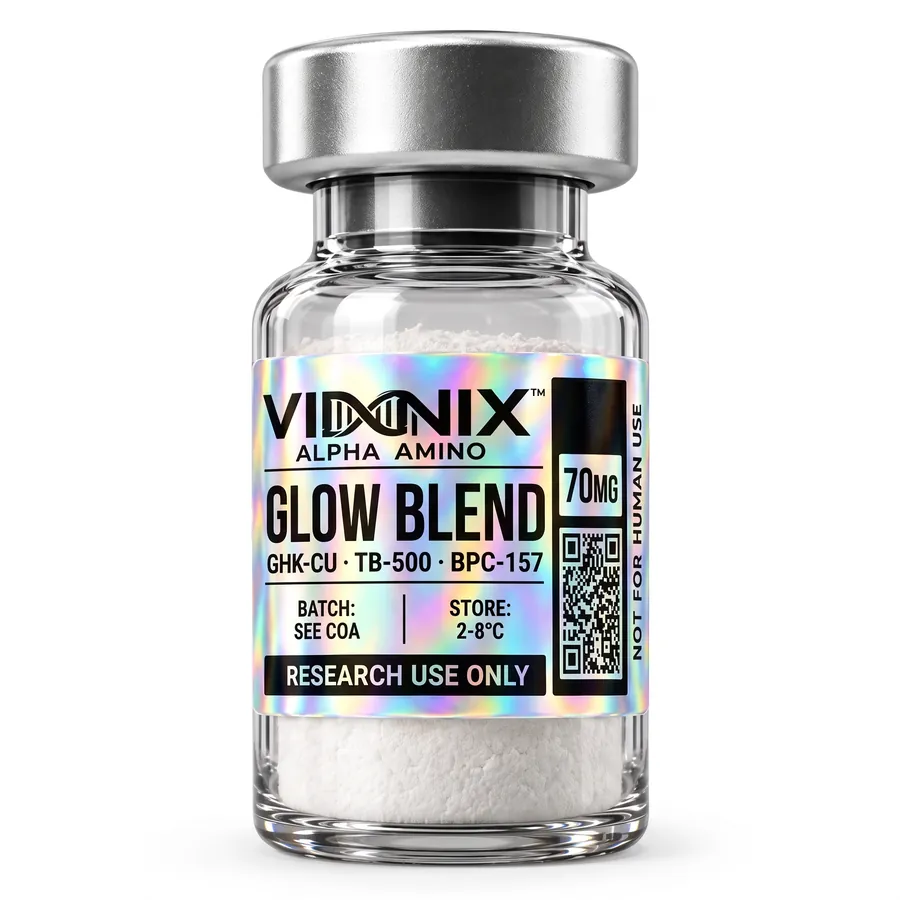
The peptide also appears in two Vinnix blends: the Wolverine Blend (paired with TB-500) and the GLOW Blend (alongside GHK-Cu and TB-500). Each blend has a separate page and separate batch documentation.
BPC-157 Sequence and Molecular Information
BPC-157 can be described by its amino-acid sequence, molecular formula, molecular mass and other chemical identifiers. Accurate characterization means paying attention to the exact substance, including any salt or chemical form that applies.
Its sequence is Gly-Glu-Pro-Pro-Pro-Gly-Lys-Pro-Ala-Asp-Asp-Ala-Gly-Leu-Val, or GEPPPGKPADDAGLV in one-letter code. Following the standard convention in Peptide Sequences, it reads from the N-terminus (glycine) on the left to the C-terminus (valine) on the right.
How many amino acids are in BPC-157?
The peptide contains 15 amino acids joined by 14 peptide bonds. If you're reading analytical data, a few features stand out. Four residues are proline, and three of those sit in a row (Pro-Pro-Pro), which limits backbone flexibility. Three acidic residues (one glutamate, two aspartates) outnumber the single basic lysine, so the free peptide carries a net negative charge at neutral pH. There's no cysteine, methionine or tryptophan, the residues most prone to oxidation, and that shortens the list of expected impurities.
What is the molecular weight of BPC-157?
PubChem lists the compound (CID 9941957) with the molecular formula C62H98N16O22, an average molecular weight of 1419.5 g/mol and a monoisotopic mass of 1418.704 Da. Its CAS registry number is 137525-51-0, and the FDA Global Substance Registration System lists it under UNII 8ED8NXK95P. Salt forms such as the acetate have a different formula and weight, so a product record should always say which form is supplied.
| Identifier | Value | Source |
|---|---|---|
| Molecular formula | C62H98N16O22 | PubChem CID 9941957 |
| Average molecular weight | 1419.5 g/mol | PubChem |
| Monoisotopic mass | 1418.704 Da | PubChem |
| CAS number | 137525-51-0 | PubChem synonyms |
| UNII | 8ED8NXK95P | FDA GSRS |
| Calculated [M+H]+ | m/z 1419.71 | Calculated from monoisotopic mass |
| Calculated [M+2H]2+ | m/z 710.36 | Calculated from monoisotopic mass |
BPC 157 Research: What Has Been Studied?
Most published BPC 157 research is animal work and laboratory (in vitro) work; in vitro vs. in vivo research explains the difference. Human reports are few and small. A 2025 systematic review of the musculoskeletal literature screened 544 records from 1993 to 2024 and included 36 studies: 35 preclinical, one clinical [4]. That ratio is a fair picture of the evidence base as a whole.
Research publications involving BPC-157 should be evaluated according to experimental design, model, methodology and limitations. A result observed in an experimental system does not establish the same result in humans.
Preclinical findings do not establish safety or effectiveness in humans. The summaries below describe what researchers investigated and how, not effects of the peptide or of any Vinnix product.
Reviews from the originating research group
Much of the literature comes from a single group at the University of Zagreb, led by Predrag Sikiric and Sven Seiwerth, who first described the peptide in the early 1990s. Their reviews pull together decades of rat studies: gastrointestinal lesion models, tendon and ligament transection models, vascular occlusion models, and work on the nitric oxide system and blood vessel formation [1][2]. With so much of the field tracing back to one laboratory, reviewers outside the group have flagged independent replication as an open question [4].
In vitro and ex vivo studies
Cell and tissue culture studies look at how the peptide interacts with specific cell types under controlled conditions. A frequently cited 2011 study cultured rat Achilles tendon explants and tendon fibroblasts, then measured cell outgrowth, survival under oxidative stress, migration and phosphorylation of the signaling proteins FAK and paxillin [5]. Keep in mind that cultured cells show biological activity in a dish, not effects in a living organism.
Metabolism and analytical studies
Because the World Anti-Doping Agency lists the compound, anti-doping laboratories have studied it too. In 2023, one group combined stable isotope labeling with ultra-high-performance liquid chromatography and high-resolution mass spectrometry (UHPLC-HRMS) to map its in vitro metabolites for doping control [6]. For analysts, this kind of work is useful: it identifies the fragments that show up when the peptide breaks down.
Human reports
Human data are very thin. A 2025 open-label pilot study tracked laboratory markers and vital signs in two adult participants [7]. Two subjects and no control group can't establish safety, and the 2025 systematic review found no adequate clinical safety data [4].
| Study type | What was investigated | Ref. |
|---|---|---|
| Review (originating group) | Rat models of GI lesions, tendon and ligament transection, vascular occlusion; NO-system and angiogenesis pathways | [1][2] |
| Systematic review | Scope, design and quality of 36 musculoskeletal studies (35 preclinical, 1 clinical) | [4] |
| In vitro / ex vivo | Rat tendon explants and fibroblasts: outgrowth, migration, FAK-paxillin signaling | [5] |
| In vitro metabolism | Metabolite profile for doping control by UHPLC-HRMS | [6] |
| Human pilot | Laboratory markers in two participants; no control group | [7] |
Regulatory Status of BPC-157
The peptide is not an approved drug in the United States. It appears on the World Anti-Doping Agency Prohibited List under section S0, non-approved substances [4]. We include these regulatory facts so readers have the full context the literature provides. Vinnix supplies it only as a material for laboratory and analytical work.
How Is BPC-157 Analytically Characterized?
Two complementary methods characterize the peptide. High-performance liquid chromatography (HPLC) measures purity, and mass spectrometry (MS) confirms identity from molecular mass. Neither is enough on its own, so a useful certificate reports both.
In HPLC testing, the sample runs through a reversed-phase column and is detected by UV absorbance, usually near 214 to 220 nm, where the peptide bond absorbs. The sequence lacks both tryptophan and tyrosine, so it absorbs little at 280 nm, and low-wavelength detection matters. Purity is reported as the main peak area as a percentage of all peak areas. Typical related impurities in synthetic peptides are deletion sequences (one residue missing), truncated chains and incompletely deprotected species carried over from solid-phase synthesis.
With electrospray ionization, mass spectrometry usually shows the peptide as a singly charged ion near m/z 1419.7 and a doubly charged ion near m/z 710.4, both calculated from the PubChem monoisotopic mass. A match supports identity. It says nothing about purity, a distinction covered in identity vs. purity in analytical testing. Labs often combine the two methods in a single LC-MS run.
BPC-157 Analytical Documentation and COA
Available Vinnix analytical reports should identify the sample or batch analyzed, the laboratory, test method, report date and results. Documentation for one batch is never represented as documentation for another. Once a batch record is published, its certificate of analysis (COA), HPLC chromatogram, mass spectrum and batch information will be linked from the COA Library.
What does a BPC-157 COA show?
- Identity: compound name, sequence and the expected versus observed molecular mass from mass spectrometry.
- Purity: HPLC purity as a percentage, with the chromatogram attached so you can check the peak profile.
- Batch details: lot number, quantity per vial (10 mg or 20 mg) and test date.
- Method notes: the column, detection wavelength and gradient, so results can be compared from batch to batch.
Match the batch number printed on the product to the one on the report, every time. Our guides to certificates of analysis and peptide testing walk through each field, and Peptide Purity explains what a purity percentage can and can't tell you.
Vinnix products are supplied for laboratory and analytical research only. They are not drugs, supplements or personal-care products, and they are not for human or veterinary use.
FAQBPC-157 FAQ
What is BPC-157?
BPC-157 is a synthetic pentadecapeptide: a chain of 15 amino acids with the sequence GEPPPGKPADDAGLV. The literature describes it as a partial sequence of a protein reported in human gastric juice. PubChem gives its molecular formula as C62H98N16O22 and its molecular weight as 1419.5 g/mol. Vinnix supplies it in 10 mg and 20 mg vials for laboratory research only.
Is BPC-157 a peptide?
Yes. It's a chain of amino acids joined by peptide bonds, which is the definition of a peptide. With 15 residues, it counts as a pentadecapeptide, far smaller than anything usually called a protein. It's made synthetically, typically by solid-phase peptide synthesis, rather than extracted from a natural source, and its exact sequence defines its identity.
What is the BPC-157 sequence?
Its sequence is Gly-Glu-Pro-Pro-Pro-Gly-Lys-Pro-Ala-Asp-Asp-Ala-Gly-Leu-Val, or GEPPPGKPADDAGLV in one-letter code. You read it from the N-terminal glycine to the C-terminal valine. Four of the residues are prolines, three of them in a row, and the sequence has no cysteine, methionine or tryptophan.
What molecular information identifies BPC-157?
Several identifiers pin it down: the sequence (GEPPPGKPADDAGLV), molecular formula C62H98N16O22, average molecular weight 1419.5 g/mol, monoisotopic mass 1418.704 Da, CAS number 137525-51-0, PubChem CID 9941957 and FDA UNII 8ED8NXK95P. Salt forms such as acetate carry different formulas and weights, so a product record should state which form is supplied.
How is BPC-157 studied?
Mostly in animal models, usually rats, and in cell and tissue culture. Human reports exist but are very small. In its musculoskeletal search, a 2025 systematic review found 35 preclinical studies and one clinical study. Individual findings should be interpreted within their specific study designs, and preclinical findings do not establish safety or effectiveness in humans.
How can BPC-157 be analytically characterized?
With two methods. Reversed-phase HPLC separates the peptide from related impurities and reports purity as a percentage of peak area. Mass spectrometry confirms identity by matching the observed mass to the calculated value; electrospray spectra typically show singly and doubly charged ions near m/z 1419.7 and 710.4. You need both, because each answers a different question, and any conclusion depends on the methods and results.
What does a BPC-157 COA show?
A Vinnix certificate of analysis for this peptide will give the batch or lot number, quantity per vial, HPLC purity with its chromatogram, and the observed molecular mass from mass spectrometry next to the expected value. It will also list the test date and methods. It covers only the batch named on it, so the lot number has to match your product.
Where can I find the Vinnix BPC-157 COA?
Batch documentation for the Vinnix product (BC10 and BC20) will be linked from this page and from the Vinnix COA Library, which will list each report by product and batch number. When available, documentation is linked directly to the relevant Vinnix batch, so check the lot number on your vial against the lot on the report. No COA is shown for a batch until its record is published.
REFScientific references
-
Sikiric P, Seiwerth S, Skrtic A, et al. Stable Gastric Pentadecapeptide BPC 157 as a Therapy and Safety Key: A Special Beneficial Pleiotropic Effect Controlling and Modulating Angiogenesis and the NO-System. Pharmaceuticals (Basel). 2025;18(6):928. PubMed 40573323
review (originating research group) -
Seiwerth S, Rucman R, Turkovic B, et al. BPC 157 and Standard Angiogenic Growth Factors. Gastrointestinal Tract Healing, Lessons from Tendon, Ligament, Muscle and Bone Healing. Curr Pharm Des. 2018;24(18):1972-1989. PubMed 29998800
review (animal studies) -
Sikiric P, Rucman R, Turkovic B, et al. Novel Cytoprotective Mediator, Stable Gastric Pentadecapeptide BPC 157. Vascular Recruitment and Gastrointestinal Tract Healing. Curr Pharm Des. 2018;24(18):1990-2001. PubMed 29879879
review (animal studies) -
Vasireddi N, Hahamyan H, Salata MJ, et al. Emerging Use of BPC-157 in Orthopaedic Sports Medicine: A Systematic Review. HSS J. 2025;21(4):485-495. PubMed 40756949
systematic review -
Chang CH, Tsai WC, Lin MS, Hsu YH, Pang JH. The promoting effect of pentadecapeptide BPC 157 on tendon healing involves tendon outgrowth, cell survival, and cell migration. J Appl Physiol (1985). 2011;110(3):774-780. PubMed 21030672
in vitro / ex vivo study -
Tian T, Jing J, Li Y, et al. Stable Isotope Labeling-Based Nontargeted Strategy for Characterization of the In Vitro Metabolic Profile of a Novel Doping BPC-157 in Doping Control by UHPLC-HRMS. Molecules. 2023;28(21):7345. PubMed 37959764
in vitro metabolism / analytical study -
Lee E, Burgess K. Safety of Intravenous Infusion of BPC157 in Humans: A Pilot Study. Altern Ther Health Med. 2025;31(5):20-24. PubMed 40131143
human pilot study (n=2, uncontrolled)
 Research Blend
 Research Blend
 Compound Library
 Peptides
 Research Library: Peptide Fundamentals