
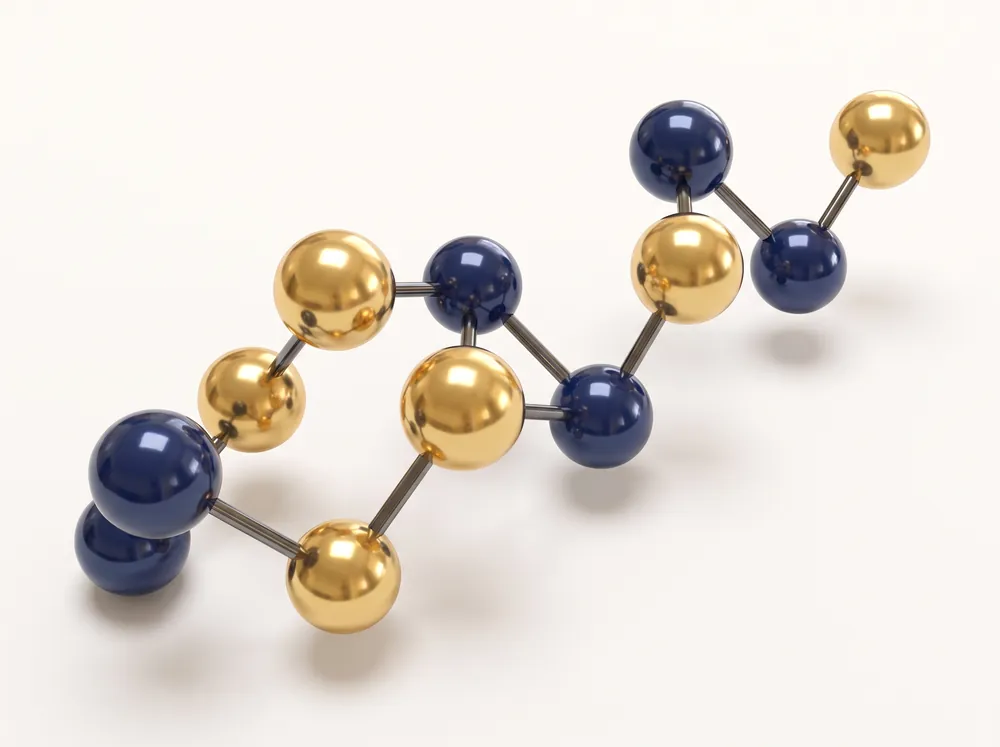
Key facts
- Sequence
- Aib-His-D-2-Nal-D-Phe-Lys-NH2
- Number of residues
- 5
- Molecular formula
- C38H49N9O5 (PubChem CID 9831659)
- Molecular weight
- 711.9 g/mol (PubChem)
- CAS number
- 170851-70-4 (FDA GSRS, UNII Y9M3S784Z6)
- Development code
- NNC 26-0161
- Vinnix availability
- Component of CJC-1295 + Ipamorelin (CP10); no standalone SKU
What Is Ipamorelin?
It is a synthetic five-residue peptide, acting at the growth hormone secretagogue receptor, which is also the receptor for the hormone ghrelin. Novo Nordisk researchers described it in 1998 as the first selective growth hormone secretagogue [1], and FDA GSRS and PubChem list it under the development code NNC 26-0161.
The compound grew out of a medicinal chemistry program built on earlier growth hormone-releasing peptides (GHRPs). According to the discovery paper, the peptide turned up in a series of compounds that dropped the central Ala-Trp dipeptide of GHRP-1 [1]. The same group published a companion paper on further analogues derived from it [2].
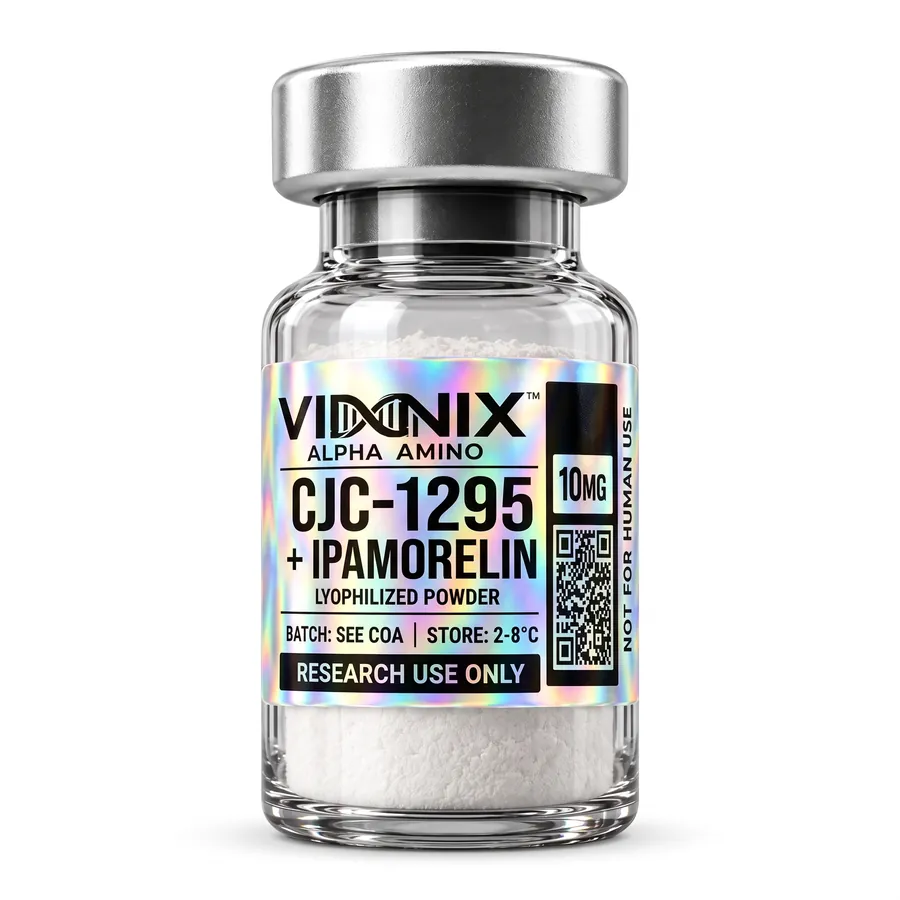
Vinnix does not sell this peptide on its own. It is one of the two peptides in the CP10 blend, alongside CJC-1295, and this is a reference-library entry.
Ipamorelin Product Specifications
With no standalone Vinnix SKU, the compound's specifications combine verified compound data with the one Vinnix product that contains it.
| Field | Value |
|---|---|
| Compound | Ipamorelin (NNC 26-0161) |
| Classification | Synthetic pentapeptide; growth hormone secretagogue receptor agonist |
| Sequence | Aib-His-D-2-Nal-D-Phe-Lys-NH2 |
| Molecular formula | C38H49N9O5 (PubChem CID 9831659) |
| Molecular weight | 711.9 g/mol (PubChem) |
| CAS number | 170851-70-4 (FDA GSRS) |
| Product quantity | Not sold separately; amount per CP10 vial listed on the batch COA when published |
| SKU | None standalone; component of CP10 (CJC-1295 + Ipamorelin, 10 mg total) |
| Batch / lot | Shown on the CP10 batch COA when published |
Ipamorelin Identity
Ipamorelin is the International Nonproprietary Name (INN). FDA GSRS records it under UNII Y9M3S784Z6 and CAS 170851-70-4; PubChem lists it as CID 9831659.
| Identifier | Value | Source |
|---|---|---|
| INN | Ipamorelin | FDA GSRS |
| Development code | NNC 26-0161 | FDA GSRS; PubChem |
| CAS | 170851-70-4 | FDA GSRS |
| UNII | Y9M3S784Z6 | FDA GSRS |
| PubChem CID | 9831659 | PubChem |
| Molecular formula | C38H49N9O5 | PubChem |
| Molecular weight | 711.9 g/mol | PubChem |
Two similar names cause confusion. The acetate salt is a salt form that PubChem lists as a synonym. Salts weigh more per formula unit than the free peptide, so a label should say which one it means. The N-acetylated analogue is a different molecule with its own GSRS record. Other GHRPs, GHRP-2 and GHRP-6 among them, are related in function but have different sequences.
Ipamorelin Sequence
Aib-His-D-2-Nal-D-Phe-Lys-NH2 is the full sequence. That's five residues, three of them non-standard, ending in an amidated C-terminus.
| Position | Residue | Type |
|---|---|---|
| 1 | Aib (2-aminoisobutyric acid, 2-methylalanine) | Non-standard, achiral |
| 2 | L-Histidine | Standard |
| 3 | D-2-Nal (3-(2-naphthyl)-D-alanine) | Non-standard D-amino acid |
| 4 | D-Phenylalanine | D-isomer of a standard amino acid |
| 5 | L-Lysine amide | Standard residue, C-terminal amide |
The full GSRS systematic name, 2-methylalanyl-L-histidyl-3-(2-naphthyl)-D-alanyl-D-phenylalanyl-L-lysinamide, spells out every one of these features. Aib and D-2-Nal have no one-letter codes, so the peptide is usually written in three-letter form (one-letter vs. three-letter codes explains the conventions). The D-configured residues and the amide belong to its identity. Make it all-L, or give it a free-acid C-terminus, and you have a different compound; the amide versus acid switch alone shifts the mass by about 1 Da. Notation conventions are covered in the peptide sequences guide.
Scientific Literature
Research on this compound stretches from late-1990s in vitro and animal pharmacology to human pharmacology and a phase 2 clinical study. Each level answers a different question.
How has the compound been studied?
- In vitro and animal pharmacology: the discovery paper compared the new peptide with GHRP-6 and GHRP-2 in rat pituitary cells, anaesthetized rats and conscious swine, and looked at its selectivity, including ACTH and cortisol levels in swine [1].
- Medicinal chemistry: follow-on work reported a series of analogues built from it [2].
- Animal studies: one rat study examined longitudinal bone growth rate [3], and a rat model of postoperative ileus examined gastrointestinal transit [4].
- Human pharmacology: in healthy male volunteers, researchers characterized pharmacokinetics and the time course of plasma GH with a population PK/PD model [5].
- Phase 2 clinical study: a multicenter, double-blind, placebo-controlled proof-of-concept trial in adults after bowel resection looked at safety and time to tolerance of a solid meal. It found no significant difference from placebo on its key endpoint [6].
Preclinical findings do not establish safety or effectiveness in humans, and the peptide is not an FDA-approved medicine.
Ipamorelin Analytical Documentation
At this size, the peptide's identity is easy to confirm by mass spectrometry. HPLC runs alongside it to assess purity.
- Mass spectrometry: at 711.9 g/mol, the molecule produces a clear singly or doubly protonated molecular ion, and MS/MS can confirm residue order. More in mass spectrometry for peptides.
- HPLC: separates the sample and reports the main peak as a share of detected UV area. Its naphthyl and phenyl groups absorb UV strongly. More in HPLC testing.
- In CP10: this pentapeptide and CJC-1295 are very different in size and elute as separate peaks, so each one should be identified and reported on its own line.
CP10 batch reports will be listed in the Vinnix COA Library as they're published. A useful certificate of analysis names the batch, the methods and the result for each component. Methods and their limits are explained in peptide testing and analysis, and the partner peptide has its own CJC-1295 page.
This peptide and the CP10 blend that contains it are supplied for laboratory and analytical research. They are not for human or veterinary use and are not intended to diagnose, treat or prevent any condition.
FAQIpamorelin FAQ
What is Ipamorelin?
It is a synthetic pentapeptide, Aib-His-D-2-Nal-D-Phe-Lys-NH2. Novo Nordisk researchers described it in 1998 as the first selective growth hormone secretagogue. It acts at the ghrelin (GHS) receptor and carries the code NNC 26-0161. At Vinnix it's available only as part of the CP10 blend, paired with CJC-1295.
Is Ipamorelin a peptide?
Yes. It's five residues joined by ordinary peptide bonds. Three of the building blocks are non-standard: 2-aminoisobutyric acid, D-2-naphthylalanine and D-phenylalanine. The C-terminal lysine is amidated. Taken together, these features make it a modified synthetic peptide, not a fragment of any natural protein.
How many amino acids are in ipamorelin?
Five: Aib, histidine, D-2-naphthylalanine, D-phenylalanine and lysine, finished with a C-terminal amide. Only histidine and lysine are standard L-amino acids. D-phenylalanine is the mirror-image form of a standard residue, while Aib and D-2-Nal are non-standard building blocks you won't find in natural proteins.
What is the Ipamorelin sequence?
The sequence is Aib-His-D-2-Nal-D-Phe-Lys-NH2. FDA GSRS gives the systematic name as 2-methylalanyl-L-histidyl-3-(2-naphthyl)-D-alanyl-D-phenylalanyl-L-lysinamide. Since Aib and D-2-Nal lack one-letter codes, people write it in three-letter form with the D-configuration and C-terminal amide shown. Drop either detail and you're describing a different compound.
What molecular information identifies Ipamorelin?
Look for formula C38H49N9O5 and molecular weight 711.9 g/mol (PubChem CID 9831659), CAS 170851-70-4 and UNII Y9M3S784Z6 (FDA GSRS), plus the development code NNC 26-0161. The acetate salt and the N-acetylated analogue are separate substances with different formulas, so don't mix them up with the free peptide.
How is Ipamorelin studied?
It has been studied in rat pituitary cells, rats and swine, in a rat model of gastrointestinal transit, in a pharmacokinetic study in healthy male volunteers, and in a phase 2 proof-of-concept trial after bowel surgery. Preclinical findings shouldn't be read as human outcomes, and the compound is not an approved medicine.
How can Ipamorelin be analytically characterized?
Mass spectrometry confirms identity from the molecular ion near 712 Da, and MS/MS can check residue order. HPLC handles purity, helped by the strong UV absorbance of the aromatic groups. In the CP10 blend, this pentapeptide and the much larger CJC-1295 separate cleanly and should be reported as two distinct components.
Where can I find the Vinnix Ipamorelin COA?
Look at the batch COAs for the Vinnix CP10 blend, which pairs this peptide with CJC-1295. They will appear in the Vinnix COA Library under CP10 as each report is published. A COA covers only the batch it names, so check that its lot number matches the one on your vial label.
REFScientific references
-
Raun K, Hansen BS, Johansen NL, et al. Ipamorelin, the first selective growth hormone secretagogue. Eur J Endocrinol. 1998;139(5):552-561. PubMed 9849822
in vitro and animal -
Ankersen M, Johansen NL, Madsen K, et al. A new series of highly potent growth hormone-releasing peptides derived from ipamorelin. J Med Chem. 1998;41(19):3699-3704. PubMed 9733495
medicinal chemistry -
Johansen PB, Nowak J, Skjaerbaek C, et al. Ipamorelin, a new growth-hormone-releasing peptide, induces longitudinal bone growth in rats. Growth Horm IGF Res. 1999;9(2):106-113. PubMed 10373343
animal -
Venkova K, Mann W, Nelson R, Greenwood-Van Meerveld B. Efficacy of ipamorelin, a novel ghrelin mimetic, in a rodent model of postoperative ileus. J Pharmacol Exp Ther. 2009;329(3):1110-1116. PubMed 19289567
animal -
Gobburu JV, Agersø H, Jusko WJ, Ynddal L. Pharmacokinetic-pharmacodynamic modeling of ipamorelin, a growth hormone releasing peptide, in human volunteers. Pharm Res. 1999;16(9):1412-1416. PubMed 10496658
human clinical pharmacology -
Beck DE, Sweeney WB, McCarter MD; Ipamorelin 201 Study Group. Prospective, randomized, controlled, proof-of-concept study of the Ghrelin mimetic ipamorelin for the management of postoperative ileus in bowel resection patients. Int J Colorectal Dis. 2014;29(12):1527-1534. PubMed 25331030
human clinical, phase 2 randomized trial
 Research Blend
 Peptides
 Research Library: Peptide Fundamentals
 Research Library
 Testing & Analysis