
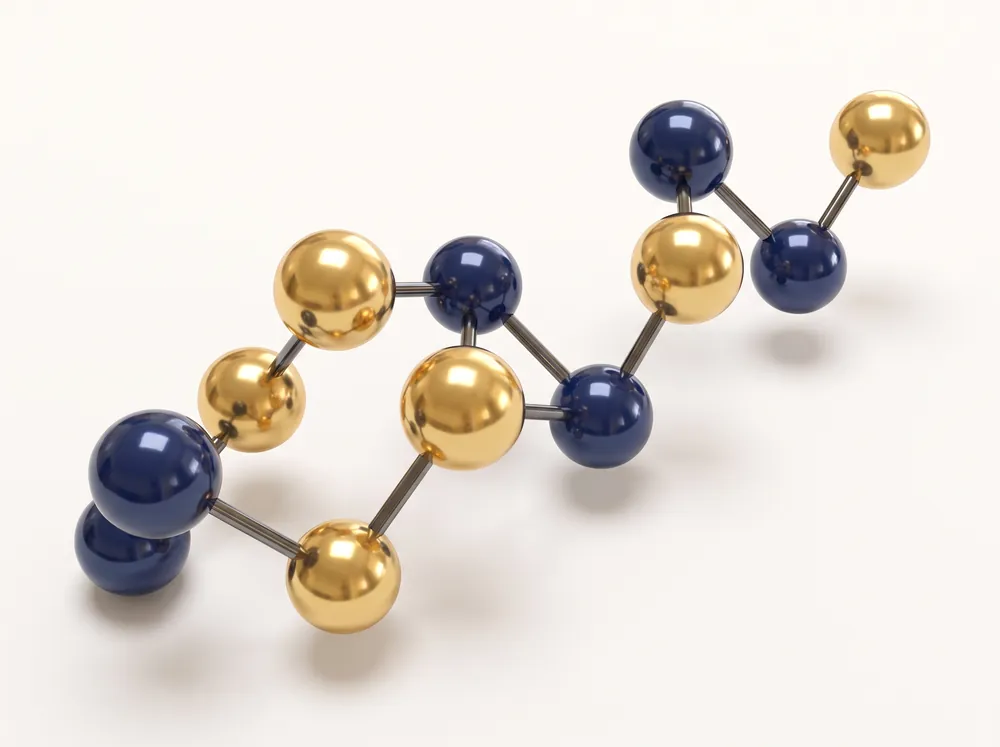
Key facts
- Compound
- Sermorelin (GRF 1-29 NH2)
- Classification
- Synthetic peptide, GHRH (1-29) amide
- Residues
- 29
- Sequence
- YADAIFTNSYRKVLGQLSARKLLQDIMSR-NH2
- Molecular formula
- C149H246N44O42S
- Molecular weight
- 3357.9 g/mol
- CAS number
- 86168-78-7
- Vinnix status
- Reference only, not sold
What Is Sermorelin?
This peptide is a synthetic copy of the first 29 amino acids of human growth hormone-releasing hormone. The full hormone has 44 residues and is also known as somatocrinin or GRF. Researchers first isolated and sequenced it in 1982, oddly enough from pancreatic tumor tissue [1], and the hypothalamic form was characterized shortly afterward [2].
Early structure-activity work found that the N-terminal 1 to 29 stretch of GHRH, capped with a C-terminal amide, keeps its receptor activity in laboratory assays. A shorter chain that still worked was easier to make and study, and it became the starting point for many later analogues [3]. Expect to see the same molecule called sermorelin, GRF (1-29) NH2, GHRH (1-29) NH2 or hGHRH(1-29)-NH2.
The peptide is not in the Vinnix catalog at the moment. This entry sits in the Compound Library as a description of the molecule, and nothing here is a claim about what any material does.
Sermorelin Product Specifications
Because it isn't a Vinnix product, the specification table sticks to verified chemical identity. Fields that would only apply to a product are marked not applicable.
| Field | Value |
|---|---|
| Compound | Sermorelin |
| Classification | Synthetic peptide, GHRH (1-29) amide |
| Sequence | YADAIFTNSYRKVLGQLSARKLLQDIMSR-NH2 |
| Molecular formula | C149H246N44O42S (PubChem CID 16132413) |
| Molecular weight | 3357.9 g/mol (PubChem) |
| CAS number | 86168-78-7 |
| Product quantity | Not applicable, not sold by Vinnix |
| SKU | Not applicable |
| Batch/Lot | Not applicable |
Sermorelin Identity
Three things pin this peptide down: its exact sequence, its C-terminal amide and the registry numbers tied to that structure. We checked the identifiers below against PubChem and the FDA Global Substance Registration System (GSRS).
| Identifier | Value | Source |
|---|---|---|
| PubChem CID | 16132413 | PubChem |
| CAS Registry Number | 86168-78-7 | PubChem synonyms |
| FDA UNII | 89243S03TE | FDA GSRS |
| Common names | Sermorelin; GRF (1-29) NH2; GHRH (1-29) NH2 | Literature usage |
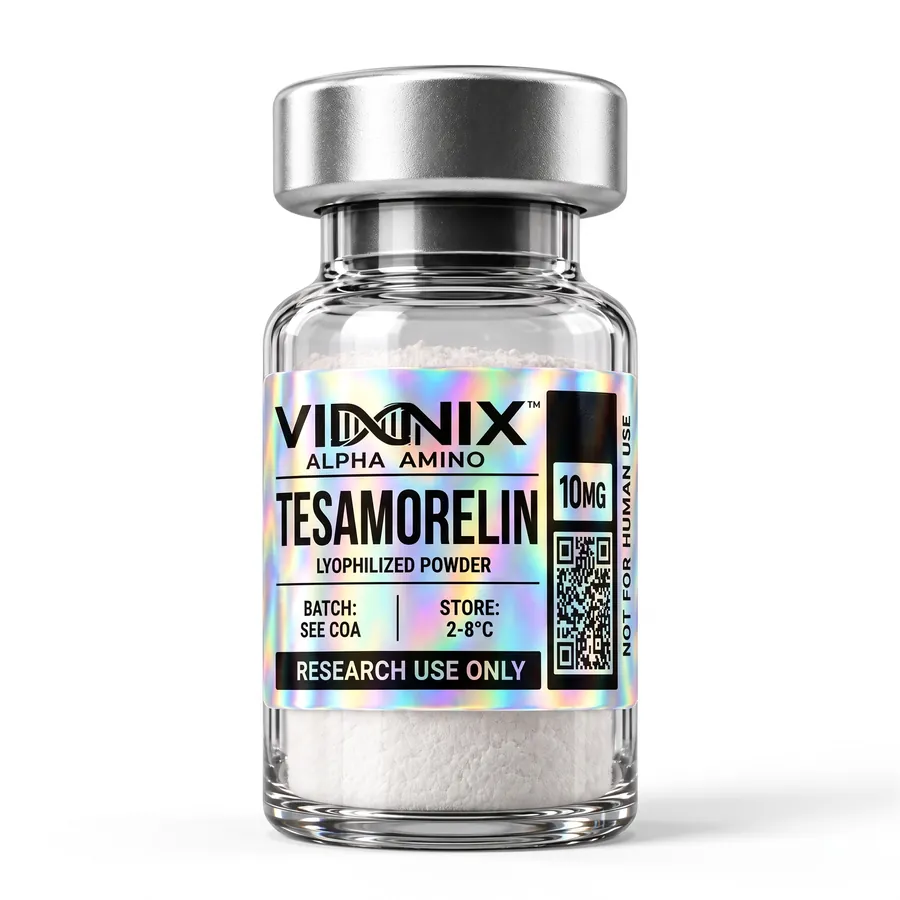
Several GHRH-derived compounds look alike on paper. Tesamorelin covers all 44 residues and adds an N-terminal modification, while CJC-1295 is a 1 to 29 analogue with substitutions. Because the names blur together, compare sequences rather than labels.
Sermorelin Peptide Sequence & Molecular Information
In one-letter code, the sequence is YADAIFTNSYRKVLGQLSARKLLQDIMSR-NH2, read from the N-terminal tyrosine to the C-terminal arginine amide.
Written in three-letter code, the chain starts Tyr-Ala-Asp-Ala-Ile-Phe and finishes Asp-Ile-Met-Ser-Arg-NH2. That "-NH2" tells you the last carboxyl group at the C-terminus is an amide, not a free acid, so the formula and mass differ from the free-acid version. The one sulfur atom in the formula belongs to methionine at position 27. New to sequence notation? Try peptide sequences and peptide bonds.
- 29 amino acids linked by 28 peptide bonds
- Every residue is a standard L-amino acid
- C-terminal amide (Arg29-NH2)
- Average molecular weight 3357.9 g/mol (PubChem)
Research Literature on Sermorelin
The literature on this peptide runs from structural chemistry through laboratory pharmacology to human clinical studies of the 1980s and 1990s. Each of those settings asks a different question, as in vitro vs. in vivo research explains.
Discovery and structure (biochemical studies)
Isolating GRF from pancreatic tumors [1] and then from hypothalamic tissue [2] gave researchers the 44-residue sequence that the 29-residue fragment is cut from.
In vitro structure-activity studies
Later, systematic substitution studies on hGHRH(1-29)-NH2 showed which positions could be changed, and that map shaped the synthetic analogues that followed [3].
Human clinical studies
In the early 1990s, controlled studies looked at the pharmacokinetics of GHRH(1-29)-NH2 in healthy volunteers [4] and compared it with growth hormone in pediatric clinical research [5]. Those trials used a regulated pharmaceutical product under medical supervision. We list them here as history only.
Analytical detection
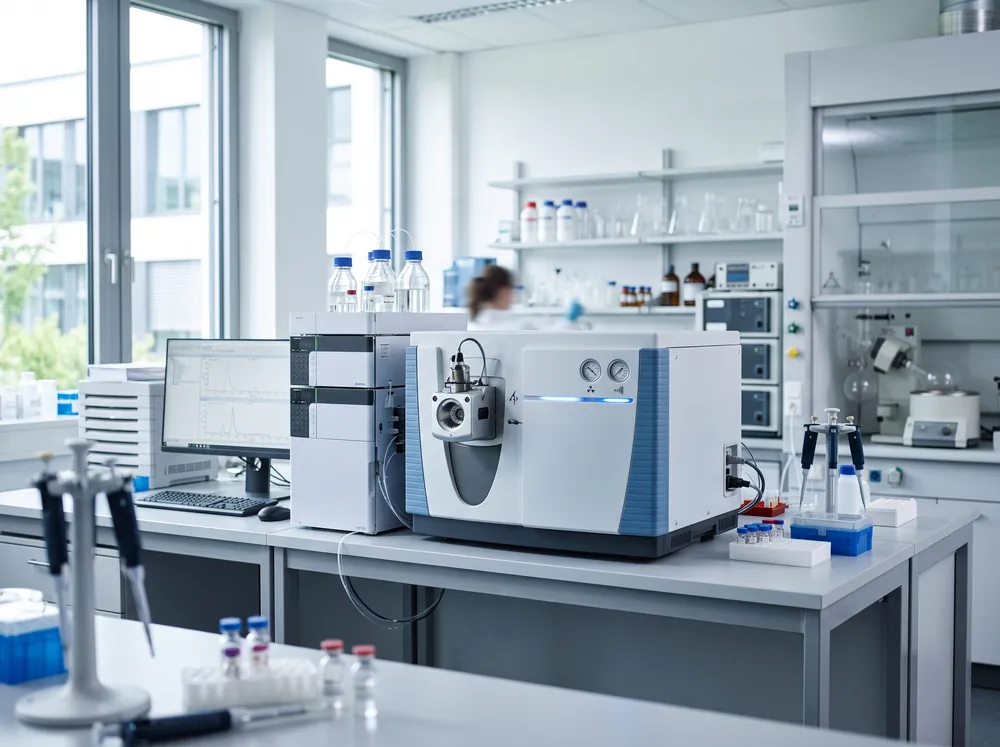
Recent papers are mostly about detection: finding GHRH analogues, this one included, with liquid chromatography and mass spectrometry [6].
The peptide was once approved in the United States as a prescription product, and its manufacturer later withdrew it from the market. That history belongs to the specific approved drug product. It says nothing about research materials.
Sermorelin Analytical Documentation
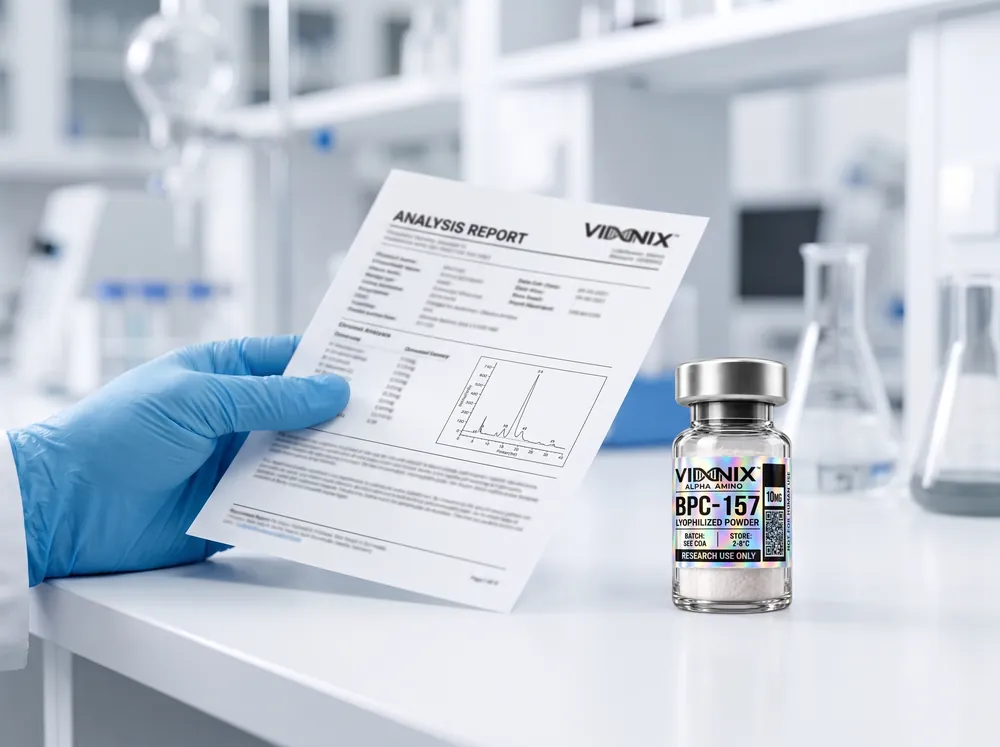
There's no Vinnix certificate of analysis for this peptide because Vinnix doesn't sell it. The methods for characterizing a peptide this size are well established, though.
- HPLC separates the main peptide from related impurities, such as truncated or oxidized sequences, and reports purity as a percentage of peak area. See HPLC testing.
- Mass spectrometry confirms identity by checking the measured mass against the expected value. In electrospray spectra, a 3.4 kDa peptide usually shows up as several multiply charged ions. See mass spectrometry.
- Common variants that analysts look for by name are methionine oxidation (+16 Da) and deamidation (+1 Da).
FAQSermorelin FAQ
What is Sermorelin?
Sermorelin is a synthetic peptide made of the first 29 amino acids of human growth hormone-releasing hormone, with an amidated C-terminus. You'll also see it written GRF (1-29) NH2. Vinnix doesn't sell it; this is a reference entry in the Vinnix Compound Library that covers its identity and literature.
Is Sermorelin a peptide?
Yes. It is a linear chain of 29 amino acids held together by 28 peptide bonds. That length puts it somewhere between short peptides and small proteins, which is why some sources call it a polypeptide. Every residue is a standard L-amino acid, and the only modification is the C-terminal amide.
What is the Sermorelin sequence?
In one-letter code it is YADAIFTNSYRKVLGQLSARKLLQDIMSR-NH2, running from tyrosine at the N-terminus to an arginine amide at the C-terminus. Those are residues 1 to 29 of human GHRH. The natural, full-length hormone is 44 amino acids long, so the fragment is roughly its first two thirds.
What molecular information identifies Sermorelin?
Its sequence plus four verified records: molecular formula C149H246N44O42S, average molecular weight 3357.9 g/mol, CAS number 86168-78-7 and FDA UNII 89243S03TE. The PubChem compound ID is 16132413. Taken together, those values separate it from tesamorelin, CJC-1295 and the other GHRH-related peptides.
How is Sermorelin studied?
It turns up in structural studies of GHRH, in in vitro structure-activity work, and in human clinical studies run while it was a regulated pharmaceutical product. Those study types answer different questions. Lab findings shouldn't be read as human outcomes, and the old clinical data don't describe today's research materials.
How can Sermorelin be analytically characterized?
Two methods do most of the work. HPLC separates the peptide from related impurities and gives a purity figure, and mass spectrometry checks that the measured mass fits the expected structure. Analysts also look for methionine oxidation and deamidation, which shift the mass by small, predictable amounts.
Where can I find the Vinnix Sermorelin COA?
There isn't one, because the peptide isn't in the Vinnix catalog. For products Vinnix does sell, certificates of analysis will be listed by product and batch in the Vinnix COA Library as each batch is released, and the guide to reading a COA walks through each section of a report.
REFScientific references
-
Guillemin R, et al. Growth hormone-releasing factor from a human pancreatic tumor that caused acromegaly. Science. 1982;218(4572):585-7. PubMed 6812220
original research, biochemical isolation -
Ling N, et al. Isolation, primary structure, and synthesis of human hypothalamic somatocrinin: growth hormone-releasing factor. Proc Natl Acad Sci U S A. 1984;81(14):4302-6. PubMed 6431406
original research, biochemical isolation and synthesis -
Cervini LA, et al. Human growth hormone-releasing hormone hGHRH(1-29)-NH2: systematic structure-activity relationship studies. J Med Chem. 1998;41(5):717-27. PubMed 9513600
in vitro structure-activity study -
Wilton P, et al. Pharmacokinetics of growth hormone-releasing hormone(1-29)-NH2 and stimulation of growth hormone secretion in healthy subjects after intravenous or intranasal administration. Acta Paediatr Suppl. 1993;388:10-5. PubMed 8329825
human clinical, randomized pharmacokinetic study -
Neyzi O, et al. Growth response to growth hormone-releasing hormone(1-29)-NH2 compared with growth hormone. Acta Paediatr Suppl. 1993;388:16-21; discussion 22. PubMed 8329826
human clinical, randomized multicenter trial -
Memdouh S, et al. Advances in the detection of growth hormone releasing hormone synthetic analogs. Drug Test Anal. 2021;13(11-12):1871-1887. PubMed 34665524
analytical method validation study
 Peptides
 Research Library: Peptide Fundamentals
 Research Library
 Documentation