
Key facts
- Compound
- PT-141 (bremelanotide)
- Classification
- Synthetic cyclic heptapeptide
- Residues
- 7 (including norleucine)
- Structure
- Ac-Nle-cyclo[Asp-His-D-Phe-Arg-Trp-Lys]-OH
- Molecular formula
- C50H68N14O10
- Molecular weight
- 1025.2 g/mol
- CAS number
- 189691-06-3
- Vinnix status
- Reference only, not sold
What Is PT-141?
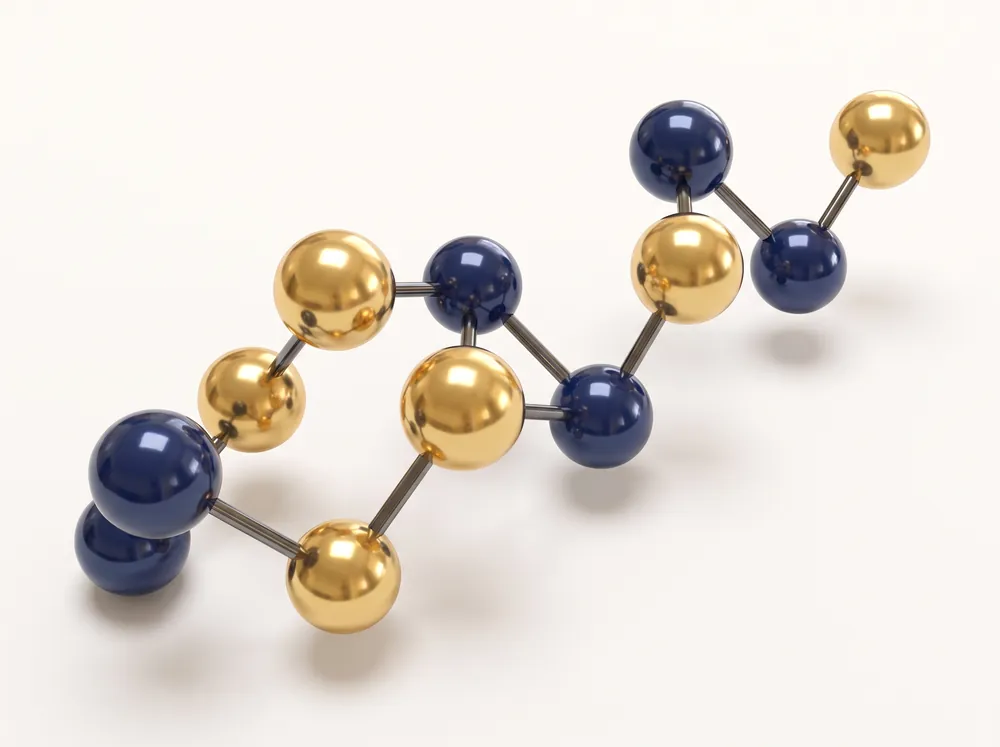
This compound is a synthetic peptide of seven residues, six of them closed into a ring by a lactam bridge. It was developed as an analogue within the melanocortin family, the peptide group that includes alpha-melanocyte-stimulating hormone, and the literature describes it as a melanocortin receptor agonist [1][2].
Its closest relative is an earlier cyclic research peptide, melanotan II [6]. The two share the same ring and the same N-terminal group. Where they part ways is the C-terminus: melanotan II ends in an amide, bremelanotide in a free carboxylic acid. One small change, and the formulas and masses no longer match. The KPV tripeptide, another melanocortin-derived compound, is a good comparison for how minor sequence edits produce distinct molecules.
Vinnix doesn't carry bremelanotide. We profile it in the Compound Library because its structure is a useful reference point, and nothing here speaks to what any material does.
PT-141 Product Specifications
No Vinnix product exists for this peptide, so only the chemistry is filled in. SKU, quantity and batch fields read not applicable.
| Field | Value |
|---|---|
| Compound | PT-141 (bremelanotide) |
| Classification | Synthetic cyclic heptapeptide |
| Sequence | Ac-Nle-cyclo[Asp-His-D-Phe-Arg-Trp-Lys]-OH |
| Molecular formula | C50H68N14O10 (PubChem CID 9941379) |
| Molecular weight | 1025.2 g/mol (PubChem) |
| CAS number | 189691-06-3 |
| Product quantity | Not applicable, not sold by Vinnix |
| SKU | Not applicable |
| Batch/Lot | Not applicable |
PT-141 Identity
The compound is identified by its cyclic structure and by the registry records for bremelanotide. We checked those records against PubChem and the FDA Global Substance Registration System.
| Identifier | Value | Source |
|---|---|---|
| PubChem CID | 9941379 (Bremelanotide) | PubChem |
| CAS Registry Number | 189691-06-3 | PubChem synonyms |
| FDA UNII | 6Y24O4F92S | FDA GSRS |
What is the PT-141 sequence?
From the N-terminus, the structure reads Ac-Nle-cyclo[Asp-His-D-Phe-Arg-Trp-Lys]-OH. "Ac" is an N-terminal acetyl group. Nle is norleucine, a non-standard amino acid, and D-Phe is the mirror-image form of phenylalanine. The brackets mark the ring formed between the side chains of aspartic acid and lysine. For more on this notation, see peptide sequences.
Recognized Terminology
PT-141 and bremelanotide name the same molecule. The first is the development code; bremelanotide is the international nonproprietary name used in regulatory and clinical literature [1].
| Term | Meaning |
|---|---|
| PT-141 | Development code for bremelanotide |
| Bremelanotide | Nonproprietary (generic) name of the same molecule |
| Melanotan II | A related cyclic peptide with a C-terminal amide; a different compound |
| Melanocortin receptors | The receptor family (MC1R to MC5R) that this peptide class is studied against |
A frequent mistake is to treat melanotan II and bremelanotide as interchangeable. Their molecular formulas, masses and registry numbers all differ, so an analytical report should match the bremelanotide values above.
Research History of PT-141
Bremelanotide research began with structure-activity chemistry on cyclic melanocortin peptides. From there it moved into a full human clinical development program and, in 2019, a US regulatory approval.
Structure-activity research (in vitro)
Researchers tested lactam-bridged analogues of melanotan II against human melanocortin receptor subtypes to map how ring structure shapes receptor selectivity [5].
Human clinical studies
Bremelanotide went through phase 1 to phase 3 trials. These included a randomized study with ambulatory blood pressure monitoring [4] and a pooled analysis of safety data from across the clinical program [7]. A validated UHPLC-MS/MS method was also developed to measure the peptide at very low plasma concentrations [3].
In 2019, the United States approved bremelanotide as the active ingredient of a prescription medicine for a specific indication [1]. That approval applies to the approved drug product alone, not to research materials sold under the development code.
PT-141 Analytical Documentation
There is no Vinnix certificate of analysis for this compound, since Vinnix does not sell it. Cyclic peptides of this size are, however, characterized with well-established methods.
- HPLC separates the cyclic peptide from linear precursors, deletion sequences and diastereomers. See HPLC testing.
- Mass spectrometry confirms the mass of 1025.2 g/mol. Ring closure releases water, so the cyclic form is 18 Da lighter than its linear precursor; melanotan II differs by about 1 Da. See mass spectrometry and LC-MS.
- Fragmentation (MS/MS) helps confirm the ring and the residue order when mass alone can't settle the question [3].
FAQPT-141 FAQ
What is PT-141?
PT-141 is the development code for bremelanotide, a synthetic cyclic heptapeptide in the melanocortin peptide family. Its formula is C50H68N14O10 and its molecular weight 1025.2 g/mol. Vinnix doesn't sell it. This Compound Library page just records the molecule's identity, terminology and regulatory history.
Is PT-141 a peptide?
Yes. It has seven residues joined by peptide bonds, plus one extra amide (lactam) bond that closes a ring between the aspartic acid and lysine side chains. Add an N-terminal acetyl group and two unusual residues, norleucine and D-phenylalanine, and you have a modified cyclic peptide.
What is the PT-141 sequence?
It's written Ac-Nle-cyclo[Asp-His-D-Phe-Arg-Trp-Lys]-OH. From the N-terminus: an acetyl cap, then norleucine, then a six-residue ring of aspartic acid, histidine, D-phenylalanine, arginine, tryptophan and lysine, finishing with a free carboxylic acid on the lysine. The ring and modified residues mean a plain one-letter string can't capture it fully.
What molecular information identifies PT-141?
Five values identify it: molecular formula C50H68N14O10, average molecular weight 1025.2 g/mol, CAS number 189691-06-3, PubChem CID 9941379 and FDA UNII 6Y24O4F92S. All belong to bremelanotide. Melanotan II, which ends in an amide rather than an acid, has different values.
How is PT-141 studied?
In two settings. There's structure-activity work on melanocortin receptors, and there are phase 1 to phase 3 human clinical trials of bremelanotide as a regulated drug product. Those clinical data concern the approved medicine used under medical supervision. They don't describe the properties of research materials.
How can PT-141 be analytically characterized?
HPLC handles purity and related substances, and mass spectrometry confirms the 1025.2 g/mol mass. Tandem mass spectrometry goes further and can confirm the residue order and the cyclic structure. Published UHPLC-MS/MS methods can also quantify bremelanotide at very low concentrations.
Where can I find the Vinnix PT-141 COA?
There isn't one, because the compound isn't in the Vinnix catalog. Certificates for Vinnix products will be filed by product and batch in the Vinnix COA Library when each batch is released, and the guide to reading a COA explains what each section of a report shows.
REFScientific references
-
Dhillon S, et al. Bremelanotide: First Approval. Drugs. 2019;79(14):1599-1606. PubMed 31429064
review, regulatory profile -
Sauter M, et al. Ultra-sensitive quantification of the therapeutic cyclic peptide bremelanotide utilizing UHPLC-MS/MS for evaluation of its oral plasma pharmacokinetics. J Pharm Biomed Anal. 2020;186:113276. PubMed 32353679
analytical method development study -
White WB, et al. Usefulness of ambulatory blood pressure monitoring to assess the melanocortin receptor agonist bremelanotide. J Hypertens. 2017;35(4):761-768. PubMed 27977473
human clinical, randomized trial -
Grieco P, et al. Extensive structure-activity studies of lactam derivatives of MT-II and SHU-9119: their activity and selectivity at human melanocortin receptors 3, 4, and 5. J Pept Res. 2003;62(5):199-206. PubMed 14531843
in vitro structure-activity study -
Dorr RT, et al. Evaluation of melanotan-II, a superpotent cyclic melanotropic peptide in a pilot phase-I clinical study. Life Sci. 1996;58(20):1777-84. PubMed 8637402
human clinical, phase 1 pilot study (melanotan II) -
Clayton AH, et al. Safety Profile of Bremelanotide Across the Clinical Development Program. J Womens Health (Larchmt). 2022;31(2):171-182. PubMed 35147466
human clinical, pooled phase 3 safety analysis
 Research Library: Peptide Fundamentals
 Research Library
 Documentation