
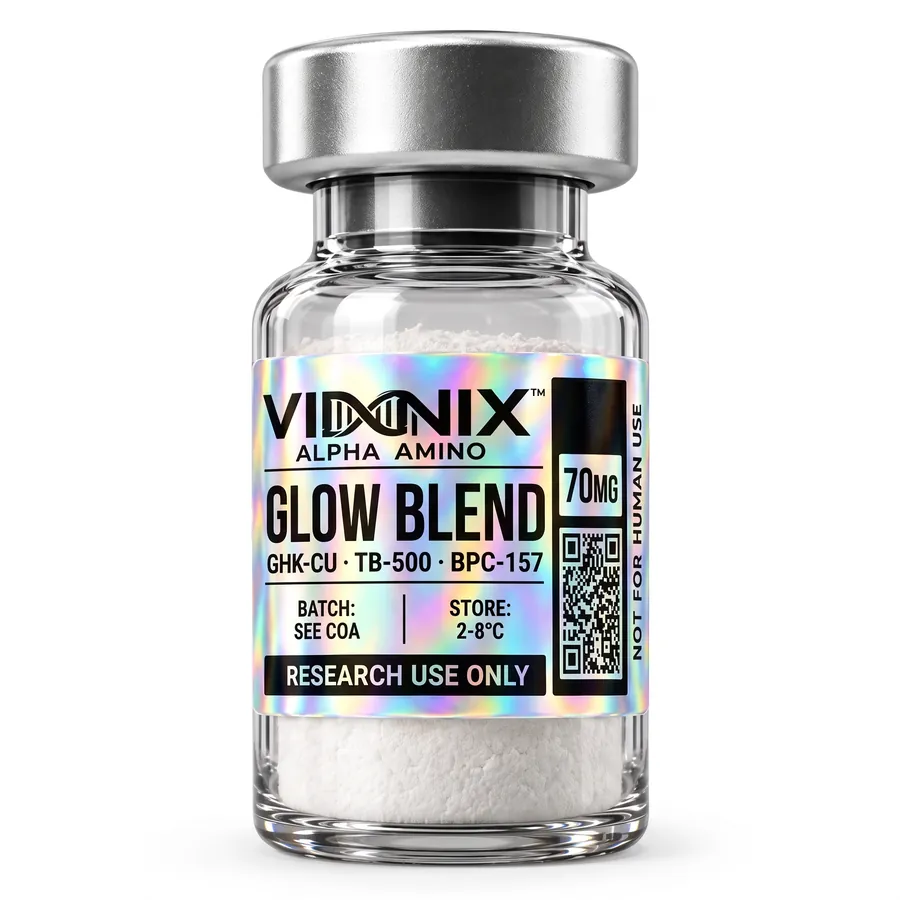
Key facts
- Product
- GLOW Blend, SKU BBG70
- Total quantity
- 70 mg
- Components
- GHK-Cu, TB-500 and BPC-157
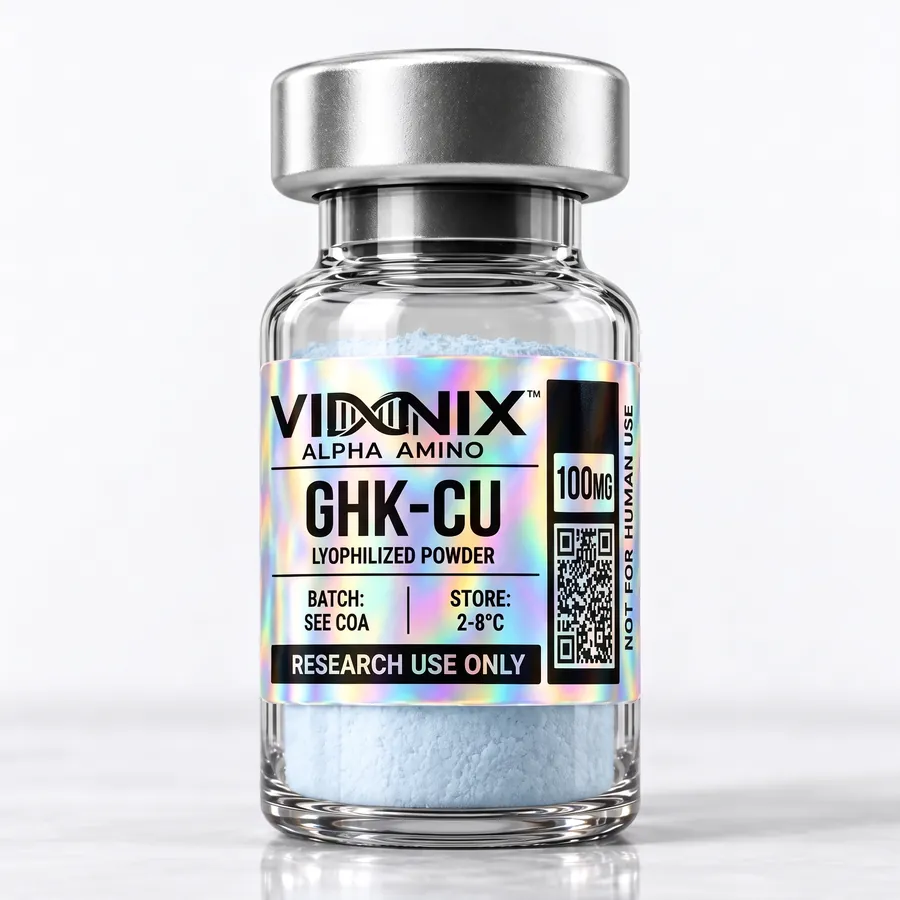
- GHK-Cu
- Copper(II) complex of Gly-His-Lys, 402.9 g/mol (PubChem CID 71587328)
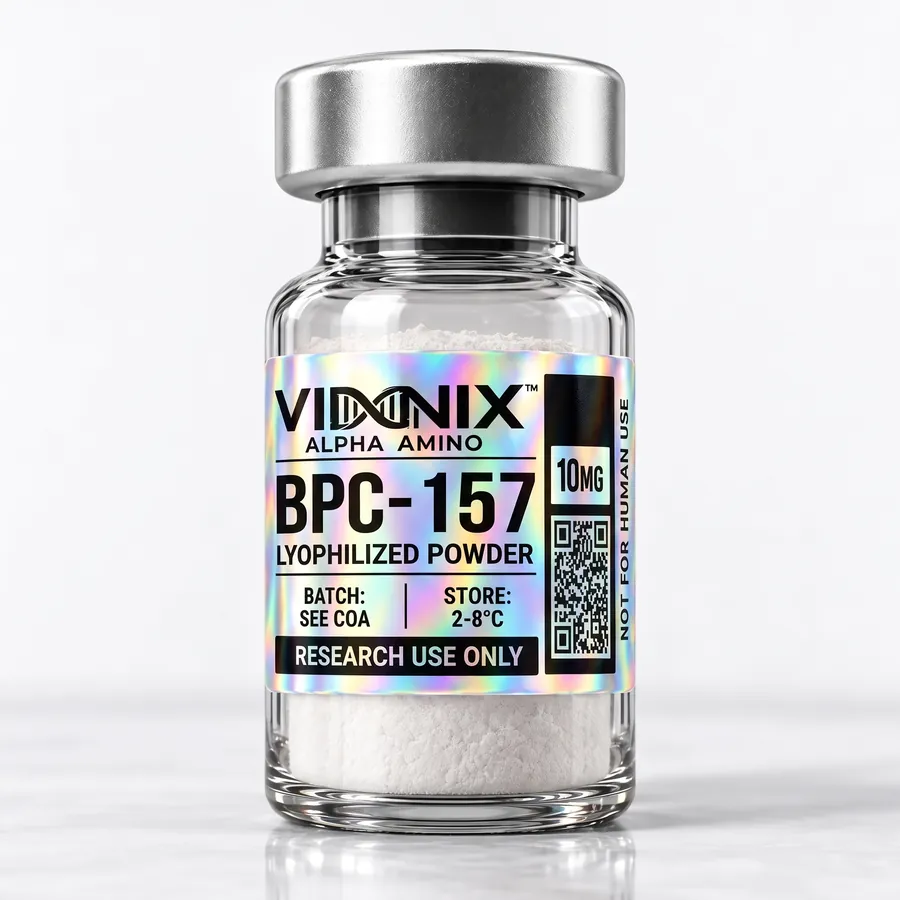
- BPC-157
- GEPPPGKPADDAGLV, 1419.5 g/mol (PubChem CID 9941957)
- TB-500
- Synthetic peptide related to thymosin beta-4; sequence stated on product record
- Intended use
- Laboratory research use only
Batch reports are published in the COA Library as each batch is released. Match the batch number on your vial to its report.
Components: GHK-Cu, TB-500, BPC-157. Amounts per vial are listed on the batch COA.
What is the GLOW peptide blend?
The GLOW peptide blend (people also search for it as the glow blend peptide) is one research product holding three separate compounds. They are the copper peptide GHK-Cu, TB-500, a peptide related to thymosin beta-4, and BPC-157, a pentadecapeptide. The name comes from the research-peptide market. It implies nothing about appearance, skin or any other effect.
Nothing bonds the three together. Their sizes are very different, too (see what is molecular weight): GHK-Cu is a copper-bound tripeptide of about 403 g/mol, while TB-500 can approach 5,000 g/mol depending on which form is used. That spread is exactly why a multi-component product needs documentation at the component level.
Vinnix products are supplied for laboratory research use only. They are not for human or veterinary use, and nothing on this page describes an effect of the product.
GLOW blend composition and quantity of each compound
The GLOW peptide blend (BBG70) holds 70 mg in total, split across three components. How much of each is present will appear on the batch record and the certificate of analysis for every batch. The total can't tell you the ratio between the peptides, so treat the per-compound figures on the COA as the reference.
| Component | Type | Amount per vial | Identity reference |
|---|---|---|---|
| GHK-Cu | Copper complex of a tripeptide | Listed on the batch record | PubChem CID 71587328; CAS 89030-95-5 |
| TB-500 | Synthetic peptide related to thymosin beta-4 | Listed on the batch record | Sequence stated on the product record |
| BPC-157 | Synthetic 15-residue peptide | Listed on the batch record | PubChem CID 9941957; CAS 137525-51-0 |
| Total | Three-component blend | 70 mg | SKU BBG70 |
What is GHK-Cu?
GHK-Cu is the copper(II) complex of GHK, the tripeptide glycine-histidine-lysine (GHK). PubChem lists the complex as C14H23CuN6O4+ (CID 71587328) at 402.9 g/mol, and the CAS number is 89030-95-5. GHK was first reported in human serum in 1973 [1]. Later, X-ray crystallography and solution studies worked out how copper binds to it [2]. Because GHK and GHK-Cu have different formulas, they are different substances, and the product record should say which form is supplied. The GHK-Cu compound page has more.
What is TB-500?
TB-500 is a trade name for a synthetic peptide related to thymosin beta-4. That parent molecule is a 43-amino-acid protein, first fully sequenced from bovine thymus in 1981 [3], with the formula C212H350N56O78S and a weight of about 4963 g/mol (PubChem CID 45382195). The trouble is that the name gets used loosely. Some materials sold as TB-500 match the full sequence; others are a short fragment, and work on short active-site sequences of thymosin beta-4 treats those fragments as distinct molecules [4]. So the product record states the exact TB-500 sequence in each Vinnix batch. Details are on the TB-500 compound page.
What is BPC-157?
The third component, BPC-157, is a synthetic 15-amino-acid peptide (a pentadecapeptide). Its sequence is GEPPPGKPADDAGLV, read from the N-terminal glycine to the C-terminal valine. PubChem files it under CID 9941957 with the molecular formula C62H98N16O22 and a molecular weight of 1419.5 g/mol; the CAS number is 137525-51-0. Salt forms such as the acetate have a different formula and weight, so a product record should name the form present. Identity data, terminology and literature are collected on the BPC-157 compound page.
Most of what has been published on BPC-157 is laboratory and animal work, such as cell-culture studies of tendon fibroblasts [5]. A 2025 systematic review called the evidence base predominantly preclinical [6].
Why do these compounds appear together in research?
Why these three? Each has its own independent body of laboratory and animal literature. They have not been studied together as a single product, and we know of no peer-reviewed controlled study of this exact three-way combination.
| Component | Example literature | Study type |
|---|---|---|
| GHK-Cu | First report of GHK in human serum [1] | In vitro |
| GHK-Cu | Copper coordination structure [2] | Structural chemistry |
| Thymosin beta-4 | Complete amino-acid sequence [3] | Biochemical (protein sequencing) |
| Thymosin beta-4 | Activity mapped to short sequences [4] | Review |
| BPC-157 | Receptor expression in tendon fibroblasts [5] | In vitro |
| BPC-157 | Orthopaedic literature review [6] | Systematic review |
Every study above looked at one compound, so none of them describes GLOW. And because the work is preclinical (in vitro vs. in vivo research explains the categories), it should not be read as establishing safety or effectiveness in humans.
How is a three-component glow peptide blend analyzed?
Testing a blend means analyzing it one component at a time. Each peptide needs its own identity result and its own quantity result (identity vs. purity explains why those are separate questions); a single purity figure for the whole vial doesn't cut it. That's the main practical difference from testing a single compound, and peptide testing and analysis goes into it further.
- Separation. HPLC separates the sample so that GHK-Cu, TB-500 and BPC-157 appear as distinct peaks at different retention times.
- Identity. Mass spectrometry measures the molecular mass behind each peak and checks it against the expected value for that component. LC-MS performs both steps in one run.
- Quantity. Each peak is compared with a reference standard for that specific peptide, which gives an amount per component rather than a single total.
- Purity. Related impurities are assessed for each component, because a high overall area percentage can hide a problem with one peptide.
GHK-Cu needs a step the other two don't. As a metal complex, its copper content can be confirmed by elemental analysis when the testing program includes that test, and its mass spectrum may show free GHK peptide next to the copper-bound form. For TB-500, the result should match the sequence on the product record, full length or fragment.
GLOW vs Wolverine vs KLOW
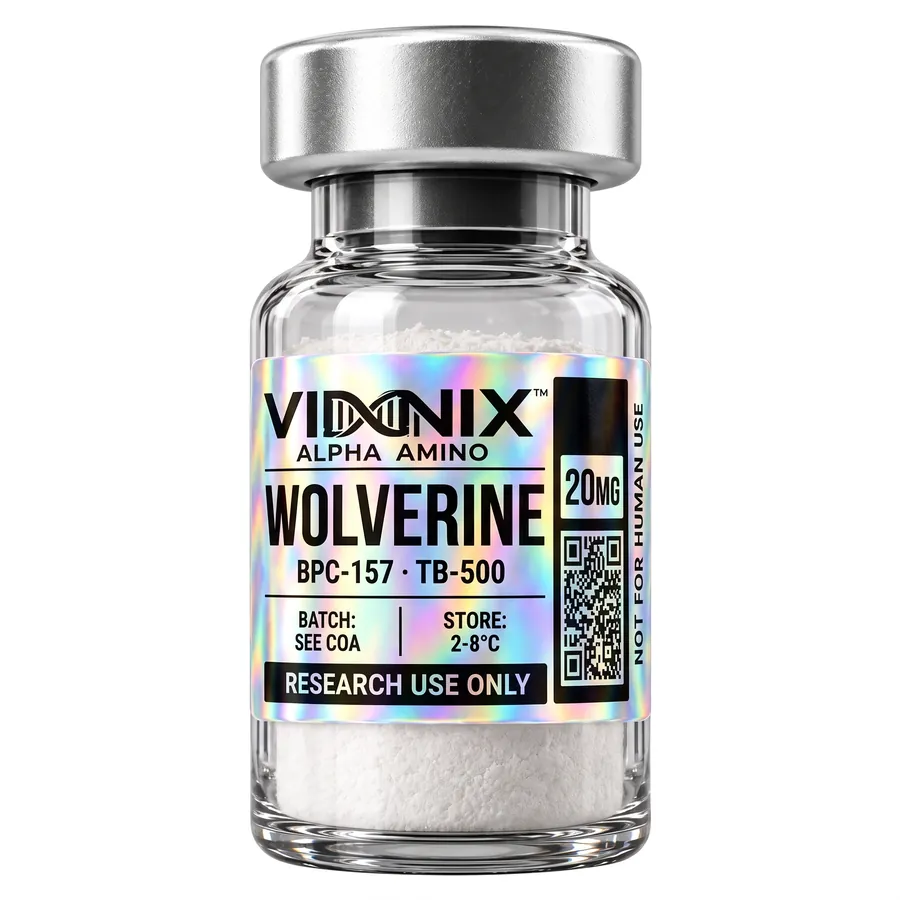
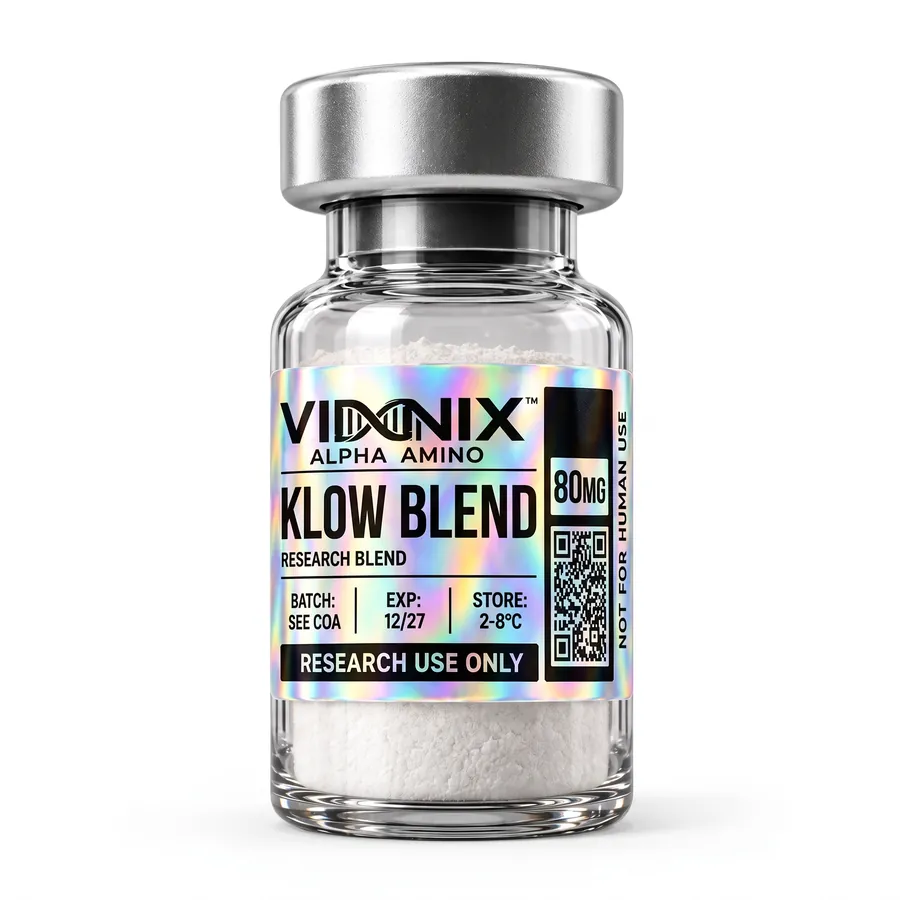
In the Vinnix catalog, the GLOW peptide blend falls between the two-component Wolverine blend and the KLOW research blend.
| Product | SKU and total | Components |
|---|---|---|
| Wolverine blend | BB20, 20 mg | BPC-157, TB-500 |
| GLOW blend | BBG70, 70 mg | GHK-Cu, TB-500, BPC-157 |
| KLOW blend | KLOW80, 80 mg | Confirmed on the KLOW80 product record |
GLOW blend COA and batch documentation
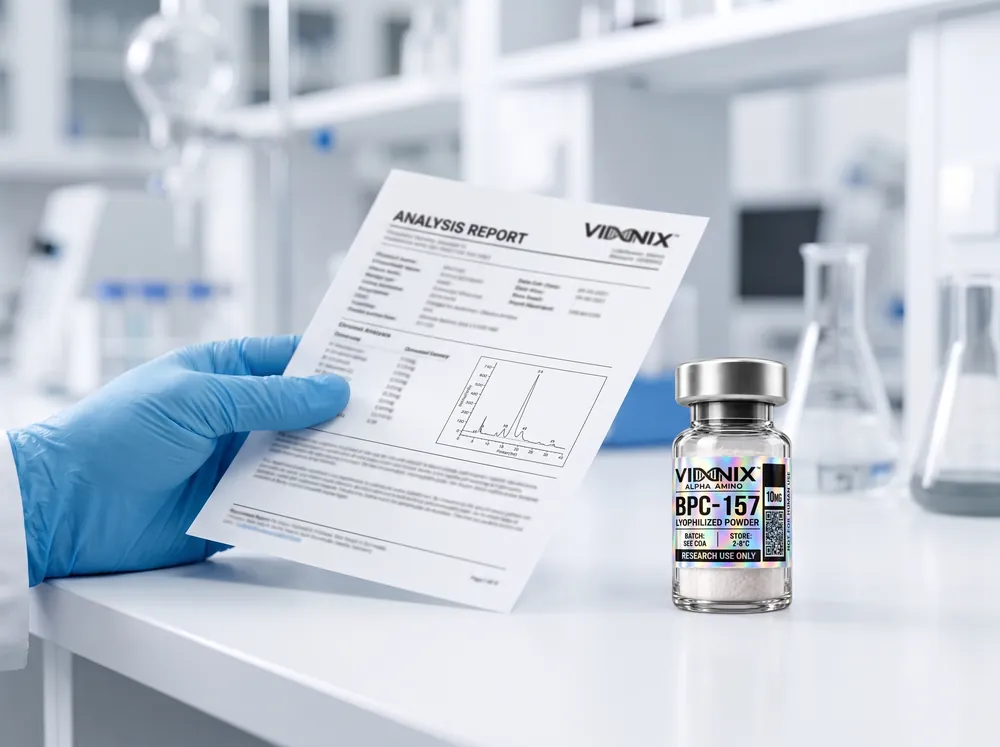
Each GLOW peptide blend batch (BBG70) will be documented with a certificate of analysis, and you should match it to the batch number on your vial. A good blend COA reports every component separately. The Vinnix COA Library will list reports by product, SKU and batch as they're published, and each is expected to show:
- Product name, SKU and batch or lot number that match the vial label
- Identity result for each component, usually by mass spectrometry
- Quantity of each component, so the per-compound amounts can be checked
- HPLC chromatogram with each peak labelled
- Testing laboratory, test date and the methods used
Stuck on a field? The guide to how to read a peptide COA walks through each part, and what a certificate of analysis is covers what a COA can and can't show.
FAQGLOW Blend FAQ
What is in the GLOW blend?
There are three separate compounds in it: GHK-Cu, the copper complex of the tripeptide Gly-His-Lys; TB-500, a synthetic peptide related to thymosin beta-4; and BPC-157, a 15-amino-acid synthetic peptide. Vinnix sells the GLOW peptide blend as BBG70, 70 mg in total, for laboratory research use only, and each batch COA will report every component.
How much of each compound is in GLOW?
BBG70 holds 70 mg in total. The individual amounts of GHK-Cu, TB-500 and BPC-157 will be given on the batch record and certificate of analysis for each batch. Don't assume an even three-way split; check the per-component quantities on the COA whose batch number matches your vial.
Is there a COA for the GLOW blend?
There will be. Each batch of the GLOW peptide blend will be documented with a certificate of analysis, published in the Vinnix COA Library and linked from this page. A complete report should identify GHK-Cu, TB-500 and BPC-157 separately, give the quantity of each, and include the HPLC chromatogram and mass spectrometry data for that particular batch.
Does the name GLOW describe what the blend does?
No. GLOW is a catalog name from the research-peptide market, not a description of any effect on skin, appearance or anything else, and Vinnix makes no such claims. The product is sold for laboratory research use only. Its documentation covers the identity, quantity and purity of each component.
What is the difference between GLOW and the Wolverine blend?
Wolverine (BB20, 20 mg) has two peptides, BPC-157 and TB-500. GLOW (BBG70, 70 mg) has those two plus GHK-Cu. That third component means a GLOW COA has to carry three identity and quantity results, and the GHK-Cu may also be checked for copper content.
Why is GHK-Cu called a copper peptide?
It's the tripeptide glycine-histidine-lysine with a copper(II) ion bound to it. X-ray crystallography shows the copper coordinating to nitrogen atoms in the glycine, the histidine side chain and the peptide backbone. GHK on its own and GHK-Cu are different substances, with different molecular formulas and weights.
REFScientific references
-
Pickart L, Thaler MM. Tripeptide in human serum which prolongs survival of normal liver cells and stimulates growth in neoplastic liver. Nat New Biol. 1973;243(124):85-7. PubMed 4349963
in vitro study -
Hureau C, Eury H, Guillot R, et al. X-ray and solution structures of Cu(II) GHK and Cu(II) DAHK complexes: influence on their redox properties. Chemistry. 2011;17(36):10151-60. PubMed 21780203
in vitro (structural chemistry) study -
Low TL, Hu SK, Goldstein AL. Complete amino acid sequence of bovine thymosin beta 4: a thymic hormone that induces terminal deoxynucleotidyl transferase activity in thymocyte populations. Proc Natl Acad Sci U S A. 1981;78(2):1162-6. PubMed 6940133
in vitro (protein sequencing) study -
Sosne G, Qiu P, Goldstein AL, Wheater M. Biological activities of thymosin beta4 defined by active sites in short peptide sequences. FASEB J. 2010;24(7):2144-51. PubMed 20179146
review -
Chang CH, Tsai WC, Hsu YH, Pang JH. Pentadecapeptide BPC 157 enhances the growth hormone receptor expression in tendon fibroblasts. Molecules. 2014;19(11):19066-77. PubMed 25415472
in vitro study -
Vasireddi N, Hahamyan H, Salata MJ, et al. Emerging Use of BPC-157 in Orthopaedic Sports Medicine: A Systematic Review. HSS J. 2025;21(4):485-495. PubMed 40756949
systematic review
 Peptides
 Compound Library
 Peptides
 Research Blend
 Research Blend
 Documentation