
Key facts
- Definition
- Long, unbranched chain of amino acids joined by peptide bonds
- Backbone
- Repeating N, alpha-C, carbonyl C units
- Ends
- One N-terminus and one C-terminus per chain
- Relation to protein
- A protein contains one or more polypeptide chains
- Example
- Insulin: two polypeptide chains (21 and 30 residues)
- Built in cells
- On the ribosome, from N-terminus to C-terminus
Polypeptide Definition
A polypeptide is a single, unbranched chain of many amino acids joined end to end by peptide bonds [1][2].
Poly just means many. In chemical terms it is no different from a peptide: it has the same amide bonds, the same repeating backbone and runs the same way, N-terminus to C-terminus. Length is what changes, along with the context. Scientists reach for the word when they want to talk about a chain as a chain. How is it made on the ribosome? How does it fold? How many separate chains does a protein contain?
The shorter end of the scale has its own article: What Is a Peptide?.
What Does a Polypeptide Chain Look Like?
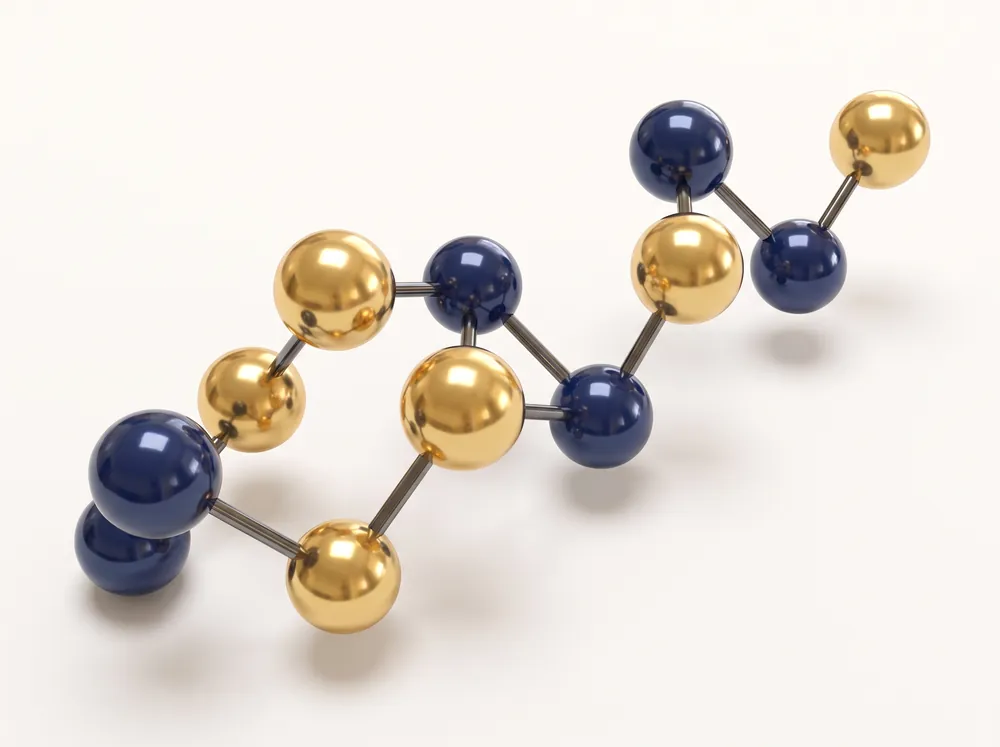
Picture a repeating backbone of nitrogen, alpha carbon and carbonyl carbon atoms, with a side chain sticking out from each alpha carbon. Repeat that unit many times and you have the chain.
The peptide bonds are flat and rigid. The bonds on either side of each alpha carbon, by contrast, can rotate, and that mix of stiff and flexible lets a long chain settle into regular local shapes. In 1951 Pauling and colleagues described the alpha helix as a hydrogen-bonded configuration of the polypeptide chain, one reason the phrase turns up so often in structural biology [3]. For the chemistry of the link itself, read What Is a Peptide Bond?.
Polypeptide vs Peptide vs Protein
Put simply: a polypeptide is a long chain, a peptide is usually a short one, and a protein is a working molecule built from one or more folded chains.
| Feature | Peptide | Polypeptide | Protein |
|---|---|---|---|
| Typical length | 2 to about 50 residues | Long; no fixed minimum | Usually 50 to several thousand residues |
| Number of chains | One (sometimes cyclic) | Always one chain | One or more chains |
| Stable fold required? | No | No | Generally yes |
| Typical usage | Short synthetic or natural chains | Chain-level description | Whole functional molecule |
| Example | KPV, BPC-157 | Insulin A chain | Insulin, titin |
The terms do overlap. A long peptide can fairly be called a polypeptide, and a single-chain protein is one too. Where one word ends and the next begins is a matter of convention [2]. Peptides vs. Proteins and Dipeptide vs. Tripeptide vs. Polypeptide compare the size vocabulary in more detail.
Why Do Some Proteins Contain More Than One Polypeptide?
Some proteins are assembled from separate chains, and the working structure only exists once they come together. The term gives us a way to count and name those chains.
Insulin is the classic case. In 1945 Sanger labeled its free amino groups and found two different N-terminal amino acids, glycine and phenylalanine. Two ends meant two chains [4]. Later work established that the A chain has 21 residues and the B chain 30, joined by two disulfide bonds between chains, with a third disulfide inside the A chain [5]. So insulin is one protein made of two polypeptides.
Bigger proteins take the idea further. Hemoglobin, antibodies and many enzymes are built from multiple subunits. Then there is the opposite extreme: titin is a single chain so large that its sequence predicts a mass of about 3 megadaltons [6].
Each chain has its own N-terminus and C-terminus. Counting free termini, as Sanger did, was one early way to count chains.
How Are Polypeptides Made?
Cells make polypeptides on ribosomes. As a ribosome reads messenger RNA, it adds amino acids one at a time, working from the N-terminus toward the C-terminus [1].
While it grows, the chain is called the nascent polypeptide. Plenty of chains are then modified during or after synthesis: the first methionine may be removed, the new N-terminus may be acetylated, signal sequences may be cut off, and precursors may be cleaved into smaller active peptides. That processing is why a protein's mature sequence can differ from the one encoded by its gene.
Laboratories usually make peptides and short polypeptides by solid-phase peptide synthesis, which runs in the opposite direction, from the C-terminus toward the N-terminus. Long proteins tend to come from recombinant expression instead. Past a certain length, chemical synthesis stops being practical.
Where Does the Polypeptide Fit in Protein Structure?
Protein structure starts with the amino acid chain. Its sequence is the primary structure, and each level above describes how that chain folds or pairs up with others.
- Primary structure: the amino acid sequence of the chain, written N-terminus to C-terminus.
- Secondary structure: local, regular shapes of the backbone, such as the alpha helix described by Pauling and colleagues [3].
- Tertiary structure: the full three-dimensional fold of one chain.
- Quaternary structure: the arrangement of several chains in a multi-chain protein [1].
Short peptides have a primary structure but usually little stable higher-order structure, which is partly why they get discussed separately from proteins. And because every level rests on the sequence, changing one residue can alter everything above it.
Polypeptide Terminology in Documents
When the term shows up in analytical or regulatory paperwork, it usually means one of two things: a long chain, or a description written chain by chain.
- Chain counts. A specification for a multi-chain protein lists each chain and its sequence separately.
- Termini. Each chain's N-terminus and C-terminus should be described, including modifications. See What Is the N-Terminus?.
- Mass. Mass spectrometry of a disulfide-linked protein may be run before and after reduction, which separates the chains so each chain's mass can be checked.
- Glossary use. Our peptide glossary lists polypeptide alongside oligopeptide, residue and related terms.
Vinnix compounds are short peptides, not multi-chain proteins. The same logic still holds, though. Identity comes down to the sequence of each chain plus its terminal groups. Browse the Compound Library for examples.
FAQFrequently asked questions
What is a polypeptide in simple terms?
A polypeptide is a long chain of amino acids linked by peptide bonds, with no branches. It has one free amino end and one free carboxyl end. Proteins are made of one or more such chains that fold into a specific shape. When people use the word, they are talking about the chain itself, not the finished, working molecule.
Is a polypeptide the same as a protein?
Not exactly. A protein is a functional molecule built from one chain or several. For a single-chain protein, the two terms overlap. Insulin is the counterexample: it has two chains, so the protein contains more than one chain, and you cannot swap the words freely.
How many amino acids are in a polypeptide?
There is no official minimum. People generally use the term for chains of several dozen residues or more, but it is also applied to any chain described at the chain level, such as the 21-residue A chain of insulin. When choosing between peptide and polypeptide, context counts for more than any fixed number.
What is the difference between a peptide and a polypeptide?
Mostly length and habit. Both are amide-linked chains of amino acids. Peptide tends to mean a shorter chain of about 2 to 50 residues, while polypeptide tends to mean a longer chain or one of the individual chains inside a protein. Chemically, the longer chain is simply a large peptide.
Can a polypeptide be branched?
The backbone of such a chain is unbranched by definition. Side chains can carry attachments, such as sugars or lipids, and separate chains can be cross-linked through disulfide bonds between cysteine residues. Those links connect chains or decorate them without turning the backbone itself into a branched chain.
What holds the polypeptide chains of a protein together?
Within each chain, residues are joined by peptide bonds. Between chains, proteins rely on disulfide bonds between cysteines, as in insulin, and on non-covalent interactions such as hydrogen bonds, ionic interactions and hydrophobic packing. Plenty of multi-chain proteins rely on non-covalent forces alone.
REFScientific references
-
Alberts B, Johnson A, Lewis J, Raff M, Roberts K, Walter P. Molecular Biology of the Cell. 4th ed. New York: Garland Science; 2002. From RNA to Protein. NCBI Bookshelf NBK26829. Source
textbook (NCBI Bookshelf) -
IUPAC-IUB Joint Commission on Biochemical Nomenclature (JCBN). Nomenclature and symbolism for amino acids and peptides. Recommendations 1983. Eur J Biochem. 1984;138(1):9-37. PubMed 6692818
nomenclature standard -
Pauling L, Corey RB, Branson HR. The structure of proteins; two hydrogen-bonded helical configurations of the polypeptide chain. Proc Natl Acad Sci U S A. 1951;37(4):205-211. PubMed 14816373
structural study -
Sanger F. The free amino groups of insulin. Biochem J. 1945;39(5):507-515. PubMed 16747948
in vitro chemical study -
Ryle AP, Sanger F, Smith LF, Kitai R. The disulphide bonds of insulin. Biochem J. 1955;60(4):541-556. PubMed 13249947
in vitro chemical study -
Labeit S, Kolmerer B. Titins: giant proteins in charge of muscle ultrastructure and elasticity. Science. 1995;270(5234):293-296. PubMed 7569978
sequencing study (cDNA)
 Research Library: Peptide Fundamentals