
Key facts
- Development code
- LY3437943
- Molecular formula
- C221H342N46O68 (PubChem CID 171390338)
- Molecular weight
- 4731 g/mol (PubChem)
- CAS number
- 2381089-83-2 (FDA GSRS, UNII NOP2Y096GV)
- Backbone length
- 39 amino acids, including non-standard residues
- Receptors studied
- GIP, GLP-1 and glucagon receptors
- Regulatory status
- Investigational; not FDA-approved (October 2026)
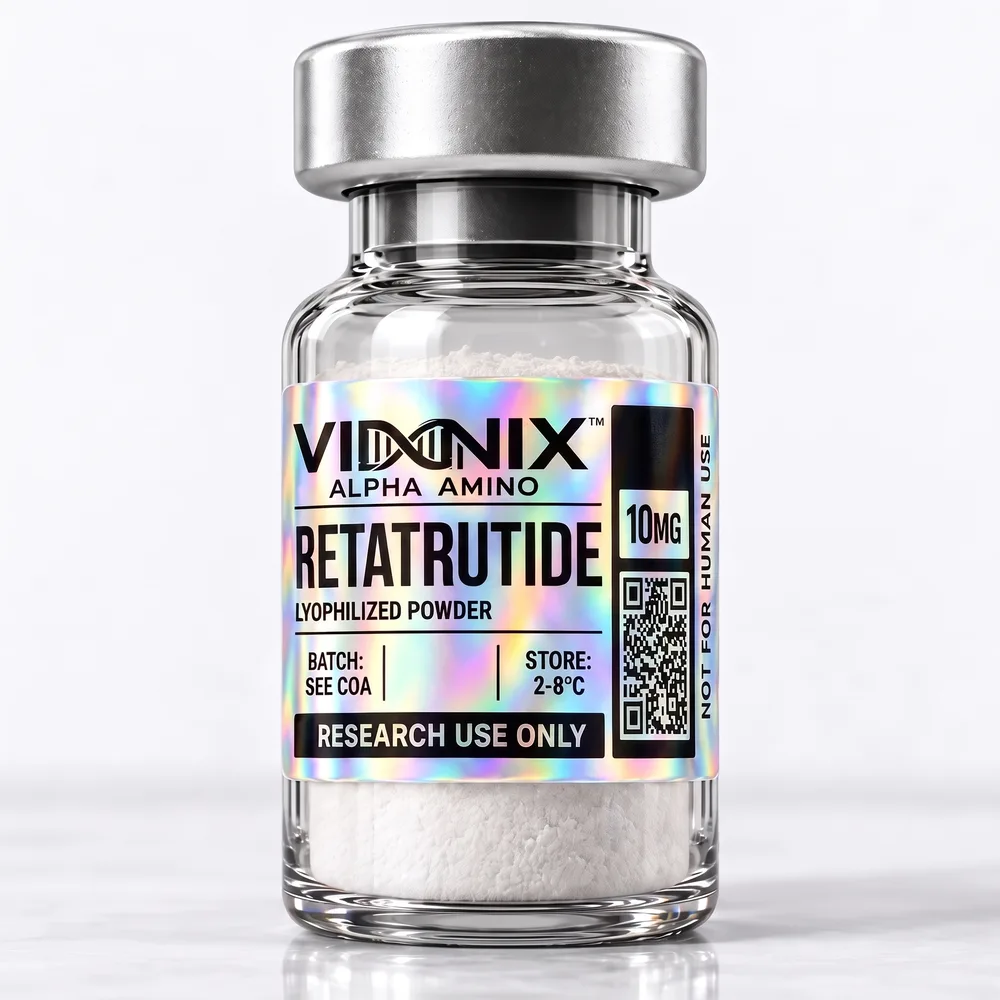
- Vinnix SKUs
- RT10, RT20, RT30
Batch reports are published in the COA Library as each batch is released. Match the batch number on your vial to its report.
What Is Retatrutide?
Retatrutide is an investigational compound studied in clinical research; the retatrutide peptide Vinnix supplies is a research material for laboratory use. It first showed up in the literature under the development code LY3437943, described as a single peptide engineered to activate three receptors: the glucose-dependent insulinotropic polypeptide (GIP) receptor, the glucagon-like peptide-1 (GLP-1) receptor and the glucagon receptor [1].
Hitting three receptors is why it's often called a triple agonist, and it's also where the catalog shorthand "reta peptide" comes from. Both names point to the same molecule. Neither name, printed on a label, proves what is inside a given vial; only analytical data tied to a batch can do that.
This page gathers the compound's identity, molecular information, terminology, published evidence and whatever product-specific analytical documentation is available. Published research on a compound is not evidence that any Vinnix product is approved for a medical purpose. For background on how chains like this are put together, see what peptides are.
Retatrutide Product Information
Vinnix lists the retatrutide peptide in three quantities: RT10 (retatrutide 10 mg), RT20 (20 mg) and RT30 (30 mg). Fields that depend on the physical batch go up only after they're confirmed from the Vinnix product record (batch number vs. lot number explains those identifiers).
| Field | Value |
|---|---|
| Compound | Retatrutide |
| Product format | Stated on the batch COA when published |
| Quantity | 10 mg, 20 mg and 30 mg |
| SKU | RT10, RT20, RT30 |
| Batch / lot | Shown on the batch COA when published |
| CAS number | 2381089-83-2 (FDA GSRS) |
| Molecular formula | C221H342N46O68 (PubChem) |
| Molecular mass | 4731 g/mol (PubChem) |
| Sequence / structure | 39-residue modified peptide; see the sequence section below |
| Available analytical documentation | Linked per batch in the COA Library once each report is published |
If you're comparing retatrutide cost or availability across suppliers, compare the documentation first. A listing of retatrutide for sale tells you nothing about identity or purity by itself. The batch report does. The full Vinnix peptides catalog lists related research compounds.
Compound Identity & Terminology
Retatrutide is the International Nonproprietary Name (INN) for the molecule that the FDA Global Substance Registration System (GSRS) records under UNII NOP2Y096GV and CAS 2381089-83-2.
- Retatrutide: the INN, used in current literature and regulatory records.
- LY3437943: the development code used in the discovery paper and early trials [1][2].
- Retatrutide sodium: GSRS keeps a separate record for the sodium salt. A salt form has a different formula weight from the free peptide, so labels and reports should state which form they mean.
- Reta / reta peptide: informal catalog shorthand. It has no formal standing and does not denote a different compound.
Similar names, salts, forms and related compounds are not interchangeable unless they genuinely are equivalent. Tirzepatide and semaglutide, for instance, are separate molecules with their own sequences, formulas and records.
Molecular Information
The molecular data below come from PubChem and FDA GSRS and are set out as a reference table.
| Property | Value | Source |
|---|---|---|
| Molecular formula | C221H342N46O68 | PubChem CID 171390338 |
| Molecular weight | 4731 g/mol | PubChem CID 171390338 |
| CAS registry number | 2381089-83-2 | FDA GSRS |
| UNII | NOP2Y096GV | FDA GSRS |
| Development code | LY3437943 | FDA GSRS; Coskun et al. [1] |
| Backbone length | 39 residues | FDA GSRS |
| C-terminus | Serine amide | FDA GSRS |
At roughly 4.7 kDa, the retatrutide peptide is big for a synthetic peptide, and that shapes how it gets analyzed. Under electrospray mass spectrometry, a molecule this size usually shows up as several multiply charged ions instead of one peak (what is a mass spectrum shows the pattern). The spectrum then has to be deconvoluted to recover the neutral mass.
Retatrutide Peptide Sequence and Structure
FDA GSRS records the retatrutide peptide backbone as the 39-letter sequence below. Several positions, though, carry non-standard residues that one-letter code can't show.
YAQGTFTSDYSILLDKKAQAAFIEYLLEGGPSSGAPPPS
| Position | Residue as recorded | Note |
|---|---|---|
| 2 | 2-aminoisobutyric acid (Aib) | Non-standard alpha-methyl amino acid shown as A in the backbone |
| 13 | alpha-methyl-L-leucine | Shown as L in the backbone |
| 17 | Lysine with an acyl side chain | Lysine linked through gamma-glutamate and an AEEA spacer to a C20 fatty diacid |
| 20 | 2-aminoisobutyric acid (Aib) | Shown as A in the backbone |
| 39 | Serine amide | Amidated C-terminus |
Those modifications are part of the molecule's identity. Take the same 39 letters, drop the Aib residues or the lipid side chain, and the mass changes, which is exactly what mass spectrometry picks up. The discovery paper describes LY3437943 as a single peptide with agonist activity at all three receptors [1]. Notation conventions are explained in the guide to peptide sequences.
Research Landscape
Retatrutide research makes most sense sorted by level of evidence. Laboratory and animal work, early human pharmacology, phase 2 and phase 3 trials, and review articles are different kinds of evidence, and they answer different questions. In vitro vs. in vivo research covers the basic distinction.
Laboratory and animal (preclinical) research
The discovery paper reports LY3437943's receptor activity in cell-based assays and its pharmacology in rodent models, alongside an early phase 1 single-ascending-dose study [1]. In vitro, the compound was relatively more active at the GIP receptor than at the GLP-1 and glucagon receptors [1]. These are preclinical findings and should not be taken as establishing safety or effectiveness in humans.
Phase 1 clinical research
A phase 1b randomized, placebo-controlled study in people with type 2 diabetes looked at safety, tolerability, pharmacokinetics and pharmacodynamic markers [2]. Phase 1 work is mostly about tolerability and how a compound behaves in the body. It isn't designed to establish clinical outcomes.
Phase 2 clinical research
In 2023, two phase 2 randomized, double-blind, placebo-controlled trials were published. The first enrolled adults with obesity, with percentage change in body weight as the primary endpoint [3]. The second enrolled adults with type 2 diabetes and looked at change in glycated hemoglobin (HbA1c), using placebo and an active comparator arm [4].
Phase 3 clinical research
Phase 3 runs along two tracks: the TRANSCEND-T2D trials in type 2 diabetes and the TRIUMPH trials in obesity. TRANSCEND-T2D-1, a double-blind randomized trial in adults with type 2 diabetes, looked at change in HbA1c [5]. TRIUMPH-1 (NCT05929066) enrolled adults with obesity but without diabetes and looked at body-weight change, with nested sub-studies in participants with knee osteoarthritis or obstructive sleep apnea [6]. TRIUMPH-2 enrolled adults with both obesity and type 2 diabetes [7]. All of these trials recorded adverse events, most often gastrointestinal.
Review literature
Narrative reviews summarize the receptor pharmacology and the trial program as of their publication date [8]. They're handy for orientation. Still, a review inherits the limits of the studies it covers, and it can go out of date quickly while phase 3 results are still arriving.
Retatrutide studies describe the materials used in those studies, which the trial sponsor manufactured and controlled. They say nothing about the characteristics of any Vinnix batch, and results from one study type shouldn't be stretched to cover another.
Regulatory Context
As of October 2026, retatrutide is an investigational compound. The US Food and Drug Administration (FDA) has not approved it as a medicine for any use.
Phase 3 results started appearing in peer-reviewed journals in 2026 [5][6][7]. Regulatory status can shift as development goes on, so always check it against current FDA sources. If approval does come, it will cover the sponsor's specific drug product, not research materials from other manufacturers, the Vinnix retatrutide peptide included.
To see how Vinnix presents literature, evidence levels and batch documentation, read the Product & Research Information Disclosure.
Analytical Documentation
Any analytical documentation for the Vinnix retatrutide peptide belongs only to the sample or batch named on that report. Different methods answer different questions.
How is retatrutide analyzed?
- HPLC: separates the sample and reports the main peak as a percentage of detected UV peak area, which is a purity measure. See HPLC testing explained.
- Mass spectrometry: measures molecular mass to support identity. For retatrutide, the observed mass is checked against the expected value for the modified peptide. See mass spectrometry for peptides.
- LC-MS: combines the two (see what LC-MS is), so you can check the identity of the main peak and of related impurities in a single run.
Retatrutide COA and batch documentation
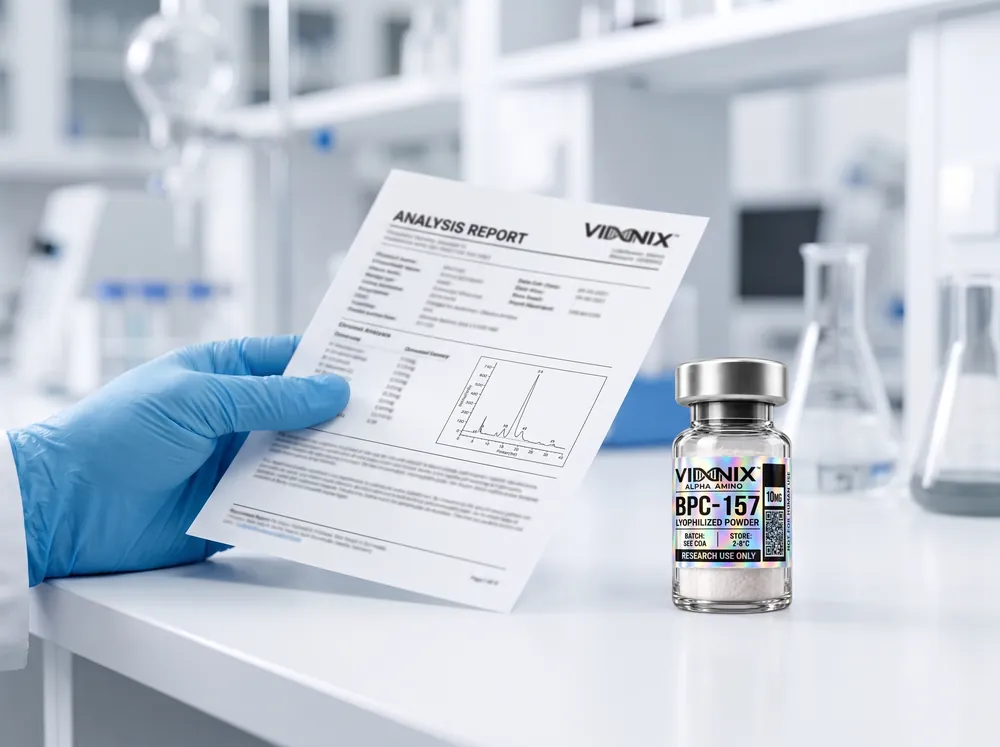
A certificate of analysis summarizes the tests run on one batch: batch number, methods, results and test date. Vinnix retatrutide peptide reports will go into the Vinnix COA Library as they become available, and each covers only the batch it names. For an overview of the methods, see peptide testing and analysis.
The Vinnix retatrutide peptide is supplied for laboratory and analytical research. It is not for human or veterinary use and is not intended to diagnose, treat or prevent any condition. Check the batch COA before using it in any experiment.
FAQRetatrutide FAQ
What is Retatrutide?
Retatrutide is an investigational peptide, developed under the code LY3437943, that was designed to activate the GIP, GLP-1 and glucagon receptors. Structurally it's a 39-residue modified chain carrying a fatty-acid side chain. It has gone through clinical trials but is not an approved medicine. Vinnix supplies the retatrutide peptide only as a laboratory research material, to be documented batch by batch.
Is retatrutide approved?
No. As of October 2026, retatrutide is investigational and the FDA has not approved it for any use. Phase 3 results are published, but publication isn't approval. If approval comes, it will cover the sponsor's specific drug product only. The Vinnix retatrutide peptide is a research-use-only material, not a drug product.
What molecular information is available for Retatrutide?
The verified fields are the molecular formula C221H342N46O68 and molecular weight of 4731 g/mol (PubChem CID 171390338), CAS number 2381089-83-2 and UNII NOP2Y096GV (FDA GSRS), plus the 39-residue backbone sequence and the positions of its modified residues. Every value on this page names its source, so you can check it yourself.
What is the molecular weight of retatrutide?
PubChem gives 4731 g/mol for the formula C221H342N46O68. That figure is for the free peptide. A salt form, like the sodium salt that FDA GSRS lists separately, has a different formula weight. On a COA, mass spectrometry results are compared with the expected value for the retatrutide peptide itself.
How is Retatrutide researched?
It's best read by study type. The discovery paper covers cell-based and animal work; after that come phase 1, phase 2 and phase 3 clinical trials, plus review articles. Results from one research setting shouldn't be generalized to another, and none of this literature describes any particular Vinnix batch.
How is Vinnix Retatrutide analyzed?
Each batch report will list its methods, which may include HPLC for purity and mass spectrometry or LC-MS for identity. HPLC shows how much of the detected material is the main component. Mass spectrometry checks that this main component has the mass expected for the modified retatrutide peptide.
Where can I find the Vinnix Retatrutide COA?
Batch-specific documentation will be linked from this page and listed in the Vinnix COA Library under RT10, RT20 or RT30 as each report comes out. Before you rely on any result, match the batch or lot number on the report with the one on the product label.
Does a COA apply to every batch?
No. A certificate of analysis covers only the sample or batch named on the report. Peptide synthesis and purification vary from run to run, so purity and content can shift between batches. Never read a result from one batch as the result for another.
REFScientific references
-
Coskun T, Urva S, Roell WC, et al. LY3437943, a novel triple glucagon, GIP, and GLP-1 receptor agonist for glycemic control and weight loss: From discovery to clinical proof of concept. Cell Metab. 2022;34(9):1234-1247.e9. PubMed 35985340
in vitro, animal and phase 1 clinical (discovery) -
Urva S, Coskun T, Loh MT, et al. LY3437943, a novel triple GIP, GLP-1, and glucagon receptor agonist in people with type 2 diabetes: a phase 1b, multicentre, double-blind, placebo-controlled, randomised, multiple-ascending dose trial. Lancet. 2022;400(10366):1869-1881. PubMed 36354040
human clinical, phase 1b randomized trial -
Jastreboff AM, Kaplan LM, Frías JP, et al. Triple-Hormone-Receptor Agonist Retatrutide for Obesity: A Phase 2 Trial. N Engl J Med. 2023;389(6):514-526. PubMed 37366315
human clinical, phase 2 randomized trial -
Rosenstock J, Frias J, Jastreboff AM, et al. Retatrutide, a GIP, GLP-1 and glucagon receptor agonist, for people with type 2 diabetes: a randomised, double-blind, placebo and active-controlled, parallel-group, phase 2 trial conducted in the USA. Lancet. 2023;402(10401):529-544. PubMed 37385280
human clinical, phase 2 randomized trial -
Bajaj HS, Welch M, Shah P, et al. Efficacy and safety of retatrutide, a GIP, GLP-1, and glucagon receptor agonist, in people with type 2 diabetes and inadequate glycaemic control with diet and exercise (TRANSCEND-T2D-1): a double-blind, randomised, phase 3 trial. Lancet. 2026;407(10546):2402-2413. PubMed 42250575
human clinical, phase 3 randomized trial -
Jastreboff AM, Kaplan LM, Davies MJ, et al. Retatrutide, a Triple Hormone Receptor Agonist, for Treatment of Obesity. N Engl J Med. 2026 (published online September 29, 2026). PubMed 42814954
human clinical, phase 3 randomized trial (TRIUMPH-1) -
Bellido V, le Roux CW, Ekinci EI, et al. Retatrutide in adults with obesity and type 2 diabetes (TRIUMPH-2): a double-blind, parallel-group, randomised, placebo-controlled, phase 3 trial. Lancet. 2026 (published online September 29, 2026). PubMed 42810372
human clinical, phase 3 randomized trial -
Panou T, Gouveri E, Popovic DS, et al. Retatrutide in type 2 diabetes mellitus and obesity: an overview. Expert Rev Clin Pharmacol. 2026;19(4):313-339. PubMed 41785010
review
 Compound Library
 Compound Library
 Testing & Analysis
 Research Library
 Research Library
 Documentation