
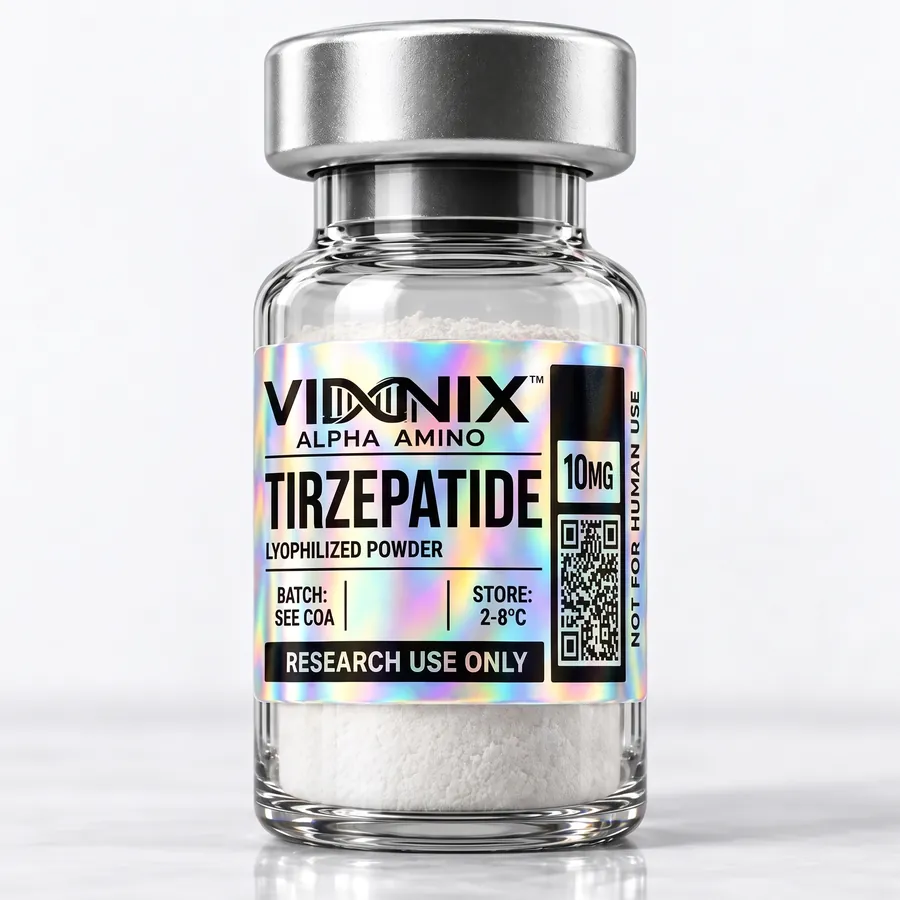
Key facts
- Development code
- LY3298176
- Molecular formula
- C225H348N48O68 (PubChem CID 166567236)
- Molecular weight
- 4813 g/mol (PubChem)
- CAS number
- 2023788-19-2 (FDA GSRS, UNII OYN3CCI6QE)
- Backbone length
- 39 amino acids, including two Aib residues
- Receptors studied
- GIP and GLP-1 receptors
- Vinnix SKUs
- TR10, TR20, TR30
Batch reports are published in the COA Library as each batch is released. Match the batch number on your vial to its report.
What Is Tirzepatide?
Tirzepatide has a well-established scientific and regulatory literature, and the tirzepatide peptide in the Vinnix catalog is a research material for laboratory and analytical work. Its development code was LY3298176. The discovery team describe it as a single peptide, modified with a fatty acid, that acts as an agonist at two receptors: the glucose-dependent insulinotropic polypeptide (GIP) receptor and the glucagon-like peptide-1 (GLP-1) receptor [1].
Two receptors means two labels in the literature: dual agonist and co-agonist. In catalogs you may see "tirz peptide" or tirzepatide research peptide. Those are informal names for the same INN. They do not describe different compounds.
Here we've gathered what matters for identifying the compound: molecular data, terminology, references and the analytical documents that apply. Anything about presentation refers to the Vinnix item only. Coming to peptides fresh? Read what peptides are first.
Tirzepatide Product Information
The tirzepatide peptide comes in three Vinnix quantities. TR10 is the 10 mg quantity, TR20 is 20 mg and TR30 is 30 mg. Batch-dependent fields appear only once the Vinnix product record confirms them (batch number vs. lot number explains those identifiers).
| Field | Value |
|---|---|
| Compound | Tirzepatide |
| Product format | Stated on the batch COA when published |
| Quantity | 10 mg, 20 mg and 30 mg |
| SKU | TR10, TR20, TR30 |
| Batch / lot | Shown on the batch COA when published |
| CAS number | 2023788-19-2 (FDA GSRS) |
| Molecular formula | C225H348N48O68 (PubChem) |
| Molecular mass | 4813 g/mol (PubChem) |
| Sequence / structure | 39-residue backbone with Aib at positions 2 and 13 and an acylated lysine at position 20 |
| Available analytical documentation | Linked per batch in the COA Library once each report is published |
A research listing for tirzepatide for sale is not proof of identity, purity or content. You get those from the batch report, not from the listing. Other research compounds are in the full Vinnix peptides catalog.
Compound Identity & Terminology
Tirzepatide is the International Nonproprietary Name (INN). The FDA Global Substance Registration System (GSRS) records the molecule under UNII OYN3CCI6QE and CAS 2023788-19-2.
- Tirzepatide: the INN that current literature and regulatory records use.
- LY3298176: the development code in the discovery paper and the early trials [1][3].
- Tirz / tirz peptide: informal catalog shorthand with no formal standing.
- Side-chain intermediates: GSRS keeps separate records for the modified lysine residue and for the protected side-chain building blocks used in synthesis. None of these is tirzepatide, and none should be labelled that way.
Approved drug products containing tirzepatide are separate, regulated formulations, each made to its own specifications. What's known about them doesn't carry over to a research material. And retatrutide and semaglutide are different molecules, each with its own records.
Molecular Information
Below is the verified molecular data for the tirzepatide peptide, taken from PubChem and FDA GSRS.
| Property | Value | Source |
|---|---|---|
| Molecular formula | C225H348N48O68 | PubChem CID 166567236 |
| Molecular weight | 4813 g/mol | PubChem CID 166567236 |
| CAS registry number | 2023788-19-2 | FDA GSRS |
| UNII | OYN3CCI6QE | FDA GSRS |
| Development code | LY3298176 | FDA GSRS; Coskun et al. [1] |
| Backbone length | 39 residues | FDA GSRS |
| C-terminus | Serine amide | FDA GSRS |
At around 4.8 kDa, the tirzepatide peptide produces a recognizable cluster of multiply charged ions in electrospray mass spectrometry (what is a mass spectrum shows the pattern). Deconvolute that cluster and you get the neutral mass, which a COA then sets against the expected value.
Tirzepatide Peptide Sequence and Structure
FDA GSRS records the tirzepatide peptide backbone as the 39-letter sequence below. Three of its positions carry modified residues, and the letters by themselves don't show them.
YAEGTFTSDYSIGLDKIAQKAFVQWLIAGGPSSGAPPPS
| Position | Residue as recorded | Note |
|---|---|---|
| 2 | 2-aminoisobutyric acid (Aib) | Shown as A in the backbone |
| 13 | 2-aminoisobutyric acid (Aib) | Shown as A in the backbone |
| 20 | Lysine with an acyl side chain | Linked through two AEEA spacers and gamma-glutamate to a C20 fatty diacid |
| 39 | Serine amide | Amidated C-terminus |
In the discovery paper, the molecule is presented as a fatty-acid-modified peptide built for activity at both receptors [1]. Both the side chain and the Aib residues alter the peptide's mass and how it behaves on a chromatography column. So the expected mass on a report has to be worked out for the full modified structure. The peptide sequences guide covers the notation.
Research Landscape
Tirzepatide has been studied at almost every level: laboratory pharmacology, animal work, early human pharmacology, phase 2 and phase 3 trials, and reviews. Each of those answers its own kind of question, and in vitro vs. in vivo research covers the basic distinction.
Laboratory and animal (preclinical) research
Cell-based receptor assays and rodent pharmacology appear in the discovery paper, together with early clinical work [1]. A later laboratory study went deeper into receptor signaling. It reported stronger engagement of the GIP receptor than of the GLP-1 receptor, and at the GLP-1 receptor a bias toward cAMP generation over beta-arrestin recruitment [2]. None of these preclinical findings establishes safety or effectiveness in humans.
Phase 1 and phase 2 clinical research
The phase 1 studies in that same paper looked at tolerability and pharmacokinetics [1]. Then came a phase 2 randomized trial in adults with type 2 diabetes, which compared several fixed regimens against placebo and an active comparator; its primary endpoint was change in HbA1c [3].
Phase 3 clinical research
Two phase 3 programs followed. SURPASS enrolled adults with type 2 diabetes, and SURPASS-1, a double-blind placebo-controlled phase 3 trial, measured change in HbA1c [4]. SURMOUNT enrolled adults with obesity or overweight, and SURMOUNT-1 measured percentage change in body weight against placebo [5]. There is also a separate cardiovascular outcomes trial, SURPASS-CVOT, set up to compare major adverse cardiovascular events against an active comparator in adults with type 2 diabetes and established cardiovascular disease [6]. Adverse events were recorded in every trial.
Review literature
Review articles summarize the receptor pharmacology and the SURPASS results, and they flag a question that is still open: how much GIP receptor activity contributes to the observed effects [7]. Treat reviews as secondary sources and read them with the primary trials they cite.
Every clinical study used drug product that the sponsor manufactured to controlled specifications. That research tells you nothing about the characteristics of a Vinnix batch, and results from one type of study don't transfer to another.
Regulatory Context
Tirzepatide is the active ingredient of prescription medicines that the US Food and Drug Administration (FDA) has approved, beginning in 2022.
The approval is narrow. It covers the specific drug products the approval holder makes under its own manufacturing and quality controls, and it does not reach another manufacturer's material, compounded preparations or any Vinnix product. The Vinnix tirzepatide peptide is a laboratory material. It is not a drug product and cannot stand in for one.
The Product & Research Information Disclosure explains how Vinnix presents literature, evidence levels and batch documentation.
Analytical Documentation
Each analytical document for the Vinnix tirzepatide peptide applies only to the sample or batch it names. The methods on it each answer a separate question about that material.
How is tirzepatide analyzed?
- HPLC: separates the sample and gives the main peak as a share of the detected UV peak area, a measure of purity. See HPLC testing explained.
- Mass spectrometry: measures molecular mass and compares it with the expected value for the modified peptide to support identity. See mass spectrometry for peptides.
- LC-MS: pairs separation with mass measurement, which lets you identify the main peak and related impurities together (see what LC-MS is).
Tirzepatide COA and batch documentation
For one batch, a certificate of analysis records the batch number, methods, results and test date. Vinnix tirzepatide peptide reports will be added to the Vinnix COA Library as they become available, and a report speaks only for the batch it names. For an overview of the methods and where they fall short, see peptide testing and analysis.
Vinnix tirzepatide is supplied for laboratory and analytical research. It is not for human or veterinary use, and it is not intended to diagnose, treat or prevent any condition. Before using it in an experiment, check the batch COA.
FAQTirzepatide FAQ
What is Tirzepatide?
Tirzepatide is a 39-residue modified peptide, developed as LY3298176, with agonist activity at both the GIP and GLP-1 receptors. It carries two Aib residues and a C20 fatty diacid side chain on lysine 20. Approved prescription medicines contain it as the active ingredient; the Vinnix tirzepatide peptide is a separate material sold only for laboratory research.
What molecular information is available for Tirzepatide?
The page gives the molecular formula C225H348N48O68 and a molecular weight of 4813 g/mol (PubChem CID 166567236), CAS number 2023788-19-2 and UNII OYN3CCI6QE (FDA GSRS), plus the 39-residue backbone sequence and where the modified residues sit. Each value is listed with its source.
What is the molecular weight of tirzepatide?
PubChem gives 4813 g/mol for the formula C225H348N48O68. That number already includes the Aib residues and the whole fatty-acid side chain. So if you're checking a mass spectrometry result on a COA, compare it with the mass of the complete modified structure, never with the bare backbone.
How is Tirzepatide researched?
It helps to sort it by study type: cell-based receptor pharmacology, animal studies, phase 1 and phase 2 trials, the large phase 3 programs, and reviews. A result from one setting shouldn't be stretched to another. None of the published studies describes a particular Vinnix batch, either.
How is Vinnix Tirzepatide analyzed?
Every batch report will list its methods, which may include HPLC for purity and mass spectrometry or LC-MS for identity. HPLC answers how much of the detected material is the main component. Mass spectrometry answers whether that main component has the mass you'd expect for the tirzepatide peptide.
Where can I find the Vinnix Tirzepatide COA?
Batch documents will be linked from this page and will appear in the Vinnix COA Library under TR10, TR20 or TR30 as each report is released. Before you rely on any result, make sure the batch or lot number on the report matches the one on the product label.
Does a COA apply to every batch?
No. A certificate of analysis covers only the sample or batch it identifies. Synthesis and purification differ from run to run, so purity and peptide content can change between batches. Don't read a result from one tirzepatide batch as if it described any other batch.
REFScientific references
-
Coskun T, Sloop KW, Loghin C, et al. LY3298176, a novel dual GIP and GLP-1 receptor agonist for the treatment of type 2 diabetes mellitus: From discovery to clinical proof of concept. Mol Metab. 2018;18:3-14. PubMed 30473097
in vitro, animal and phase 1 clinical (discovery) -
Willard FS, Douros JD, Gabe MB, et al. Tirzepatide is an imbalanced and biased dual GIP and GLP-1 receptor agonist. JCI Insight. 2020;5(17):e140532. PubMed 32730231
in vitro and ex vivo pharmacology -
Frias JP, Nauck MA, Van J, et al. Efficacy and safety of LY3298176, a novel dual GIP and GLP-1 receptor agonist, in patients with type 2 diabetes: a randomised, placebo-controlled and active comparator-controlled phase 2 trial. Lancet. 2018;392(10160):2180-2193. PubMed 30293770
human clinical, phase 2 randomized trial -
Rosenstock J, Wysham C, Frías JP, et al. Efficacy and safety of a novel dual GIP and GLP-1 receptor agonist tirzepatide in patients with type 2 diabetes (SURPASS-1): a double-blind, randomised, phase 3 trial. Lancet. 2021;398(10295):143-155. PubMed 34186022
human clinical, phase 3 randomized trial -
Jastreboff AM, Aronne LJ, Ahmad NN, et al. Tirzepatide Once Weekly for the Treatment of Obesity. N Engl J Med. 2022;387(3):205-216. PubMed 35658024
human clinical, phase 3 randomized trial -
Nicholls SJ, Bhatt DL, Buse JB, et al. Comparison of tirzepatide and dulaglutide on major adverse cardiovascular events in participants with type 2 diabetes and atherosclerotic cardiovascular disease: SURPASS-CVOT design and baseline characteristics. Am Heart J. 2024;267:1-11. PubMed 37758044
human clinical, phase 3 trial design paper -
Nauck MA, D'Alessio DA. Tirzepatide, a dual GIP/GLP-1 receptor co-agonist for the treatment of type 2 diabetes with unmatched effectiveness regrading glycaemic control and body weight reduction. Cardiovasc Diabetol. 2022;21(1):169. PubMed 36050763
review
 Compound Library
 Compound Library
 Testing & Analysis
 Research Library
 Research Library
 Documentation