
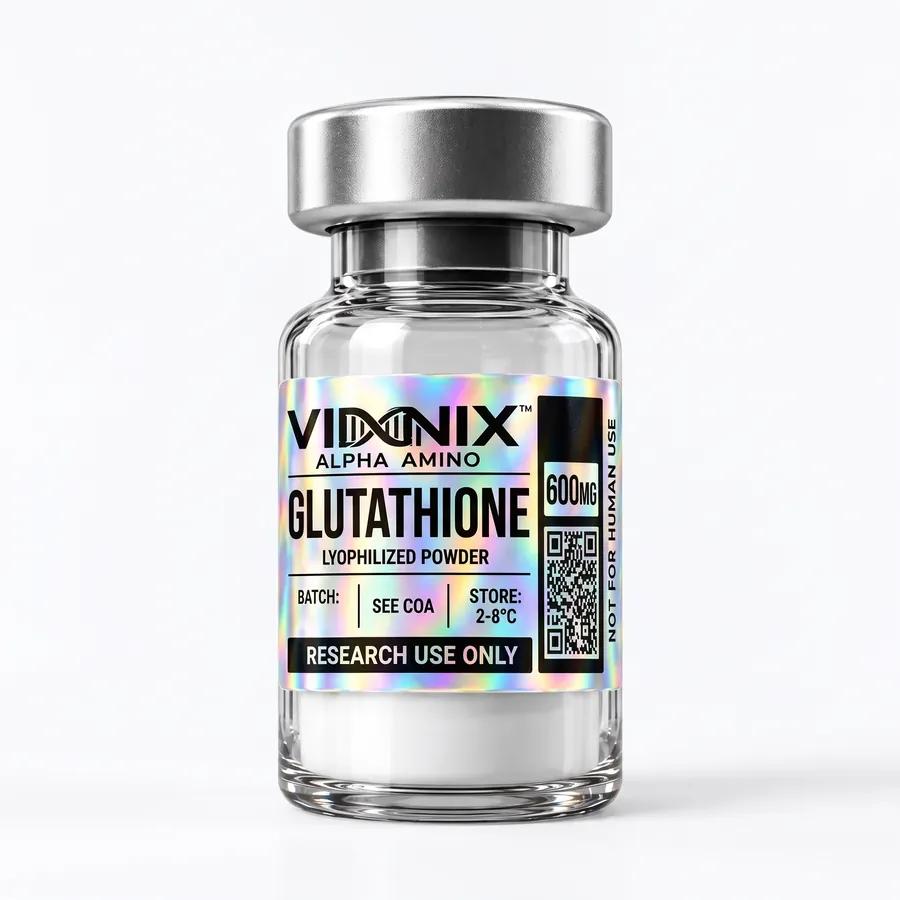
Key facts
- Structure
- gamma-L-Glu-L-Cys-Gly
- Amino acids
- 3 (tripeptide)
- Molecular formula
- C10H17N3O6S (reduced, GSH)
- Molecular weight
- 307.3 g/mol (PubChem CID 124886)
- CAS number
- 70-18-8
- UNII
- GAN16C9B8O
- Vinnix SKU
- GT600 (600 mg)
Batch reports are published in the COA Library as each batch is released. Match the batch number on your vial to its report.
What Is Glutathione?
The glutathione peptide is a tripeptide built from glutamate, cysteine and glycine, and few small molecules in biochemistry have been studied as heavily. Cells make it with enzymes, not on ribosomes. In many cell types it is the most abundant non-protein thiol [1][2].
The gamma bond in the glutathione peptide
The chemistry gets interesting at the first bond. Glutamate attaches to cysteine through its side-chain (gamma) carboxyl group instead of the usual alpha carboxyl, which is why the molecule is written gamma-Glu-Cys-Gly. That gamma linkage also explains why most ordinary peptidases can't break it down [1].
Here we treat the glutathione peptide strictly as a chemical entity: structure, its two main forms, the biochemistry literature, how it is analyzed, and how Vinnix batches are documented. We make no claim about any effect of the Vinnix product.
Glutathione Product Specifications
The glutathione peptide is supplied at 600 mg per vial (SKU GT600), for laboratory research only. Lot number, physical form, which form is supplied (reduced or oxidized) and the storage statement will all come with each batch record when it is published. For general background on how dry peptide material is kept, see peptide storage.
| Field | Value |
|---|---|
| Compound | Glutathione (reduced, GSH) |
| Classification | Tripeptide |
| Sequence | gamma-L-glutamyl-L-cysteinyl-glycine |
| Molecular formula | C10H17N3O6S |
| Molecular weight | 307.3 g/mol (PubChem CID 124886) |
| CAS number | 70-18-8 |
| Product quantity | 600 mg per vial |
| SKU | GT600 |
| Form | Shown on the batch COA when published |
| Batch / lot | Shown on the batch COA when published |
| Storage | Shown on the batch COA when published |
| COA | Linked per batch from the Vinnix COA Library as each report is released |
Glutathione Sequence and Molecular Information
The sequence is gamma-Glu-Cys-Gly. L-glutamate links through its gamma carboxyl to L-cysteine, and L-cysteine joins glycine through an ordinary peptide bond. The one-letter shorthand ECG hides that gamma bond and can mislead (see one-letter vs. three-letter amino acid codes), so we use the full name.
What amino acids make up glutathione?
Three amino acids: glutamate (glutamic acid), cysteine and glycine. Each has a job. Glutamate provides the free alpha-amino and alpha-carboxyl groups at one end. Cysteine provides the thiol (-SH) group, and that thiol drives most of the molecule's chemistry. Glycine supplies the C-terminal carboxyl. Our amino acids page covers these building blocks in more depth.
| Identifier | Reduced (GSH) | Oxidized (GSSG) |
|---|---|---|
| PubChem CID | 124886 | 65359 |
| Molecular formula | C10H17N3O6S | C20H32N6O12S2 |
| Molecular weight | 307.3 g/mol | 612.6 g/mol |
| Monoisotopic mass | 307.084 Da | 612.152 Da |
| CAS number | 70-18-8 | Not used on this page |
| UNII (FDA GSRS) | GAN16C9B8O | Not used on this page |
Reduced vs Oxidized Glutathione
Reduced glutathione (GSH) carries a free thiol on its cysteine. The oxidized form (GSSG) is two GSH molecules linked by a disulfide bond between their cysteines. These are different molecules, with different formulas, weights and identifiers.
Most of the glutathione peptide's chemistry comes down to switching between the two. Two thiols lose two hydrogens and form one disulfide; the reverse reaction gives the thiols back. GSH oxidizes when exposed to air, especially in solution. That makes the GSH to GSSG ratio a basic quality attribute for any material of this kind, and biochemists track the same ratio as a core measurement in their own experiments [2][4].
A product record should state whether it supplies GSH or GSSG. The Vinnix GT600 specification refers to the reduced form, GSH; confirm the form on the batch certificate.
Published Research on Glutathione
The literature on the glutathione peptide is enormous. It covers more than a century of biochemistry, from the first chemical characterization through enzymology to analytical methods, and the main reviews group it into a few themes.
- Biosynthesis (review): it is assembled in two ATP-dependent steps, first by glutamate-cysteine ligase forming gamma-glutamylcysteine, then by glutathione synthetase adding glycine [3].
- Biochemical roles and metabolism (review): classic reviews describe its thiol-disulfide chemistry, its use as a substrate by enzyme families such as glutathione S-transferases, and the gamma-glutamyl pathway of its turnover [1][2].
- Measurement (review of analytical methods): a detailed review compares methods for determining GSH and GSSG in biological samples, including HPLC with various detectors and derivatization strategies [4].
All of this is basic biochemistry in cells and tissues. None of it is evidence about any research material, and preclinical findings should not be read as establishing safety or effectiveness in humans.
How Is Glutathione Analyzed?
HPLC does most of the work in characterizing the glutathione peptide, with mass spectrometry confirming identity. Analysts watch the oxidized form closely as a related substance.
The molecule is hard to see by UV. It has no aromatic residues, so HPLC methods either detect at low wavelengths or derivatize the thiol or amine group to boost the signal [4]. On a raw-material chromatogram, analysts look for GSSG and for related substances such as the dipeptides gamma-glutamylcysteine and cysteinylglycine.
By mass spectrometry, GSH gives a protonated ion near m/z 308.09 and GSSG one near m/z 613.16 (both calculated from PubChem monoisotopic masses). Notice the 305 Da gap between them. It isn't a simple doubling, because two hydrogens are lost when the disulfide forms.
Glutathione COA and Batch Documentation
Each Vinnix 600 mg batch of the glutathione peptide will be documented with a certificate of analysis linking the vial to its test results, published by batch number in the COA Library. Each report is expected to list:
- Lot number, quantity per vial and test date
- Form supplied (reduced or oxidized)
- HPLC purity, including GSSG (oxidized form) content
- Identity confirmation and the methods used
Need help with a specific field? Try Certificate of Analysis and Peptide Testing. To see where tripeptides sit in the wider peptide family, read What Are Peptides? or look at GHK-Cu, another tripeptide in the catalog.
Vinnix products are supplied strictly for laboratory and analytical research. They are not drugs, supplements or personal-care products, are not for human or veterinary use, and nothing on this page describes or implies any use in people or animals.
FAQGlutathione FAQ
What is glutathione?
Glutathione is a tripeptide made of glutamate, cysteine and glycine, written gamma-Glu-Cys-Gly because glutamate is linked through its side-chain carboxyl. In its reduced form (GSH) PubChem lists the formula C10H17N3O6S and a molecular weight of 307.3 g/mol. Vinnix supplies the glutathione peptide as a 600 mg vial for laboratory research only.
Is glutathione a peptide?
Yes. The glutathione peptide is a tripeptide, three amino acids joined by two amide bonds. One bond is a bit odd: glutamate connects to cysteine through its gamma (side-chain) carboxyl rather than the alpha carboxyl. And cells build it with two enzymes instead of on ribosomes. Chemically, though, it is still a small peptide.
What amino acids make up glutathione?
Three amino acids: glutamate, cysteine and glycine. A gamma-glutamyl bond joins glutamate to cysteine, and a standard peptide bond joins cysteine to glycine. Most of its chemistry comes from the cysteine thiol group, including the disulfide bond that forms GSSG, the oxidized form.
What is the molecular weight of glutathione?
PubChem lists the reduced form (GSH, CID 124886) at 307.3 g/mol with the formula C10H17N3O6S and a monoisotopic mass of 307.084 Da. The oxidized form (GSSG, CID 65359) is a separate molecule, C20H32N6O12S2, at 612.6 g/mol. A certificate should state which form was tested.
What is the difference between reduced and oxidized glutathione?
The reduced form (GSH) has a free thiol on its cysteine. The oxidized form (GSSG) is two GSH molecules joined by a disulfide bond, minus two hydrogens. Air exposure can turn GSH into GSSG, which is why the GSSG figure deserves a close look on any certificate of analysis for this compound.
How can glutathione be analytically characterized?
Mostly by HPLC. Because the glutathione peptide lacks a strong chromophore, methods use low-wavelength UV detection or derivatization, and the trace is checked for GSSG and dipeptide related substances. Mass spectrometry then confirms identity, with protonated ions near m/z 308.09 for the reduced form and 613.16 for the oxidized form.
Where can I find the Vinnix glutathione COA?
Reports for Vinnix glutathione 600 mg (SKU GT600) will be linked from this page and listed by batch number in the Vinnix COA Library once published. Make sure the lot number on your vial matches the lot on the report. A batch record that hasn't been published yet has no COA link until it is.
REFScientific references
-
Forman HJ, Zhang H, Rinna A. Glutathione: overview of its protective roles, measurement, and biosynthesis. Mol Aspects Med. 2009;30(1-2):1-12. PubMed 18796312
review -
Monostori P, Wittmann G, Karg E, Turi S. Determination of glutathione and glutathione disulfide in biological samples: an in-depth review. J Chromatogr B Analyt Technol Biomed Life Sci. 2009;877(28):3331-3346. PubMed 19560987
review (analytical methods)
 Peptides
 Amino Acids
 Research Library: Peptide Fundamentals
 Testing & Analysis
 Documentation