

Key facts
- Full name
- Liquid chromatography-mass spectrometry
- Interface
- Usually electrospray ionization (ESI)
- Data produced
- Retention time, m/z and intensity together
- Typical mobile phase acid
- Formic acid (MS-compatible)
- Variants
- LC-MS/MS, LC-HRMS
- Main peptide uses
- Identity, impurity profiling, blend component confirmation
Definition: What Is LC-MS?
LC-MS joins liquid chromatography (LC) directly to mass spectrometry (MS), so separation and mass measurement happen in one continuous analysis. The column spreads components out over time. As each one leaves the column, an ion source turns it into ions.
The technique became routine once electrospray ionization gave a simple, dependable interface between a liquid stream and a vacuum mass analyzer [1][2]. Within peptide testing, it sits between the two single techniques, borrowing the separation power of HPLC and the identification power of mass spectrometry.
How LC-MS Works, Step by Step
Four stages make up a run: separation, ionization, mass analysis and data processing.
- Separation: the dissolved peptide sample goes onto a reversed-phase column, and a water to acetonitrile gradient separates components by hydrophobicity.
- Ionization: column outflow enters an electrospray source, which charges the peptides, often across several charge states [2].
- Mass analysis: a quadrupole, ion trap, time-of-flight or Orbitrap analyzer measures m/z for whatever ions arrive at each moment.
- Data processing: software builds a total ion chromatogram, pulls out extracted ion chromatograms for specific masses and deconvolutes spectra into neutral masses.
LC-MS/MS adds a second stage of mass analysis that fragments selected ions. The b-ion and y-ion ladders that result carry sequence-level information [3]. High-resolution LC-MS (LC-HRMS) goes the other direction, measuring mass precisely enough to separate species whose masses differ by small fractions of a dalton.
Why Combine the Methods?
Putting the two together means you read chromatographic and mass information for each component at once, rather than running two separate experiments.
- Each peak gets a mass: a standalone MS test shows the main mass; the combined method shows which retention-time peak carries which mass.
- Impurities become identifiable: a deletion sequence, an oxidized form or a protecting-group adduct each sits at a characteristic mass difference from the main peptide [4][5].
- Less ion suppression: separating components before ionization makes it less likely that the main peptide drowns out minor species [1].
- Blends can be resolved: each component of a multi-peptide product elutes on its own and is confirmed by its own mass.
The two parent techniques are compared side by side in HPLC vs mass spectrometry.
Total Ion and Extracted Ion Chromatograms
You get two kinds of chromatogram from each run. The total ion chromatogram (TIC) sums every ion detected at each moment. The extracted ion chromatogram (XIC) plots only the signal for a chosen m/z value.
The TIC resembles an HPLC trace and shows where material elutes. The XIC is pickier. Extract the m/z of the expected peptide and you see whether that mass lines up exactly with the main peak's retention time. Extract the mass of a suspected impurity, say the main mass minus one residue, and you see whether that impurity elutes and where [4][5]. Since the XIC isolates a single mass, it can expose a minor component buried under a larger peak in the TIC or UV trace, as long as the two species differ in mass.
| Data view | What it shows | Typical use |
|---|---|---|
| UV chromatogram | Absorbance vs time | Purity by area % |
| Total ion chromatogram (TIC) | All detected ions vs time | Overview of eluting material |
| Extracted ion chromatogram (XIC) | Signal for one m/z vs time | Locating a specific peptide or impurity |
| Mass spectrum at a peak | Ion abundance vs m/z at one time point | Identity of the component in that peak |
Beyond peptide characterization, these same capabilities have made the method a routine tool in clinical biochemistry, where it measures many analytes in a single run with high specificity [1]. Same principles, different question.
LC-MS for Peptide Blends
For blends, this is the practical way to confirm every component. Each one elutes at its own retention time and can be matched to its own expected mass.
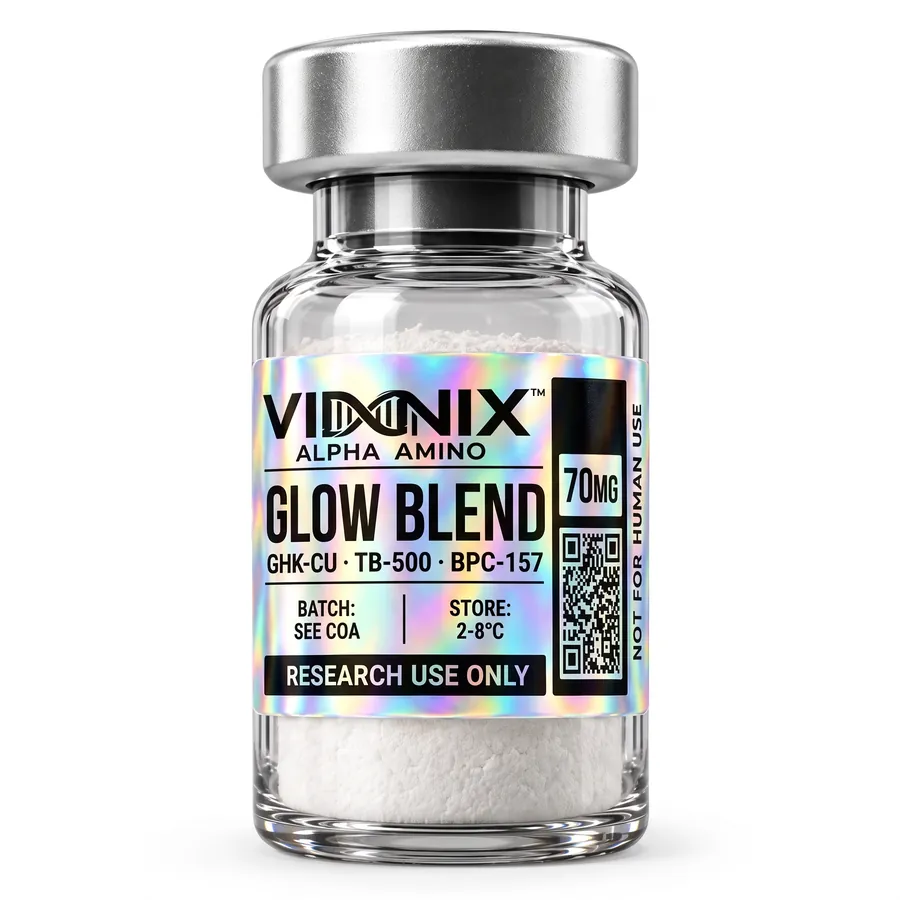
Take a blend of BPC-157 and TB-500, as in the Wolverine blend. It should give two main LC peaks, each with a deconvoluted mass that matches one component. A three-component product like the GLOW blend (GHK-Cu, TB-500 and BPC-157) should give three. A missing expected mass, or an unexpected major one, is exactly what a single combined purity number would hide.
Analytical Context: Reading LC-MS Results
Results still have to be read in light of the method, the sample and the question being asked. The method has its own conditions and trade-offs.
| Factor | Why it matters |
|---|---|
| Mobile phase acid | Trifluoroacetic acid sharpens UV peaks but suppresses ESI signal, so LC-MS methods often use formic acid; retention and peak shape can differ from a UV purity method |
| Ionization efficiency | Signal intensity varies between molecules, so MS peak areas are not direct purity values [1] |
| Mass accuracy | Low-resolution and high-resolution instruments support different levels of confidence in a mass match |
| Isobaric species | Same-mass isomers need chromatographic separation or MS/MS to tell apart [3] |
| Adducts and charge states | Sodium adducts and multiple charge states must be accounted for before comparing with theoretical mass |
Many reports take purity from a UV trace and identity from the MS data of the same run or a parallel one. Each value should name its method. The certificate of analysis guide shows how this appears on a COA.
FAQFrequently asked questions
What is LC-MS used for?
It separates a mixture and identifies the components by mass in a single analysis. With peptides, that means confirming the main peptide's identity, assigning masses to impurity peaks and verifying each component of a blend. Clinical biochemistry, proteomics and pharmaceutical analysis also lean on it heavily for sensitive, specific measurement of many compounds.
What is the difference between LC-MS and HPLC?
HPLC separates a sample and usually detects components by UV absorbance. That supports a purity measurement but can't identify anything. LC-MS uses the same kind of separation, then sends the column output into a mass spectrometer, so every separated component also gets a mass. That's identity information a UV HPLC run simply can't give you.
What is the difference between LC-MS and LC-MS/MS?
LC-MS measures the mass-to-charge ratio of intact ions as they elute. LC-MS/MS adds a second stage that fragments selected ions and measures the pieces. With peptides, those fragments form b-ion and y-ion ladders that spell out the amino acid sequence, which is stronger identity confirmation than intact mass alone.
Can LC-MS measure peptide purity?
Partly. The method shows which impurities are present and gives a rough sense of their relative signal. But ionization efficiency varies from molecule to molecule, so MS signal on its own isn't a reliable purity percentage. Purity is usually reported from a UV chromatogram, with LC-MS identifying the main peak and characterizing the impurity peaks the UV method picked up.
Why do LC-MS methods often use formic acid instead of TFA?
Trifluoroacetic acid sharpens peptide peaks in UV HPLC, but it suppresses ionization in an electrospray source and costs MS sensitivity. Formic acid plays much better with mass spectrometry. One side effect: an LC-MS chromatogram and a UV purity chromatogram of the same peptide can show slightly different retention times and peak shapes.
REFScientific references
-
Pitt JJ. Principles and applications of liquid chromatography-mass spectrometry in clinical biochemistry. Clin Biochem Rev. 2009;30(1):19-34. PubMed 19224008
review -
Fenn JB, Mann M, Meng CK, Wong SF, Whitehouse CM. Electrospray ionization for mass spectrometry of large biomolecules. Science. 1989;246(4926):64-71. PubMed 2675315
methods review -
Steen H, Mann M. The ABC's (and XYZ's) of peptide sequencing. Nat Rev Mol Cell Biol. 2004;5(9):699-711. PubMed 15340378
review -
D'Hondt M, Bracke N, Taevernier L, et al. Related impurities in peptide medicines. J Pharm Biomed Anal. 2014;101:2-30. PubMed 25044089
review -
Li M, Josephs RD, Daireaux A, et al. Structurally related peptide impurity identification and accurate quantification for synthetic oxytocin by liquid chromatography-high-resolution mass spectrometry. Anal Bioanal Chem. 2021;413(7):1861-1870. PubMed 33479819
analytical method study
 Testing & Analysis
 Research Library
 Research Blend