
Key facts
- Usual supplied form
- Lyophilized (freeze-dried) solid
- Main stress factors
- Heat, moisture, light, oxygen and repeated freeze-thaw
- Solid vs. solution
- The dry solid is generally more stable than a solution [3][4]
- Residues prone to oxidation
- Met, Cys, Trp, His and Tyr [5]
- Compound-specific conditions
- Given on the product label and batch documentation
What Is a Lyophilized Peptide?
A lyophilized peptide is one that has been freeze-dried. The peptide solution is frozen, then held under vacuum so the ice turns straight to vapor, leaving a dry, porous solid [1][2]. Removing water this way slows the chemical reactions that degrade peptides in solution, which is why most research peptides ship as a powder or cake rather than a liquid.
Lyophilization lowers water content; it doesn't remove it entirely, and the dry solid can take moisture back from the air. Our article on what lyophilization is covers the three drying stages and what the appearance of the cake can tell you.
General Peptide Storage Principles
Good peptide storage comes down to limiting the things that drive degradation. Reviews of solid-state stability point to the same short list again and again: temperature, residual moisture, oxygen and light [3][4].
- Keep it cold. Chemical reactions slow as temperature drops. Many laboratory protocols keep dry peptides frozen for long-term storage unless the product documentation says otherwise.
- Keep it dry. Store vials tightly closed, ideally with a desiccant, and limit how often they are opened.
- Keep it dark. Amber vials or a closed box protect residues that absorb light.
- Keep it sealed. Less air in contact with the peptide means less oxidation.
- Keep records. Note the batch number, the date received and each time the vial is opened.
None of these is a substitute for the conditions printed for a specific product. They are the defaults a careful lab falls back on when deciding how to hold material it has just received.
Why Peptide Storage Varies by Compound
Two peptides of the same length can behave very differently in a freezer, because stability depends on which amino acids are present. A few residues account for most of the trouble.
| Feature | What can happen | Why it matters for storage |
|---|---|---|
| Met, Cys, Trp, His, Tyr | Oxidation [5] | Limit air exposure; Met sulfoxide adds 16 Da |
| Asn and Gln, especially Asn-Gly | Deamidation [3][4] | Faster with moisture and higher temperature |
| Asp-containing sequences | Isomerization or cleavage [4] | Slowed by dry, cold conditions |
| Free cysteines | Disulfide formation or scrambling [4] | Oxygen and pH both play a part |
| Trp, Tyr, Phe | Photodegradation [6] | Protect from light |
Counter-ions, residual solvent and any excipients also affect how a particular material holds up, and that's another reason one rule can't fit every product. The peptide purity article explains how degradation products show up as extra peaks on a chromatogram.
Temperature and Light
Temperature is the first variable in peptide storage. Lower temperature slows degradation in both the solid and solution states [3][4], so freezer storage is common for long-term holding of dry peptides. Frost-free freezers deserve a word of caution. They warm periodically to clear ice, and those small cycles add up over months; a manual-defrost unit holds a steadier temperature.
Light is easier to forget. Tryptophan, tyrosine and phenylalanine absorb ultraviolet light, and exposure can start photo-oxidation that continues after the light is gone [6]. Keeping vials in their box or in amber glass costs nothing and removes the risk.
Moisture and Opening a Vial
Moisture is the peptide storage problem that labs most often underestimate. Many lyophilized peptides are hygroscopic. They pull water from the air, and even a few percent extra moisture can speed deamidation and other reactions in the solid [3]. The most common way water gets in is simple: a cold vial is opened in a warm room and condensation forms on the powder.
The usual lab practice is to let a sealed vial reach room temperature, ideally in a desiccator, before opening it. Weigh out what is needed quickly, flush or reseal the vial, and return it to cold storage.
Freeze-Thaw Cycles and Aliquoting
Each freeze and thaw exposes a dissolved peptide to ice surfaces, concentration shifts and pH changes, and studies on proteins show that freezing and thawing rates affect how much damage occurs [7]. Repeated cycles compound the problem.
Laboratories avoid this by dividing a solution into single-use aliquots, freezing them once and thawing only what an experiment needs. Labeling each aliquot with the batch number keeps results traceable to the source material.
Handling Peptide Solutions in the Lab
Once a lyophilized peptide is dissolved for an assay, the clock runs faster. Solutions are generally less stable than the dry solid [4]. In practice, labs dissolve only what an experiment needs, choose the solvent and pH from the supplier's documentation or the published method, use sterile technique to keep microbes out, and record when the solution was prepared. Leftover solution is aliquoted and frozen, or discarded according to the lab's own procedures.
Where to Find Storage Conditions for a Product
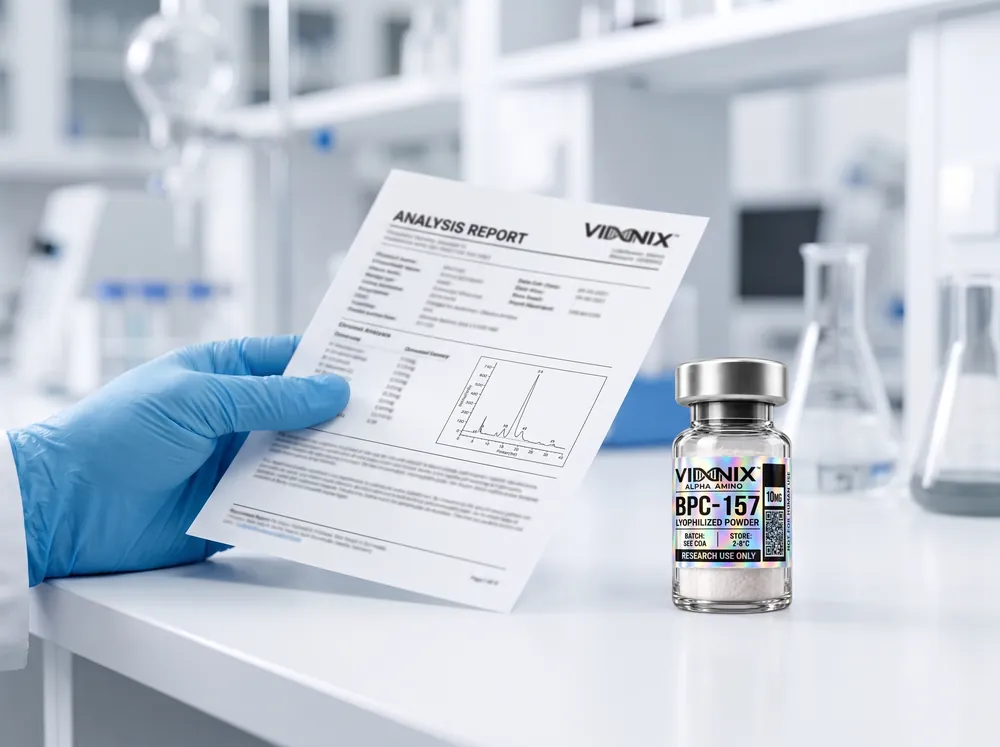
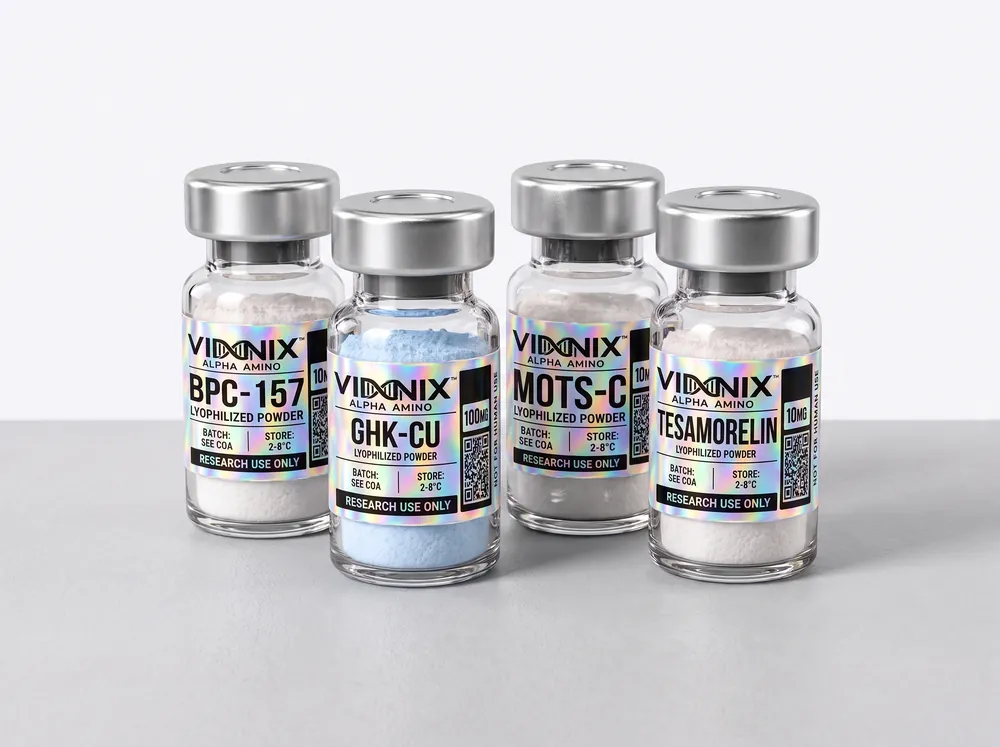
Peptide storage conditions for each Vinnix product will be given in the Storage field of its key facts. Until a batch is released, that field points to the batch documentation; once published, the conditions for that compound appear on the product page, the vial label and the batch COA. Browse the product catalog, and use the certificate of analysis for a batch to check identity and purity after storage. The guide to sourcing research peptides covers what storage and shipping information a supplier should give you.
FAQFrequently asked questions
What does lyophilized mean?
It means freeze-dried. The material was frozen and then dried under vacuum so the ice turned directly into vapor, leaving a dry solid. A lyophilized peptide usually looks like a white powder or a porous cake. The term describes the physical form only; it says nothing about purity or content.
How are lyophilized peptides stored?
As general peptide storage practice, lyophilized peptides are kept cold, dry and dark in tightly sealed vials, often with a desiccant, and opened as rarely as possible. Long-term holding is commonly in a freezer. Conditions vary by compound, though, so the label and batch documentation for the specific product come first.
Why should a vial warm up before it is opened?
A cold vial opened in room air collects condensation, and many lyophilized peptides absorb that water readily. Extra moisture speeds deamidation and other reactions in the solid. Letting the sealed vial reach room temperature first, preferably in a desiccator, keeps the powder dry.
Is a peptide solution as stable as the dry powder?
Generally not. In solution, peptide chains move freely and water takes part in reactions such as deamidation and hydrolysis, so degradation is faster than in the dry solid. That is why labs prepare solutions close to when they're needed and freeze any remainder in single-use aliquots.
Where can I find storage conditions for a Vinnix product?
On the product page, under Storage in the key facts, and on the vial label and batch documentation. If the batch record isn't published yet, the conditions will appear when it is. Use those compound-specific instructions rather than any general rule, including the general principles on this page.
REFScientific references
-
Wang W. Lyophilization and development of solid protein pharmaceuticals. Int J Pharm. 2000;203(1-2):1-60. PubMed 10967427
review -
Tang X, Pikal MJ. Design of freeze-drying processes for pharmaceuticals: practical advice. Pharm Res. 2004;21(2):191-200. PubMed 15032301
review (process design) -
Lai MC, Topp EM. Solid-state chemical stability of proteins and peptides. J Pharm Sci. 1999;88(5):489-500. PubMed 10229638
review -
Manning MC, Chou DK, Murphy BM, Payne RW, Katayama DS. Stability of protein pharmaceuticals: an update. Pharm Res. 2010;27(4):544-575. PubMed 20143256
review -
Li S, Schoneich C, Borchardt RT. Chemical instability of protein pharmaceuticals: mechanisms of oxidation and strategies for stabilization. Biotechnol Bioeng. 1995;48(5):490-500. PubMed 18623513
review -
Kerwin BA, Remmele RL Jr. Protect from light: photodegradation and protein biologics. J Pharm Sci. 2007;96(6):1468-1479. PubMed 17230445
review -
Cao E, Chen Y, Cui Z, Foster PR. Effect of freezing and thawing rates on denaturation of proteins in aqueous solutions. Biotechnol Bioeng. 2003;82(6):684-690. PubMed 12673768
in vitro study
 Research Library
 Documentation
 Research Peptide Catalog