

Key facts
- First reported
- 1973, human plasma (Pickart and Thaler)
- Peptide
- Glycyl-L-histidyl-L-lysine (GHK)
- Metal
- Copper(II), 1:1 complex in solution
- Copper donors in solution
- Gly amine N, Gly-His amide N, His imidazole N
- Color in solution
- Blue (Cu(II) d-d absorption)
- Hydrophilicity
- log D about -2.4 at pH 4.5 to 7.4
- Evidence base
- Chemistry, cell culture, animal studies, reviews
Where does GHK-Cu come from?
The story starts with a plasma fraction. In 1973 Loren Pickart and Martin Thaler described a small peptide from human serum that changed how cultured liver cells behaved, including cells from a liver tumor line [1]. The active material turned out to be a tripeptide: glycine, histidine and lysine, written GHK.
The copper part came into focus soon after. GHK binds copper(II) so readily that, in a biological fluid, a meaningful share of it is likely to carry the metal. In 1981 Lau and Sarkar tested this directly with equilibrium dialysis: at equal concentrations of albumin and GHK, about 42% of the copper ended up on the tripeptide rather than the protein [2]. Albumin is the main copper carrier in plasma, so that is a strong showing for a molecule with three residues.
That result explains why the literature splits in two. Some papers study free GHK, others the preformed copper complex, and in many culture media the line blurs because trace copper is already present. Check which form the authors actually added.
How does GHK bind copper?
Copper(II) prefers four donor atoms arranged roughly in a square, often with a weaker fifth ligand above or below. GHK supplies three of the four equatorial donors from one compact end of the molecule. The free amine of glycine, the deprotonated amide nitrogen of the Gly-His peptide bond and a nitrogen of the histidine imidazole ring close around the metal [3].
The fourth position is the interesting one. In the crystal, Hureau and colleagues found a dimeric structure in which a carboxylate oxygen from a neighboring complex fills that site. In solution the complex is monomeric and the fourth site holds a labile oxygen ligand, usually water, that other molecules can displace [3]. They showed that glycine or histidine can occupy it to form ternary complexes, and that copper exchanges quickly between GHK molecules, probably through a transient Cu(GHK)2 species [3].
Why pH matters so much
The amide nitrogen only binds after it loses a proton, and that deprotonation is driven by the copper itself. Push the pH down and protons compete for the same nitrogens. Lau and Sarkar mapped several copper species across pH 3.5 to 10.6 using potentiometric titration and visible spectroscopy [2]. In practice, strongly acidic conditions loosen the complex, and the lysine side chain, which does not bind copper, still adds to the overall stability compared with Gly-His alone [2].
| Feature | Solid state (X-ray) | Solution |
|---|---|---|
| Nuclearity | Dimer | Monomer |
| Equatorial N donors | 3 (amine, amide, imidazole) | 3 (amine, amide, imidazole) |
| Fourth equatorial site | Carboxylate O from neighbor | Labile O ligand, exchangeable |
| Lysine side chain | Not bound to Cu | Not bound to Cu |
| Source | [3] | [2][3] |
Why is GHK-Cu blue?
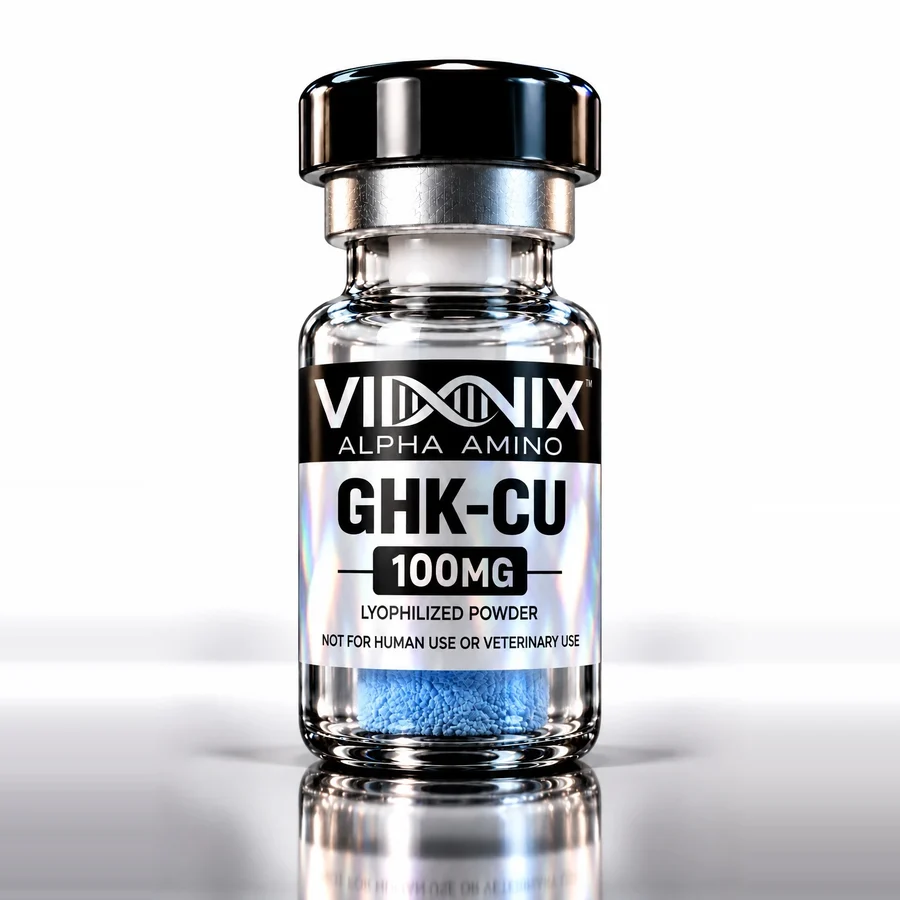
Copper(II) has a d9 electron configuration, and the nitrogen ligands split its d orbitals by an amount that matches visible light. The complex absorbs weakly in the orange-red region, roughly around 600 nm, so the light that passes through looks blue. Free GHK has no metal and no chromophore in the visible range, so its solutions are colorless.
That color is a crude but useful bench indicator. A solution that loses its blue, turns cloudy or drifts toward green or brown has changed: copper may have left the peptide, precipitated or been reduced. Color cannot tell you purity, but an unexpected change is a reason to test before use.
A blue solution does not prove identity or purity. Visible absorbance only shows that copper is bound to some nitrogen ligand. Confirm identity by mass spectrometry and purity by HPLC.
What is the difference between the copper complex and free GHK?
They have different formulas and masses, listed on the GHK-Cu product page. The practical differences show up at the bench.
- Metal load. The complex brings its own copper. Free GHK will scavenge copper from media, buffers or glassware, so the amount of complex formed depends on what else is in the tube.
- Redox behavior. Hureau and colleagues reported that Cu(II)-GHK was inert toward ascorbate oxidation under moderate conditions, but could be reduced to Cu(I) near -0.62 V versus Ag/AgCl, after which the copper was released [3].
- Chelator sensitivity. Strong chelators such as EDTA bind copper(II) more tightly than GHK does and will strip the metal. Leave them out of any buffer meant to keep the complex intact.
- Analysis. Methods built for ordinary peptides can partly dissociate the complex, so a chromatogram may show free GHK that was not present in the vial.
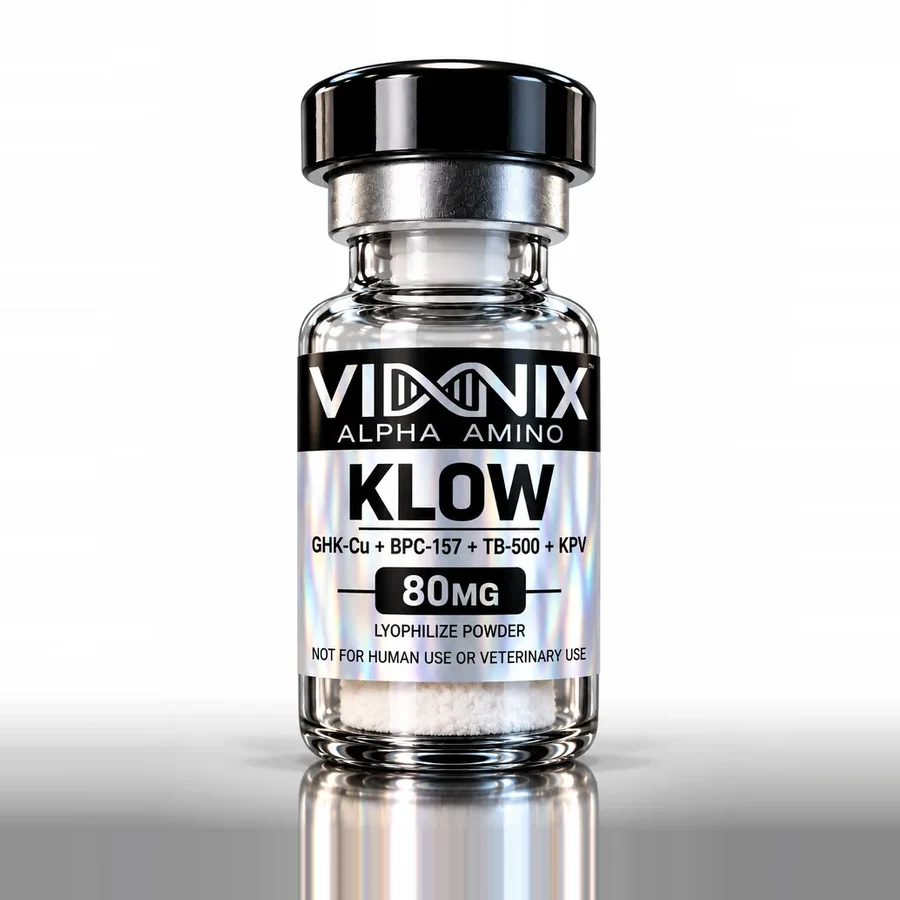
For blended materials such as the GLOW blend and the KLOW blend, each component has to be identified separately. Copper exchange between GHK molecules is fast [3], so the metal content should be reported for the whole vial rather than inferred from the peptide amount.
What did in vitro and animal studies investigate?
The table sorts the main lines of work by study type. All of it is preclinical, and none of it establishes effects in people (see in vitro vs. in vivo research).
| Study type | What was examined | Ref. |
|---|---|---|
| Cell culture (1973) | Plasma tripeptide and cultured liver cell behavior | [1] |
| Solution chemistry | Copper species across pH, competition with albumin | [2] |
| Structural chemistry | X-ray, EPR and NMR structures; redox behavior | [3] |
| Fibroblast culture | Collagen synthesis in cultured fibroblasts | [4] |
| Gene expression (in vitro) | Connectivity Map screen and lung fibroblast follow-up | [5] |
| Review | Reinterpretation of gene expression datasets | [6] |
| Preformulation | Stability, solubility and degradation products | [7] |
Collagen-related cell studies
In 1988 Maquart and colleagues added GHK-Cu to cultured human fibroblasts and measured collagen synthesis. They reported an increase that began at very low concentrations in the medium, peaked in the nanomolar range and did not depend on a change in cell number [4]. They also pointed out that the GHK sequence occurs within the alpha 2(I) chain of type I collagen, which led them to propose protease release as a possible source of the peptide in tissue [4]. That was a hypothesis, not a measurement.
Gene expression studies
The more recent interest comes from transcriptomics. Campbell and colleagues built a gene expression signature from lung tissue with emphysema and searched the Connectivity Map, a database of expression profiles from cell lines exposed to many compounds, for profiles running the other way. GHK was among the hits, and the group followed up in cultured lung fibroblasts [5]. Pickart and coworkers later used the same database to describe broad shifts in gene expression associated with GHK [6].
Limits worth keeping in mind
- Connectivity Map profiles come from a handful of cancer cell lines, and an inverse expression pattern is a correlation, not a mechanism.
- Much of the review literature comes from one group with commercial ties to the compound, so primary studies deserve more weight than summaries.
- Cell culture concentrations do not translate to tissues, and many experiments did not control background copper in the medium.
How stable is GHK-Cu in solution?
Better than many people assume, at least in the right pH window. Badenhorst and colleagues developed a stability-indicating reversed-phase HPLC method and stressed the complex under several conditions [7]. In water and in buffers from pH 4.5 to 7.4 it remained stable for at least two weeks at 60 °C. Under basic and oxidative stress it underwent hydrolytic cleavage with first-order kinetics, and acidic stress caused degradation to a lesser extent [7]. Mass spectrometry identified three main degradation products, one of them free histidine [7].
The same study measured log D values between -2.38 and -2.49 across pH 4.5 to 7.4, so the complex is highly water-soluble and partitions very poorly into octanol [7]. They also found it less stable next to a negatively charged lipid, dicetyl phosphate, which is a reminder that excipients and surfaces can pull on the copper [7].
Light sensitivity is less well documented in peer-reviewed work than vendor pages suggest. The cautious position is to treat any redox-active copper complex as light and oxygen sensitive, since reduction to Cu(I) releases the metal from the peptide [3].
How should GHK-Cu be stored and handled at the bench?
General principles are in our peptide storage guide, with background on freeze-dried solids in what is lyophilization. A copper complex adds a few points.
- Keep the dry solid cold, dark and dry. A sealed vial in a freezer, inside a container with desiccant, protects against moisture and light at the same time.
- Let the vial reach room temperature before opening so condensation does not form on a hygroscopic solid.
- Prepare solutions in high-purity water or a mildly acidic to neutral buffer. Stay inside roughly pH 4.5 to 7.4, where the preformulation data showed stability [7], and avoid alkaline conditions.
- Leave out chelators (EDTA, EGTA), reducing agents and thiols unless the experiment is designed around them.
- Use clean plastic or acid-washed glass, label with date and concentration, and split stock into single-use aliquots to limit freeze-thaw cycles.
- Check color before use. A loss of blue, turbidity or a green-brown tint means the solution should be tested or discarded.
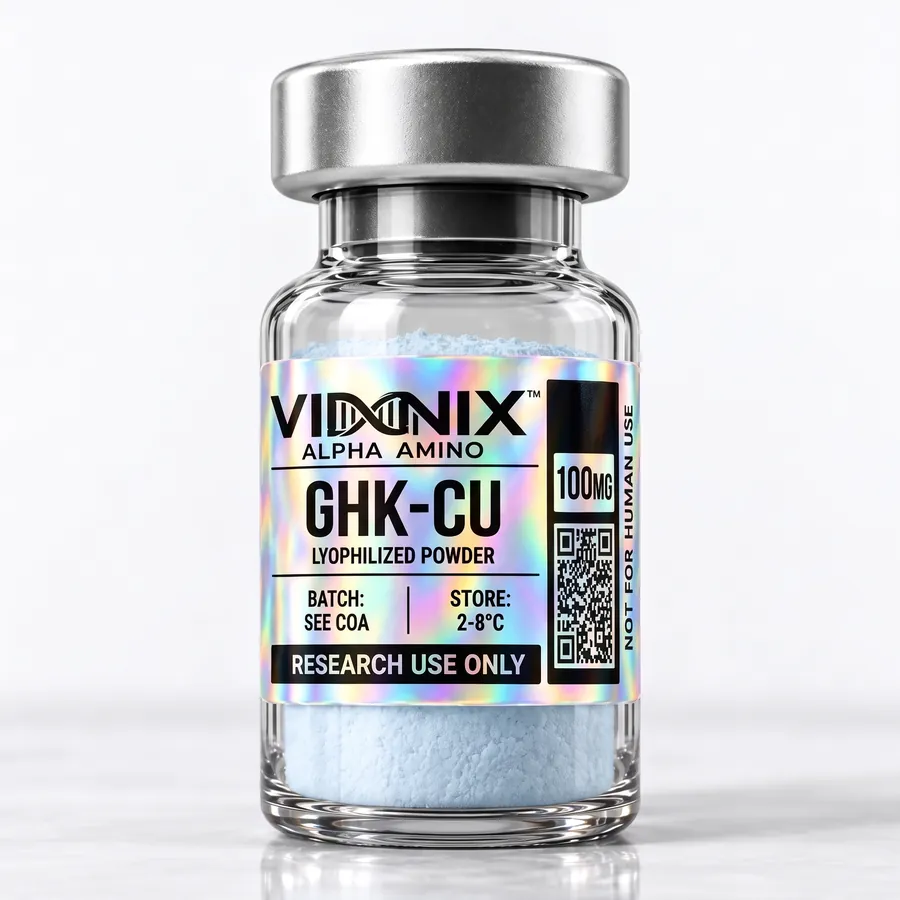
GHK-Cu from Vinnix is supplied for laboratory and analytical research. It is not for human or veterinary use, and nothing here describes use in people or animals.
How is GHK-Cu identity tested?
The distinction between identity and purity is especially sharp for a metal complex. A material can be pure GHK and still not be the copper complex, or contain the complex alongside excess free copper salt.
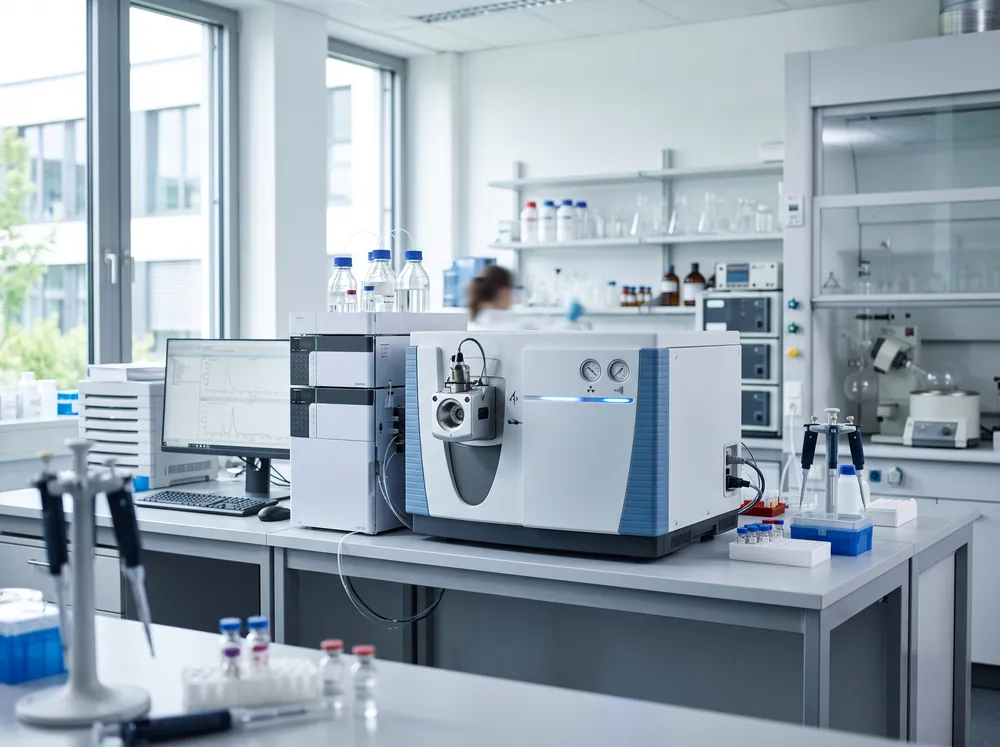
- Mass spectrometry. Look for the intact copper ion and the paired 63Cu and 65Cu peaks two mass units apart. A free GHK ion alone suggests either dissociation in the source or a copper-free sample. Our guide to reading a mass spectrum shows the isotope pattern logic.
- HPLC. Purity by HPLC needs method conditions on the report. Acidic mobile phases with TFA can strip copper, so ask whether the method was stability-indicating and run near neutral pH, as in the preformulation study [7].
- Copper content. An elemental method such as ICP gives the copper percentage, which you can compare with the theoretical 1:1 ratio.
- Visible spectrum. A quick UV-vis scan confirms the copper-nitrogen band but not identity on its own.
- Counterion and peptide content. GHK-Cu is often supplied as an acetate or chloride salt, so the net peptide content per vial is less than the gross weight.
When buying from any supplier, ask for the batch number, observed versus expected mass, the HPLC chromatogram with method conditions, the copper content method and result, and the counterion. A supplier that cannot say whether the product is free GHK or the copper complex has not characterized it.
FAQFrequently asked questions
Who discovered GHK-Cu?
Loren Pickart and Martin Thaler reported the tripeptide GHK from human serum in 1973, working with cultured liver cells. Its strong affinity for copper(II) was characterized in the years that followed, and the copper complex became a research subject in its own right.
Why is GHK-Cu blue but GHK colorless?
The blue comes from copper(II). Its d orbitals, split by the nitrogen ligands of the peptide, absorb orange-red light near 600 nm, so the transmitted light looks blue. Free GHK has no metal and absorbs no visible light, so its solutions are colorless.
Which atoms of GHK hold the copper?
In solution, three nitrogens: the free amine of glycine, the deprotonated amide nitrogen between glycine and histidine, and a nitrogen of the histidine imidazole ring. A fourth site is filled by a labile oxygen ligand, usually water. The lysine side chain does not bind copper.
Does pH affect GHK-Cu?
Yes. Low pH protonates the binding nitrogens and loosens the complex, and alkaline or oxidative conditions cause hydrolytic cleavage of the peptide. A preformulation study found it stable for at least two weeks at 60 °C between pH 4.5 and 7.4.
Can HPLC strip copper from GHK-Cu?
It can. Acidic reversed-phase mobile phases protonate the amide and imidazole nitrogens and release copper, so free GHK may appear in the chromatogram even if the vial held the intact complex. Method conditions should always be printed with the result.
REFScientific references
-
Pickart L, Thaler MM. Tripeptide in human serum which prolongs survival of normal liver cells and stimulates growth in neoplastic liver. Nat New Biol. 1973;243(124):85-87. PubMed 4349963
in vitro -
Lau SJ, Sarkar B. The interaction of copper(II) and glycyl-L-histidyl-L-lysine, a growth-modulating tripeptide from plasma. Biochem J. 1981;199(3):649-656. PubMed 7340824
in vitro (solution chemistry) -
Hureau C, Eury H, Guillot R, Bijani C, Sayen S, Solari PL, et al. X-ray and solution structures of Cu(II) GHK and Cu(II) DAHK complexes: influence on their redox properties. Chemistry. 2011;17(36):10151-10160. PubMed 21780203
in vitro (structural chemistry) -
Maquart FX, Pickart L, Laurent M, Gillery P, Monboisse JC, Borel JP. Stimulation of collagen synthesis in fibroblast cultures by the tripeptide-copper complex glycyl-L-histidyl-L-lysine-Cu2+. FEBS Lett. 1988;238(2):343-346. PubMed 3169264
in vitro -
Campbell JD, McDonough JE, Zeskind JE, Hackett TL, et al. A gene expression signature of emphysema-related lung destruction and its reversal by the tripeptide GHK. Genome Med. 2012;4(8):67. PubMed 22937864
in vitro (gene expression) -
Pickart L, Vasquez-Soltero JM, Margolina A. GHK and DNA: resetting the human genome to health. Biomed Res Int. 2014;2014:151479. PubMed 25302294
review -
Badenhorst T, Svirskis D, Wu Z. Physicochemical characterization of native glycyl-l-histidyl-l-lysine tripeptide for wound healing and anti-aging: a preformulation study for dermal delivery. Pharm Dev Technol. 2016;21(2):152-160. PubMed 25384620
in vitro (stability)
 Blog
 Blog
 Blog
 Peptides
 Research Blend
 Research Blend
 Laboratory Practice