

Key facts
- MOTS-c origin
- Encoded in mitochondrial DNA (12S rRNA region), described 2015
- MOTS-c sequence
- MRWQEMGYIFYPRKLR (16 residues)
- SS-31 origin
- Synthetic Szeto-Schiller peptide, early 2000s
- SS-31 sequence
- D-Arg-Dmt-Lys-Phe-NH2 (4 residues)
- Main site studied
- MOTS-c: cytosol and nucleus signaling; SS-31: inner membrane cardiolipin
- Human trials
- Elamipretide: phase 2/3 and phase 3; MOTS-c: mostly observational measurements
- Research status
- Both sold by Vinnix for laboratory research use only
What is the difference between MOTS-c and SS-31?
The short version: MOTS-c is a natural signaling peptide that mitochondria make, and SS-31 is a drug-like molecule that chemists built to go to mitochondria. One comes out of the organelle, the other was designed to get in.
That difference shapes everything else. MOTS-c research asks how a mitochondrial gene product talks to the rest of the cell, mostly through metabolic signaling. SS-31 research asks what happens when you stabilize the inner mitochondrial membrane directly. The two literatures barely overlap, and we could not find a published head-to-head comparison of the pair in the same model.
The evidence base is lopsided too. Elamipretide, the nonproprietary name for SS-31, went through randomized human trials and a regulatory review. MOTS-c work is largely cell culture and mouse studies, plus measurements of the peptide's natural levels in people.
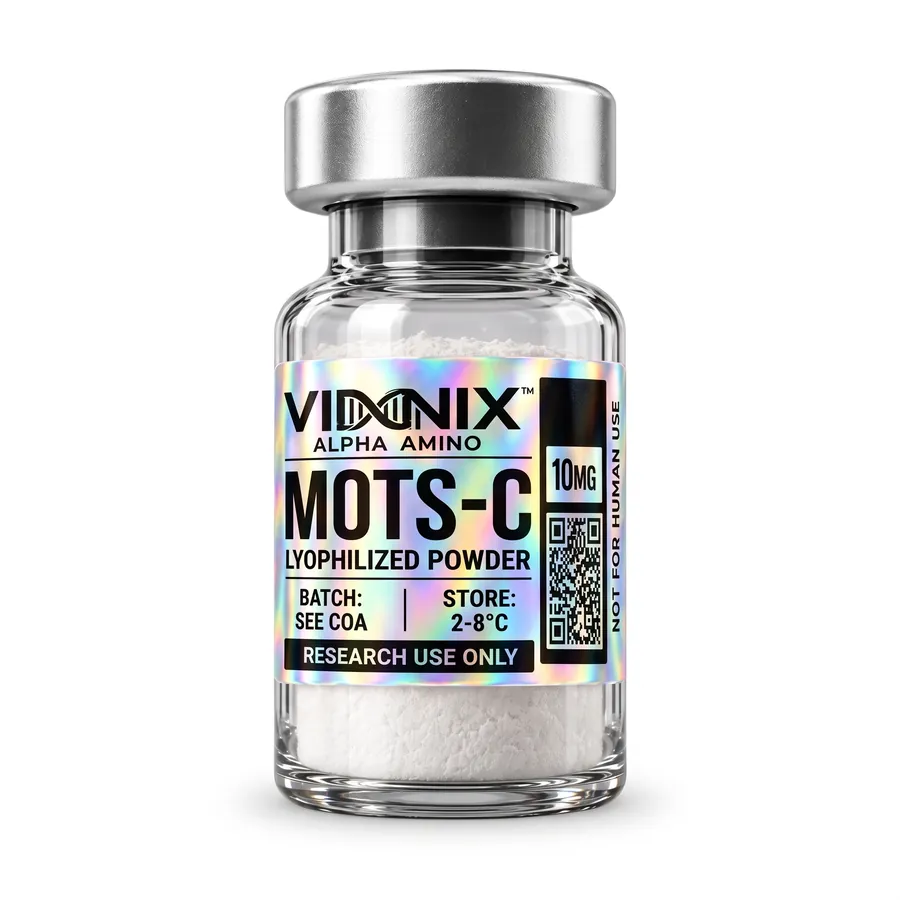
What is MOTS-c?
MOTS-c stands for mitochondrial open reading frame of the 12S rRNA type-c. Lee and colleagues reported it in 2015 after searching mitochondrial DNA for short open reading frames, following the earlier discovery of humanin. They found a 16-residue peptide coded inside the 12S ribosomal RNA gene [1].
In that first paper, cell experiments linked MOTS-c to inhibition of the folate cycle and de novo purine synthesis, which raised levels of the metabolite AICAR and activated AMPK. Mouse experiments pointed to skeletal muscle as its main target tissue [1]. A 2018 follow-up from the same group reported that MOTS-c moved into the nucleus of cultured cells under metabolic stress such as glucose restriction, in an AMPK-dependent way, and changed the expression of nuclear genes [2].
That nuclear finding is why MOTS-c gets described as a retrograde signal: a message sent from the mitochondrial genome back to the nuclear one. It is an interesting idea, and so far it rests on cell and rodent data.
What is SS-31 (elamipretide)?
SS-31 belongs to the Szeto-Schiller peptides, a series named after Hazel Szeto and Peter Schiller. The design alternates aromatic and positively charged residues, and it includes 2',6'-dimethyltyrosine (Dmt), a modified tyrosine. In the 2004 paper that described the family, the peptides entered cells and concentrated at the inner mitochondrial membrane rather than spreading through the cytosol [3].
The current explanation centers on cardiolipin, a phospholipid found almost only in the inner mitochondrial membrane. Birk and colleagues reported in 2013 that SS-31 bound cardiolipin selectively and, in their models, protected cytochrome c function in the electron transport chain [4]. Under the name elamipretide, the compound moved into clinical development for rare mitochondrial diseases.
How do the structures and sequences compare?
Size alone separates them. MOTS-c is a linear chain of 16 standard L-amino acids. SS-31 has four residues, two of them nonstandard, and an amidated C-terminus. If the notation below is unfamiliar, see our pages on peptide sequences and one-letter vs three-letter codes.
| Property | MOTS-c | SS-31 (elamipretide) |
|---|---|---|
| Source | Encoded in mitochondrial DNA | Synthetic design |
| Length | 16 residues | 4 residues |
| Sequence | MRWQEMGYIFYPRKLR | D-Arg-Dmt-Lys-Phe-NH2 |
| Nonstandard residues | None | D-arginine, 2',6'-dimethyltyrosine |
| C-terminus | Free acid | Amide |
| Molecular formula | C101H152N28O22S2 | C32H49N9O5 |
| Molecular weight | 2174.6 g/mol | 639.8 g/mol |
| CAS number | 1627580-64-6 | 736992-21-5 |
The D-arginine at the start of SS-31 is deliberate. D-amino acids are poorly recognized by many proteases, and the amidated C-terminus removes a negative charge, leaving a compact molecule with a net positive charge. MOTS-c has no such modifications, so it behaves more like a typical natural peptide.
Where in the mitochondria does each one act?
This is the question people most often get wrong, because the shared label suggests a shared target. The reported sites are different.
- MOTS-c: produced from the mitochondrial genome, then reported to act outside the organelle, on cytosolic metabolism (folate cycle, AMPK) and, under stress, in the nucleus [1][2]. In this model the mitochondrion is the sender, not the main site of action.
- SS-31: reported to accumulate at the inner mitochondrial membrane and associate with cardiolipin, near the respiratory complexes and cytochrome c [3][4]. Here the mitochondrion is the target.
A study that measures membrane potential or cristae structure is closer to the SS-31 literature, while one that measures AMPK phosphorylation, glucose handling or nuclear gene expression is closer to the MOTS-c literature. Choosing readouts that match each peptide's proposed mechanism is the main design point if someone wants to compare them.

What did preclinical studies examine?
Most of what is known about both peptides comes from cell and animal work. Our page on in vitro vs in vivo research covers why those findings do not transfer directly to people.
MOTS-c
The 2015 study combined cultured cells with mice fed a high-fat diet, and reported effects on insulin sensitivity and weight gain in those mice [1]. Reynolds and colleagues in 2021 measured MOTS-c levels in human skeletal muscle and plasma around exercise, and separately treated aged mice, reporting changes in physical performance measures in the animals [5]. The human part of that work was observational: it measured the body's own peptide and did not test supplied MOTS-c [5].
SS-31
The 2004 paper used isolated mitochondria, cell lines exposed to oxidative stressors, and an isolated guinea pig heart reperfusion model [3]. The 2013 cardiolipin study used model membranes and a rat kidney ischemia model [4]. Over the following decade SS-31 appeared in many rodent models of aging and organ injury, which is a large but heterogeneous body of work.
Has elamipretide been through clinical trials?
Yes, and the record is mixed in a way worth reading closely. TAZPOWER, a phase 2/3 trial in Barth syndrome, a rare genetic disorder of cardiolipin metabolism, randomized 12 participants in a crossover design. Neither primary endpoint (6-minute walk distance and a symptom score) was met in the placebo-controlled part. The open-label extension that followed reported changes in both measures at 36 weeks, without a placebo comparison [6].
MMPOWER-3, a phase 3 trial in primary mitochondrial myopathy, randomized 218 participants to elamipretide or placebo for 24 weeks. It did not meet its primary endpoints, again the 6-minute walk test and a fatigue score [7].
In September 2025 the US Food and Drug Administration granted elamipretide accelerated approval for a Barth syndrome indication, based on a muscle strength measure [8]. Accelerated approval relies on an intermediate endpoint and requires a confirmatory trial. According to the same review, other indications remained in phase 3 development [8].
For MOTS-c we found no comparable published efficacy trial. That gap matters when the two are discussed as if they were equally characterized.
What are the limits of the evidence?
- No direct comparison. We found no study testing MOTS-c and SS-31 side by side, so any ranking of one over the other is opinion.
- Small or negative human trials. Elamipretide's two published efficacy trials missed their primary endpoints, and the Barth syndrome trial had 12 participants [6][7].
- One lab dominates early MOTS-c work. The founding mechanistic papers came from one research group [1][2]. Independent replication is growing but uneven.
- Model differences. Rodent diet models, isolated organs and cell stress assays answer narrow questions. Doses and routes in animal papers are specific to those models.
None of this makes either peptide uninteresting. It means a well-designed study should state which mechanism it is testing and pick controls to match.
How do handling and storage differ in the lab?
Both are usually supplied as lyophilized powders, and the general rules on our peptide storage page apply to each: cold, dry, dark, and minimal freeze-thaw. A few compound-specific points are worth noting at the bench.
- Oxidation-prone residues. MOTS-c contains two methionines and a tryptophan, which oxidize more readily than most residues. Limiting air exposure and repeated warming of solutions is sensible. SS-31 has no methionine or cysteine.
- Counterions. SS-31 carries several positive charges, so it is supplied as a salt. Check the label or documentation for the counterion, since it affects the mass you weigh versus the peptide content you get.
- Adsorption. Small cationic peptides can stick to glass and some plastics at low concentrations. Low-binding tubes are a common precaution.
- Identity checks. Mass spectrometry separates the two easily (about 2175 vs 640 g/mol), which helps catch a labeling mix-up.
Whichever peptide you source, ask the supplier what analytical data back the batch you receive. Our guides on what a COA should contain and sourcing research peptides list the questions to ask.
FAQFrequently asked questions
Is SS-31 the same as elamipretide?
Yes. SS-31 is the original laboratory code from the Szeto-Schiller series, and elamipretide is the nonproprietary name used in clinical development. Both refer to D-Arg-Dmt-Lys-Phe-NH2.
Is MOTS-c made by the body?
Yes. It is encoded by a short open reading frame inside the mitochondrial 12S rRNA gene, and researchers have measured it in human plasma and skeletal muscle. Research-grade MOTS-c is made by chemical synthesis to the same 16-residue sequence.
Do MOTS-c and SS-31 work the same way?
No. Published work places MOTS-c in metabolic signaling outside the mitochondrion, including the nucleus, while SS-31 is reported to bind cardiolipin on the inner mitochondrial membrane. The shared label of mitochondrial peptide hides very different proposed mechanisms.
Is elamipretide FDA approved?
In September 2025 the FDA granted elamipretide accelerated approval for one indication in Barth syndrome, with a confirmatory trial required. That approval covers a specific medicine. Research-grade SS-31 sold for laboratory use is a different thing and is not for human or veterinary use.
Has MOTS-c been tested in human trials?
We found no published randomized efficacy trial of MOTS-c. The human data are mainly measurements of the body's own MOTS-c levels, for example around exercise, which describe natural biology rather than test the peptide.
Which is better for mitochondrial research?
Neither is better in general. They answer different questions: SS-31 suits studies of inner membrane structure and cardiolipin, and MOTS-c suits studies of mitochondrial-to-nuclear signaling and metabolic regulation. The choice depends on the mechanism being tested.
REFScientific references
-
Lee C, Zeng J, Drew BG, et al. The mitochondrial-derived peptide MOTS-c promotes metabolic homeostasis and reduces obesity and insulin resistance. Cell Metab. 2015;21(3):443-454. PubMed 25738459
in vitro and animal study -
Kim KH, Son JM, Benayoun BA, Lee C. The mitochondrial-encoded peptide MOTS-c translocates to the nucleus to regulate nuclear gene expression in response to metabolic stress. Cell Metab. 2018;28(3):516-524.e7. PubMed 29983246
in vitro and animal study -
Zhao K, Zhao GM, Wu D, et al. Cell-permeable peptide antioxidants targeted to inner mitochondrial membrane inhibit mitochondrial swelling, oxidative cell death, and reperfusion injury. J Biol Chem. 2004;279(33):34682-34690. PubMed 15178689
in vitro and animal study -
Birk AV, Liu S, Soong Y, et al. The mitochondrial-targeted compound SS-31 re-energizes ischemic mitochondria by interacting with cardiolipin. J Am Soc Nephrol. 2013;24(8):1250-1261. PubMed 23813215
in vitro and animal study -
Reynolds JC, Lai RW, Woodhead JST, et al. MOTS-c is an exercise-induced mitochondrial-encoded regulator of age-dependent physical decline and muscle homeostasis. Nat Commun. 2021;12(1):470. PubMed 33473109
animal study with human sample measurements -
Reid Thompson W, Hornby B, Manuel R, et al. A phase 2/3 randomized clinical trial followed by an open-label extension to evaluate the effectiveness of elamipretide in Barth syndrome, a genetic disorder of mitochondrial cardiolipin metabolism. Genet Med. 2021;23(3):471-478. PubMed 33077895
human clinical, phase 2/3 randomized trial -
Karaa A, Bertini E, Carelli V, et al. Efficacy and safety of elamipretide in individuals with primary mitochondrial myopathy: the MMPOWER-3 randomized clinical trial. Neurology. 2023;101(3):e238-e252. PubMed 37268435
human clinical, phase 3 randomized trial -
Shirley M. Elamipretide: first approval. Drugs. 2026;86(3):377-383. PubMed 41335372
review, regulatory profile
 Blog
 Blog
 Blog
 Peptides
 Peptides
 Laboratory Practice