

Key facts
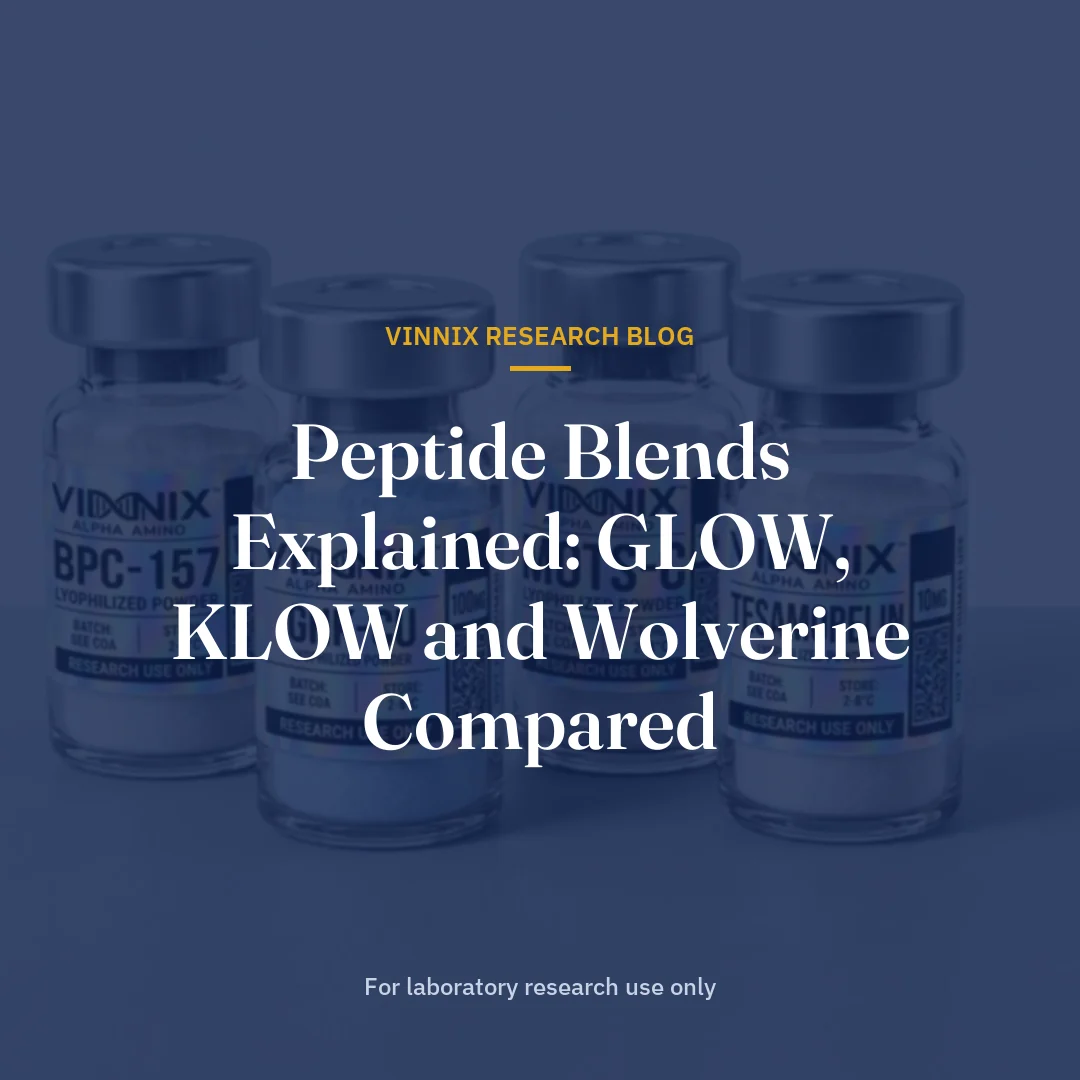
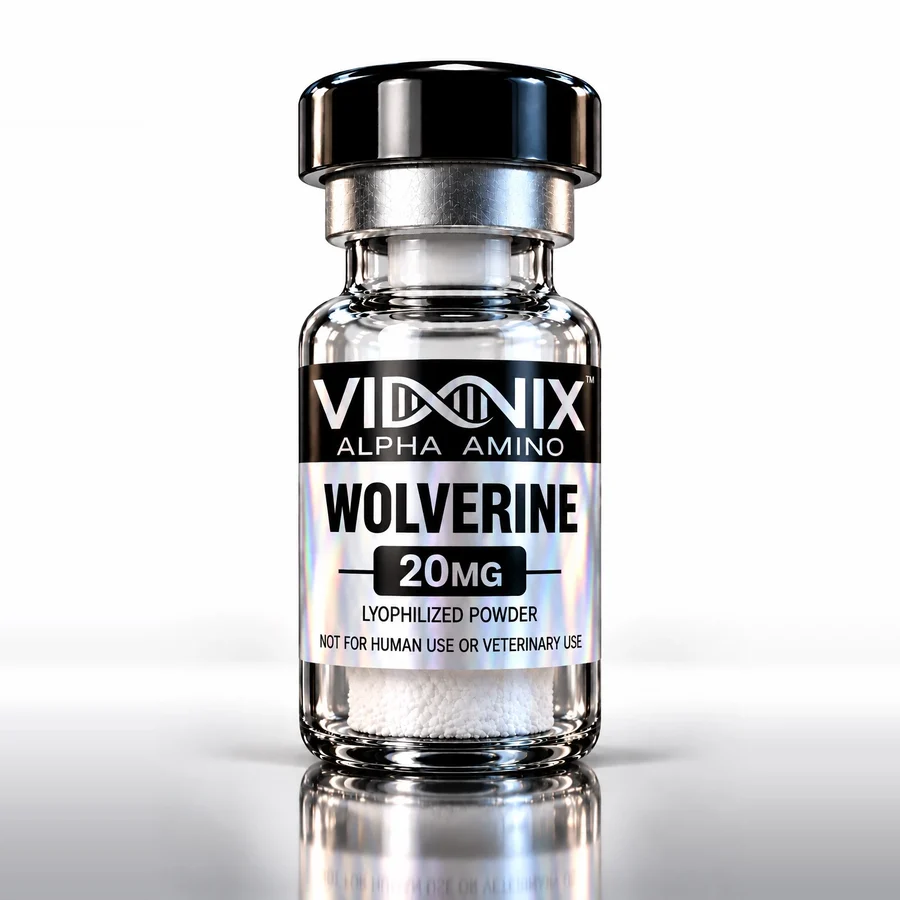
- Wolverine (BB20)
- BPC-157 and TB-500, 20 mg total
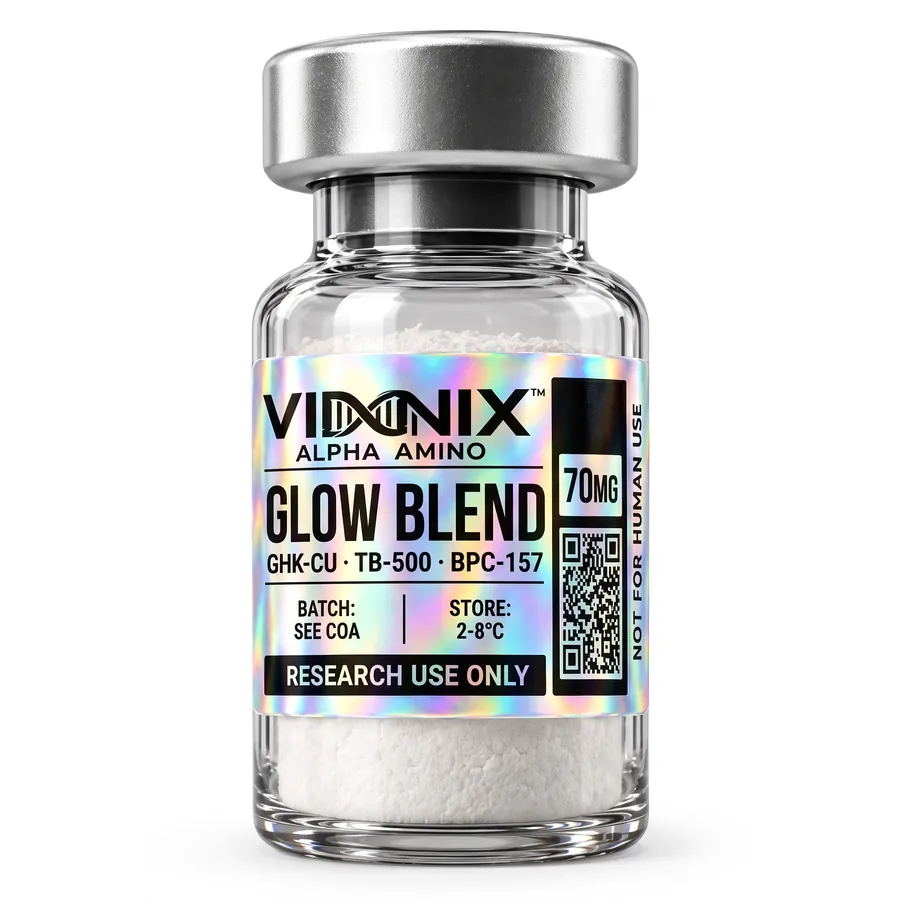
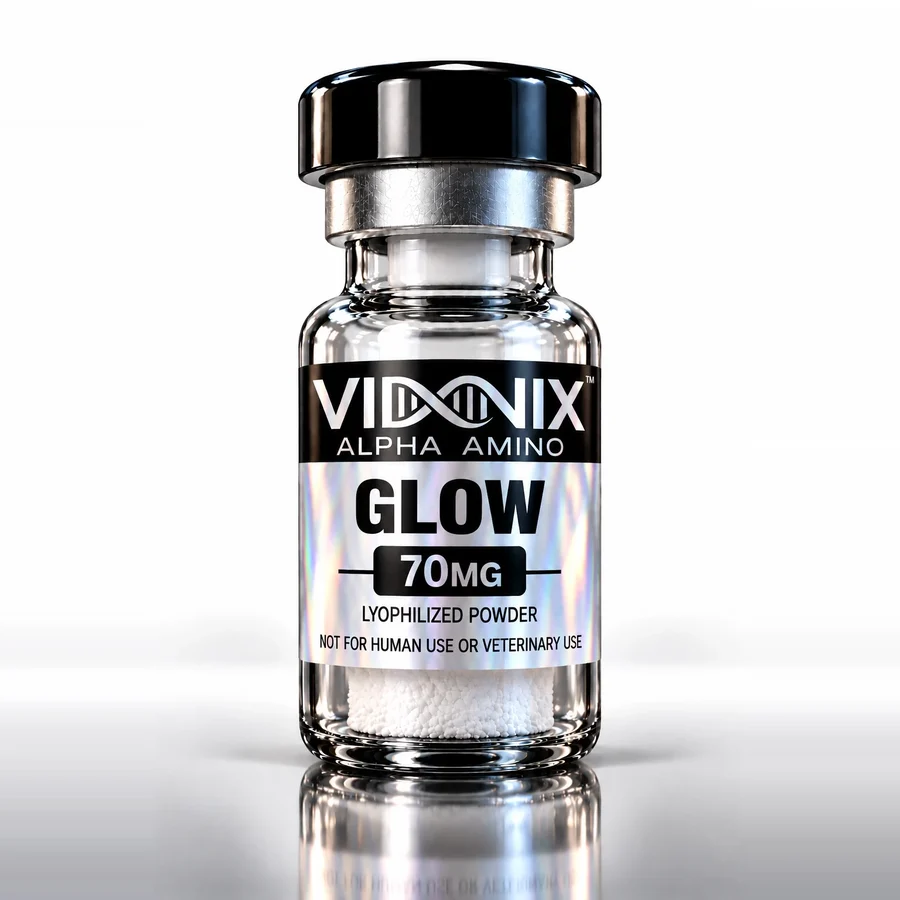
- GLOW (BBG70)
- GHK-Cu, TB-500 and BPC-157, 70 mg total
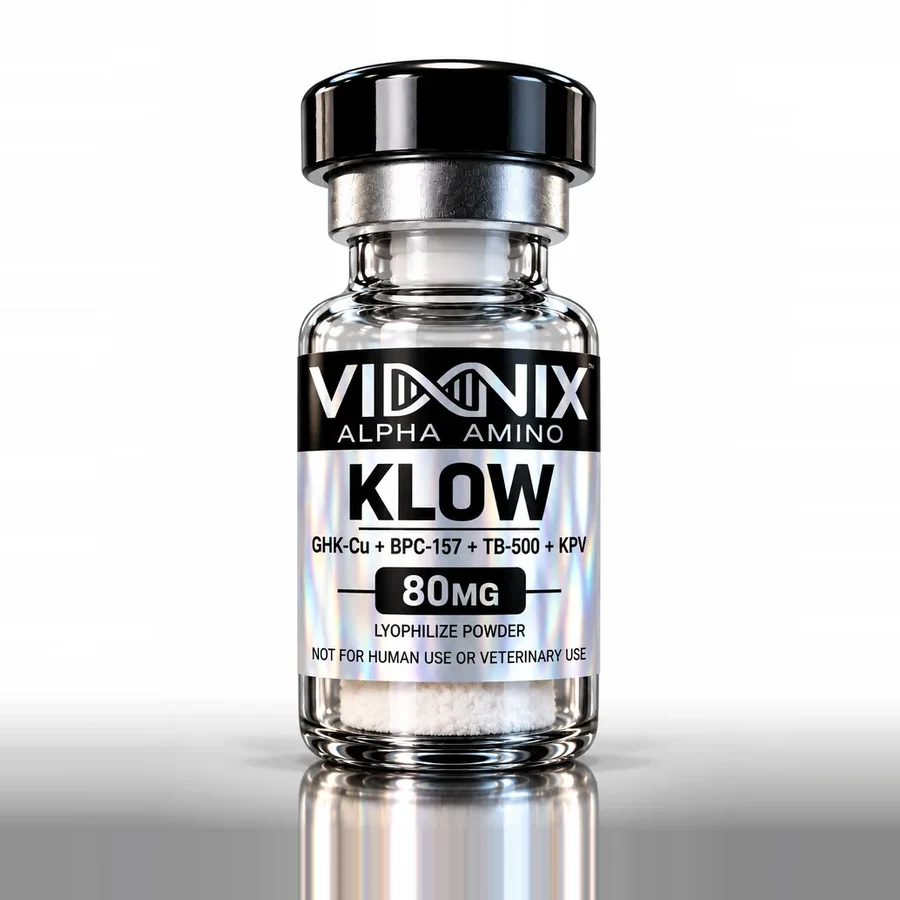
- KLOW (KLOW80)
- GHK-Cu, TB-500, BPC-157 and KPV, 80 mg total
- Per-component amounts
- Not listed yet; to be reported per batch
- Chemical bond between components
- None; each peptide is a separate molecule
- How blends are tested
- HPLC separation into peaks, MS identity for each peak
- Intended use
- Laboratory research use only
What is a peptide blend?
A peptide blend is a physical mixture. Two or more peptides are made separately, then combined in one vial, usually as a freeze-dried powder. Nothing links them. Each molecule keeps its own sequence, its own molecular weight and its own chemistry, and each one would behave the same way in a vial on its own.
That distinction matters more than it sounds. A fusion peptide or a conjugate is one molecule with one identity. A blend is several molecules with several identities, and every question you would ask about a single peptide (what is it, how much is there, how pure is it) has to be asked once per component.
The names you see in this corner of the market, GLOW, KLOW and Wolverine among them, are catalog labels. They come from vendor and forum usage, not from a pharmacopeia or a registry, and none of them describes what the material does.
Vinnix blends are supplied for laboratory research. They are not for human or veterinary use, and nothing in this post describes an effect of any product.
Why do researchers use combined peptide vials?
The reasons are practical, not scientific. A lab that works with the same set of peptides in parallel has fewer vials to log, store and reconstitute when they arrive pre-combined.
- Fewer vials. One vial and one label instead of three or four, which means less freezer space and fewer inventory entries.
- Matched lots. Every component in the vial shares one batch number, so the material traces back to a single production record.
- One reconstitution step. The whole set goes into solution together, which removes one source of pipetting variation between components.
None of that changes the chemistry. A blend is a packaging decision. If a study design depends on each peptide on its own, separate vials are still the better format.
What are the downsides of peptide blends?
The convenience comes with real costs, and most of them land on the analytical side.
- Fixed ratios. The proportion of each peptide is set at manufacture. You cannot raise one component without raising the others, and you cannot leave one out.
- Harder testing. A single peptide gives one main peak on a chromatogram. A four-component blend gives four main peaks plus the impurities of all four, and some of those can overlap.
- Identity per component. A vial-level purity number tells you very little. Each peptide needs its own identity result, or one of them could be wrong or missing without the total looking unusual.
- Shared conditions. All components sit in the same solvent, at the same pH, for the same time. Conditions that suit one peptide may not suit another.
Peptide-related impurities such as deletion sequences, oxidation products and leftover counter-ions are well documented for single peptides [6]. In a blend, each component brings its own set, and the report has to keep them apart.
What is in GLOW, KLOW and Wolverine?
Between them, the three blends use only four peptides. Here is what each one is.
BPC-157
BPC-157 is a synthetic 15-residue peptide, GEPPPGKPADDAGLV, listed in PubChem at 1419.5 g/mol (CID 9941957). A 2025 systematic review of the orthopaedic literature found 36 eligible studies, 35 of them preclinical, and no clinical safety data [4].
TB-500
TB-500 is a trade name tied to thymosin beta-4, a 43-residue protein. A 2012 analytical study identified the N-acetylated 17-23 fragment, Ac-LKKTETQ, in a product sold as TB-500 [2], and that fragment sits in the actin-binding region that reviews of thymosin beta-4 describe [3]. Some sellers use the same name for the full-length protein, so the product record has to state which sequence is in the vial.
GHK-Cu
GHK-Cu is the tripeptide Gly-His-Lys with a copper(II) ion bound to it, 402.9 g/mol in PubChem (CID 71587328). X-ray and spectroscopic work showed that the copper binds the N-terminal amine, a backbone amide nitrogen and the histidine imidazole [1]. It is the only metal complex among the four.
KPV
KPV is the tripeptide Lys-Pro-Val, 342.4 g/mol, the C-terminal residues 11 to 13 of alpha-melanocyte-stimulating hormone. One in vitro study measured calcium signalling in human keratinocyte cell lines exposed to KPV and related peptides [5].
Each peptide has its own literature, and almost all of it is cell or animal work on that compound alone. We know of no peer-reviewed controlled study of any of these three combinations.
GLOW vs KLOW vs Wolverine: how do they compare?
The three products nest inside each other. Wolverine is the two-peptide core, GLOW adds GHK-Cu, and KLOW adds KPV on top of GLOW.
| Wolverine | GLOW | KLOW | |
|---|---|---|---|
| SKU | BB20 | BBG70 | KLOW80 |
| Total per vial | 20 mg | 70 mg | 80 mg |
| Components | 2 | 3 | 4 |
| BPC-157 | Yes | Yes | Yes |
| TB-500 | Yes | Yes | Yes |
| GHK-Cu | No | Yes | Yes |
| KPV | No | No | Yes |
| Amount of each component | Not listed yet | Not listed yet | Not listed yet |
| Main peaks expected on HPLC | 2 | 3 (plus possible free GHK) | 4 (plus possible free GHK) |
Per-component amounts for all three products are not listed yet. Until they are, do not divide the total by the number of peptides. A 70 mg total could be split in many ways, and the split is exactly what a blend's documentation should state.
A vial total says how much powder is present, not how much of each peptide. The per-component quantity on the batch documentation is the figure that matters.
How are peptide blends tested?
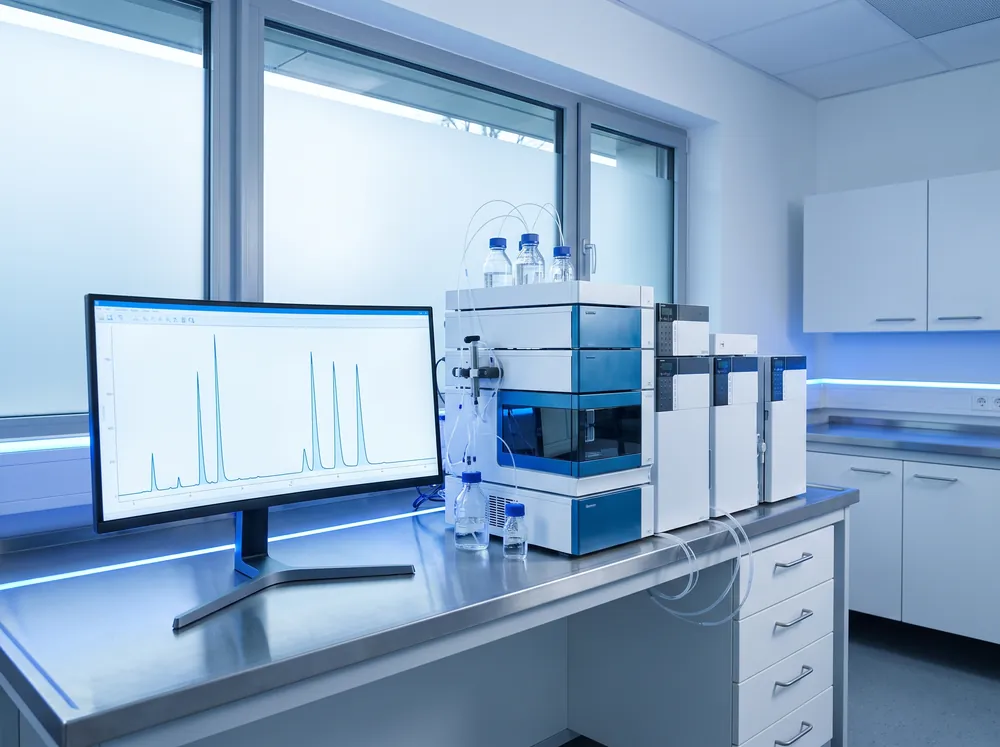
Blend testing has two jobs: pull the components apart, then prove what each one is. Reversed-phase HPLC handles the first. The peptides interact differently with the column and elute at different retention times, so a clean run shows one labelled peak per component.
Mass spectrometry handles the second. Each peak's measured mass is checked against the expected value for that peptide. LC-MS does both in one run, which is why it is the usual identity method for mixtures. A doping-control study of TB-500 used the same approach to find the 17-23 fragment in a commercial product [2].
- Separation. One peak per component, each resolved from its neighbours and from impurities.
- Identity. A mass match for every peak, not just the largest.
- Quantity. Each peak compared against a reference standard of that peptide, giving milligrams per component.
- Purity per component. Related impurities assigned to the peptide they came from.
The four peptides span a wide size range, from KPV at about 342 g/mol to BPC-157 at about 1420 g/mol, and further if the TB-500 is full-length. Very small, polar peptides such as KPV and GHK can elute early and close to the solvent front, so method development for a blend is harder than for any single component. GHK-Cu adds one more wrinkle: under some MS conditions the copper dissociates, and free GHK can appear beside the complex. A good report says which form each signal represents.
How should peptide mixtures be stored?
The general rules from our peptide storage guide apply: keep the lyophilized powder cold, dry and away from light, and let a refrigerated vial reach room temperature before opening it so moisture does not condense inside.
Mixtures add a weakest-link problem. Once a blend is in solution, the stability of the whole vial is set by its least stable component. Peptides in water are exposed to hydrolysis, deamidation and oxidation, and the dry state slows those reactions [7]. That is the main argument for keeping blends lyophilized until they are needed.
Metal ions are worth a note. Reviews of protein stability describe metal-catalysed oxidation of susceptible residues in solution [7]. GLOW and KLOW both contain a copper complex alongside other peptides. Whether that measurably affects the other components in these specific blends has not been published, but it is one more reason to treat a reconstituted blend as short-lived bench material and to record the reconstitution date on the vial.
What to ask any supplier before buying a peptide blend
A blend is only as well documented as its weakest component. Before ordering from any supplier, ask for documentation that answers these points for the specific batch you would receive.
- The full component list, with the exact sequence of each peptide (and for TB-500, whether it is the fragment or full-length thymosin beta-4).
- The amount of each component in milligrams, not just the vial total.
- An HPLC chromatogram with every main peak labelled by component.
- A mass spectrometry result for each component, with expected and observed masses.
- The batch number on the documents, matching the vial label.
- The testing laboratory, the test date and the methods used.
If a supplier offers one purity figure for the whole vial and nothing else, that does not tell you whether all the listed peptides are present. Per-component data is the standard to hold every blend to, including ours.
FAQFrequently asked questions
Is KLOW just GLOW with KPV added?
By component list, yes. KLOW contains GHK-Cu, TB-500 and BPC-157, the same three peptides as GLOW, plus the tripeptide KPV. The totals differ (80 mg for KLOW80, 70 mg for BBG70), and per-component amounts for both are not listed yet, so the ratios cannot be compared.
Are the peptides in a blend bonded together?
No. Each component is a separate molecule mixed in the same vial. That is why HPLC can resolve them into separate peaks and why each one needs its own identity and quantity result.
Does a blend contain equal amounts of each peptide?
Not necessarily, and you should not assume it. The vial total does not tell you the split. Per-component amounts for the Vinnix blends are not listed yet and will be reported per batch.
Can a peptide blend be separated back into single peptides?
In principle, preparative HPLC can isolate each component, since that is how the peptides are purified in the first place. In practice it costs time and material, so if a study needs single peptides it is simpler to start from separate vials.
Do the names GLOW, KLOW and Wolverine mean anything scientifically?
No. They are market catalog names. They identify a particular combination of peptides and say nothing about effects, and they are not defined by any pharmacopeia or registry.
REFScientific references
-
Hureau C, Eury H, Guillot R, et al. X-ray and solution structures of Cu(II) GHK and Cu(II) DAHK complexes: influence on their redox properties. Chemistry. 2011;17(36):10151-60. PubMed 21780203
in vitro (structural chemistry) -
Esposito S, Deventer K, Goeman J, Van der Eycken J, Van Eenoo P. Synthesis and characterization of the N-terminal acetylated 17-23 fragment of thymosin beta 4 identified in TB-500, a product suspected to possess doping potential. Drug Test Anal. 2012;4(9):733-8. PubMed 22962027
analytical chemistry -
Sosne G, Qiu P, Goldstein AL, Wheater M. Biological activities of thymosin beta4 defined by active sites in short peptide sequences. FASEB J. 2010;24(7):2144-51. PubMed 20179146
review -
Vasireddi N, Hahamyan H, Salata MJ, et al. Emerging Use of BPC-157 in Orthopaedic Sports Medicine: A Systematic Review. HSS J. 2025;21(4):485-495. PubMed 40756949
systematic review -
Elliott RJ, Szabo M, Wagner MJ, Kemp EH, MacNeil S, Haycock JW. alpha-Melanocyte-stimulating hormone, MSH 11-13 KPV and adrenocorticotropic hormone signalling in human keratinocyte cells. J Invest Dermatol. 2004;122(4):1010-9. PubMed 15102092
in vitro study -
D'Hondt M, Bracke N, Taevernier L, et al. Related impurities in peptide medicines. J Pharm Biomed Anal. 2014;101:2-30. PubMed 25044089
review -
Manning MC, Chou DK, Murphy BM, Payne RW, Katayama DS. Stability of protein pharmaceuticals: an update. Pharm Res. 2010;27(4):544-75. PubMed 20143256
review
 Blog
 Blog
 Blog
 Research Blend
 Research Blend
 Research Blend
 Testing & Analysis