

Key facts
- Bacteriostatic water
- Sterile water + 0.9% (9 mg/mL) benzyl alcohol
- Sterile water
- Sterile water, no antimicrobial preservative
- Container type
- Bacteriostatic: multiple-dose. Sterile: single-dose
- Typical pH (one US label)
- 5.7, range 4.5 to 7.0
- Opened multi-dose vial
- Discard within 28 days unless the label says otherwise
- Storage (unopened, US label)
- 20 to 25 °C
- Labeled warning
- Not for use in neonates (benzyl alcohol)
What is the difference between bacteriostatic water and sterile water?
Both start as the same thing: water for injection that has been purified, sterilized and packaged so it is free of microorganisms and pyrogens. The difference is what happens after that. Bacteriostatic water has benzyl alcohol added, typically at 0.9% (9 mg per mL), as an antimicrobial preservative [1]. Sterile water has nothing added.
That single ingredient changes how the container may be used. A preservative does not make a solution sterile again after contamination, but it slows the growth of bacteria that might get in when a stopper is punctured. That is why bacteriostatic water is sold as a multiple-dose container and sterile water as a single-dose one.
| Property | Bacteriostatic water | Sterile water |
|---|---|---|
| Preservative | Benzyl alcohol, usually 0.9% | None |
| Container type | Multiple-dose vial | Single-dose vial or ampule |
| After first puncture | Usable for a limited period (commonly 28 days) | Discard the remainder |
| Preservative compatibility concern | Yes, benzyl alcohol can interact with some proteins | No |
| Labeled population restriction | Not for neonates | None related to preservative |
| Common lab role | Diluent for a vial that will be accessed repeatedly | Diluent for one-time use or preservative-sensitive material |
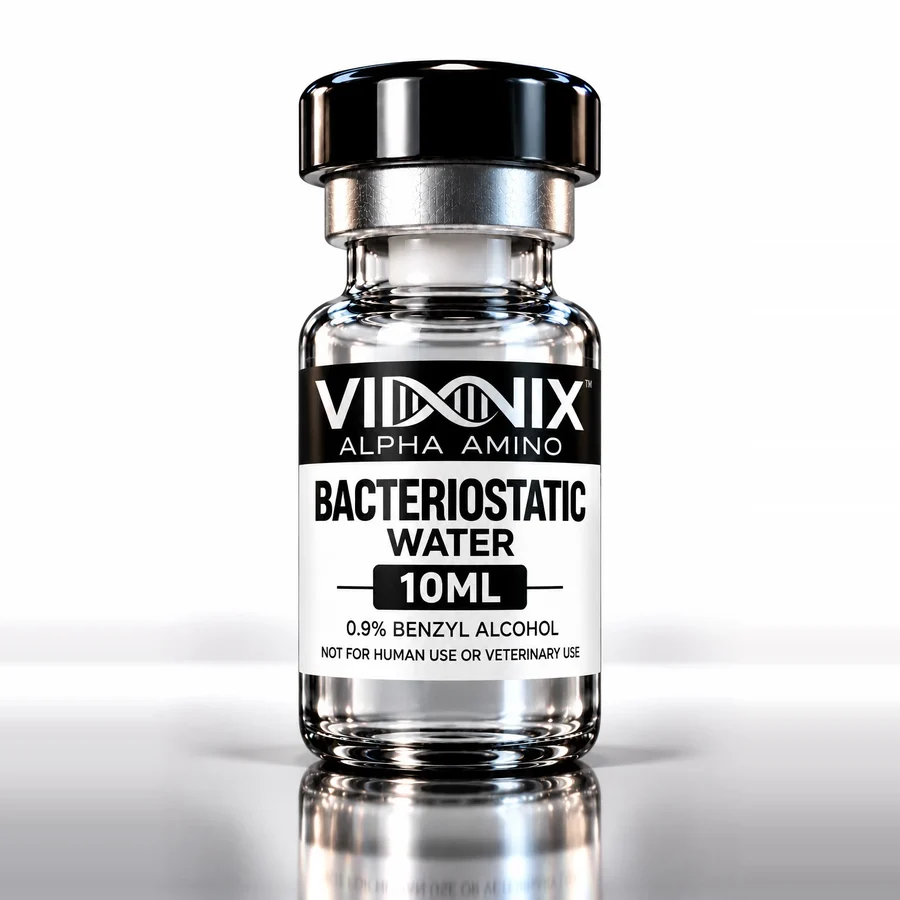
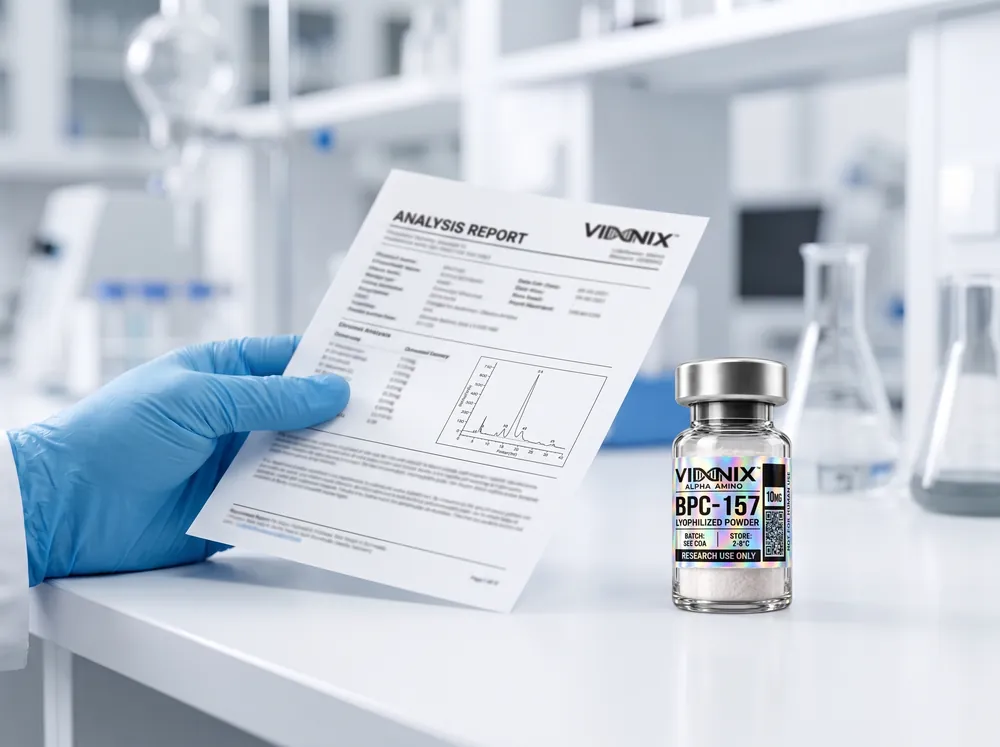
Vinnix stocks bacteriostatic water in a 10 mL vial as a laboratory diluent. Like everything on the site, it is for research use only.
How does USP define each one?
The United States Pharmacopeia (USP) has separate monographs for the two products. Bacteriostatic Water for Injection is described as sterilized water for injection containing one or more suitable antimicrobial agents, in containers no larger than 30 mL, with the label naming the agent and its proportion. Sterile Water for Injection contains no antimicrobial agent and is packaged as single-dose containers.
In practice, US manufacturers use benzyl alcohol. One widely used US label lists 0.9% (9 mg/mL) or 1.1% (11 mg/mL) benzyl alcohol, a pH of 5.7 with a range of 4.5 to 7.0, and storage at 20 to 25 °C [1]. The same label carries a boxed "NOT FOR USE IN NEONATES" statement [1].
The size limit on bacteriostatic containers keeps the number of punctures per vial modest. A preservative buys time against occasional contamination. It was never meant to cover a large container entered dozens of times.
Why does benzyl alcohol matter?
Benzyl alcohol is there to keep a multi-use vial from becoming a culture flask. At 0.9% it is bacteriostatic: it inhibits growth rather than reliably killing every organism. The product still depends on clean technique at each entry.
It also has a documented toxicity history, which is why the neonatal warning exists. In 1982, Gershanik and colleagues described a "gasping syndrome" in premature infants in a neonatal intensive care unit and linked it to benzyl alcohol from preserved flush solutions and diluents [2]. Labels have carried the neonatal restriction since. For a research lab this is background, but it explains the wording you will see on the vial.
The more relevant point at the bench is chemistry. Benzyl alcohol can push some proteins toward aggregation. Work from the University of Colorado on recombinant interleukin-1 receptor antagonist found that benzyl alcohol bound weakly to the protein and shifted it toward partially unfolded, aggregation-prone forms in solution [3]. A follow-up study found that reconstituting a lyophilized formulation with 0.9% benzyl alcohol produced more aggregation than reconstituting with plain water [4]. These were studies of one protein, and small peptides often behave differently, but they show the preservative is not chemically inert.
Which diluent should a lab use for a lyophilized peptide?
Most research peptides arrive as a dry solid made by lyophilization, so somebody has to choose a liquid to dissolve them in. The decision usually comes down to two questions: how often will the vial be entered, and does anything about the material argue against benzyl alcohol?
- Bacteriostatic water is the usual choice when a reconstituted vial will be sampled repeatedly over days or weeks and the material is known to tolerate benzyl alcohol.
- Sterile water fits when the whole vial will be used in one session, when the solution will be split into aliquots straight away, or when the assay or material is sensitive to preservatives.
- Another solvent is needed when the peptide is not water-soluble at a workable concentration. Hydrophobic or highly charged sequences sometimes need a small amount of dilute acid, dilute base or an organic co-solvent first.
Two things override any general rule: the product documentation and the experiment. If a supplier's technical sheet or the certificate of analysis lists a recommended solvent, start there. If a cell assay is sensitive to benzyl alcohol, a preserved diluent can confound results even when the peptide itself is stable in it.
Is bacteriostatic water compatible with every peptide?
No. Compatibility has three parts: the preservative, the pH and the ionic strength.
On the preservative, the label itself warns that some drugs may be incompatible in a vehicle containing benzyl alcohol [1]. For peptides, the risk is aggregation or precipitation, which is more likely with larger or more hydrophobic sequences and at higher temperatures [3][5].
On pH, bacteriostatic water is mildly acidic, around pH 5.7 on one label [1]. A peptide is least soluble near its isoelectric point, where its net charge is close to zero. A sequence rich in basic residues usually dissolves well in slightly acidic water, while an acidic sequence may dissolve better slightly above neutral. Residual counter-ions left over from synthesis and purification, such as trifluoroacetate or acetate, also shift the pH of the final solution.
On salt, some labs use 0.9% sodium chloride (normal saline) or bacteriostatic saline instead of water when isotonicity matters for the downstream assay. Salt can lower the solubility of some peptides, and in lyophilization work sodium chloride has been shown to destabilize protein structure in the dried solid [4]. Saline is a deliberate choice for a reason, not a default.
When a peptide's behavior in a diluent is unknown, dissolve a small portion first. A clear solution with no haze, film or particles after gentle swirling is the minimum acceptable result before committing the whole vial.
How long does bacteriostatic water last after opening?
Unopened, it lasts until the expiration date printed on the vial, stored as the label directs. Once the stopper has been punctured, a different clock starts.
US infection-control guidance from the CDC says an opened multiple-dose vial should be dated and discarded within 28 days unless the manufacturer specifies a different date for that opened vial [6]. That 28-day window is where the commonly quoted figure comes from. It never extends past the printed expiration date.
Sterile water in a single-dose container has no open-vial period. Whatever is left after the first entry should be discarded, because nothing in the solution slows contamination.
A reconstituted peptide solution is a separate question. The 28 days applies to the diluent vial, not to the peptide dissolved in it. How long a peptide stays chemically intact in solution depends on the sequence, pH and temperature, and many labs aliquot and freeze solutions rather than rely on refrigerated storage. The peptide storage guide covers that in more detail.
How should diluents be stored and handled at the bench?
Good handling protects both the diluent and the material it touches. None of it is complicated, but each step closes off a common source of contamination or degradation.
- Write the date of first puncture on every multiple-dose vial, and the discard date next to it.
- Wipe the rubber septum with 70% isopropyl alcohol and let it dry before each entry.
- Use a new sterile needle or sterile pipette tip for every withdrawal. Never return unused liquid to the source vial.
- Work in a laminar flow hood or biosafety cabinet when the downstream assay is sterile.
- Add diluent slowly down the inside wall of the peptide vial, then swirl gently. Vigorous shaking can foam the solution and promote aggregation.
- Store the diluent as its label states, and store the reconstituted peptide according to its own documentation.
Light and temperature matter for the peptide more than for the water. Bacteriostatic water is labeled for room-temperature storage, but many labs refrigerate an opened vial anyway to slow any microbial growth.
What mistakes do labs make with these diluents?
Most problems come from treating the two products as interchangeable, or from trusting the preservative too much.
- Reusing a single-dose sterile water vial. With no preservative, any organism introduced on the first entry can grow freely.
- Ignoring the open-vial date. A bacteriostatic vial punctured two months ago is past the 28-day limit even if it looks clear.
- Assuming benzyl alcohol is inert. It can change the behavior of some proteins and peptides, and it can interfere with cell-based assays.
- Shaking to dissolve. Swirling or gentle rolling is enough for most lyophilized cakes. Foam is a warning sign.
- Confusing the diluent's shelf life with the solution's. The water may be fine for 28 days while the peptide in it degrades sooner.
- Buying unlabeled diluent. A vial that does not name its preservative, concentration, lot and expiry gives no basis for any of the decisions above.
If you are building a reconstitution procedure for a new material, record the diluent, its lot number, the date and the visual appearance of the solution. Those notes make it far easier to trace a problem later, and they belong with the rest of your purity and handling records.
FAQFrequently asked questions
Can sterile water be used instead of bacteriostatic water for peptides?
Yes, in many lab situations. Sterile water dissolves most water-soluble peptides just as well. The difference is reuse: without a preservative, an opened vial should not be entered again, so labs using sterile water usually prepare the solution in one session and aliquot it straight away. It is also the better choice when benzyl alcohol could interfere with the material or assay.
Is bacteriostatic water the same as sterile water?
No. Both are sterile, but bacteriostatic water contains an antimicrobial preservative, usually 0.9% benzyl alcohol, and is packaged for multiple entries. Sterile water contains no preservative and is packaged for single use. Labels for bacteriostatic water also carry a warning against use in neonates because of benzyl alcohol.
Does bacteriostatic water need to be refrigerated?
Unopened vials are labeled for controlled room temperature, 20 to 25 °C on one common US label. Refrigeration is not required by that label, though some labs refrigerate opened vials as an extra precaution. Always follow the storage statement on the specific product.
Why is benzyl alcohol not used for newborns?
Benzyl alcohol was linked in 1982 to a fatal "gasping syndrome" in premature infants who received preserved flush solutions and diluents. Newborns clear it poorly. Since then, products containing it carry a neonatal warning, and preservative-free sterile water is specified for that population.
Can bacteriostatic saline replace bacteriostatic water?
Sometimes. Bacteriostatic sodium chloride contains the same type of preservative in 0.9% saline. It suits work where isotonic conditions matter, but salt can reduce the solubility of some peptides, so it should be tested on a small portion first.
REFScientific references
-
Hospira, Inc. Bacteriostatic Water for Injection, USP (benzyl alcohol 0.9% and 1.1%), prescribing information. Pfizer Labeling. Source
regulation / product label -
Gershanik J, Boecler B, Ensley H, McCloskey S, George W. The gasping syndrome and benzyl alcohol poisoning. N Engl J Med. 1982;307(22):1384-8. PubMed 7133084
clinical case report -
Zhang Y, Roy S, Jones LS, et al. Mechanism for benzyl alcohol-induced aggregation of recombinant human interleukin-1 receptor antagonist in aqueous solution. J Pharm Sci. 2004;93(12):3076-89. PubMed 15514986
in vitro -
Roy S, Jung R, Kerwin BA, Randolph TW, Carpenter JF. Effects of benzyl alcohol on aggregation of recombinant human interleukin-1-receptor antagonist in reconstituted lyophilized formulations. J Pharm Sci. 2005;94(2):382-96. PubMed 15614819
in vitro -
Roy S, Katayama D, Dong A, Kerwin BA, Randolph TW, Carpenter JF. Temperature dependence of benzyl alcohol- and 8-anilinonaphthalene-1-sulfonate-induced aggregation of recombinant human interleukin-1 receptor antagonist. Biochemistry. 2006;45(12):3898-911. PubMed 16548517
in vitro -
Centers for Disease Control and Prevention. Preventing Unsafe Injection Practices: Clinical Safety. CDC Injection Safety. Source
regulation / guidance
 Blog
 Blog
 Research supplies
 Laboratory Practice
 Research Library
 Documentation