
Key facts
- Selank sequence
- Thr-Lys-Pro-Arg-Pro-Gly-Pro (TKPRPGP)
- Semax sequence
- Met-Glu-His-Phe-Pro-Gly-Pro (MEHFPGP)
- Molecular weight
- Selank 751.9 g/mol; Semax 813.9 g/mol (PubChem)
- Parent peptides
- Selank: tuftsin; Semax: ACTH(4-7)
- Shared feature
- C-terminal Pro-Gly-Pro (glyproline) tail
- Origin
- Institute of Molecular Genetics, Russian Academy of Sciences, Moscow
- US status
- Not FDA approved; laboratory research use only
What are Selank and Semax?
Both are short synthetic peptides of seven amino acids. Each one takes a fragment of a naturally occurring peptide and adds the same tripeptide, Pro-Gly-Pro, to its C-terminus. The first four residues differ completely, so the two molecules have different charges, masses and chemistry.
Selank is built on tuftsin, a four-residue peptide cut from the heavy chain of immunoglobulin G. Semax is built on residues 4 to 7 of adrenocorticotropic hormone (ACTH). They are often grouped together because they share a laboratory, a design rule and a good part of their literature, not because they are the same kind of molecule.
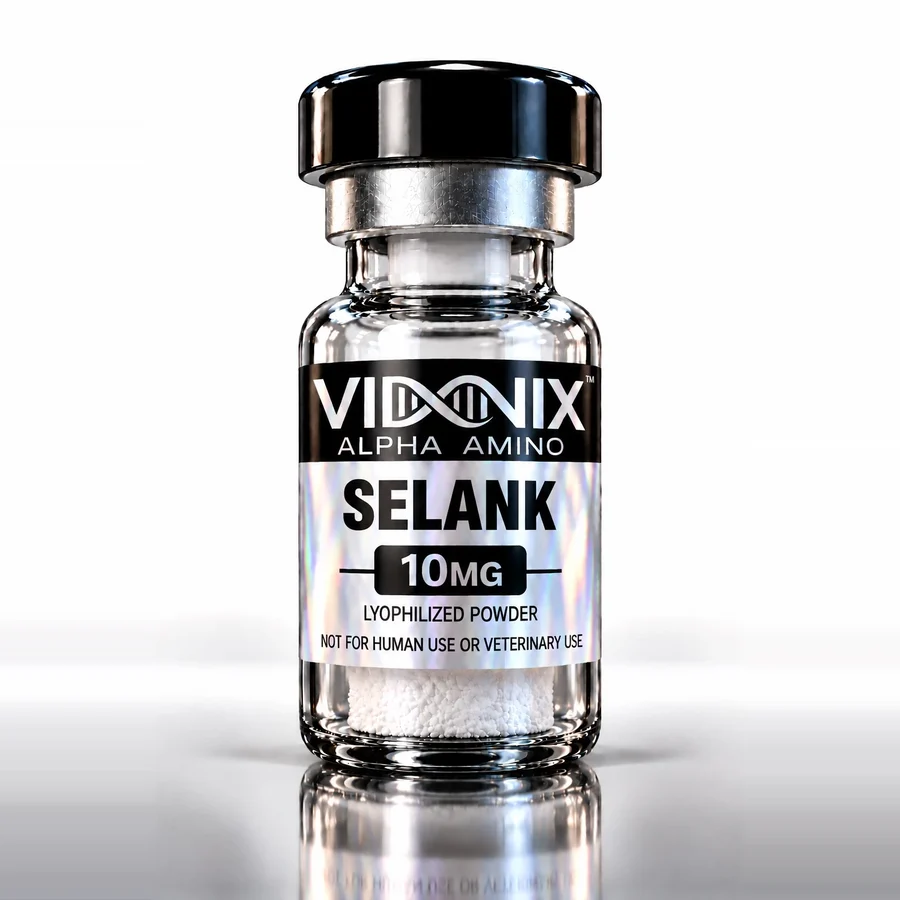
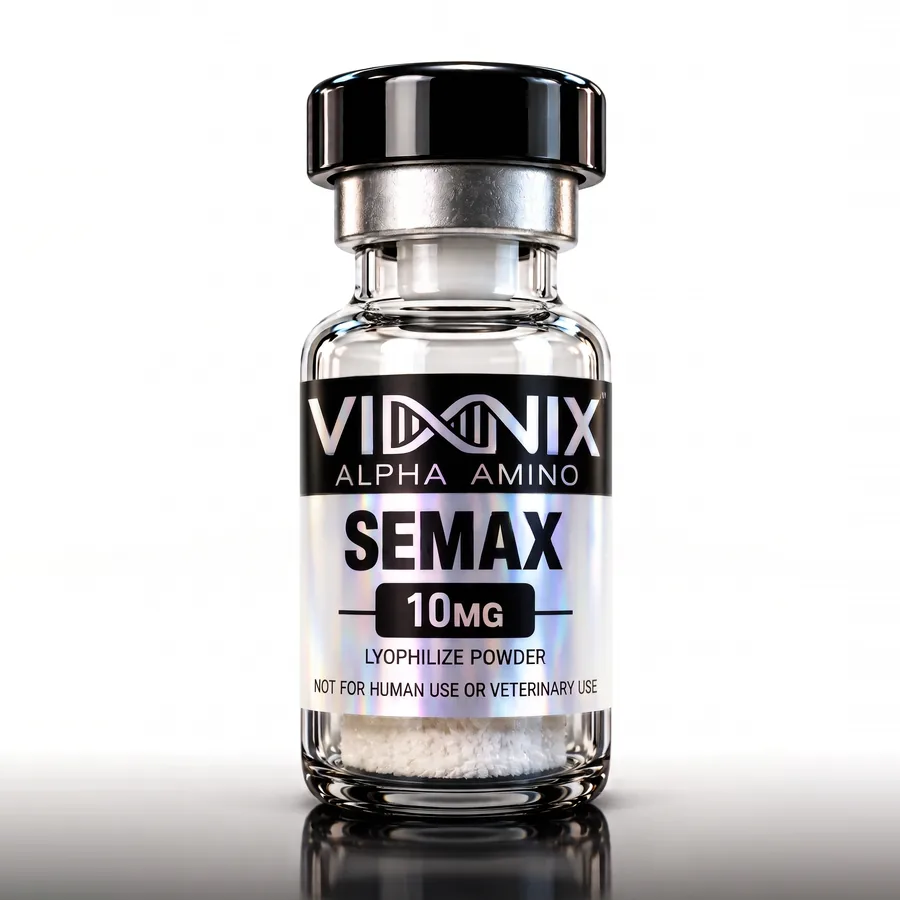
Vinnix supplies Selank and Semax for laboratory research only. They are not for human or veterinary use, and nothing here describes an effect in people.
Where were Selank and Semax developed?
Both came out of Moscow peptide chemistry, centred on the Institute of Molecular Genetics of the Russian Academy of Sciences (IMG RAS). The group around N.F. Myasoedov at IMG RAS appears as authors on much of the published work for both molecules, including degradation studies [3] and gene expression work in rodents [4][5].
The design idea was published by Ashmarin and colleagues, who worked with the IMG RAS group. They described a family of proline-rich regulatory peptides they called glyprolines, and proposed hybrid or "chimeric" peptides that join a natural regulatory fragment to a glyproline tail [2]. Selank and Semax are the two best-known examples of that approach.
Tuftsin itself was first described in 1970 as a peptide that stimulated phagocytic cells [1]. ACTH is a 39-residue pituitary hormone. In both cases the starting fragment is short and is broken down quickly by peptidases, which is the problem the glyproline tail was meant to address.
What is the structural difference between Selank and Semax?
The table puts the identity data side by side. Molecular formulas, weights and monoisotopic masses are from PubChem; CAS numbers are from the FDA Global Substance Registration System. All values describe the free peptide, not a salt form.
| Property | Selank | Semax |
|---|---|---|
| Sequence (one-letter) | TKPRPGP | MEHFPGP |
| Sequence (three-letter) | Thr-Lys-Pro-Arg-Pro-Gly-Pro | Met-Glu-His-Phe-Pro-Gly-Pro |
| Parent fragment | Tuftsin (TKPR) | ACTH(4-7) (MEHF) |
| Molecular formula | C33H57N11O9 | C37H51N9O10S |
| Molecular weight | 751.9 g/mol | 813.9 g/mol |
| Monoisotopic mass | 751.434 Da | 813.348 Da |
| PubChem CID | 11765600 | 9811102 |
| CAS number | 129954-34-3 | 80714-61-0 |
| Charged side chains | Lys, Arg (basic) | Glu (acidic), His |
| Sulfur-containing residue | None | Met at position 1 |
The charge difference is the one that shows up at the bench. With lysine, arginine and a free N-terminal amine, Selank carries a clear net positive charge near neutral pH. Semax has one glutamate, one histidine and no basic residues besides the N-terminus, so it sits much closer to neutral. That affects retention on reversed-phase HPLC and the charge states seen in electrospray mass spectrometry.
One naming point causes confusion. Semax is usually called an ACTH(4-10) analogue, but native ACTH(4-10) reads Met-Glu-His-Phe-Arg-Trp-Gly. Semax keeps only the first four of those residues and replaces the rest with Pro-Gly-Pro. Our guide to peptide sequences covers how to read these strings.
Why do both peptides end in Pro-Gly-Pro?
The tail is there for stability. Proline-rich sequences resist many common peptidases, and Ashmarin's group argued that glyproline-containing peptides were far more stable than the short regulatory fragments they were attached to [2].
Stable does not mean intact forever. When Zolotarev and colleagues followed isotope-labelled Semax in the presence of rat brain cell cultures and plasma membranes, the main routes were loss of the N-terminal Met-Glu and of the C-terminal Gly-Pro, giving pentapeptides [3]. That in vitro result is a good reminder that the tail slows breakdown in some settings without stopping it.
What have studies on Selank and Semax looked at?
The literature is small, mostly preclinical and concentrated in a few Russian groups, and many papers were published in Russian-language journals. Independent replication outside those groups is limited. These are representative examples, grouped by study type.
- In vitro enzyme study. Kost and colleagues measured inhibition of enkephalin-degrading enzymes in human serum samples and reported IC50 values of about 10 micromolar for Semax and 20 micromolar for Selank [6].
- In vitro degradation study. The Semax breakdown work described above, using rat brain cell cultures and membranes [3].
- Animal gene expression study (Selank). Expression of 84 inflammation-related genes was measured in mouse spleen at 6 and 24 hours; 34 showed significant changes [4].
- Animal gene expression study (Semax). Genome-wide transcriptional analysis of rat cortex after experimental focal ischemia, where most altered genes were immune-related [5].
- Animal behaviour study (both). Rats with a 6-OHDA lesion were tested in a maze; neither peptide changed motor activity, and Selank was associated with lower anxiety-like measures in that model [7].
These are cell and rodent results from specific models. They do not establish safety or any effect in humans, and animal findings often fail to carry over. Our article on in vitro vs. in vivo research explains why the study type should frame how much weight a result gets.
Are Selank and Semax FDA approved?
No. Neither peptide is approved by the US Food and Drug Administration for any use. Both appear in the FDA's Global Substance Registration System, but that registry only assigns identifiers such as UNII codes. A registry entry says nothing about approval.
Both were registered as medicines in Russia, which is where nearly all of the clinical literature comes from. That registration does not carry over to the United States or the EU. In the US, Selank and Semax are sold only as research chemicals, and Vinnix supplies them on that basis alone.
How stable are Selank and Semax, and how are they handled?
As lyophilized powders, both behave like most short peptides. Our peptide storage guide covers the bench basics: cold, dry and dark, with the vial warmed to room temperature before opening so that moisture does not condense on the powder.
Semax has one extra weak point: the methionine at position 1. Methionine oxidizes to methionine sulfoxide on exposure to air, light or trace metals, adding 16 Da to the mass. A careful handler minimizes headspace air and repeated opening, and a careful analyst looks for an M+16 signal and reports it as an impurity. Selank has no methionine or cysteine, so this route does not apply to it.
Once in solution, both are exposed to peptidase contamination and slow hydrolysis. Sterile technique, clean diluent and short holding times are the usual bench practice. Freeze-thaw cycles are best avoided by preparing only what a run needs.
Why are Selank and Semax often discussed together?
Partly history, partly chemistry. They came from the same institute, were built on the same hybrid-peptide principle and share their last three residues. Several papers tested both side by side, including the serum enzyme study [6] and the rat 6-OHDA study [7], which naturally pairs them in search results and reviews.
The pairing hides real differences. The parent peptides come from unrelated systems, one from an immunoglobulin and one from a pituitary hormone. The charges differ, the masses differ by 62 Da and only Semax has an oxidation-prone residue. For laboratory purposes they are two separate compounds with separate identity data.
How to tell Selank from Semax, and what to check on documents
Mass spectrometry separates them immediately. Selank should give a neutral monoisotopic mass of 751.43 Da (about m/z 752.44 for the singly protonated ion) and Semax 813.35 Da (about m/z 814.36). Both share the Pro-Gly-Pro tail, so fragment ions from that end alone cannot tell them apart; the intact mass can.
Watch for modified variants. Products sold as N-acetyl Semax or Semax amidate are different substances: N-terminal acetylation adds about 42 Da, and a C-terminal amide lowers the mass by about 1 Da. The documentation should name the exact form and show a mass that matches it.
When reviewing any supplier's batch documents for either peptide, check for:
- The full sequence and the form supplied (free peptide, acetate salt, acetylated or amidated).
- An observed mass that matches the expected value for that form.
- An HPLC chromatogram showing the main peak and any impurities.
- For Semax, whether an M+16 oxidation product was looked for.
- A batch number that matches the vial label, plus the lab, date and methods.

FAQFrequently asked questions
What is the main difference between Selank and Semax?
Their first four residues. Selank starts with tuftsin (Thr-Lys-Pro-Arg), a fragment of immunoglobulin G. Semax starts with ACTH(4-7) (Met-Glu-His-Phe). Both end in Pro-Gly-Pro. That gives them different masses (751.9 vs 813.9 g/mol), charges and identifiers.
Who developed Selank and Semax?
Both were developed in Moscow, mainly by researchers at the Institute of Molecular Genetics of the Russian Academy of Sciences working with Ashmarin's group, who described the hybrid glyproline peptide concept.
Is Selank or Semax approved in the United States?
No. Neither is approved by the FDA. Both were registered as medicines in Russia, but that status does not apply in the US, where they are available only as research chemicals.
Is N-acetyl Semax the same compound as Semax?
No. Acetylating the N-terminus changes the formula and adds about 42 Da to the mass, so it is a distinct substance that needs its own identity data.
Does Vinnix sell Selank and Semax separately?
Yes. Selank is supplied as a standalone 10 mg vial and Semax as a standalone research vial, both for laboratory research use only.
REFScientific references
-
Najjar VA, Nishioka K. "Tuftsin": a natural phagocytosis stimulating peptide. Nature. 1970;228(5272):672-3. PubMed 4097539
original research (peptide isolation) -
Ashmarin IP, Samonina GE, Lyapina LA, et al. Natural and hybrid ("chimeric") stable regulatory glyproline peptides. Pathophysiology. 2005;11(4):179-185. PubMed 15837162
review -
Zolotarev YA, Dolotov OV, Inozemtseva LS, et al. Degradation of the ACTH(4-10) analog Semax in the presence of rat basal forebrain cell cultures and plasma membranes. Amino Acids. 2006;30(4):403-8. PubMed 16773243
in vitro study -
Kolomin T, Shadrina M, Andreeva L, Slominsky P, Limborska S, Myasoedov N. Expression of inflammation-related genes in mouse spleen under tuftsin analog Selank. Regul Pept. 2011;170(1-3):18-23. PubMed 21609736
animal study -
Medvedeva EV, Dmitrieva VG, Povarova OV, et al. The peptide semax affects the expression of genes related to the immune and vascular systems in rat brain focal ischemia: genome-wide transcriptional analysis. BMC Genomics. 2014;15:228. PubMed 24661604
animal study -
Kost NV, Sokolov OIu, Gabaeva MV, et al. [Semax and selank inhibit the enkephalin-degrading enzymes from human serum]. Bioorg Khim. 2001;27(3):180-3. PubMed 11443939
in vitro study -
Slominsky PA, Shadrina MI, Kolomin TA, et al. Peptides semax and selank affect the behavior of rats with 6-OHDA induced PD-like parkinsonism. Dokl Biol Sci. 2017;474(1):106-109. PubMed 28702721
animal study
 Blog
 Blog
 Blog
 Compound Library
 Compound Library
 Research Library: Peptide Fundamentals