
Key facts
- Building blocks
- Amino acids (20 standard, plus non-standard residues in synthetic peptides)
- Linkage
- Peptide (amide) bond between a carboxyl group and an amino group
- By-product of each bond
- One molecule of water (18.02 g/mol)
- Written direction
- N-terminus to C-terminus
- Typical size
- About 2 to 50 amino acids; no single official cut-off
- Common analysis
- HPLC for purity, mass spectrometry for identity
Definition: What Is a Peptide?
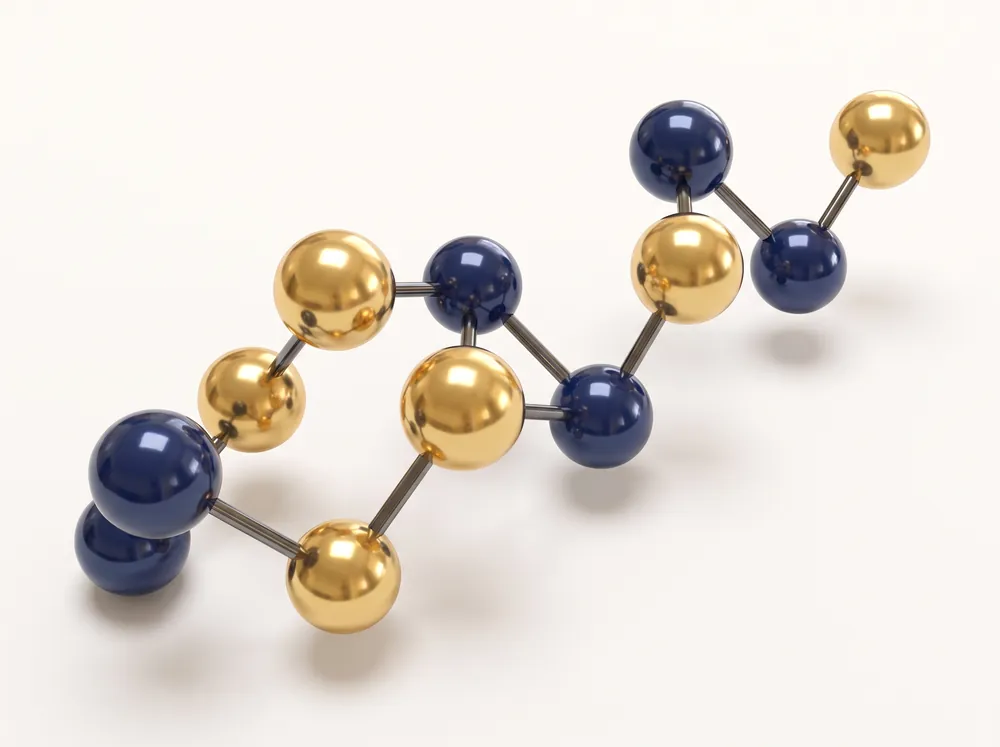
A peptide is a molecule built from two or more amino acids linked end to end by peptide bonds. That's the whole definition, and it covers an enormous category. With twenty standard amino acids available in any order, a chain of just ten residues already has 2010 possible sequences, which is more than ten trillion [1].
So "what are peptides?" never has a one-compound answer. The word "peptide" names a class, the way "metal" or "sugar" does. Glutathione, BPC-157 and tesamorelin are all peptides, and they differ in length, sequence, formula, molecular weight and chemical behavior. What's true of one peptide doesn't automatically hold for another.
Peptide = amino acids + peptide bonds + a defined order (sequence). Change any one of the three and you have a different molecule.
Peptides and Amino Acids
What Are Peptides Made From?
The building blocks are amino acids: small organic molecules, each with an amino group (-NH2), a carboxyl group (-COOH) and a side chain on a central alpha carbon [1]. That side chain, often called the R group, is the difference between glycine and tryptophan or lysine. Some side chains are acidic and some basic. Some are oily and repel water. One, cysteine's, carries a thiol that can form disulfide bridges.
Living cells build their peptides and proteins mostly from 20 standard amino acids, with selenocysteine and pyrrolysine as rarer extras in some organisms. Chemists in a lab aren't bound by that list. A synthetic peptide can include D-amino acids (the mirror-image forms), aminoisobutyric acid (Aib), N-methylated residues and plenty of other building blocks. In ipamorelin and SS-31, for example, the non-standard residues are part of what the molecule is. For the individual building blocks in more depth, see our amino acids overview.
Once amino acids are linked into a chain, chemists call each unit a residue, since each has given up the atoms of a water molecule to form the bond. This matters when you do the arithmetic. A linear peptide's molecular weight is the sum of its free amino acids, minus 18.02 g/mol for each peptide bond formed.
What Is a Peptide Bond?
A peptide bond is the amide linkage between the carboxyl carbon of one amino acid and the amino nitrogen of the next, and forming it releases one molecule of water. In a simple linear peptide, then, a chain of n amino acids has n minus 1 peptide bonds.
This bond is stronger and stiffer than an ordinary single bond. Its electrons are shared across the carbonyl oxygen, the carbon and the nitrogen, so the C-N link behaves partly like a double bond and holds the six atoms around it in one flat plane [1]. That stiffness limits the ways a peptide chain can fold. Our peptide bond guide covers the full chemistry, including cis and trans forms and why the bond resists water at neutral pH.
What Is a Peptide Sequence?
A peptide sequence is the exact order of amino acids in the chain. International convention writes it from the N-terminus to the C-terminus [2]. No other identifier tells you as much about a peptide.
You can write a sequence in three-letter code (Gly-His-Lys) or one-letter code (GHK). Two peptides with the same length, and even the same amino-acid composition, are still different compounds if the order differs: GHK and KHG contain identical residues and are not the same molecule. Modifications such as a C-terminal amide (-NH2) or an N-terminal acetyl group (Ac-) get written into the sequence too, because they change the formula and the mass. Understanding peptide sequences has a full code table and notation guide. For any single compound, the most exact answer to "what are peptides?" is its sequence.
What Are Peptides Like in Practice? Short, Medium and Long Examples
Sizes vary a lot, and real compounds make the spread easier to picture. The table below lines up a few peptides from the Vinnix catalog, from a tripeptide to a 44-residue chain, using values from PubChem.
| Peptide | Residues | Sequence or structure | Molecular weight |
|---|---|---|---|
| Glutathione (reduced) | 3 | gamma-Glu-Cys-Gly | 307.3 g/mol |
| KPV | 3 | Lys-Pro-Val (KPV) | 342.4 g/mol |
| BPC-157 | 15 | GEPPPGKPADDAGLV | 1419.5 g/mol |
| MOTS-c | 16 | MRWQEMGYIFYPRKLR | 2174.6 g/mol |
| Sermorelin | 29 | YADAIFTNSYRKVLGQLSARKLLQDIMSR-NH2 | 3357.9 g/mol |
| Tesamorelin | 44 (plus N-terminal trans-3-hexenoyl group) | Modified GHRH (1-44) amide | 5136 g/mol |
Short: Glutathione is a tripeptide of glutamate, cysteine and glycine. It's also a reminder that not every peptide linkage follows the textbook. The glutamate is attached through its side-chain (gamma) carboxyl group, not its alpha carboxyl, and cells assemble the molecule with dedicated enzymes instead of on the ribosome.
Medium: MOTS-c has 16 residues. When it was first described in 2015, the surprise was where it came from: the mitochondrial genome, in a region that codes for 12S ribosomal RNA, rather than nuclear DNA [6]. Stories like that are part of why peptide research keeps turning up new sequences.
Long: Tesamorelin contains all 44 amino acids of human growth hormone-releasing hormone, plus a trans-3-hexenoyl group on the N-terminus. At about 5,100 g/mol, it is close to the informal line where some authors would switch to calling it a polypeptide or a small protein.
Peptides vs. Proteins
Any answer to "what are peptides?" has to say where peptides stop and proteins start. The two use the same building blocks and the same bond. What separates them is mostly size and structural complexity, and nobody has fixed a universal cut-off between the two.
A common rule of thumb calls chains under about 50 amino acids peptides and anything longer proteins. Scientific naming also carries history and function with it, though. Insulin has 51 residues split across two chains, and people routinely call it both a peptide hormone and a small protein. Proteins usually fold into stable three-dimensional shapes, and many are made of several chains; most short peptides stay flexible in water [1]. Our peptides vs proteins comparison puts the differences side by side.
Natural and Synthetic Peptides
Ask a biologist and a chemist "what are peptides?" and you may get different examples. Biology is full of naturally occurring peptides, and chemists can also make them in a laboratory for research.
Organisms produce peptides in two main ways. Many are cut out of larger precursor proteins assembled on ribosomes. Others, glutathione and many microbial peptides among them, are put together by enzymes that link amino acids without any ribosome. Across different organisms, natural peptides work as hormones, signaling molecules, antimicrobial agents and metabolic intermediates [7].
A synthetic peptide is built by a chemist to a defined sequence. Chemical synthesis lets researchers get a specific sequence in quantity, add labels or modifications, and swap single residues to compare closely related molecules. The result can be chemically identical to a natural peptide, or different from it on purpose.
Plenty of peptides aren't simple straight chains. Some are cyclic, with the ends joined or a ring closed through side chains. Others are cross-linked by disulfide bridges between cysteines, have an acetylated N-terminus or an amidated C-terminus, or carry attached lipid or sugar groups. Every one of these features belongs to the molecule's identity and has to show up in its written structure and formula.
Why Are Peptides Studied?
Part of the answer to "what are peptides?" is where they sit: between small molecules and large proteins. That middle position makes them handy tools for questions about molecular recognition, structure and chemistry.
The questions differ from field to field. Chemists look at how sequence affects folding, stability and solubility. Analytical scientists work out ways to separate peptides that are nearly identical. Biochemists use synthetic fragments to map which part of a bigger protein touches a receptor. Pharmaceutical scientists treat peptides as a drug class, and reviews of that field cover both their selectivity and their practical problems, such as being broken down quickly by proteases [7].
Any single study uses one peptide, in one model, under one set of conditions. Cell culture (in vitro) and animal results describe what happened in that model, not what would happen in people. Preclinical findings do not establish safety or effectiveness in humans.
Vinnix peptides are for laboratory research only, and nothing in this library describes use in humans or animals.
What Is Peptide Synthesis?
Peptide synthesis means assembling a chosen amino-acid sequence under control. In the lab, that usually means solid-phase peptide synthesis (SPPS).
R. Bruce Merrifield introduced SPPS in 1963 [3]. His idea was to anchor the growing chain to an insoluble resin bead, so excess reagents could be washed away after each step instead of purifying the product every time. Each cycle strips a temporary protecting group, couples the next protected amino acid and washes the resin. Once the sequence is finished, the peptide is cleaved off the resin, purified, and usually freeze-dried to a powder. Our peptide synthesis explainer goes through Fmoc and Boc chemistry, coupling reagents and purification.
How Are Peptides Analyzed?
In the lab, "what are peptides?" turns into a narrower question: what is in this sample? Two methods do most of the work, and they answer different questions: high-performance liquid chromatography (HPLC) measures purity, and mass spectrometry (MS) confirms identity.
- HPLC separates the main peptide from related impurities like truncated or oxidized forms. Reversed-phase HPLC is the standard approach for peptides, and purity is reported as the main peak's share of the total peak area [4]. See what HPLC testing measures.
- Mass spectrometry measures mass-to-charge ratio. Electrospray ionization, which was developed for large biomolecules, produces multiply charged ions so that peptides and proteins can be weighed accurately [5]. See mass spectrometry for peptide identity.
- LC-MS puts the two together, so every separated peak gets a mass.
- Other methods include amino-acid analysis, which backs up net peptide content measurements, and tests for water or counter-ion content.
One number never answers everything about a sample. A peptide can read 99% pure by HPLC and still be the wrong molecule if nobody checked identity. Our peptide testing overview and guide to certificates of analysis show how to read the results together.
FAQFrequently asked questions
What are peptides?
Peptides are chains of amino acids linked by peptide bonds, usually somewhere from 2 to about 50 residues long. Each one is defined by its sequence, the exact order of its amino acids, so the word names a broad class of molecules, not one substance. Glutathione, BPC-157 and tesamorelin are all peptides, and their structures are very different.
What are peptides made of?
Amino acids. Each one contributes a backbone unit and a side chain, and neighboring units are joined by peptide bonds, each of which releases one water molecule. Natural peptides mostly stick to the 20 standard amino acids. Synthetic peptides can also contain D-amino acids, Aib and other non-standard residues.
What is the difference between a peptide and a protein?
Both are chains of amino acids joined by peptide bonds. Peptides are shorter, often under about 50 residues, and usually don't hold a stable folded structure. Proteins are longer and typically fold into defined three-dimensional shapes, sometimes from several chains. There's no official cut-off, so history and context also shape what people call things.
How many amino acids are in a peptide?
At least two. Two residues make a dipeptide and three a tripeptide, and chains of roughly 2 to 20 residues often get called oligopeptides. Longer chains are polypeptides. For a sense of scale in the Vinnix catalog: glutathione has 3 residues, MOTS-c has 16, and tesamorelin has 44 plus an N-terminal modification.
Are all peptides made by the ribosome?
No. Many natural peptides are cut from larger proteins that ribosomes made, but dedicated enzymes assemble others. Glutathione is the classic case. Cells build it in two enzymatic steps, and its glutamate is linked through the side-chain gamma carboxyl instead of the usual alpha carboxyl. Research peptides are usually made chemically, by solid-phase synthesis.
How do you confirm what a peptide sample is?
Mass spectrometry is the usual identity check: it confirms that the measured mass matches what the sequence and formula predict. Purity is a separate measurement, normally by reversed-phase HPLC. A good certificate of analysis reports both, with the batch number and the method, so you can trace every result back to a specific lot.
REFScientific references
-
Alberts B, Johnson A, Lewis J, Raff M, Roberts K, Walter P. Molecular Biology of the Cell. 4th ed. New York: Garland Science; 2002. The Shape and Structure of Proteins. NCBI Bookshelf NBK26830. Source
textbook (NCBI Bookshelf) -
IUPAC-IUB Joint Commission on Biochemical Nomenclature (JCBN). Nomenclature and symbolism for amino acids and peptides. Recommendations 1983. Eur J Biochem. 1984;138(1):9-37. PubMed 6692818
nomenclature standard -
Merrifield RB. Solid phase peptide synthesis. I. The synthesis of a tetrapeptide. J Am Chem Soc. 1963;85(14):2149-2154. doi:10.1021/ja00897a025 (not indexed in PubMed; verified via Crossref).
original chemistry method paper -
Mant CT, Chen Y, Yan Z, et al. HPLC analysis and purification of peptides. Methods Mol Biol. 2007;386:3-55. PubMed 18604941
methods review -
Fenn JB, Mann M, Meng CK, Wong SF, Whitehouse CM. Electrospray ionization for mass spectrometry of large biomolecules. Science. 1989;246(4926):64-71. PubMed 2675315
analytical methods paper -
Lee C, Zeng J, Drew BG, et al. The mitochondrial-derived peptide MOTS-c promotes metabolic homeostasis and reduces obesity and insulin resistance. Cell Metab. 2015;21(3):443-454. PubMed 25738459
in vitro and animal study (cited here for sequence origin only) -
Muttenthaler M, King GF, Adams DJ, Alewood PF. Trends in peptide drug discovery. Nat Rev Drug Discov. 2021;20(4):309-325. PubMed 33536635
review
 Research Library: Peptide Fundamentals
 Research Library: Peptide Fundamentals
 Amino Acids