
Key facts
- 1. Documentation
- Name, sequence, quantity and identifiers stated plainly
- 2. COA contents
- Batch, methods, laboratory, date and results
- 3. Testing
- Identity (mass spectrometry) and purity (HPLC) both reported
- 4. Traceability
- Batch number on the vial matches the COA
- 5. Labeling
- Research use only, with no health claims
- 6. Transparency
- Reachable supplier that explains its documentation
- 7. Storage and shipping
- Conditions stated for each compound
Product Documentation: The First Check When Sourcing Research Peptides
The peptide market presents products with very different amounts of information. When sourcing research peptides, start with the listing itself. It should say exactly what is being offered: the recognized name, the sequence or other defining specification, the quantity per vial and, where they exist, registry identifiers such as a PubChem CID or CAS number.
Vague or nickname-only labeling makes evaluation hard. Some catalog names cover more than one molecule, so a listing that gives a sequence and formula is far easier to check against public records. Our overview of peptide research terminology explains what each of those fields means.
What a COA Should Contain
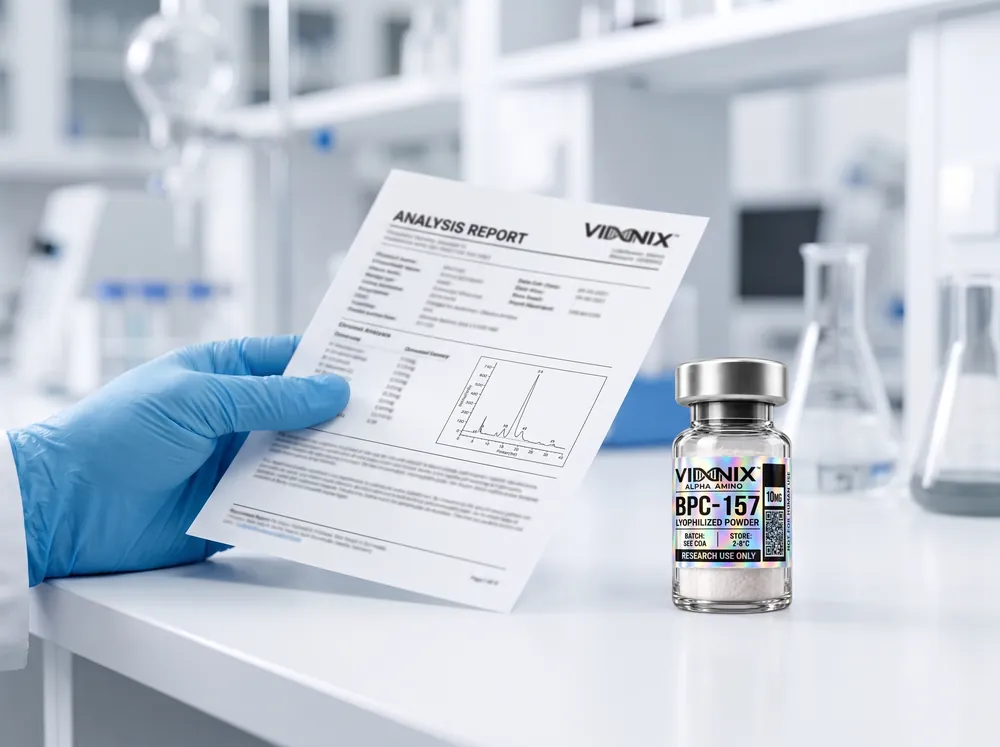
A certificate of analysis is the main document behind a product, and its value depends on what is on it. A useful COA states:
- Product name, quantity and batch or lot number
- Each test performed and the method used
- The testing laboratory and the date of analysis
- Results with units and, where relevant, acceptance limits
- Supporting data such as the HPLC chromatogram and mass spectrum
A COA with a purity figure and nothing else tells you little. The COA checklist and how to read a COA go through each field.
Identity Testing vs. Purity Testing
Different methods answer different questions. Mass spectrometry confirms identity by matching the measured mass to the expected one. HPLC estimates purity from the share of total peak area in the main peak. A high purity figure does not prove the main peak is the right molecule, and a correct mass does not prove the sample is pure. Related impurities from synthesis, such as deletion or truncated sequences, are exactly what these tests are meant to catch [1].
Look for both results on the same batch, or for LC-MS, which combines them. Identity vs. purity in analytical testing explains the distinction in more depth.
Batch Traceability
Test results describe a batch, not a product name. A batch or lot number printed on the vial, repeated on the COA, is what links the material in your hands to the data that describe it. Without that match, a certificate is only a sample of what the supplier once made. Pharmaceutical quality specifications for peptides are built around the same batch-level logic [2].
Record the batch number when material arrives and keep it with your experimental notes. Batch number vs. lot number explains the terms.
Research-Use Labeling
Material sold for laboratory research should be labeled as such and described in research terms: identity, specifications and documentation. Listings that promise effects in people, suggest amounts to take or borrow the names of approved medicines are describing something other than a research reagent. Plain, consistent research-use labeling is a sign the supplier understands what it is selling, and it is one of the easier checks to make when sourcing research peptides.
Supplier Transparency
Sourcing research peptides is easier when the supplier makes its documentation easy to find and its claims easy to check. Practical signs of transparency include a working contact route, an explanation of which tests are run and by whom, references to primary literature rather than testimonials, and a clear statement of what hasn't been confirmed yet. Scientific evidence comes from appropriate studies and authoritative databases, not product copy, so treat dramatic marketing as a reason for more questions.
Storage and Shipping Handling
Peptides are usually shipped lyophilized because the dry solid is far more stable than a solution [3]. Even so, heat and moisture still matter. When sourcing research peptides, look for a listing that states storage conditions for each compound and explains how material is packed for transit. On arrival, check that the vial is sealed and intact, note the batch number and store it as the label directs. The peptide storage guide covers the general principles.
How Vinnix Approaches These Points
Vinnix is building its catalog around the same checklist we suggest for sourcing research peptides. Product pages give the SKU and quantity, compound entries list identifiers checked against PubChem and FDA GSRS, and batch reports are added to the COA Library as each batch is released. Where information such as storage conditions hasn't been confirmed, the page defers to the batch record instead of guessing. Our research methodology explains how sources are chosen.
FAQFrequently asked questions
What should I check first when sourcing research peptides?
Start with the listing. It should give the compound's recognized name, its sequence or other defining specification, the quantity per vial and registry identifiers where they exist. If you can't tell exactly which molecule is being offered, nothing else on the page can be checked properly.
What is the difference between identity and purity testing?
Identity testing, usually mass spectrometry, confirms the main component is the expected molecule by matching its mass. Purity testing, usually HPLC, estimates what share of the detected material that component makes up. Each can pass while the other fails, so a useful report includes both for the same batch.
Why does batch traceability matter?
Analytical results describe one batch. A batch or lot number on the vial that matches the number on the COA is the only thing connecting your material to its test data. Without that link, the certificate tells you about some other material, not necessarily the vial in front of you.
What does research use only labeling mean?
It means the material is supplied for laboratory, analytical and scientific research, not for human or veterinary use. A research-use listing describes identity, specifications and documentation. Claims about effects in people, intake amounts or comparisons with approved medicines don't belong on a research reagent listing.
Does a high purity figure prove a peptide is what the label says?
No. HPLC purity shows how much of the detected material sits in the main peak, not what that peak is. A sample could be highly pure and still be the wrong sequence. Identity needs its own test, normally mass spectrometry or LC-MS, reported for the same batch.
REFScientific references
-
D'Hondt M, Bracke N, Taevernier L, et al. Related impurities in peptide medicines. J Pharm Biomed Anal. 2014;101:2-30. PubMed 25044089
review -
Vergote V, Burvenich C, Van de Wiele C, De Spiegeleer B. Quality specifications for peptide drugs: a regulatory-pharmaceutical approach. J Pept Sci. 2009;15(11):697-710. PubMed 19750489
review (pharmacopeial specifications) -
Lai MC, Topp EM. Solid-state chemical stability of proteins and peptides. J Pharm Sci. 1999;88(5):489-500. PubMed 10229638
review
 Documentation