
Key facts
- Core principle
- Different partitioning between a mobile and a stationary phase
- Origin
- Mikhail Tswett, plant pigments, early 1900s
- Partition chromatography
- Martin and Synge, 1941
- Main families
- Gas, liquid, thin-layer, ion-exchange, size-exclusion, affinity
- Standard for peptides
- Reversed-phase HPLC
- Output
- Chromatogram (signal vs. time)
What is chromatography?
Chromatography is a separation method. You start with a mixture and spread its components apart, in space or in time, until each one can be seen on its own. Whatever the technique, it comes down to two ingredients: a mobile phase that moves and a stationary phase that stays put.
The name means "color writing". The Russian botanist Mikhail Tswett coined it in the early 1900s after washing plant extracts through a column packed with chalk and watching the pigments separate into colored bands [2]. Color rarely comes into it now. Tswett's principle, though, has not changed.
How does chromatography work?
The trick is that each component spends a different share of its time stuck to the stationary phase. A molecule that is attached goes nowhere. Once it is back in the mobile phase, it travels at the speed of the flow. So the molecules that bind more strongly sit still for longer, and they fall behind.
Chemists describe that balance with a partition (or distribution) coefficient, which is the concentration of a component in the stationary phase divided by its concentration in the mobile phase. In 1941 Archer Martin and Richard Synge described a partition method between two liquid phases and gave a theory for it, applying it to separate amino acids from protein hydrolysates [1]. The work won them a shared Nobel Prize in Chemistry in 1952.
Whether two components come apart cleanly depends on how differently they interact with the phases (selectivity), how narrow each band stays on the way through (efficiency) and how long the column holds on to them in total (retention).
What are the mobile phase and stationary phase?
The mobile phase is the gas or liquid that flows through the system, carrying the sample with it. The stationary phase is the solid, or bound liquid, that it flows past. Swap either one and you change the basis of the separation.
| Technique | Mobile phase | Stationary phase | Separates by |
|---|---|---|---|
| Gas chromatography (GC) | Inert gas | Liquid film or solid in a column | Volatility and polarity |
| Thin-layer chromatography (TLC) | Solvent | Silica layer on a plate | Polarity |
| Reversed-phase liquid chromatography | Water and organic solvent | Hydrophobic bonded silica (e.g. C18) | Hydrophobicity |
| Ion-exchange chromatography | Aqueous buffer | Charged resin | Net charge |
| Size-exclusion chromatography | Aqueous buffer | Porous beads | Molecular size |
| Affinity chromatography | Buffer | Immobilized binding partner | Specific binding |
What type of chromatography is used for peptides?
For peptides, the standard technique is reversed-phase HPLC, used both to purify them and to assess purity [3][4]. Here the stationary phase is silica carrying hydrophobic chains, and the mobile phase is water with a rising proportion of acetonitrile. Peptides separate by how hydrophobic they are as a whole, and that follows from their amino acid sequence.
Other modes fill in around it. Ion exchange sorts peptides by charge. Size exclusion is the usual way to look for aggregates, and hydrophilic interaction methods pick up very polar peptides that reversed-phase columns barely retain [4]. To see how a reversed-phase system is built and run, read how does HPLC work.
Analytical vs. preparative chromatography
The analytical kind measures a sample. The preparative kind purifies material. Same chemistry, different jobs.
- Analytical runs use tiny amounts of sample, and everything goes to a detector. What comes out is a chromatogram for judging purity, as in HPLC testing.
- Preparative runs use bigger columns and heavier loads, and someone collects the separated fractions. After peptide synthesis, preparative reversed-phase HPLC removes most synthesis by-products, and the pooled fractions are then freeze-dried, as described in what is lyophilization.
What does chromatography tell you, and what does it not?
A chromatogram shows how many separable components the detector can see, and in what proportions. It does not, by itself, say what those components are. Under fixed conditions a peak's retention time is characteristic of a compound, but two different compounds can elute at almost the same moment.
That gap is why the method so often gets paired with a detector that measures mass. Hooking the liquid separation up to a mass spectrometer, called LC-MS, adds mass information to each peak. We compare the two kinds of evidence in HPLC vs. mass spectrometry, and the hands-on skill of reading the output gets its own guide, how to read an HPLC chromatogram.
A short history: from chalk columns to HPLC
It took most of a century to get from Tswett's columns to the fast, high-pressure technique labs use today. His columns ran on gravity. Martin and Synge's partition theory in 1941 explained what controls separation and predicted that smaller particles would give better results [1]. Starting in the late 1960s, pumps strong enough to push liquid through columns of very fine particles turned that prediction into HPLC, and later ultra-high-pressure systems pushed particle sizes and pressures further still [2].
FAQFrequently asked questions
What is chromatography in simple terms?
Chromatography is a way of pulling a mixture apart. A flowing liquid or gas carries the mixture past a fixed material. Anything that sticks to that material more strongly moves more slowly, so the parts come out one after another, where they can be detected or collected separately.
Who invented chromatography?
The credit goes to Mikhail Tswett, a Russian botanist who separated plant pigments on columns of chalk in the early 1900s and gave the method its name. Archer Martin and Richard Synge later developed the partition method and its theory in 1941, work that earned them the 1952 Nobel Prize in Chemistry and laid foundations for modern liquid and gas separations.
What are the mobile and stationary phases?
The mobile phase is the gas or liquid that moves through the system and carries the sample. The stationary phase is the material that stays fixed, such as particles packed in a column or a coating on a plate. Components separate because each one splits its time between the two phases in a different way.
What is the difference between chromatography and HPLC?
Chromatography is the whole family of separation techniques. HPLC, or high-performance liquid chromatography, is one member of it: a liquid mobile phase gets pumped at high pressure through a column of very small particles. HPLC gives sharper, faster separations than older gravity-fed column methods and is the standard approach for analyzing peptide purity.
What type of chromatography is used for peptides?
For peptides, reversed-phase HPLC is the standard. It uses a hydrophobic stationary phase, commonly C18-bonded silica, and a water-acetonitrile gradient with an acid additive such as trifluoroacetic acid. Labs turn to ion-exchange, size-exclusion and hydrophilic interaction modes for narrower questions, such as charge variants, aggregates or very polar peptides.
Does chromatography identify a compound?
Not on its own. It separates components and shows how much of each the detector sees, and under fixed conditions retention time is characteristic of a compound. The catch is that different compounds can elute at nearly the same time, so identity is usually confirmed with a second technique, most often mass spectrometry, either separately or coupled as LC-MS.
What is a chromatogram?
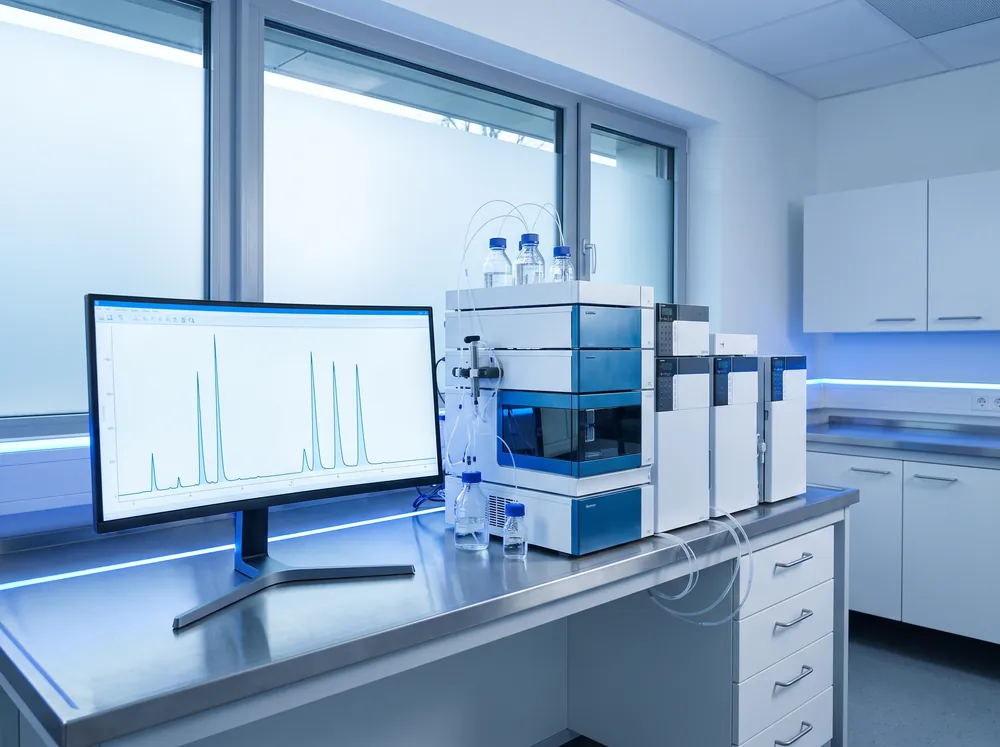
A chromatogram is the record a separation run produces, with detector signal plotted against time or distance. Each separated component appears as a peak or band. In HPLC the horizontal axis is retention time and the vertical axis is detector response, and the peak areas are used to compare how much of each component the detector saw.
REFScientific references
-
Martin AJ, Synge RL. A new form of chromatogram employing two liquid phases: a theory of chromatography. 2. Application to the micro-determination of the higher monoamino-acids in proteins. Biochem J. 1941;35(12):1358-1368. PubMed 16747422
original research (method development) -
Engelhardt H. One century of liquid chromatography. From Tswett's columns to modern high speed and high performance separations. J Chromatogr B Analyt Technol Biomed Life Sci. 2004;800(1-2):3-6. PubMed 14753203
historical review -
Aguilar MI. Reversed-phase high-performance liquid chromatography. Methods Mol Biol. 2004;251:9-22. PubMed 14704435
methods chapter -
Mant CT, Chen Y, Yan Z, et al. HPLC analysis and purification of peptides. Methods Mol Biol. 2007;386:3-55. PubMed 18604941
methods review
 Research Library
 Research Library
 Testing & Analysis