
Key facts
- Usual method
- Reversed-phase HPLC, UV 214 to 220 nm
- Expressed as
- Main peak area % of total integrated area
- Common impurities
- Deletion, truncated, oxidized and incompletely deprotected sequences
- Not included
- Water, counter-ions (TFA, acetate), salts
- Identity test
- Mass spectrometry, separate from purity
- Quantity test
- Amino acid analysis / net peptide content
What Does Peptide Purity Mean?
Peptide purity describes how much of the peptide material in a sample is the target sequence rather than a structurally related impurity, as measured by a defined analytical method. That makes it a composition measure. It says nothing on its own about identity, amount or suitability.
Most of the impurities that purity captures are by-products of synthesis. In solid-phase peptide synthesis, an incomplete coupling leaves a deletion sequence one residue short, incomplete deprotection leaves protecting-group adducts, and side reactions produce racemized or oxidized forms [1]. Peptides keep changing after synthesis, too, through deamidation, oxidation, pyroglutamate formation or aggregation [1]. Preparative HPLC strips out most of this material; analytical HPLC then measures what is left. For the background, see peptide synthesis explained.
| Impurity type | Origin | How it is usually detected |
|---|---|---|
| Deletion sequence (n-1) | Incomplete coupling during synthesis | HPLC peak plus LC-MS mass one residue lighter |
| Truncated sequence | Chain growth stopped early | HPLC peak, LC-MS lower mass |
| Protecting-group adduct | Incomplete deprotection | Late HPLC peak, LC-MS higher mass |
| Oxidized form (e.g. Met) | Synthesis or storage | HPLC shoulder or nearby peak, +16 Da by MS |
| Diastereomer (racemized residue) | Side reaction during coupling | HPLC only if resolved; same mass by MS |
| Deamidated form | Degradation (Asn, Gln) | HPLC peak, +1 Da by MS |
How Is Purity Evaluated?
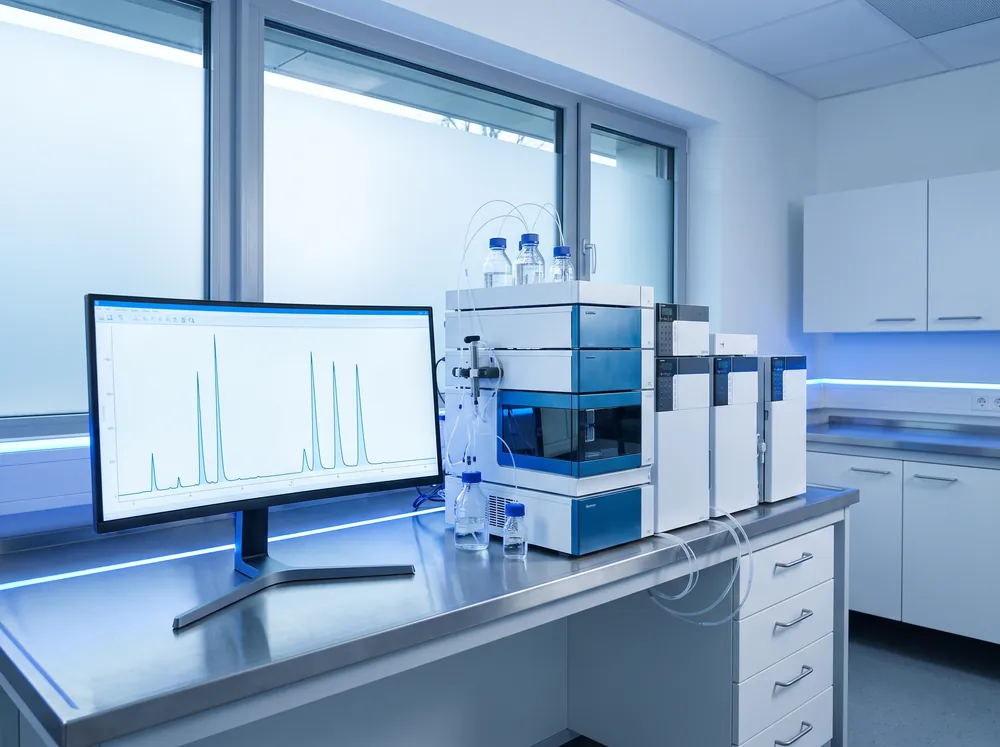
Peptide purity is evaluated mainly by reversed-phase HPLC with UV detection. Purity is the main peak area divided by the total area of all integrated peaks, expressed as a percentage.
At 214 to 220 nm the detector picks up the peptide bond itself, so the target and its related impurities respond in roughly similar ways. That is why area % works as a relative measure [2]. The chromatogram is the evidence behind the number, and a purity figure that arrives without one can't be checked. Pharmacopeial specifications for approved peptide drugs define purity by method, cap individual and total related substances, and pair the result with separate identification and assay tests [3][4]. Method details are in what is HPLC testing.
LC-MS often runs alongside the UV method to work out what each impurity peak actually is. An unlabeled bump becomes a named impurity, such as a specific deletion sequence [5]. See what is LC-MS.
What Does 99% Purity Mean?
99% purity means that in one HPLC analysis, under the stated method and wavelength, the main peak made up 99% of the total integrated peak area. Strip away that context and the number loses most of its meaning; it is not a universal measure of identity, amount or suitability.
- It does mean the detected, UV-absorbing peptide-related material was 99% main peak under that method.
- It does not mean 99% of the powder weight is peptide; water and counter-ions are not in the calculation.
- It does not prove the main peak is the correct sequence; that needs mass spectrometry.
- It does not cover impurities that co-elute with the main peak or are not detected at that wavelength.
- It does not describe a different batch; purity is batch-specific.
A reported 99% may describe an analytical measurement rather than the absolute mass fraction of the named compound, because chromatographic area percentages depend on detector response and on which components the method can detect.
Method choices move the number. A fast, steep gradient can fold minor peaks into the main one. A higher detection wavelength can under-count impurities that lack aromatic residues. So two purity claims can only be compared fairly when both state their method and show a chromatogram.
Identity vs. Purity
Identity and purity are independent. A sample can return a high purity result while that number tells you nothing about what the main component is. A dominant chromatographic peak does not, by itself, establish the identity of the material in that peak.
Imagine the wrong sequence was synthesized and then purified well. HPLC would still report a clean, high-purity main peak. Only a mass measurement, checked against the theoretical mass of the intended sequence, exposes the mismatch, and tandem MS can go further and confirm residue order [6]. That is why a complete report puts an identity result from mass spectrometry next to the purity result, as covered in HPLC vs mass spectrometry.
Purity vs. Quantity
Purity describes composition among peptide species. Quantity describes how much peptide is actually in the vial, and the two are separate questions.
A lyophilized peptide is never just peptide: it also holds bound water and counter-ions. Peptides purified with trifluoroacetic acid usually end up as trifluoroacetate salts, and residual TFA is itself listed among peptide-product impurities [1]. Net peptide content, measured by amino acid analysis or quantitative methods against a reference, is the share of total weight that is peptide [7]. The counter-ion can matter in an experiment as well. In vitro, low concentrations of trifluoroacetate affected cell proliferation in osteoblast and chondrocyte cultures, which is why some researchers ask for an acetate or hydrochloride form [8].
| Measurement | Example value | What it describes |
|---|---|---|
| HPLC purity | 99.1% | Main peak share of UV peak area |
| Water content | 6% | Bound water by weight |
| Counter-ion content | 12% | Trifluoroacetate or acetate by weight |
| Net peptide content | ~80% | Peptide share of total powder weight |
Pharmacopeias characterize their peptide reference standards for exactly these components so that quantity can be assigned correctly [4]. To see how these values show up on paperwork, read the certificate of analysis guide and the overview of peptide testing.
How to Read a Peptide Purity Claim
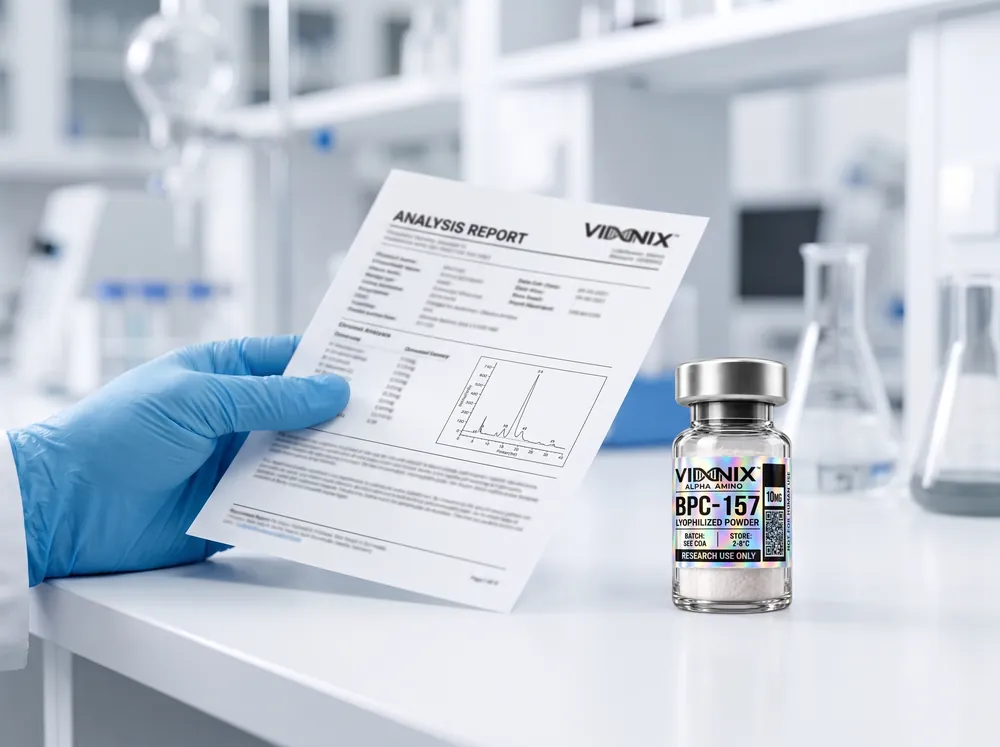
You can test a peptide purity claim by asking three things: is it tied to a method, to a batch, and to data you can see? A bare percentage on a label or product page is a summary. It isn't evidence. When you evaluate a report, review the method, laboratory, sample ID, chromatogram, calculations and any disclosed limitations.
- Find the method. Purity should name HPLC (or UPLC), the column type and the detection wavelength.
- Find the batch. The report's batch or lot number should match the product being reviewed, because purity varies from batch to batch.
- Look at the chromatogram. Check that the main peak is sharp, that impurity peaks are integrated and that the baseline is clean.
- Check for an identity result. A mass spectrometry or LC-MS result should confirm the main peak is the intended peptide.
- Separate purity from content. If a net peptide content or water result is reported, read it as a different measurement; if not, quantity is unknown.
- Note the laboratory and date. Results describe the sample tested on that date at that laboratory.
Pharmacopeial monographs for approved peptides go further. They set limits for each identified related substance and for total impurities instead of reporting one headline figure [3], and that level of detail makes a good benchmark for research-grade documentation. The how to read a COA guide applies this checklist field by field, and batch reports for Vinnix products go into the COA library as each batch is released.
FAQFrequently asked questions
What is peptide purity?
Peptide purity is the percentage of the peptide-related material in a sample that is the intended sequence, usually measured by reversed-phase HPLC with UV detection. It compares the target against related impurities like deletion sequences, truncated chains and oxidized forms. What it doesn't tell you is the identity of the main peak or how much peptide is actually there.
How is peptide purity calculated?
It's usually calculated from an HPLC chromatogram: the main peak's integrated area divided by the total area of all integrated peaks, times 100. The answer depends on the column, gradient, detection wavelength and integration settings. So treat any purity value as incomplete until you've seen the stated method and the chromatogram behind it.
Is 99% purity the same as 99% peptide?
No. 99% purity means the main peak made up 99% of the detected UV peak area in one HPLC run. A lyophilized peptide also carries water and counter-ions such as trifluoroacetate or acetate, and HPLC with UV detection doesn't report either. Net peptide content, the share of total weight that is peptide, is usually noticeably lower.
Does high purity confirm a peptide's identity?
No. HPLC purity tells you how dominant the main peak is, not which molecule it is. A well-purified wrong sequence can still look very pure. Identity comes from a separate test, mass spectrometry, which compares the observed molecular mass with the theoretical mass of the intended sequence and sometimes adds MS/MS sequence confirmation.
What impurities are found in synthetic peptides?
Common impurities in synthetic peptides include deletion sequences missing one amino acid, truncated chains, sequences with incompletely removed protecting groups, racemized residues, and oxidized or deamidated forms. Residual counter-ions such as trifluoroacetate from purification can also be present. LC-MS is often used to identify which of these each minor HPLC peak represents.
What is net peptide content?
Net peptide content is the percentage of a peptide powder's total weight that is actually peptide once bound water and counter-ions are accounted for. Labs usually measure it by amino acid analysis, which hydrolyzes the peptide and quantifies the amino acids that come out. It answers a quantity question that HPLC purity simply can't.
REFScientific references
-
D'Hondt M, Bracke N, Taevernier L, et al. Related impurities in peptide medicines. J Pharm Biomed Anal. 2014;101:2-30. PubMed 25044089
review -
Mant CT, Chen Y, Yan Z, et al. HPLC analysis and purification of peptides. Methods Mol Biol. 2007;386:3-55. PubMed 18604941
methods review -
Vergote V, Burvenich C, Van de Wiele C, De Spiegeleer B. Quality specifications for peptide drugs: a regulatory-pharmaceutical approach. J Pept Sci. 2009;15(11):697-710. PubMed 19750489
review (pharmacopeial specifications) -
McCarthy D, Han Y, Carrick K, et al. Reference standards to support quality of synthetic peptide therapeutics. Pharm Res. 2023;40(6):1317-1328. PubMed 36949371
review (pharmacopeial reference standards) -
Li M, Josephs RD, Daireaux A, et al. Structurally related peptide impurity identification and accurate quantification for synthetic oxytocin by liquid chromatography-high-resolution mass spectrometry. Anal Bioanal Chem. 2021;413(7):1861-1870. PubMed 33479819
analytical method study -
Steen H, Mann M. The ABC's (and XYZ's) of peptide sequencing. Nat Rev Mol Cell Biol. 2004;5(9):699-711. PubMed 15340378
review -
Hoofnagle AN, Whiteaker JR, Carr SA, et al. Recommendations for the generation, quantification, storage, and handling of peptides used for mass spectrometry-based assays. Clin Chem. 2016;62(1):48-69. PubMed 26719571
consensus recommendations -
Cornish J, Callon KE, Lin CQ, et al. Trifluoroacetate, a contaminant in purified proteins, inhibits proliferation of osteoblasts and chondrocytes. Am J Physiol. 1999;277(5):E779-E783. PubMed 10567002
in vitro study
 Testing & Analysis
 Research Library
 Documentation