

Key facts
- Core check
- Batch number on the vial matches the batch on the COA
- Identity test
- Mass spectrometry (observed mass vs theoretical)
- Purity test
- HPLC with stated method and chromatogram
- Online SARM products matching label (JAMA 2017)
- 18 of 44 (41%)
- Purity in falsified peptide drugs (Belgium 2018)
- 5% to 75% for cysteine-containing peptides
- Biggest marketing red flag
- Human-use, dosing or benefit language
What have independent tests of online peptides found?
The best evidence comes from laboratories that bought products online and analyzed them, usually official medicines control labs or anti-doping labs. Their results are consistent enough to take seriously.
In a 2017 study in JAMA, Van Wagoner and colleagues bought 44 products sold online as selective androgen receptor modulators, a class of unapproved research chemicals, and analyzed them with anti-doping methods. Only 52% contained the expected type of compound, 9% contained no active compound at all, 25% contained substances not listed on the label, and the amount matched the label in only 18 of 44 (41%) [1]. These were not peptides, but they were sold through the same kind of channel with the same kind of labeling.
Peptide-specific work comes mainly from the Belgian Scientific Institute of Public Health, which tests suspect products for regulators. Its group built LC-MS/MS screening methods because counterfeit and illegal injectable peptide preparations kept turning up in seizures [2]. In a 2018 study of the ten most frequently encountered falsified peptide drugs from three suspected illegal internet pharmacies, they found large variation in the amount of peptide per unit, purity as low as 5% to 75% for cysteine-containing peptides, and arsenic and lead in some samples above the ICH limit for parenteral products [3].
They were small samples from specific channels at specific times. They show that labeling cannot be taken on trust. They do not measure how common bad product is across all suppliers today.
What are the red flags on a certificate of analysis?
A certificate of analysis is the main document a buyer has, which also makes it the main document that gets faked or recycled. Read it as evidence, not decoration. The guide to reading a COA walks through each field. These are the signs that a COA should not be relied on.
| What you see | Why it is a problem |
|---|---|
| No COA, or "available on request" that never arrives | No evidence the lot was tested |
| Generic COA with no batch or lot number | Cannot be tied to the vial you receive |
| Same COA reused across batches or vial sizes | Each lot needs its own test; recycled paper is not data |
| No testing lab named, or a lab you cannot find | No one is accountable for the result |
| No test date, or a date years old | Says nothing about current stock |
| Purity number with no method, column or chromatogram | A figure without a method cannot be checked |
| Purity only, no mass spectrometry result | Shows how clean the sample is, not what it is |
| Round, perfect values on every product | Real chromatograms produce real, slightly messy numbers |
| Edited-looking PDF, mismatched fonts, cropped logos | Possible alteration of another lab's report |
A COA that passes all of these is still only as good as the lab behind it. The companion article on what a COA should contain lists the fields a complete report includes.
How do identity and purity testing differ?
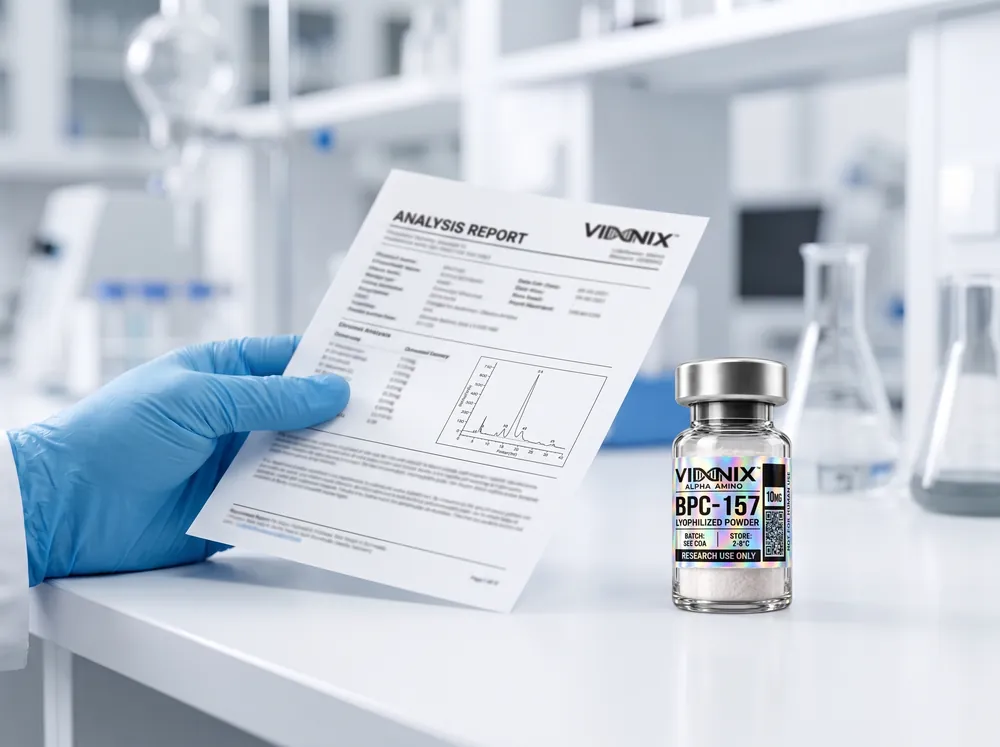
Identity asks what the material is. Purity asks how much of the sample is that material rather than something else. A product can pass one and fail the other, which is why one test alone is not enough. The longer explanation is in identity vs purity in analytical testing.
Identity is normally confirmed by mass spectrometry. The instrument measures the mass of the main component, and that observed mass should match the theoretical mass of the sequence within the instrument's tolerance. A wrong peptide, a truncated sequence or an unexpected modification shows up as a mass that does not fit.
Purity is normally measured by reversed-phase HPLC with UV detection. The main peak's area is compared with the total area of all peaks. Synthesis leaves behind related impurities such as deletion sequences, incompletely deprotected side chains, oxidized residues and dimers, and these appear as extra peaks [4].
Neither test measures how much peptide is in the vial. A sample can be 99% pure and still be underfilled, because purity is a ratio. Fill accuracy requires net peptide content or a quantitative assay against a reference standard, which is a separate result and often missing from supplier paperwork.

Which prices and marketing claims should worry you?
Peptide synthesis, purification, freeze-drying and third-party testing all cost money. When a price sits far below what established suppliers charge for the same compound and amount, something in that chain is usually being skipped. Cheap is not proof of fake, but a large gap deserves a question.
Marketing language is a sharper signal. A supplier selling genuine research materials describes them as research materials. Pages that talk about dosing, injection, cycles, personal results or health benefits are describing human use, whatever the small print says.
The FDA reads it the same way. In a February 2025 warning letter to an online peptide seller, the agency stated that "research use only" and "not for human consumption" disclaimers did not change its conclusion, because claims on the seller's own website showed the products were intended for human use [5]. A seller willing to make those claims has already shown how it treats rules.
- Before-and-after stories, testimonials or reviews describing personal effects
- Dosing charts, reconstitution-for-use guides or "protocols"
- Benefit claims phrased as what a compound does for a person
- Pressure tactics: countdown timers, "last batch" warnings, bulk discounts that outpace the market
What should you check on the vial and label?
Once a product arrives, the physical vial is the next piece of evidence. Check it before the paperwork goes in a drawer.
- Batch or lot number printed on the vial and matching the COA exactly. If they differ, the COA is not for your material. See batch number vs lot number for how the two terms are used.
- Compound name and amount stated in the same form as the COA, for example "BPC-157, 10 mg".
- Research-use statement on the label, with no dosing or human-use instructions.
- Intact seal: a crimped cap with a flip-off top and an undamaged stopper.
- Expected appearance: a lyophilized peptide is normally a white or off-white powder or cake. Visible liquid in a vial sold as lyophilized, discoloration or a vial that looks empty all deserve a question to the supplier.
- Storage on arrival: shipping conditions should match what the documentation says the compound needs.
A small or shrunken cake is not proof of underfilling, since fill volume and drying conditions change how a cake looks. Only a quantitative test can confirm the amount, which is one more reason the paperwork matters.
Why does third-party testing matter?
A test run by the seller, on a sample the seller chose, reported on a form the seller made, can be accurate. It just cannot be checked. An independent analytical lab adds a party with its own reputation and its own records, and a report you can verify by contacting the lab with the report number.
Independent testing is also how the problems above came to light. The JAMA study used chain-of-custody procedures and accredited anti-doping methods [1], and the Belgian work used validated LC-MS/MS and UHPLC methods built to ISO 17025 requirements [2]. The same tools are available to any supplier willing to pay for them. Vinnix's peptide testing page explains what each method measures.
What should you ask a supplier before you buy?
A good supplier answers these quickly and specifically. Vague replies, delays or a change of subject are answers too.
- Is there a COA for the specific lot I will receive, and does its batch number appear on the vial?
- Which laboratory ran the tests, and can I confirm the report with that lab directly?
- Does the COA include both HPLC purity and mass spectrometry identity, with the method and the chromatogram or spectrum?
- When was this lot tested, and when was it manufactured?
- Is net peptide content or fill amount measured, or only purity?
- How is the product stored before shipping, and how is it packed for transit?
- Is the product sold strictly for research use, with no human-use guidance anywhere on your site?
For a deeper look at evaluating a supplier as a whole, including transparency, traceability and labeling, read A Guide to Sourcing Research Peptides. This checklist covers the warning signs. That guide covers what good practice looks like.
FAQFrequently asked questions
How can I tell if a research peptide is fake?
You cannot tell by eye. Start with the documentation: a batch-specific COA from a named, contactable lab, showing HPLC purity and mass spectrometry identity, with a batch number that matches your vial. If those are missing, treat the product as unverified. Confirming identity and amount yourself requires sending a sample to an independent analytical lab.
What does underfilled mean for a peptide vial?
It means the vial holds less peptide than the label states. A purity result does not catch this, because purity is a ratio of the main component to impurities. Fill accuracy needs a quantitative measurement, such as net peptide content or an assay against a reference standard.
Is a COA enough to trust a supplier?
Not on its own. A COA can be generic, outdated, reused across batches or altered. It is useful when it is batch-specific, names an independent lab you can contact, is dated, states its methods and includes both identity and purity results.
Does high HPLC purity mean the peptide is correct?
No. HPLC shows how much of the sample is the main component, but not what that component is. A wrong peptide can still produce one clean peak. Mass spectrometry, which compares the observed mass with the expected mass of the sequence, is what confirms identity.
Why does "for research use only" not settle it?
Because the label has to match the rest of the selling. The FDA has stated in warning letters that research-use disclaimers did not hold when the seller's own website promoted human use. Consistent research framing across the label, product page and marketing is the signal to look for.
REFScientific references
-
Van Wagoner RM, Eichner A, Bhasin S, Deuster PA, Eichner D. Chemical composition and labeling of substances marketed as selective androgen receptor modulators and sold via the internet. JAMA. 2017;318(20):2004-2010. PubMed 29183075
product analysis study -
Vanhee C, Janvier S, Desmedt B, et al. Analysis of illegal peptide biopharmaceuticals frequently encountered by controlling agencies. Talanta. 2015;142:1-10. PubMed 26003685
analytical methods study -
Janvier S, Cheyns K, Canfyn M, et al. Impurity profiling of the most frequently encountered falsified polypeptide drugs on the Belgian market. Talanta. 2018;188:795-807. PubMed 30029448
product analysis study -
D'Hondt M, Bracke N, Taevernier L, et al. Related impurities in peptide medicines. J Pharm Biomed Anal. 2014;101:2-30. PubMed 25044089
review -
US Food and Drug Administration. Warning Letter to USApeptide.com, MARCS-CMS 696885. February 26, 2025. Source
regulation
 Blog
 Blog
 Blog
 Research Library
 Testing & Analysis
 Research Library