
Key facts
- Is it the right molecule?
- Identity: mass spectrometry or LC-MS
- How much of the sample is that molecule?
- Purity: HPLC peak area
- How much peptide is in the vial?
- Content: amino acid analysis or quantitative HPLC
- Which material was tested?
- Batch or lot number on the COA
- What kind of evidence is it?
- In vitro, animal or human study
Understanding Peptide Research
Anyone new to understanding peptide research hits the same wall: a single abstract mentions a sequence, a molecular weight, an HPLC purity and an animal model, and each term comes from a different field. None of them is hard on its own. The difficulty is knowing which question each one answers.
To make understanding peptide research easier, this page sorts the vocabulary by that question and points to the full article for each topic. If you want definitions in alphabetical order instead, the peptide glossary lists them A to Z.
Describing a Peptide: Amino Acids, Bonds and Sequence
A peptide is a chain of amino acids joined by peptide bonds. Its sequence, the order of those amino acids from the N-terminus to the C-terminus, is the first thing to check when studying any compound, because two chains of the same length but a different order are different molecules.
- What are amino acids? covers the building blocks.
- What is a peptide bond? explains the link between them.
- Understanding peptide sequences shows how sequences are written and read.
- One-letter vs. three-letter codes decodes notation like TKPRPGP.
- The N-terminus and the C-terminus explain chain direction and end modifications.
- Peptides vs. proteins deals with where one term stops and the other starts.
Formula, Weight and Mass
Every peptide has a molecular formula and a characteristic mass that follow from its sequence. These numbers are what analytical results get compared against, so understanding peptide research means knowing which one a report is quoting. Average molecular weight, used for weighing, differs slightly from the monoisotopic mass that a mass spectrometer measures.
- What is a molecular formula?
- What is molecular weight? and molecular weight vs. molecular mass
- What is a CAS number? explains the registry identifiers used alongside PubChem and FDA GSRS records.
Chromatography and HPLC
Chromatography separates the components of a mixture. In peptide research the version you'll meet most is reversed-phase HPLC with UV detection, which reports purity as the main peak's share of the total peak area. That number reflects what the method can see under its conditions, and related impurities with similar properties can be hard to resolve [1].
Mass Spectrometry and LC-MS
Mass spectrometry measures ions by their mass-to-charge ratio. For peptides it answers the identity question: does the measured mass match the mass expected from the sequence? LC-MS couples the two methods, separating the sample first and then measuring the mass behind each peak. HPLC and mass spectrometry answer different questions, so a report that relies on only one leaves a gap.
Identity, Purity and Content
These three words cause more confusion than any others when understanding peptide research. Identity asks whether the main component is the right molecule. Purity asks what share of the detected material that component makes up. Content asks how much peptide, by weight, the sample actually holds once water and counter-ions are accounted for. Quality specifications for peptides treat them as separate tests for this reason [2].
Identity vs. purity in analytical testing and peptide purity explained go further, and the peptide testing hub brings every method together.
Certificates of Analysis and Batch Records
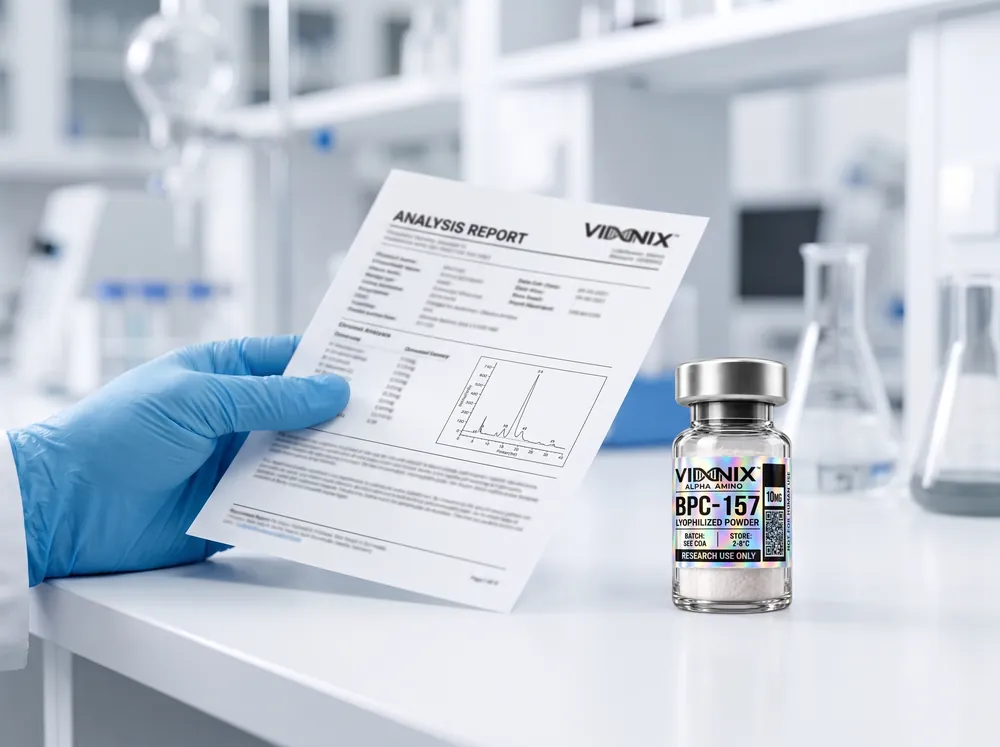
A certificate of analysis (COA) is where test results are written down. Useful questions to ask of any COA: does it identify the sample and batch, which methods were run, when, by which laboratory, and what does each reported number actually represent? A COA describes one batch, so the batch or lot number is what ties it to a vial.
Reading the Peptide Research Literature
The last skill in understanding peptide research is judging what a study can tell you. A cell-culture result, an animal study and a controlled human trial sit at very different levels of evidence, and most published work on research peptides is preclinical. Our in vitro vs. in vivo guide explains the difference, and the research methodology page shows how Vinnix labels evidence types and checks identifiers. When you're comparing suppliers rather than papers, the guide to sourcing research peptides applies the same thinking to product documentation.
FAQFrequently asked questions
What does peptide research involve?
It spans several disciplines. Chemists design and synthesize sequences, analytical chemists confirm identity and purity with methods like HPLC and mass spectrometry, and biologists study peptides in cells, tissues or animals. Reading the literature well means knowing which of those questions a given paper or report is answering.
Where should a beginner start with peptide terminology?
For understanding peptide research, start with amino acids, peptide bonds and sequence notation, since every other term builds on them. Then learn molecular formula and molecular weight, because analytical results are compared against those values. The peptide glossary gives short definitions, and each Research Library article covers one topic in depth.
What is the difference between HPLC and mass spectrometry?
HPLC separates a sample and is usually used to estimate purity from peak areas. Mass spectrometry measures mass-to-charge ratio and is used to confirm identity. They answer different questions, which is why good testing reports often include both, or use LC-MS to combine them in one run.
What should a certificate of analysis show?
At a minimum: the product name and batch or lot number, the methods used, the test date, the laboratory, and the results with their units and acceptance limits. For peptides that usually means an identity result by mass spectrometry and a purity result by HPLC, with the chromatogram attached.
What does preclinical mean in peptide research?
Preclinical describes studies done before any testing in humans, such as cell-culture experiments and animal studies. Most published work on research peptides falls into this category. Such findings can generate hypotheses, but they don't establish safety or effectiveness in people. Keeping that label in view is a big part of understanding peptide research.
REFScientific references
-
D'Hondt M, Bracke N, Taevernier L, et al. Related impurities in peptide medicines. J Pharm Biomed Anal. 2014;101:2-30. PubMed 25044089
review -
Vergote V, Burvenich C, Van de Wiele C, De Spiegeleer B. Quality specifications for peptide drugs: a regulatory-pharmaceutical approach. J Pept Sci. 2009;15(11):697-710. PubMed 19750489
review (pharmacopeial specifications)
 Testing & Analysis
 Research Library: Peptide Fundamentals
 Documentation